


Mouse cardiac troponin Ⅰ(cTn-Ⅰ) ELISA kit
The Ultimate 1-Stop ELISA Marketplace:
60,000+ ELISA kits Available to Serve Scientists from All Fields of Life Science
Always Powered by Diagnocine for Precision Research.
Most comprehensive buffers, reagents and detection agents are provided with each kit to optimize data output.
All-inclusive format covers everything from sample preparation to signal detection. Every step can be customized and optimized for your precision research.
DiagnoCine Precision buffers and reagents are Made in USA ISO 13485 Certified
Why waste time searching for your ELISA kit when you can get everything in one place? Diagnocine can provide you with all the ELISA needs you have (customized ELISAs also available) on the planet through a single, streamlined ordering process.
* all types of species
* HRP and AP detection
* Low target signal enhancement
* Inquire about a trial version or a customized version
4 core reagents below are included with every order, plus 1 of the 2 detection-specific reagents (matched automatically to your kit type) — 5 components, every time.
+ the 5th component, matched to your kit's detection method:
If you have any questions or need additional information, please call us at 551-245-1033 or email us at support@diagnocine.com. Our team will be happy to assist you.
Universal Compatibility
All buffers and detection reagents work seamlessly across target proteins, bridging the gap in assay consistency.
1-Stop Convenience
Consolidate your lab's purchasing. Source all ELISA needs and experience optimal buffers and reagents in a single shipment.
Enhanced Precision
Designed by scientists for scientists, all components are engineered to deliver sharper results and an optical signal.
Mouse cardiac troponin Ⅰ(cTn-Ⅰ) ELISA kit
Sandwich quantitative immunoassay for Mouse cardiac troponin Ⅰ(cTn-Ⅰ) ELISA kit in mouse serum, plasma available in multiple catalog sizes:
Note: Please send inquiries regarding Trial 24T orders to support@diagnocine.com.
| Uniprot No. | P48787 |
| Species | Mus musculus (Mouse) |
| Sample types | serum, plasma |
| Detection range | 15.6pg/mL-1000pg/mL |
| Sensitivity | 7.8pg/mL |
| Assay time | 1-5h |
| Sample loading volume | 50-100μL |
| Detection wavelength | 450 nm |
| Assay principle | Sandwich (Quantitative) |
| Data analysis | Standard curve + Curve Expert software |
| Research area | Others |
| Storage condition | 2-8°C (see protocol for full details) |
| Shipping condition | 4 °C |
| Shelf life | 6 months |
10 business days
Processing + 3-5 days shipping
In Stock : USA
Worldwide shipping available
Antibody capture
450 nm detection
Standard curve
Quantification
In this sandwich ELISA, Mouse cardiac troponin Ⅰ(cTn-Ⅰ) ELISA kit in the sample is captured between a pre-coated capture antibody and a detection antibody. Signal intensity is proportional to analyte concentration. Quantification uses a standard curve fitted with Curve Expert software, covering 15.6pg/mL-1000pg/mL with a minimum detectable dose of 7.8pg/mL.
This ELISA kit provides quantitative measurement of cardiac troponin I (TNNI3) in mouse serum and plasma, supporting research into myocardial injury and cardiac pathology. Because TNNI3 is released into circulation at very low concentrations following cardiomyocyte damage, detecting it in murine models demands exceptional analytical sensitivity and a range calibrated to the mouse's small blood volume and correspondingly low circulating levels.
Detection Range: The 15.6–1000 pg/mL range aligns with the trace concentrations of TNNI3 expected in mouse circulation, where even significant cardiac injury produces far lower absolute levels than in human patients. Most samples from ischemia-reperfusion or cardiotoxicity models should fall within range without extensive dilution.
- Abnormal TnI phosphorylation observed in cardiac failure may explain exacerbated relaxation delay in response to increased afterload and contribute to blunted chronotropic reserve. PMID: 16936010
- The cTnI-G203S mutation disrupts interactions with partner proteins, and results in intracellular Ca2+ dysregulation early in life, suggesting a pathogenic role in development of familial hypertrophic cardiomyopathy. PMID: 16950368
- TnI deficiency impairs left ventricular relaxation, which leads to diastolic heart failure. PMID: 17526646
- cTnI-Cre mice have delayed onset of Cre activity during early heart development PMID: 17540338
- key role of cTnI in myocyte relaxation PMID: 17615373
- The primary effect of protein kinase A phosphorylation of cardiac troponin I is reduced Ca(2+) sensitivity of force, whereas phosphorylation of cardiac myosin-binding protein C accelerates the kinetics of force development. PMID: 17641226
- Changes in Ca(2+) affinity also support the idea that the equilibrium between states of actin-tropomyosin-troponin was shifted to the inactive state by mutations that mimic troponin I phosphorylation. PMID: 17872964
- Thr144 in cardiac TnI modulates cardiac myofilament length-dependent activation. PMID: 17975107
- Lys184 deletion in troponin I impairs relaxation kinetics and induces hypercontractility in murine cardiac myofibrils. PMID: 18096573
- Simultaneous defects in MHC7 & TnI accelerate onset & progression of familial hypertrophic cardiomyopathy. Compared with single-mutant models, double-mutant mice develop severe disease & premature death, progressing directly to a dilated phenotype. PMID: 18362229
- Impaired relaxation is the main manifestation in transgenic mice expressing a restrictive cardiomyopathy mutation, R193H, in cardiac TnI. PMID: 18408133
- Removal of the N-terminal extension of cardiac troponin I as a functional compensation for impaired myocardial beta-adrenergic signaling PMID: 18815135
- Transfer of troponin I-specific T cells can induce inflammation and fibrosis in wild-type mice, leading to deterioration of contractile function. Two sequence motifs of cTnI that induce inflammation and fibrosis in myocardium are characterized. PMID: 18955666
- These results indicate that YY1 is a novel regulator of fetal TnI transcription in the heart. PMID: 19013134
- the nNOS-PMCA4b complex regulates contractility via cAMP and phosphorylation of both PLB and cTnI. PMID: 19278978
- Studies indicate that that immunization of genetically susceptible mice with troponin I but not troponin T induced a robust autoimmune response leading to marked inflammation and fibrosis in the myocardium. PMID: 19446498
- Ca(2+) binding to thin filaments reconstituted with either cTnI(wild-type) or pseudo-phosphorylated cTnI(S23D/S24D), cTnI(T144E), and cTnI(S23D/S24D/T144E) was determined. PMID: 20164197
- the functional effect of cTnI mutation and its potential value in compensating for the cTnT abnormality PMID: 20551314
- Loss of troponin I leads to myofibril hypersensitivity to Ca(2+) causing impaired relaxation in restrictive cardiomyopathy. PMID: 20580639
- Data suggest that AMPK emerges as a possibly important regulator of cardiac and skeletal contractility via phosphorylation of a preferred site adjacent to the inhibitory loop of the thin filament protein TnI. PMID: 21416543
- Generation and functional characterization of knock-in mice harboring the cardiac troponin I-R21C mutation associated with hypertrophic cardiomyopathy. PMID: 22086914
- Conclude that cTnI phosphorylation by AMPK may represent a novel mechanism of regulation of cardiac function. PMID: 22456184
- A new functional and pathological role of amino acid modifications in the N-terminal acidic domain of cardiac TnI has been found that is modified by phosphorylations at TnI(S23/S24). PMID: 22940544
- Data show that cardiac TnI gene transition and the alternatively spliced cardiac TnT isoform switching occur in postnatal pulmonary vein. PMID: 23176202
- The pattern of cTnI post-translational modification depends on sex and hypertrophic cardiomyopathy genotype. PMID: 23352598
- Conclude that dilated cardiomyopathy-causing mutations in thin filament proteins abolish the relationship between myofilament Ca(2+) sensitivity and troponin I phosphorylation by PKA. PMID: 23539503
- R193H and R205H mutation increase the binding affinity of Troponin I for Troponin T and Troponin C. PMID: 24326031
- Combined troponin I Ser-150 and Ser-23/24 phosphorylation sustains thin filament Ca(2+) sensitivity playing an adaptive role to preserve contraction during acidic ischemia. PMID: 24657721
- Dominant negative TnI-TnT interface mutation decreases the binding affinity of cTnI for TnT, causes early ventricular remodeling, and blunts the beta-adrenergic response of cardiac myocytes. PMID: 24898585
- these results indicate that the inability to enhance myofilament relaxation through cTnI phosphorylation predisposes the heart to abnormal diastolic function, reduced accessibility of cardiac reserves, dysautonomia, and hypertrophy. PMID: 24973218
- troponin I phosphorylation specifically alters the Ca(2+) sensitivity of isometric tension and the time course of relaxation in cardiac muscle myofibrils PMID: 25418306
- The difference in myosin regulatory light chain phosphorylation between the ventricles of R21C(+/+) in cardiac troponin I mice likely contributes to observed differences in contractile force and the lower tension monitored in the LV of HCM mice PMID: 25961037
- The contributions of cardiac myosin binding protein C and troponin I phosphorylation to beta-adrenergic enhancement of in vivo cardiac function PMID: 26635197
- Hyperphosphorylation of this serine199 in cTnI C terminus impacts heart function by depressing diastolic function at baseline and limiting systolic reserve under physiological stresses. Paradoxically, it preserves heart function after ischemia/reperfusion injury, potentially by decreasing proteolysis of cTnI. PMID: 28899987
- Pim-1 is a novel kinase that phosphorylates cTnI primarily at Ser23/24 and Ser150 in cardiomyocytes, which in turn may modulate myofilament function under a variety of physiological and pathophysiological conditions. PMID: 29544221
Intra-assay Precision (Precision within an assay): CV%<8% | ||||||
Three samples of known concentration were tested twenty times on one plate to assess. | ||||||
Inter-assay Precision (Precision between assays): CV%<10% | ||||||
Three samples of known concentration were tested in twenty assays to assess. | ||||||
These standard curves are provided for demonstration only. A standard curve should be generated for each set of samples assayed. | ||||||
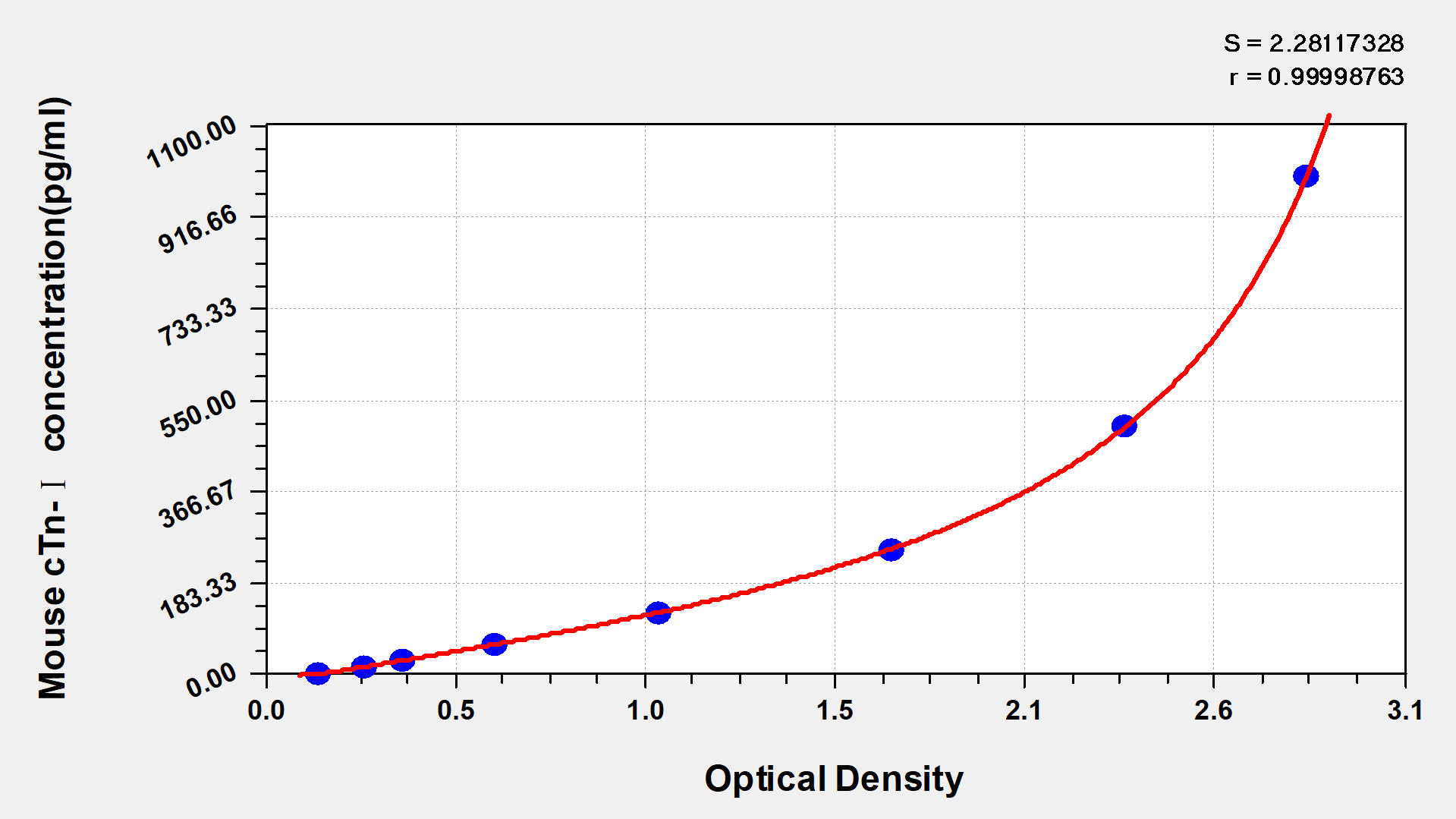 | ||||||
pg/ml | OD1 | OD2 | Average | Corrected | ||
1000 | 2.770 | 2.837 | 2.803 | 2.649 | ||
500 | 2.272 | 2.367 | 2.320 | 2.165 | ||
250 | 1.678 | 1.708 | 1.693 | 1.539 | ||
125 | 1.102 | 1.029 | 1.066 | 0.911 | ||
62.5 | 0.631 | 0.621 | 0.626 | 0.471 | ||
31.2 | 0.388 | 0.373 | 0.381 | 0.226 | ||
15.6 | 0.286 | 0.274 | 0.280 | 0.126 | ||
0 | 0.158 | 0.151 | 0.155 |
| ||
To assess the linearity of the assay, samples were spiked with high concentrations of mouse cTn-Ⅰin various matrices and diluted with the Sample Diluent to produce samples with values within the dynamic range of the assay. | ||||||
| Sample | Serum(n=4) | ||||
1:1 | Average % | 90 | ||||
Range % | 85-95 | |||||
1:2 | Average % | 98 | ||||
Range % | 94-103 | |||||
1:4 | Average % | 95 | ||||
Range % | 88-101 | |||||
1:8 | Average % | 102 | ||||
Range % | 95-108 | |||||
The recovery of mouse cTn-Ⅰspiked to levels throughout the range of the assay in various matrices was evaluated. Samples were diluted prior to assay as directed in the Sample Preparation section. | ||||||
Sample Type | Average % Recovery | Range | ||||
Serum (n=5) | 96 | 89-103 | ||||
EDTA plasma (n=4) | 90 | 84-98 | ||||