

.jpg "/Content/Upload/Product/Mouse_ELISA_kits_Diagnocine_1200_1200(58).jpg")
Mouse Soluble Cluster of differentiation 40 ligand,sCD40L ELISA Kit
The Ultimate 1-Stop ELISA Marketplace:
60,000+ ELISA kits Available to Serve Scientists from All Fields of Life Science
Always Powered by Diagnocine for Precision Research.
Most comprehensive buffers, reagents and detection agents are provided with each kit to optimize data output.
All-inclusive format covers everything from sample preparation to signal detection. Every step can be customized and optimized for your precision research.
DiagnoCine Precision buffers and reagents are Made in USA ISO 13485 Certified
Why waste time searching for your ELISA kit when you can get everything in one place? Diagnocine can provide you with all the ELISA needs you have (customized ELISAs also available) on the planet through a single, streamlined ordering process.
* all types of species
* HRP and AP detection
* Low target signal enhancement
* Inquire about a trial version or a customized version
4 core reagents below are included with every order, plus 1 of the 2 detection-specific reagents (matched automatically to your kit type) — 5 components, every time.
+ the 5th component, matched to your kit's detection method:
If you have any questions or need additional information, please call us at 551-245-1033 or email us at support@diagnocine.com. Our team will be happy to assist you.
Universal Compatibility
All buffers and detection reagents work seamlessly across target proteins, bridging the gap in assay consistency.
1-Stop Convenience
Consolidate your lab's purchasing. Source all ELISA needs and experience optimal buffers and reagents in a single shipment.
Enhanced Precision
Designed by scientists for scientists, all components are engineered to deliver sharper results and an optical signal.
Mouse Soluble Cluster of differentiation 40 ligand,sCD40L ELISA Kit
Sandwich quantitative immunoassay for Mouse Soluble Cluster of differentiation 40 ligand,sCD40L in mouse serum, plasma, tissue homogenates, cell culture supernates. available in multiple catalog sizes:
Note: Please send inquiries regarding Trial 24T orders to support@diagnocine.com.
| Uniprot No. | P27548 |
| Species | Mus musculus (Mouse) |
| Sample types | serum, plasma, tissue homogenates, cell culture supernates. |
| Detection range | 0.274 ng/ml-200 ng/ml. |
| Sensitivity | 0.274 ng/ml. |
| Assay time | 1-5h |
| Sample loading volume | 50-100μL |
| Detection wavelength | 450 nm |
| Assay principle | Sandwich (Quantitative) |
| Data analysis | Standard curve + Curve Expert software |
| Research area | Immunology |
| Storage condition | 2-8°C (see protocol for full details) |
| Shipping condition | 4 °C |
| Shelf life | 6 months |
10 business days
Processing + 3-5 days shipping
In Stock : USA
Worldwide shipping available
Antibody capture
450 nm detection
Standard curve
Quantification
In this sandwich ELISA, Mouse Soluble Cluster of differentiation 40 ligand,sCD40L in the sample is captured between a pre-coated capture antibody and a detection antibody. Signal intensity is proportional to analyte concentration. Quantification uses a standard curve fitted with Curve Expert software, covering 0.274 ng/ml-200 ng/ml. with a minimum detectable dose of 0.274 ng/ml..
The mouse soluble cluster of differentiation 40 ligand (sCD40L) ELISA Kit is used to quantitatively measure mouse sCD40L concentrations in serum, plasma, cell culture supernates, or tissue homogenates. It performs well in important characteristics, including sensitivity and specificity. This assay is based on the sandwich ELISA mechanism and enzyme-substrate chromogenic reaction. The solution color develops proportionally to the amount of sCD40L in the sample. And the intensity of the color can be measured at 450 nm via a microplate reader.
CD40L (CD40LG) mediates a range of activities on B cells, including induction of activation-associated surface antigen, entry into the cell cycle, isotype switching, Ig secretion, and memory generation. CD40–CD40L signaling also plays important roles in monocyte activation and DC maturation. CD40L, especially, has been shown to be a critical and powerful regulator of immune responses in atherosclerosis. In humans, CD40L expression peaks in late-stage atherosclerotic plaques, and its expression is related to features of plaque vulnerability. Many studies have shown that elevated serum levels of the sCD40L are linked to hypercholesterolemia, stroke, diabetes, and acute coronary syndrome (ACS) and predict recurrent CVD.
- Western blot analysis confirmed strong CD154 expression in the cultured cell line PC10, but not in LK2. We also assessed CD154 expression in SCID mouse xenografts of these cell lines. PMID: 23404288
- Propose a role of MMP-9 in regulating platelet-dependent infiltration of neutrophils and tissue damage in septic lung injury by controlling CD40L shedding from platelets. PMID: 23617547
- A major part of central and effector memory CD8(+) T cells expresses CD40L, one key molecule for CD4(+) T-cell-mediated help. PMID: 23719298
- Protein kinase C zeta is critically required for sCD40L-induced Mac-1 activation and neutrophil adhesive function. PMID: 23785403
- expression of CD40L in an earlier developmental step may be determinant in the regulation of the class switch recombination process PMID: 24030045
- Preexisting autoreactive T cells specific for cardiac myosins are important functional barriers to donor specific transfusion/anti-CD154 antibody induced prolongation of cardiac allograft survival in mice. PMID: 24056628
- many ATII-induced effects on vascular dysfunction, such as vascular inflammation, oxidative stress and a pro-thrombotic state, are mediated at least in part via CD40L. PMID: 24061433
- These data indicate that the ability of autoreactive CD4(+) T cells to undergo tolerance mediated by CD8(+) dendritic cells is defective in NOD mice and that blocking CD40-CD40L interactions can restore tolerance induction. PMID: 24082013
- in vivo biochemical or genetic inhibition of NFATc2 activity in megakaryocyte diminishes platelet CD40L implicates the NFATc2/EGR-1 axis as a key regulatory pathway of inflammatory and immunomodulatory activity in platelets PMID: 24106272
- data show that vaccination with TAA/CD40L DNA can induce potent antitumor effects against TAA-expressing tumors through the generation of better functioning antigen-specific CD8+ T cells. PMID: 24664420
- Key contributions of CD40L and IFNG signaling in the antitumor responses triggered in vivo by B-Raf(V600E) inhibitors. PMID: 24736544
- CD154 expression by CD4 T cells is required for the priming memory CD8 T cells that are capable of fully responding to secondary infection. PMID: 24777309
- Data indicate that a single dose of adenoviral vectors secreting nucleoprotein (NP)-CD40L fusion protein (rAd-SNP40L) completely protected mice from lethal viral challenge 4 mo after immunization. PMID: 24928989
- findings indicate that targeting Rac1 signaling might be a useful way to control pathologic elevations of CD40L in the systemic circulation in abdominal sepsis PMID: 25046439
- Platelets promote allergic asthma through the expression of CD154. PMID: 25418472
- Report targeting and liposomal drug delivery of methotrexate to CD40L expressing T cells for treatment of autoimmune diseases. PMID: 25839125
- The tissue-specific, activation-dependent and reversible expression of CD40L fully mimics the physiological induction and disappearance of the molecule from the surface of murine T lymphocytes. PMID: 26223487
- PU.1 Expression in T Follicular Helper Cells Limits CD40L-Dependent Germinal Center B Cell Development. PMID: 26363052
- our results unambiguously demonstrate that while CD40L is critical to generate effective primary CD8(+) T-cell responses also under inflammatory conditions, CD40L expression by CD8(+) T cells themselves is dispensable in acute lymphocytic choriomeningitis virus infection. PMID: 27562840
- studies identify a novel molecular mechanism of regulation of CD40L by the transcription factor GLI2 in the tumor microenvironment downstream of CCR3 signaling PMID: 28461568
- These results suggest that combination of IL-21, anti-Tim1 and CD40L treatment induced B10 cell's IL-10 competency in vitro and inhibited periodontal bone loss in ligature-induced experimental periodontitis. PMID: 28583714
- Soluble CD40 ligand directly alters glomerular permeability and may act as a circulating permeability factor in focal segmental glomerulosclerosis. PMID: 29155846
- MR1-induced bone accrual was associated with increased Treg development and elevated production of cytotoxic T lymphocyte antigen 4, a costimulation inhibitor that promotes T cell anergy and CD8+ T cell expression of the bone anabolic ligand Wnt-10b. PMID: 29522194
Intra-assay Precision (Precision within an assay): CV%<8% | ||||||
Three samples of known concentration were tested twenty times on one plate to assess. | ||||||
Inter-assay Precision (Precision between assays): CV%<10% | ||||||
Three samples of known concentration were tested in twenty assays to assess. | ||||||
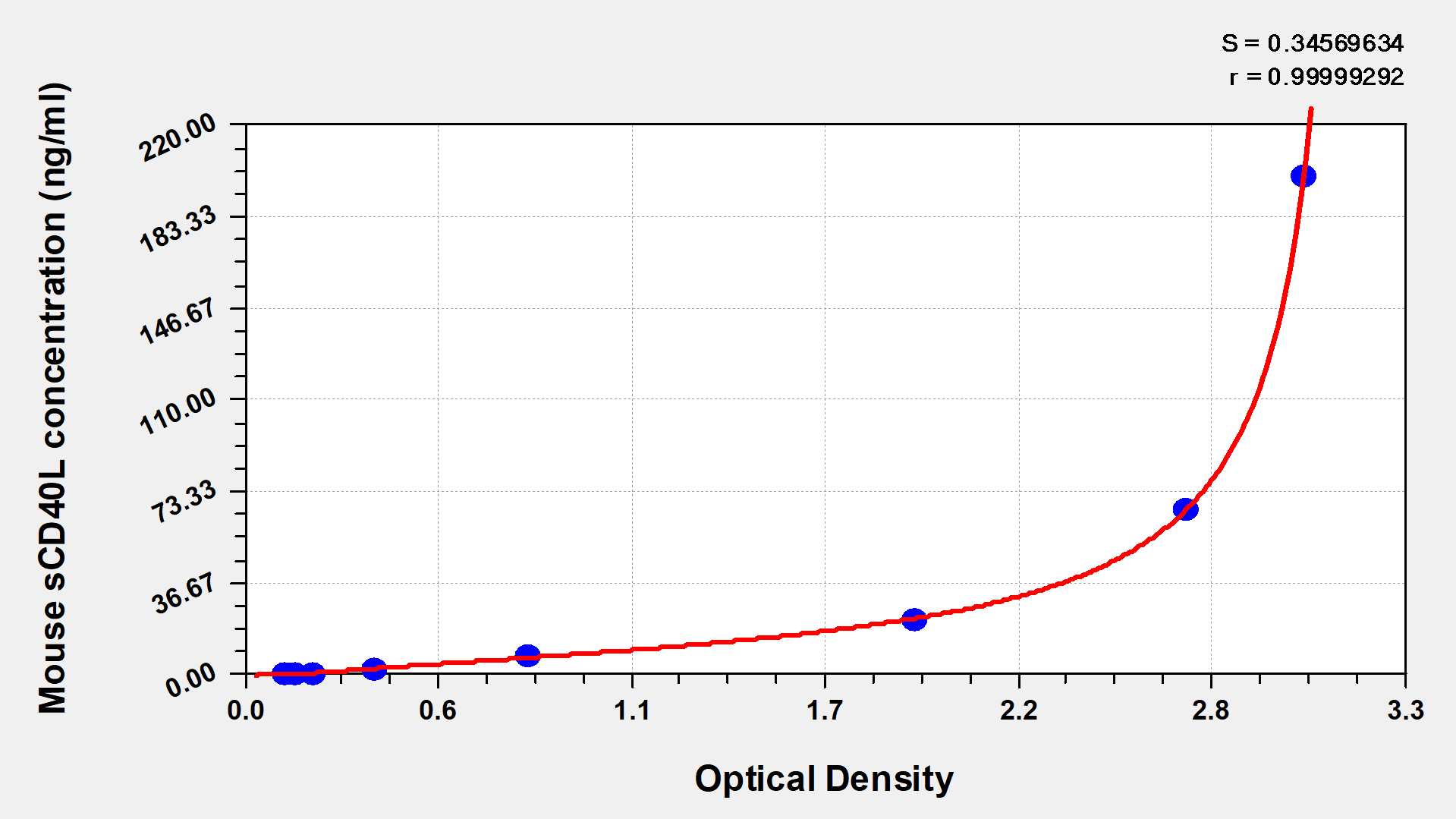
These standard curves are provided for demonstration only. A standard curve should be generated for each set of samples assayed. | |||||||
| |||||||
ng/ml | OD1 | OD2 | Average | Corrected | |||
200 | 3.091 | 2.934 | 3.013 | 2.890 | |||
66.66 | 2.697 | 2.667 | 2.682 | 2.560 | |||
22.22 | 1.897 | 1.928 | 1.913 | 1.790 | |||
7.40 | 0.801 | 0.829 | 0.815 | 0.693 | |||
2.469 | 0.377 | 0.381 | 0.379 | 0.256 | |||
0.823 | 0.202 | 0.213 | 0.208 | 0.085 | |||
0.274 | 0.148 | 0.154 | 0.151 | 0.029 | |||
0 | 0.120 | 0.125 | 0.122 |
| |||
To assess the linearity of the assay, samples were spiked with high concentrations of mouse sCD40L in various matrices and diluted with the Sample Diluent to produce samples with values within the dynamic range of the assay. | ||||||
| Sample | Serum(n=4) | ||||
1:1 | Average % | 86 | ||||
Range % | 80-96 | |||||
1:2 | Average % | 92 | ||||
Range % | 90-95 | |||||
1:4 | Average % | 93 | ||||
Range % | 90-99 | |||||
1:8 | Average % | 95 | ||||
Range % | 89-98 | |||||
The recovery of mouse sCD40L spiked to levels throughout the range of the assay in various matrices was evaluated. Samples were diluted prior to assay as directed in the Sample Preparation section. | ||||||
Sample Type | Average % Recovery | Range | ||||
Serum (n=5) | 92 | 89-96 | ||||
EDTA plasma (n=4) | 99 | 95-104 | ||||