

Mouse Granulocyte Colony Stimulating Factor,G-CSF ELISA Kit
The Ultimate 1-Stop ELISA Marketplace:
60,000+ ELISA kits Available to Serve Scientists from All Fields of Life Science
Always Powered by Diagnocine for Precision Research.
Most comprehensive buffers, reagents and detection agents are provided with each kit to optimize data output.
All-inclusive format covers everything from sample preparation to signal detection. Every step can be customized and optimized for your precision research.
DiagnoCine Precision buffers and reagents are Made in USA ISO 13485 Certified
Why waste time searching for your ELISA kit when you can get everything in one place? Diagnocine can provide you with all the ELISA needs you have (customized ELISAs also available) on the planet through a single, streamlined ordering process.
* all types of species
* HRP and AP detection
* Low target signal enhancement
* Inquire about a trial version or a customized version
4 core reagents below are included with every order, plus 1 of the 2 detection-specific reagents (matched automatically to your kit type) — 5 components, every time.
+ the 5th component, matched to your kit's detection method:
If you have any questions or need additional information, please call us at 551-245-1033 or email us at support@diagnocine.com. Our team will be happy to assist you.
Universal Compatibility
All buffers and detection reagents work seamlessly across target proteins, bridging the gap in assay consistency.
1-Stop Convenience
Consolidate your lab's purchasing. Source all ELISA needs and experience optimal buffers and reagents in a single shipment.
Enhanced Precision
Designed by scientists for scientists, all components are engineered to deliver sharper results and an optical signal.
Mouse Granulocyte Colony Stimulating Factor,G-CSF ELISA Kit
Sandwich quantitative immunoassay for colony stimulating factor 3 (granulocyte) in mouse serum, plasma,tissue homogenates available in multiple catalog sizes:
Note: Please send inquiries regarding Trial 24T orders to support@diagnocine.com.
| Target name | colony stimulating factor 3 (granulocyte) |
| Uniprot No. | P09920 |
| Species | Mus musculus (Mouse) |
| Sample types | serum, plasma,tissue homogenates |
| Detection range | 7.8 pg/mL-500 pg/mL |
| Sensitivity | 1.95 pg/mL |
| Assay time | 1-5h |
| Sample loading volume | 50-100μL |
| Detection wavelength | 450 nm |
| Assay principle | Sandwich (Quantitative) |
| Data analysis | Standard curve + Curve Expert software |
| Research area | Immunology |
| Storage condition | 2-8°C (see protocol for full details) |
| Shipping condition | 4 °C |
| Shelf life | 6 months |
10 business days
Processing + 3-5 days shipping
In Stock : USA
Worldwide shipping available
Antibody capture
450 nm detection
Standard curve
Quantification
In this sandwich ELISA, colony stimulating factor 3 (granulocyte) in the sample is captured between a pre-coated capture antibody and a detection antibody. Signal intensity is proportional to analyte concentration. Quantification uses a standard curve fitted with Curve Expert software, covering 7.8 pg/mL-500 pg/mL with a minimum detectable dose of 1.95 pg/mL.
Diagnocine's mouse G-CSF ELISA kit is an in vitro enzyme-linked immunosorbent assay for the quantitative measurement of mouse G-CSF in serum, plasma, or tissue homogenates. This assay uses the sandwich enzyme immunoassay technique in combination with the enzyme-substrate chromogenic reaction to quantify the analyte in the sample. The color develops positively to the amount of G-CSF in samples. The color intensity is measured at 450 nm via a microplate reader.
G-CSF (CSF3), specific for granulocytes, is a cytokine used clinically for promoting the production and release of bone marrow-derived hematopoietic stem cells and granulocytes. CSF3 and its receptor CSF3R regulate granulopoiesis, neutrophil function, and hematopoietic stem cell mobilization. It also increases the production and release of neutrophils and modulates the differentiation, lifespan, and effector functions of mature neutrophils. CSF3 is currently used to treat neutropenia and to mobilize hematopoietic stem cells for transplantation. Studies have found that CSF3 plays an important role in cancer progression. CSF3 is upregulated in different types of cancer cells, such as lung cancer, gastric cancer, colorectal cancer, invasive bladder carcinoma, glioma, and breast cancer.
- Endothelial cell(EC)-intrinsic MYD88 signaling and subsequent G-CSF production by ECs is required for myeloid progenitor lineage skewing toward granulocyte-macrophage progenitors, increased colony-forming unit granulocyte activity. PMID: 24990886
- Exposure of Sca-1(+) cells to G-CSF in the culture medium for 72 h induced time-dependent but self-limiting cell cycle acceleration with a restricted effect on the CSC proliferation. PMID: 25160782
- Adventitial CXCL1/granulocyte-colony stimulating factor expression in response to aortic dissection triggers local neutrophil recruitment and activation. This leads to adventitial inflammation via IL-6 and results in aortic expansion and rupture. PMID: 25563839
- constitutive activation of the NF-kappaB pathway in CAIX-depleted cells restored G-CSF secretion PMID: 25623234
- G-CSF acts in a cell intrinsic manner to expand multipotent progenitors to increase production of tumor-derived Ly6G+ neutrophils. PMID: 25624500
- G-CSF supports long-term muscle regeneration in mouse models of muscular dystrophy. PMID: 25865621
- Overexpression of VEGF may compensate for the G-CSF deficit through preservation of cellular components, including blood vessels, in the postinfarction heart. PMID: 25976246
- rapidly induces autophagy after spinal cord injury to inhibit neuronal apoptosis PMID: 26524416
- findings provide convincing evidence that monophosphoryl lipid A-induced G-CSF facilitates early expansion, mobilization, and recruitment of neutrophils to the site of infection after burn injury PMID: 26538529
- Results suggested that G-CSF plays an important role in preventing colitis, likely through populating immune regulatory macrophages in the intestine. PMID: 26687628
- SB203580 increases G-CSF expression in macrophages by increasing the stability of G-CSF mRNA via its 3'UTR, and the effect was not due to its inhibition of p38 MAPK activity. PMID: 26772539
- data demonstrate that G-CSF is a pivotal driver of the disease progression in the K/BxN serum-transfer arthritis (STA) model and possibly acts in part by regulating neutrophil numbers in the circulation PMID: 26848119
- physiologically produced G-CSF not only acts as a neutrophil mobilizer at the relatively late stage of acute inflammation, but also prevents exaggerated neutrophil mobilization. PMID: 27551153
- We propose that in aggressive pancreatic ductal adenocarcinoma , elevated G-CSF contributes to tumor progression through promoting increases in infiltration of neutrophil-like cells with high immunosuppressive activity. Such a mechanism provides an avenue for a neoadjuvant therapeutic approach for this devastating disease PMID: 28775207
- these data provide strong evidence for a role for G-CSF in the development of ACI after burn injury through suppression of EPO signaling in bone marrow erythroid cells. PMID: 28867537
- central regulator of the transition to postinflammatory chronic visceral pain PMID: 28973941
- The opposing roles of G-CSF and IFNgamma in regulation of innate inflammatory responses in a murine viral encephalitis model reveal G-CSF as a potential therapeutic target. PMID: 29352287
- We confirmed that acute lung injury was associated with high serum G-CSF levels, and elevated neutrophil elastase activity in the lungs and serum of mice with adenine-induced acute kidney injury (AKI). G-CSF could be a target for new anti-lung injury strategy in patients with AKI. PMID: 30056257
Intra-assay Precision (Precision within an assay): CV%<8% | ||||||||||||||||||||||||||||||||||||||||||||||||||
Three samples of known concentration were tested twenty times on one plate to assess. | ||||||||||||||||||||||||||||||||||||||||||||||||||
Inter-assay Precision (Precision between assays): CV%<10% | ||||||||||||||||||||||||||||||||||||||||||||||||||
Three samples of known concentration were tested in twenty assays to assess. | ||||||||||||||||||||||||||||||||||||||||||||||||||
| ||||||||||||||||||||||||||||||||||||||||||||||||||
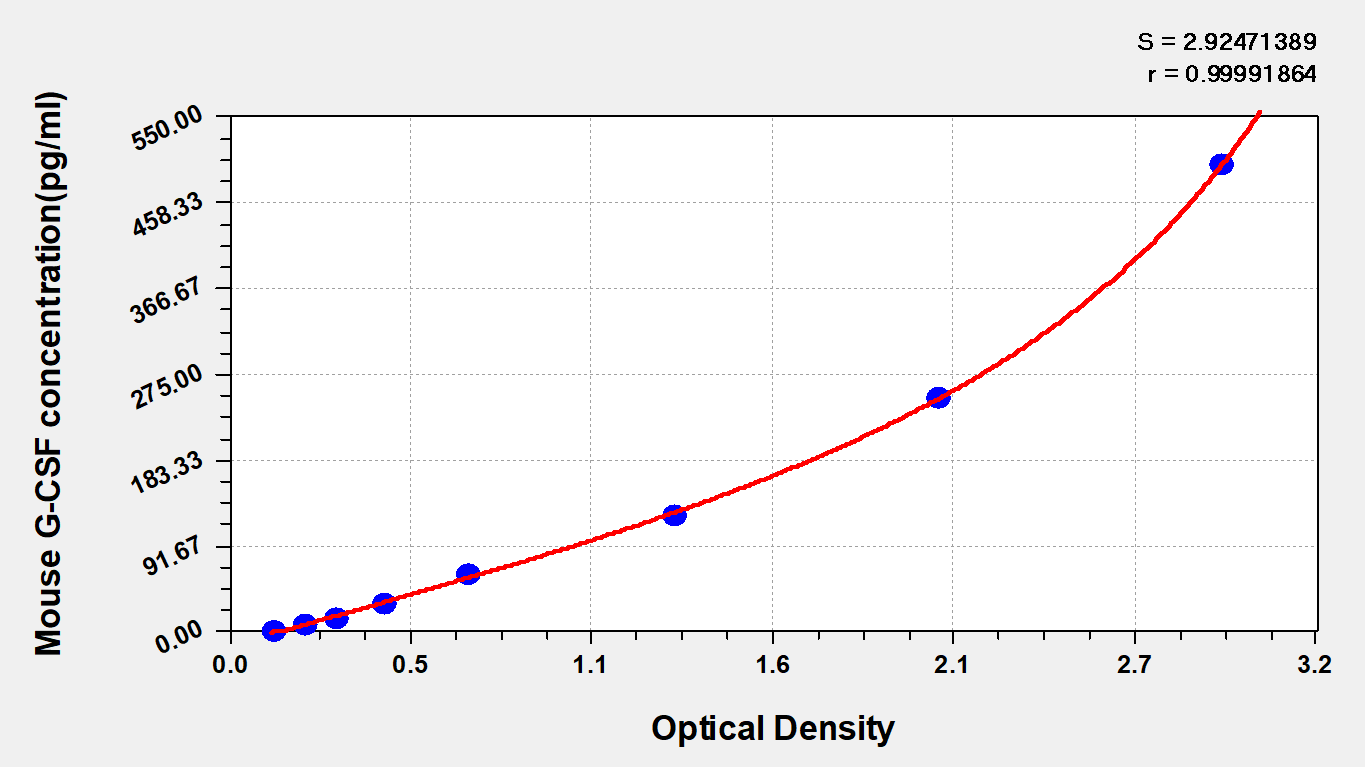
These standard curves are provided for demonstration only. A standard curve should be generated for each set of samples assayed. | ||||||||||
| ||||||||||
pg/ml | OD1 | OD2 | Average | Corrected | ||||||
500 | 2.897 | 2.964 | 2.931 | 2.785 | ||||||
250 | 2.089 | 2.103 | 2.096 | 1.950 | ||||||
125 | 1.311 | 1.330 | 1.321 | 1.175 | ||||||
62.5 | 0.724 | 0.711 | 0.718 | 0.572 | ||||||
31.2 | 0.479 | 0.454 | 0.467 | 0.321 | ||||||
15.6 | 0.319 | 0.342 | 0.331 | 0.185 | ||||||
7.8 | 0.234 | 0.244 | 0.239 | 0.093 | ||||||
0 | 0.141 | 0.151 | 0.146 |
| ||||||
To assess the linearity of the assay, samples were spiked with high concentrations of mouse G-CSF in various matrices and diluted with the Sample Diluent to produce samples with values within the dynamic range of the assay. | |||||||||
| Sample | Serum(n=4) | |||||||
1:1 | Average % | 87 | |||||||
Range % | 85-89 | ||||||||
1:2 | Average % | 102 | |||||||
Range % | 99-106 | ||||||||
1:4 | Average % | 98 | |||||||
Range % | 96-102 | ||||||||
1:8 | Average % | 92 | |||||||
Range % | 90-94 | ||||||||
The recovery of mouse G-CSF spiked to levels throughout the range of the assay in various matrices was evaluated. Samples were diluted prior to assay as directed in the Sample Preparation section. | |||||||||
Sample Type | Average % Recovery | Range | |||||||
Serum (n=5) | 89 | 85-93 | |||||||