

.jpg "/Content/Upload/Product/Human_ELISA_kits_Diagnocine_1200_1200(87).jpg")
Human tumor necrosis factor-related apoptosis-inducing ligand receptor 4(TRAIL-R4) ELISA Kit
The Ultimate 1-Stop ELISA Marketplace:
60,000+ ELISA kits Available to Serve Scientists from All Fields of Life Science
Always Powered by Diagnocine for Precision Research.
Most comprehensive buffers, reagents and detection agents are provided with each kit to optimize data output.
All-inclusive format covers everything from sample preparation to signal detection. Every step can be customized and optimized for your precision research.
DiagnoCine Precision buffers and reagents are Made in USA ISO 13485 Certified
Why waste time searching for your ELISA kit when you can get everything in one place? Diagnocine can provide you with all the ELISA needs you have (customized ELISAs also available) on the planet through a single, streamlined ordering process.
* all types of species
* HRP and AP detection
* Low target signal enhancement
* Inquire about a trial version or a customized version
4 core reagents below are included with every order, plus 1 of the 2 detection-specific reagents (matched automatically to your kit type) — 5 components, every time.
+ the 5th component, matched to your kit's detection method:
If you have any questions or need additional information, please call us at 551-245-1033 or email us at support@diagnocine.com. Our team will be happy to assist you.
Universal Compatibility
All buffers and detection reagents work seamlessly across target proteins, bridging the gap in assay consistency.
1-Stop Convenience
Consolidate your lab's purchasing. Source all ELISA needs and experience optimal buffers and reagents in a single shipment.
Enhanced Precision
Designed by scientists for scientists, all components are engineered to deliver sharper results and an optical signal.
Human tumor necrosis factor-related apoptosis-inducing ligand receptor 4(TRAIL-R4) ELISA Kit
Sandwich quantitative immunoassay for Human tumor necrosis factor-related apoptosis-inducing ligand receptor 4(TRAIL-R4) in human serum, plasma, tissue homogenates available in multiple catalog sizes:
Note: Please send inquiries regarding Trial 24T orders to support@diagnocine.com.
| Uniprot No. | Q9UBN6 |
| Species | Homo sapiens (Human) |
| Sample types | serum, plasma, tissue homogenates |
| Detection range | 0.156 ng/ml - 10 ng/ml |
| Sensitivity | 0.039 ng/ml |
| Assay time | 1-5h |
| Sample loading volume | 50-100μL |
| Detection wavelength | 450 nm |
| Assay principle | Sandwich (Quantitative) |
| Data analysis | Standard curve + Curve Expert software |
| Research area | Cell Biology |
| Storage condition | 2-8°C (see protocol for full details) |
| Shipping condition | 4 °C |
| Shelf life | 6 months |
10 business days
Processing + 3-5 days shipping
In Stock : USA
Worldwide shipping available
Antibody capture
450 nm detection
Standard curve
Quantification
In this sandwich ELISA, Human tumor necrosis factor-related apoptosis-inducing ligand receptor 4(TRAIL-R4) in the sample is captured between a pre-coated capture antibody and a detection antibody. Signal intensity is proportional to analyte concentration. Quantification uses a standard curve fitted with Curve Expert software, covering 0.156 ng/ml - 10 ng/ml with a minimum detectable dose of 0.039 ng/ml.
This Human TNFRSF10D ELISA Kit was designed for the quantitative measurement of Human TNFRSF10D protein in serum, plasma, tissue homogenates. It is a Sandwich ELISA kit, its detection range is 0.312 ng/mL-20 ng/mL and the sensitivity is 0.078 ng/mL.
- Enhanced expression of DcR2 promotes peripheral blood eosinophil survival in the airways of allergic asthmatics following segmental antigen challenge. PMID: 12421985
- Cytotoxicity and apoptosis induced by TRAIL to beta-cell lines CM were inhibited competitively by soluble TRAIL receptors, R1, R2, R3 or R4. PMID: 12488957
- Respiratory syncytial virus infection strongly up-regulated the expression of tumor necrosis factor-related apoptosis-inducing ligand (TRAIL) and its functional receptors death receptor 4 (DR4) and DR5. PMID: 12915532
- Our results demonstrate that DcR1 and DcR2 genes are frequently methylated in various tumor types and aberrant methylation was the cause for silencing of DcR1 and DcR2 expression. PMID: 14999791
- The DcR2 was found to have a truncated and non-functional death domain. PMID: 15538968
- CD8+ lymphocytes and NKT lymphocytes, but not CD4+ lymphocytes, express TRAIL-R4 PMID: 15919363
- Resistance to TRAIL-induced apoptosis in acute myeloid leukemia cells is associated with expression of TRAIL-R4. PMID: 15921376
- Preligand assembly domain-mediated ligand-independent association between TRAIL receptor 4 (TR4) and TR2 regulates TRAIL-induced apoptosis. PMID: 16319225
- DCR2 was found positive in 81 and 33% normal, 46 and 10% nodular hyperplasia, 74 and 36% PIN tissues, 87 and 89% low-grade carcinomas, and 100 and 93% high-grade carcinomas PMID: 16799475
- TRAIL-R4-beta is a new splice variant of TRAIL-receptor 4 lacking the cysteine rich domain 1 PMID: 16934748
- The specificity of DcR1- and DcR2-mediated TRAIL inhibition reveals an additional level of complexity for the regulation of TRAIL signaling. PMID: 16980609
- CASP8, DCR2, and HIN-1 methylation leads to progression of neuroblastoma PMID: 17545522
- These data strongly support a recent proposal that a segment at 8p21.3 contains crucial prostate cancer tumor suppressors. PMID: 18460741
- DCR2-methylated patients showed significantly poorer 5-year event-free survival in the whole neuroblastoma group (43% PMID: 18980997
- High TRAIL death receptor 4 and decoy receptor 2 expression correlates with significant cell death in pancreatic ductal adenocarcinoma patients. PMID: 18981952
- Results indicate that disc cells, after herniation, undergo apoptotic cell death via the DR5/TRAIL pathway. PMID: 19730199
- these results demonstrated that hypoxia-inducible factor 1alpha played a crucial role in regulating the transcription of DcR2. PMID: 20018172
- TRAIL receptor-4 expression profiles on T cells might be important in revelation of rheumatoid arthritis pathogenesis. PMID: 20799941
- ANT2 shRNA treatment sensitized MCF7, T47 D, and BT474 cells to TRAIL-induced apoptosis by up-regulating the expression of TRAIL death receptors 4 and 5 (DR4 and DR5) and down-regulating the TRAIL decoy receptor 2 (DcR2). PMID: 20875141
- The membrane expression of the TRAIL receptors DR4, DR5, DcR1 and DcR2 is greater in normal endometrium than endometrioid adenocarcinoma (EAC). The level of the receptors in EAC is not dependent on grading and staging and does not predict survival. PMID: 23584885
- the results presented here claim for a relevant impact of aberrant methylation of decoy receptors in melanoma and allow to understand how the silencing of DcR1 and DcR2 is related to melanomagenesis. PMID: 24211571
- membrane expression more common in endometrioid endometrial cancer than in normal endometrium PMID: 24649804
- This study identified TNFRSF10D DNA methylation status as an independent prognostic biomarker for relapse-free survival and overall mortality in non-metastatic melanoma patients. PMID: 25003639
- Results identified epigenetic inactivation of TNFRSF10C and TNFRSF10D in majority of cervical cancer cases. PMID: 26542757
- Urinary DcR2 could potentially serve as a novel biomarker for tubulointerstitial injury and may reflect senescence of renal proximal tubular cells in diabetic nephropathy. PMID: 28356293
- results suggest that CD264 is a surface marker of cellular age for bone marrow-derived mesenchymal stem cells. PMID: 28962588
- The high-dose hook effect was apparent during ELISA testing of uDcR2 in chronic kidney disease (CKD) patients, yet dilution of the urine samples neutralized this effect. However, the use of a four-fold dilution of urine for uDcR2/cre testing may eliminate the high-dose hook effect and make it possible to effectively monitor the severity of TII in CKD patients. PMID: 29879421
Intra-assay Precision (Precision within an assay): CV%<8% | ||||||
Three samples of known concentration were tested twenty times on one plate to assess. | ||||||
Inter-assay Precision (Precision between assays): CV%<10% | ||||||
Three samples of known concentration were tested in twenty assays to assess. | ||||||
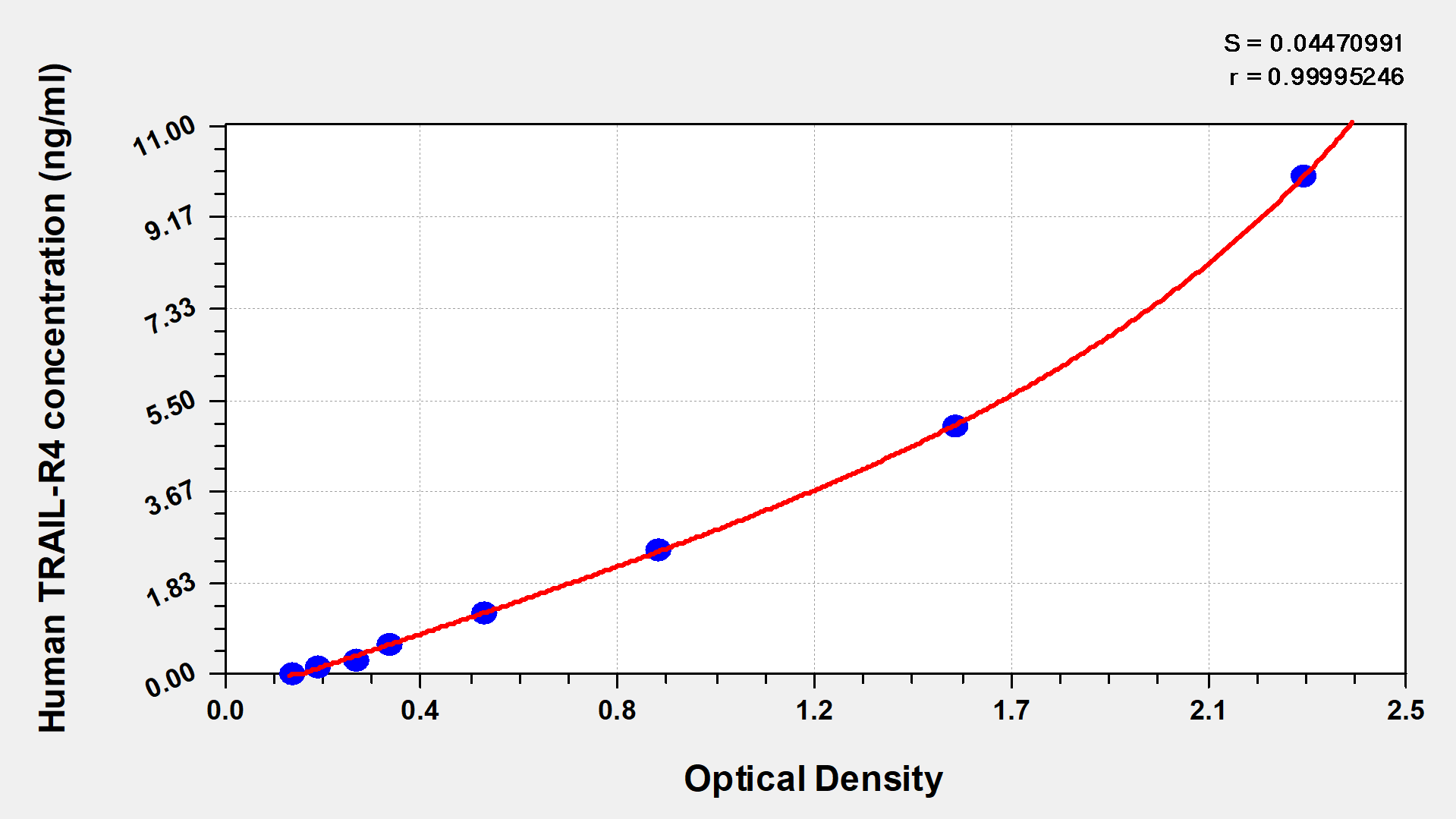
These standard curves are provided for demonstration only. A standard curve should be generated for each set of samples assayed. | |||||||
| |||||||
ng/ml | OD1 | OD2 | Average | Corrected | |||
10 | 2.214 | 2.323 | 2.269 | 2.112 | |||
5 | 1.597 | 1.486 | 1.542 | 1.385 | |||
2.5 | 0.957 | 0.886 | 0.922 | 0.765 | |||
1.25 | 0.547 | 0.568 | 0.558 | 0.401 | |||
0.625 | 0.355 | 0.366 | 0.361 | 0.204 | |||
0.312 | 0.281 | 0.297 | 0.289 | 0.132 | |||
0.156 | 0.208 | 0.214 | 0.211 | 0.054 | |||
0 | 0.156 | 0.157 | 0.157 |
| |||
To assess the linearity of the assay, samples were spiked with high concentrations of human TRAIL-R4 in various matrices and diluted with the Sample Diluent to produce samples with values within the dynamic range of the assay. | ||||||
| Sample | Serum(n=4) | ||||
1:1 | Average % | 89 | ||||
Range % | 86-92 | |||||
1:2 | Average % | 95 | ||||
Range % | 91-99 | |||||
1:4 | Average % | 98 | ||||
Range % | 92-104 | |||||
1:8 | Average % | 92 | ||||
Range % | 82-95 | |||||
The recovery of human TRAIL-R4 spiked to levels throughout the range of the assay in various matrices was evaluated. Samples were diluted prior to assay as directed in the Sample Preparation section. | ||||||
Sample Type | Average % Recovery | Range | ||||
Serum (n=5) | 95 | 90-101 | ||||
EDTA plasma (n=4) | 107 | 102-110 | ||||