

Human thymus activation regulated chemokine,TARC ELISA Kit
The Ultimate 1-Stop ELISA Marketplace:
60,000+ ELISA kits Available to Serve Scientists from All Fields of Life Science
Always Powered by Diagnocine for Precision Research.
Most comprehensive buffers, reagents and detection agents are provided with each kit to optimize data output.
All-inclusive format covers everything from sample preparation to signal detection. Every step can be customized and optimized for your precision research.
DiagnoCine Precision buffers and reagents are Made in USA ISO 13485 Certified
Why waste time searching for your ELISA kit when you can get everything in one place? Diagnocine can provide you with all the ELISA needs you have (customized ELISAs also available) on the planet through a single, streamlined ordering process.
* all types of species
* HRP and AP detection
* Low target signal enhancement
* Inquire about a trial version or a customized version
4 core reagents below are included with every order, plus 1 of the 2 detection-specific reagents (matched automatically to your kit type) — 5 components, every time.
+ the 5th component, matched to your kit's detection method:
If you have any questions or need additional information, please call us at 551-245-1033 or email us at support@diagnocine.com. Our team will be happy to assist you.
Universal Compatibility
All buffers and detection reagents work seamlessly across target proteins, bridging the gap in assay consistency.
1-Stop Convenience
Consolidate your lab's purchasing. Source all ELISA needs and experience optimal buffers and reagents in a single shipment.
Enhanced Precision
Designed by scientists for scientists, all components are engineered to deliver sharper results and an optical signal.
Human thymus activation regulated chemokine,TARC ELISA Kit
Sandwich quantitative immunoassay for chemokine (C-C motif) ligand 17 in human serum, plasma, tissue homogenates available in multiple catalog sizes:
Note: Please send inquiries regarding Trial 24T orders to support@diagnocine.com.
| Target name | chemokine (C-C motif) ligand 17 |
| Uniprot No. | Q92583 |
| Species | Homo sapiens (Human) |
| Sample types | serum, plasma, tissue homogenates |
| Detection range | 15.6 pg/mL-1000 pg/mL |
| Sensitivity | 3.9 pg/mL |
| Assay time | 1-5h |
| Sample loading volume | 50-100μL |
| Detection wavelength | 450 nm |
| Assay principle | Sandwich (Quantitative) |
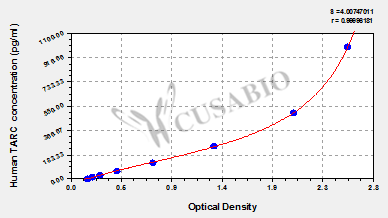
| Data analysis | Standard curve + Curve Expert software |
| Research area | Immunology |
| Storage condition | 2-8°C (see protocol for full details) |
| Shipping condition | 4 °C |
| Shelf life | 6 months |
10 business days
Processing + 3-5 days shipping
In Stock : USA
Worldwide shipping available
Antibody capture
450 nm detection
Standard curve
Quantification
In this sandwich ELISA, chemokine (C-C motif) ligand 17 in the sample is captured between a pre-coated capture antibody and a detection antibody. Signal intensity is proportional to analyte concentration. Quantification uses a standard curve fitted with Curve Expert software, covering 15.6 pg/mL-1000 pg/mL with a minimum detectable dose of 3.9 pg/mL.
This human TARC ELISA kit employs the quantitative sandwich enzyme immunoassay technique to measure the levels of human TARC in multiple samples, including serum, plasma, or tissue homogenates. It also uses the enzyme-substrate chromogenic reaction to visualize and analyze the analyte levels through the color intensity. The intensity of the colored product is in direct proportion to the TARC levels in the sample and is measured at 450 nm through a microplate reader.
TARC, also called CCL17, is constitutively expressed in the thymus and produced by dendritic cells (DCs), endothelial cells, keratinocytes, and bronchial epithelial cells. CCL17 plays an important role in T cell development in the thymus, and it binds to CCR4 and displays chemotactic activity for T lymphocytes, predominantly Th2 cells. Moreover, some studies have demonstrated that chemokine CCL17, an important regulator of atherosclerosis, is positively related to coronary artery disease, independent of traditional cardiovascular risk factors. Another study has revealed that circulating CCL17 plays a crucial role in aging as well as Ang II-induced pathological cardiac remodeling and heart failure (HF).
- Serum levels of CCL17 were positively correlated with coronary artery disease. PMID: 25062565
- Serum TARC may represent a suitable biomarker for monitoring of atopic dermatitis severity in daily practice. PMID: 25199679
- TARC was correlated with disease status and its monitoring may be able to predict PET positivity after alloSCT, thus potentially allowing an early immune manipulation. PMID: 25240818
- The serum TARC level is a very sensitive biomarker for monitoring the severity and treatment response in AD PMID: 25268342
- CCL17 and CCL18 dermal expression is associated with leprosy polarity. PMID: 25412496
- Serum CCL17 levels are associated with coronary artery disease and atherosclerosis severity independently of traditional cardiovascular risk factors. PMID: 25555269
- The SNP rs223895 in TARC/CCL17 gene is associated with the susceptibility to Kawasaki disease. PMID: 26182268
- CCL17 positively regulates the tumorigenesis of hepatocellular carcinoma.Higher levels of intratumoral CCL17 expression are associated with poorer survival of hepatocellular carcinoma patients. PMID: 26781124
- Data suggest that Th1 (IFN-gamma-inducible protein-10 IP-10/CXCL10) and Th2 (thymus and activation regulated chemokine TARC/CCL17) and (macrophage derived chemokine MDC/CCL22) cooperatively play a role in the development of ankylosing spondylitis (AS). PMID: 26827189
- TARC production in HaCaT keratinocytes through the interaction between IL-22 and IL-22Ralpha facilitates T-cell migration in atopic dermatitis caused by house dust mites. PMID: 26914146
- levels elevated in rheumatoid arthritis synovial fluid, due to production by mononuclear cells, particularly CD1c classical dendritic cells PMID: 27250804
- Serum TARC levels are well correlated with blood eosinophil counts in patients with generalized drug eruptions, indicating that Th2-type immune reactions underlie TARC production. Serum TARC measurements also have potent diagnostic value for DIHS, with high sensitivity and specificity. PMID: 27497618
- GM-CSF can mediate inflammation and pain by regulating IRF4-induced CCL17 production PMID: 27525438
- elevated pre-treatment levels of sGal-1, sCD163, sCD30 and TARC can be found in patients with classic Hodgkin lymphoma. However, only plasma TARC accurately reflects disease activity and correlates with clinical treatment response. PMID: 27610595
- Based on the ADEPT study data set, we report that airway mucosal expression of CCL26 was a robust discriminator of type 2 inflammation from healthy nonatopic subjects. Furthermore, airway mucosal CCL26 expression was best identified by using a panel of clinical biomarkers, including Feno values, bEOS counts, and expression of 2 novel markers, sCCL17 and sCCL26 PMID: 28089872
- High CCL17 expression is associated with colon cancer cell migration. PMID: 28146427
- TARC is a candidate biomarker for PTSD only in males. PMID: 28170001
- Low CCL17 expression is a potential independent adverse prognostic biomarker for recurrence and survival of patients with clear cell renal cell carcinoma after nephrectomy. PMID: 28178948
- Taken together, our data showed a likely positive feedback mechanism of enhanced IL-6 production in ectopic milieu. The high levels of IL-6 in the peritoneal cavity stimulate the expression of CCL17 in endometrial stromal cells by activating JNK signal pathway, and then, CCL17 further induces CCR4 expression on macrophages, which eventually leads to an increase in IL-6 production via NF-kappaB activation. PMID: 28240436
- IP-10 serum increase or TARC/IP-10 ratio decrease along with abnormal hepatic enzymatic alteration could signify early rejection of the transplanted liver. PMID: 28245475
- Data suggest that high levels of CCL17 and CCL22 in endometrium in women with endometriosis promote (1) recruitment of Tregs, (2) immunosuppression of Tregs, and (3) angiogenesis in endometrium. (Tregs = regulatory T cells) PMID: 28383711
- Serum TARC levels correlate well with indicators of systemic inflammation and of disease severity among patients with a drug eruption except SJS/TEN. Serum TARC may be a prognostic biomarker of severity of inflammation in drug eruptions. PMID: 28648978
- This review presents key clinical studies of Multiple sclerosis together with experimental studies in animals that have demonstrated functional roles of CCR4, CCL17, and CCL22 in experimental autoimmune encephalomyelitis pathogenesis. [review] PMID: 29099057
- TARC serum levels were elevated in 78% of sarcoidosis patients and correlated with disease severity. PMID: 29598931
- Serum TARC level may be a potent marker reflecting better response to IL-17A inhibitors for psoriasis treatment. PMID: 29655215
- The expression of CCL17 was decreased in nasal polyp (NP) epithelium compared to the epithelium of normal ethmoid sinus, whereas the expression of CCL22 was not decreased. E-cadherin was differentially distributed between the epithelium of normal ethmoid sinus and NP epithelium. EGFR was also decreased in NPs. PMID: 29746583
- The frequency of the CC genotype in the TARC rs223828 SNP was higher in patients with intractable Graves disease than in patients with Graves disease in remission. PMID: 29848886
| Intra-assay Precision (Precision within an assay): CV%<8% | |||||||
| Three samples of known concentration were tested twenty times on one plate to assess. | |||||||
| Inter-assay Precision (Precision between assays): CV%<10% | |||||||
| Three samples of known concentration were tested in twenty assays to assess. | |||||||
| These standard curves are provided for demonstration only. A standard curve should be generated for each set of samples assayed. | ||||||||||||||||||||||||||||||||||||||||||||||||||||||||||||||||||||||||
| ||||||||||||||||||||||||||||||||||||||||||||||||||||||||||||||||||||||||
| To assess the linearity of the assay, samples were spiked with high concentrations of human TARC in various matrices and diluted with the Sample Diluent to produce samples with values within the dynamic range of the assay. | |||||||
| Sample | Serum(n=4) | ||||||
| 1:5 | Average % | 106 | |||||
| Range % | 101-115 | ||||||
| 1:10 | Average % | 104 | |||||
| Range % | 102-108 | ||||||
| 1:20 | Average % | 87 | |||||
| Range % | 84-93 | ||||||
| 1:40 | Average % | 94 | |||||
| Range % | 90-97 | ||||||
| The recovery of human TARC spiked to levels throughout the range of the assay in various matrices was evaluated. Samples were diluted prior to assay as directed in the Sample Preparation section. | |||||||
| Sample Type | Average % Recovery | Range | |||||
| Serum (n=5) | 96 | 90-101 | |||||
| EDTA plasma (n=4) | 89 | 85-92 | |||||