
.jpg "/Content/Upload/Product/Human_ELISA_kits_Diagnocine_1200_1200(218).jpg")
Human low density lipoprotein receptor,LDLR ELISA Kit
The Ultimate 1-Stop ELISA Marketplace:
60,000+ ELISA kits Available to Serve Scientists from All Fields of Life Science
Always Powered by Diagnocine for Precision Research.
Most comprehensive buffers, reagents and detection agents are provided with each kit to optimize data output.
All-inclusive format covers everything from sample preparation to signal detection. Every step can be customized and optimized for your precision research.
DiagnoCine Precision buffers and reagents are Made in USA ISO 13485 Certified
Why waste time searching for your ELISA kit when you can get everything in one place? Diagnocine can provide you with all the ELISA needs you have (customized ELISAs also available) on the planet through a single, streamlined ordering process.
* all types of species
* HRP and AP detection
* Low target signal enhancement
* Inquire about a trial version or a customized version
4 core reagents below are included with every order, plus 1 of the 2 detection-specific reagents (matched automatically to your kit type) — 5 components, every time.
+ the 5th component, matched to your kit's detection method:
If you have any questions or need additional information, please call us at 551-245-1033 or email us at support@diagnocine.com. Our team will be happy to assist you.
Universal Compatibility
All buffers and detection reagents work seamlessly across target proteins, bridging the gap in assay consistency.
1-Stop Convenience
Consolidate your lab's purchasing. Source all ELISA needs and experience optimal buffers and reagents in a single shipment.
Enhanced Precision
Designed by scientists for scientists, all components are engineered to deliver sharper results and an optical signal.
Human low density lipoprotein receptor,LDLR ELISA Kit
Sandwich quantitative immunoassay for low density lipoprotein receptor in human serum, plasma, tissue homogenates available in multiple catalog sizes:
Note: Please send inquiries regarding Trial 24T orders to support@diagnocine.com.
| Target name | low density lipoprotein receptor |
| Uniprot No. | P01130 |
| Species | Homo sapiens (Human) |
| Sample types | serum, plasma, tissue homogenates |
| Detection range | 31.25 pg/mL-2000 pg/mL |
| Sensitivity | 7.8 pg/mL |
| Assay time | 1-5h |
| Sample loading volume | 50-100μL |
| Detection wavelength | 450 nm |
| Assay principle | Sandwich (Quantitative) |
| Data analysis | Standard curve + Curve Expert software |
| Research area | Cardiovascular |
| Storage condition | 2-8°C (see protocol for full details) |
| Shipping condition | 4 °C |
| Shelf life | 6 months |
10 business days
Processing + 3-5 days shipping
In Stock : USA
Worldwide shipping available
Antibody capture
450 nm detection
Standard curve
Quantification
In this sandwich ELISA, low density lipoprotein receptor in the sample is captured between a pre-coated capture antibody and a detection antibody. Signal intensity is proportional to analyte concentration. Quantification uses a standard curve fitted with Curve Expert software, covering 31.25 pg/mL-2000 pg/mL with a minimum detectable dose of 7.8 pg/mL.
- Higher Gleason grade was associated with lower LDLR expression, lower SOAT1 and higher SQLE expression. Besides high SQLE expression, cancers that became lethal despite primary treatment were characterized by low LDLR expression (odds ratio for highest versus lowest quintile, 0.37; 95% CI 0.18-0.76) and by low SOAT1 expression (odds ratio, 0.41; 95% CI 0.21-0.83). PMID: 28595267
- Report familial hypercholesterolemia patients with multiple mutations at the LDLR gene presenting with more severe phenotype than single mutants. PMID: 28645073
- LDLr in the activated PSFs may become a novel target receptor for controlled drug delivery. PMID: 28686975
- PCSK9 inhibits lipoprotein(a) clearance through the LDLR. PMID: 28750079
- Results indicate the importance of the LDL receptor (LDLR) in the growth of triple-negative and HER2-overexpressing breast cancers in the setting of elevated circulating LDL cholesterol (LDL-C). PMID: 28759039
- Twenty mutations including synonymous, missense, and intronic mutations were identified in the LDLR coding region of 32 Brazilian patients with familial hypercholesterolemia. PMID: 28873201
- Liposomes modified with both apolipoproteins A-I and E were internalized in HepG2 cells in FBS-depleted culture medium at the same levels as unmodified liposomes in FBS-containing culture medium, which indicates that apolipoproteins A-I and E were the major serum components involved in liposomal binding to SR-B1 or LDLR (or both). PMID: 28888368
- Heparan sulfate proteoglycans binding is required for PCSK9-induced LDLR degradation. PMID: 28894089
- LDLR associated with Familial Hypercholesterolemia and Polygenic Hypercholesterolemia in patients with Acute Coronary Syndrome , age =65 years, and LDL-C levels /=160 mg/dl. PMID: 28958330
- These findings suggest that LDLR rs2738464 may affect the affinity of miR-330 binding to the LDLR 3'-UTR, thus regulating LDLR expression and contributing to clear cell renal cell carcinoma risk PMID: 29029037
- Systematic mutation of the AREs (ARE1-3) in the LDLR 3'UTR and expression of each mutant coupled to a luciferase reporter in Huh7 cells demonstrated that ARE1 is required for rapid LDLR mRNA decay and 5-AzaC-induced mRNA stabilization via the IRE1alpha-EGFR-ERK1/2 signaling cascade. PMID: 29208426
- membrane LDLR was reduced and lost the ability to take up LDL. Our data also expand the spectrum of known LDLR mutations PMID: 29228028
- Authors performed an analysis of public databases and literature for every variant published associated with FH, in the genes LDLR, APOB, and PCSK9. PMID: 29261184
- This study adds 9 novel variations and 11 recurrent variations to the spectrum of LDLR gene mutations in Indian population. The in silico analysis for all the variations detected in this study were done to predict the probabilistic effect in pathogenicity of Familial Hypercholesterolemia. PMID: 29269200
- Vesicular stomatitis virus G protein complex with two distinct cysteine-rich domains (CR2 and CR3) of LDL-R PMID: 29531262
- HepG2 cell lines transfected with siRNA directed to PCSK9 were challenged with Hcy, homocysteine thiolactone (HTL), testosterone, 5alpha-dihydroxytestosterone (5alpha-DHT), or estradiol for 24h, leading to an overt expression of PCSK9 and down-regulated expression of LDLR. PMID: 29660344
- The frequency of known mutations in the LDLR gene in this cohort of patients was markedly low compared to frequencies reported in other populations. PMID: 29720182
- Data suggest maternal glycemic response during pregnancy is associated with lower DNA methylation of 4 CpG sites within PDE4B gene in placenta (collected after normal-weight term birth); 3 additional CpG sites are differentially methylated relative to maternal glucose response within TNFRSF1B, LDLR, and BLM genes. (PDE4B = phosphodiesterase-4B; TNFRSF1B = TNF receptor superfamily member-1B; BLM = Bloom syndrome protein) PMID: 29752424
- In this review we present a broad spectrum of functionally characterized missense LDLr variants identified in patients with Familial hypercholesterolemia (FH), which is mandatory for a definite diagnosis of FH. PMID: 29874871
Intra-assay Precision (Precision within an assay): CV%<8% | |||||||||||||||||||||||||||||||||||||||||||||||||||||||||
Three samples of known concentration were tested twenty times on one plate to assess. | |||||||||||||||||||||||||||||||||||||||||||||||||||||||||
Inter-assay Precision (Precision between assays): CV%<10% | |||||||||||||||||||||||||||||||||||||||||||||||||||||||||
Three samples of known concentration were tested in twenty assays to assess. | |||||||||||||||||||||||||||||||||||||||||||||||||||||||||
| |||||||||||||||||||||||||||||||||||||||||||||||||||||||||
These standard curves are provided for demonstration only. A standard curve should be generated for each set of samples assayed. | ||||||||||||||||
| ||||||||||||||||
pg/ml | OD1 | OD2 | Average | Corrected | ||||||||||||
2000 | 2.372 | 2.3 | 2.336 | 2.232 | ||||||||||||
1000 | 1.738 | 1.683 | 1.711 | 1.607 | ||||||||||||
500 | 1.32 | 1.302 | 1.311 | 1.207 | ||||||||||||
250 | 0.818 | 0.834 | 0.826 | 0.722 | ||||||||||||
125 | 0.552 | 0.543 | 0.548 | 0.444 | ||||||||||||
62.5 | 0.327 | 0.317 | 0.322 | 0.218 | ||||||||||||
31.25 | 0.22 | 0.212 | 0.216 | 0.112 | ||||||||||||
0 | 0.103 | 0.105 | 0.104 | |||||||||||||
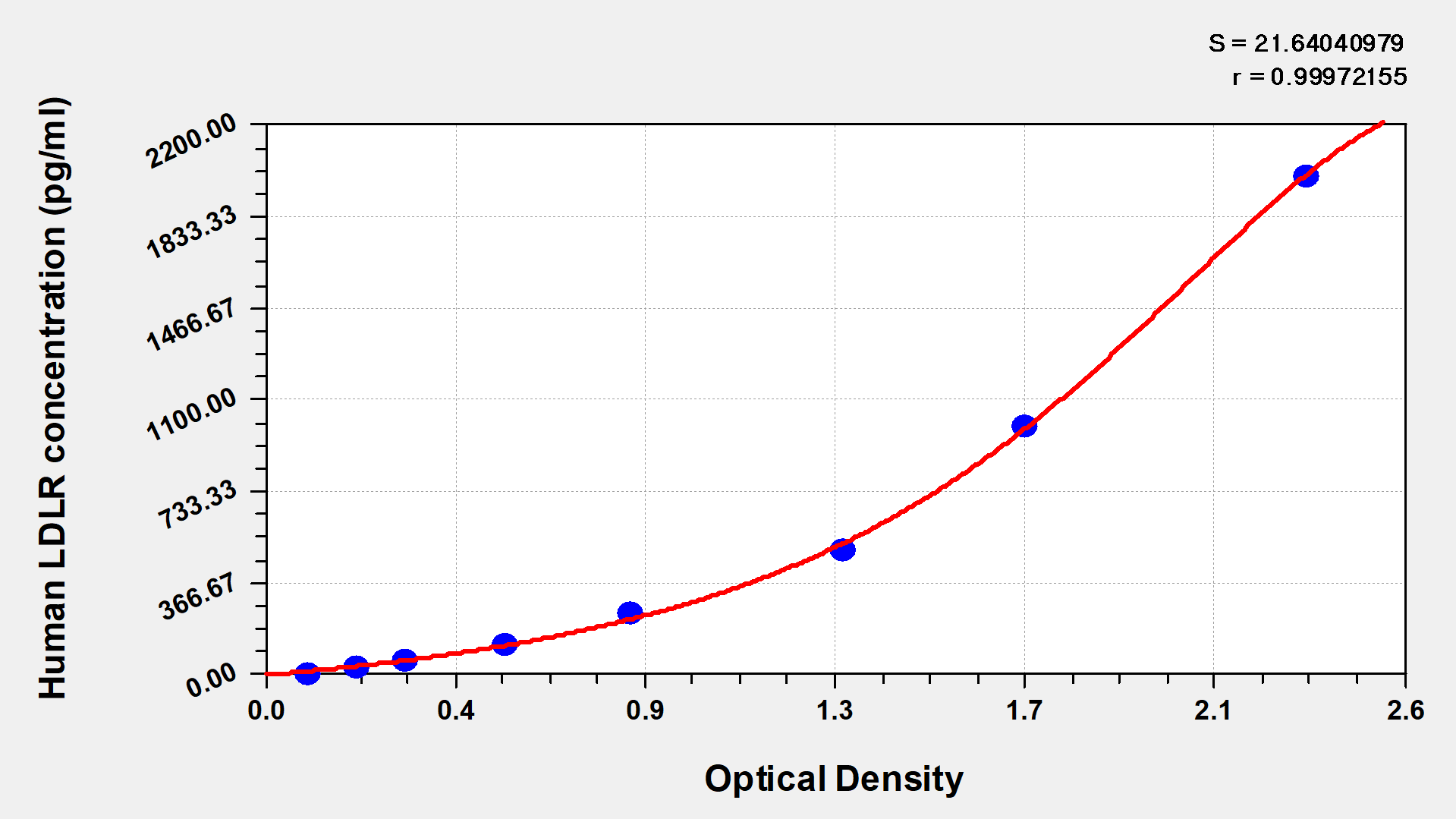
To assess the linearity of the assay, samples were spiked with high concentrations of human LDLR in various matrices and diluted with the Sample Diluent to produce samples with values within the dynamic range of the assay. | |||||||||||||||
| Sample | Serum(n=4) | |||||||||||||
1:20 | Average % | 96 | |||||||||||||
Range % | 88-99 | ||||||||||||||
1:40 | Average % | 101 | |||||||||||||
Range % | 94-105 | ||||||||||||||
1:80 | Average % | 92 | |||||||||||||
Range % | 84-96 | ||||||||||||||
1:160 | Average % | 104 | |||||||||||||
Range % | 94-107 | ||||||||||||||
The recovery of human LDLR spiked to levels throughout the range of the assay in various matrices was evaluated. Samples were diluted prior to assay as directed in the Sample Preparation section. | |||||||||||||||
Sample Type | Average % Recovery | Range | |||||||||||||
Serum (n=5) | 108 | 101-112 | |||||||||||||
Heparin plasma (n=4) | 94 | 87-98 | |||||||||||||