Human lipolysaccharide binding protein,LBP ELISA Kit
The Ultimate 1-Stop ELISA Marketplace:
60,000+ ELISA kits Available to Serve Scientists from All Fields of Life Science
Always Powered by Diagnocine for Precision Research.
Most comprehensive buffers, reagents and detection agents are provided with each kit to optimize data output.
All-inclusive format covers everything from sample preparation to signal detection. Every step can be customized and optimized for your precision research.
DiagnoCine Precision buffers and reagents are Made in USA ISO 13485 Certified
Why waste time searching for your ELISA kit when you can get everything in one place? Diagnocine can provide you with all the ELISA needs you have (customized ELISAs also available) on the planet through a single, streamlined ordering process.
* all types of species
* HRP and AP detection
* Low target signal enhancement
* Inquire about a trial version or a customized version
4 core reagents below are included with every order, plus 1 of the 2 detection-specific reagents (matched automatically to your kit type) — 5 components, every time.
+ the 5th component, matched to your kit's detection method:
If you have any questions or need additional information, please call us at 551-245-1033 or email us at support@diagnocine.com. Our team will be happy to assist you.
Universal Compatibility
All buffers and detection reagents work seamlessly across target proteins, bridging the gap in assay consistency.
1-Stop Convenience
Consolidate your lab's purchasing. Source all ELISA needs and experience optimal buffers and reagents in a single shipment.
Enhanced Precision
Designed by scientists for scientists, all components are engineered to deliver sharper results and an optical signal.
Human lipolysaccharide binding protein,LBP ELISA Kit
Sandwich quantitative immunoassay for lipopolysaccharide binding protein in human serum, plasma, tissue homogenates available in multiple catalog sizes:
Note: Please send inquiries regarding Trial 24T orders to support@diagnocine.com.
| Target name | lipopolysaccharide binding protein |
| Uniprot No. | P18428 |
| Species | Homo sapiens (Human) |
| Sample types | serum, plasma, tissue homogenates |
| Detection range | 15.6ng/mL-1000ng/mL |
| Sensitivity | 7.8ng/mL |
| Assay time | 1-5h |
| Sample loading volume | 50-100μL |
| Detection wavelength | 450 nm |
| Assay principle | Sandwich (Quantitative) |
| Data analysis | Standard curve + Curve Expert software |
| Research area | Immunology |
| Storage condition | 2-8°C (see protocol for full details) |
| Shipping condition | 4 °C |
| Shelf life | 6 months |
10 business days
Processing + 3-5 days shipping
In Stock : USA
Worldwide shipping available
Antibody capture
450 nm detection
Standard curve
Quantification
In this sandwich ELISA, lipopolysaccharide binding protein in the sample is captured between a pre-coated capture antibody and a detection antibody. Signal intensity is proportional to analyte concentration. Quantification uses a standard curve fitted with Curve Expert software, covering 15.6ng/mL-1000ng/mL with a minimum detectable dose of 7.8ng/mL.
This ELISA kit provides quantitative measurement of Lipopolysaccharide-Binding Protein (LBP) in human serum, plasma, and tissue homogenates, supporting immunology research focused on innate immune responses to gram-negative bacterial infection. Because circulating LBP concentrations rise dramatically during acute-phase responses — from baseline levels of ~5–15 μg/mL to >30–50 μg/mL during sepsis — researchers need an assay that accommodates this wide dynamic shift with appropriate sample dilution planning.
Detection Range: The 15.6–1000 ng/mL range is designed for use with diluted serum or plasma samples, as physiological LBP concentrations are in the microgram-per-milliliter range. Researchers should anticipate 1:100 to 1:1000 dilutions depending on whether samples are from healthy donors or patients with active infection.
- High LBP is associated with Crohn's disease. PMID: 20865702
- LBP measurements performed shortly after preterm premature rupture of membranes, are not of value either in the prediction of newborn's infection, or in the prognosis of latency period duration. PMID: 21353369
- This study highlights the LBP rs2232596 and CD14 rs4914 polymorphisms as biomarkers for elevated colorectal carcinoma susceptibility in the Chinese Han population PMID: 21633598
- Cytokine concentrations in amniotic fluid during the mid-trimester did not differ with parity or fetal gender. IL-6, IL-8, and LBP levels appeared stable with gestational week (GW), whereas GW significantly influenced TNF-alpha concentrations. PMID: 21702700
- Aseptic trauma primes the innate immune system for the posttraumatic release of lipopolysaccharide binding protein and sCD14 PMID: 21722015
- The availability of commercial methods for the automated measurement of the soluble CD14 subtype presepsin and lipopolysaccharide binding protein represent a challenge for the evaluation in clinical practice of reliable markers of neonatal sepsis. PMID: 21740312
- During the first 14 days of postoperative sepsis, LBP plasma concentrations showed a time course that was very similar to CRP with a high concordance in the pattern of day-to-day changes PMID: 21901123
- Association of lipopolysaccharide-binding protein gene polymorphisms with cerebral infarction in a Chinese population PMID: 22476641
- our study demonstrated that an elevated LBP level of >15000 ng/ml may serve as a biomarker for the prediction and monitoring of aGVHD. PMID: 22552880
- expression in oral keratinocytes is stimulated by Porphyromonas gingivalis LPS PMID: 22736337
- LBP is a surrogate marker of microbial translocation in association with physical functioning of older adults. PMID: 22960476
- Serum LBP concentrations increased with age. Overweight, obesity, and having metabolic syndrome (particularly, low HDL cholesterol levels) were associated with higher LBP concentrations PMID: 23349936
- Human lipopolysaccharide-binding protein (LBP) and CD14 independently deliver triacylated lipoproteins to Toll-like receptor 1 (TLR1) and TLR2 and enhance formation of the ternary signaling complex PMID: 23430250
- Suggest that the serum LBP concentration constitutes a reliable biologic marker for the diagnosis of a febrile urinary tract infection in children. PMID: 23463341
- Mutations in the lipopolysaccharide binding protein impair innate immunity. PMID: 24120359
- In childnre, LBP was independently associated with BMI and with measures of obstructive sleep apnea severity as well as with metabolic dysfunction, particularly insulin resistance as indicated by the homeostasis model assessment of insulin resistance. PMID: 24276451
- report pre-ART IL-6 and LBP levels as well as IL-6, LBP and I-FABP levels during IRIS-event as potential biomarkers in TB-IRIS PMID: 24312369
- In preterm neonates born to asymptomatic women with PPROM, LBP in cord blood at delivery is an excellent diagnostic biomarker of Fetal inflammatory response syndrome/funisitis with prognostic potential. PMID: 24335151
- study suggested that elevated plasma LBP was associated with an increased risk of developing MetS among middle-aged and older Chinese, especially in normal-weight individuals. PMID: 24906952
- serum level elevated in late-onset neonatal sepsis in very low birth weight infants PMID: 25014514
- Adjusting for body mass index and waist circumference, LBP levels remained significantly increased in metabolic syndrome and increased with increasing numbers of MetS risk factors. PMID: 25063948
- The main findings of this study are that, in acute stroke patients, levels of LBP, IL-10, IL-6 and CRP show a different time course in patients with and without post-stroke infection. PMID: 25613713
- Data show that after matching for gender, age, and body mass index (BMI), serum lipopolysaccharide-binding protein (LBP) does not improve prediction of the development of type 2 diabetes mellitus (T2DM) independently. PMID: 25753130
- Low levels of microbial translocation marker LBP are associated with sustained viral response after anti-HCV treatment in HIV-1/HCV co-infected patients PMID: 25785448
- Report increased secretion of Fetuin A, LBP and HMGB-1 from subcutaneous adipose tissue in metabolic syndrome. PMID: 25978344
- LBP level was not significantly different in neutropenic systemic inflammatory response syndrome patients and sepsis patients. PMID: 26046926
- Serum LBP level is significantly elevated in polycystic ovary syndrome women and is associated with insulin resistance. PMID: 26799617
- LBP serves not only as an extracellular LPS shuttle but in addition facilitates intracellular transport of LPS. PMID: 26804480
- novel observation that sCD14 compared with lipopolysaccharide binding protein, offers a preferred target to ameliorate TLR especially TLR4-induced inflammation and insulin resistance in human obesity and metabolic syndrome PMID: 26880233
- LBP, an endotoxemia associated protein might be used as an inflammatory biomarker of both infectious and non-infectious origins in HCV-infected subjects PMID: 28107471
- Serum LBP levels are associated with arterial stiffness, independent of obesity and traditional cardiovascular risk factors, especially in men with type 2 diabetes. PMID: 28486964
- This study shows a remarkable reversal of amyloid fibrin formation by LBP addition to the plasma of Parkinson's Disease patients . PMID: 29494603
Intra-assay Precision (Precision within an assay): CV%<8% | ||||||
Three samples of known concentration were tested twenty times on one plate to assess. | ||||||
Inter-assay Precision (Precision between assays): CV%<10% | ||||||
Three samples of known concentration were tested in twenty assays to assess. | ||||||
These standard curves are provided for demonstration only. A standard curve should be generated for each set of samples assayed. | ||||||
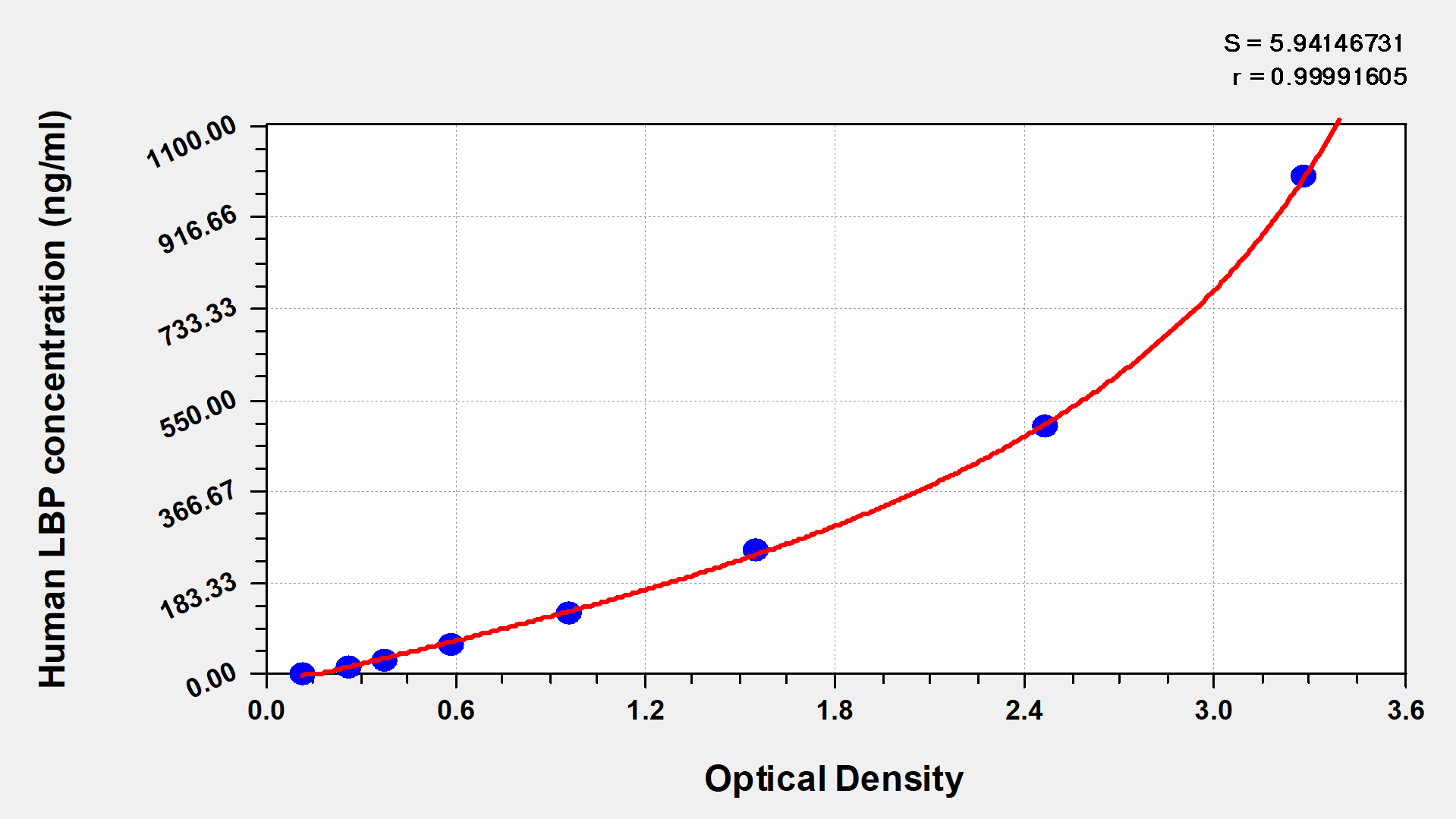 | ||||||
ng/ml | OD1 | OD2 | Average | Corrected | ||
1000 | 3.411 | 3.234 | 3.322 | 3.195 | ||
500 | 2.448 | 2.547 | 2.498 | 2.370 | ||
250 | 1.588 | 1.568 | 1.578 | 1.451 | ||
125 | 0.984 | 0.979 | 0.982 | 0.854 | ||
62.5 | 0.595 | 0.611 | 0.603 | 0.476 | ||
31.2 | 0.400 | 0.383 | 0.391 | 0.264 | ||
15.6 | 0.278 | 0.284 | 0.281 | 0.154 | ||
0 | 0.130 | 0.125 | 0.127 |
| ||
To assess the linearity of the assay, samples were spiked with high concentrations of human LBP in various matrices and diluted with the Sample Diluent to produce samples with values within the dynamic range of the assay. | ||||||
| Sample | Serum(n=4) | ||||
1:40 | Average % | 92 | ||||
Range % | 88-97 | |||||
1:80 | Average % | 90 | ||||
Range % | 86-96 | |||||
1:160 | Average % | 97 | ||||
Range % | 91-103 | |||||
1:320 | Average % | 106 | ||||
Range % | 100-111 | |||||
The recovery of human LBP spiked to levels throughout the range of the assay in various matrices was evaluated. Samples were diluted prior to assay as directed in the Sample Preparation section. | ||||||
Sample Type | Average % Recovery | Range | ||||
Serum (n=5) | 95 | 89-99 | ||||
EDTA plasma (n=4) | 98 | 90-107 | ||||