

.jpg "/Content/Upload/Product/Human_ELISA_kits_Diagnocine_1200_1200(180).jpg")
Human interferon-inducible protein 10,IP-10 ELISA Kit
The Ultimate 1-Stop ELISA Marketplace:
60,000+ ELISA kits Available to Serve Scientists from All Fields of Life Science
Always Powered by Diagnocine for Precision Research.
Most comprehensive buffers, reagents and detection agents are provided with each kit to optimize data output.
All-inclusive format covers everything from sample preparation to signal detection. Every step can be customized and optimized for your precision research.
DiagnoCine Precision buffers and reagents are Made in USA ISO 13485 Certified
Why waste time searching for your ELISA kit when you can get everything in one place? Diagnocine can provide you with all the ELISA needs you have (customized ELISAs also available) on the planet through a single, streamlined ordering process.
* all types of species
* HRP and AP detection
* Low target signal enhancement
* Inquire about a trial version or a customized version
4 core reagents below are included with every order, plus 1 of the 2 detection-specific reagents (matched automatically to your kit type) — 5 components, every time.
+ the 5th component, matched to your kit's detection method:
If you have any questions or need additional information, please call us at 551-245-1033 or email us at support@diagnocine.com. Our team will be happy to assist you.
Universal Compatibility
All buffers and detection reagents work seamlessly across target proteins, bridging the gap in assay consistency.
1-Stop Convenience
Consolidate your lab's purchasing. Source all ELISA needs and experience optimal buffers and reagents in a single shipment.
Enhanced Precision
Designed by scientists for scientists, all components are engineered to deliver sharper results and an optical signal.
Human interferon-inducible protein 10,IP-10 ELISA Kit
Sandwich quantitative immunoassay for Human interferon-inducible protein 10,IP-10 in human serum, plasma, tissue homogenates available in multiple catalog sizes:
Note: Please send inquiries regarding Trial 24T orders to support@diagnocine.com.
| Uniprot No. | P02778 |
| Species | Homo sapiens (Human) |
| Sample types | serum, plasma, tissue homogenates |
| Detection range | 15.6 pg/mL-1000 pg/mL |
| Sensitivity | 3.9 pg/mL |
| Assay time | 1-5h |
| Sample loading volume | 50-100μL |
| Detection wavelength | 450 nm |
| Assay principle | Sandwich (Quantitative) |
| Data analysis | Standard curve + Curve Expert software |
| Research area | Immunology |
| Storage condition | 2-8°C (see protocol for full details) |
| Shipping condition | 4 °C |
| Shelf life | 6 months |
10 business days
Processing + 3-5 days shipping
In Stock : USA
Worldwide shipping available
Antibody capture
450 nm detection
Standard curve
Quantification
In this sandwich ELISA, Human interferon-inducible protein 10,IP-10 in the sample is captured between a pre-coated capture antibody and a detection antibody. Signal intensity is proportional to analyte concentration. Quantification uses a standard curve fitted with Curve Expert software, covering 15.6 pg/mL-1000 pg/mL with a minimum detectable dose of 3.9 pg/mL.
This ELISA kit provides quantitative measurement of CXCL10 (IP-10) in human samples, supporting research into interferon-γ-driven immune signaling and chemokine-mediated T cell recruitment. Because CXCL10 levels can shift dramatically between homeostatic and inflammatory states, the kit is designed to capture this dynamic range without requiring extensive sample manipulation.
Detection Range: The 15.6–1000 pg/mL range spans baseline circulating CXCL10 concentrations in healthy serum (~50–300 pg/mL) through the elevated levels seen in active viral infection, autoimmunity, or transplant rejection, often exceeding 500 pg/mL. Most serum and plasma samples can be assayed neat or with minimal dilution, while inflamed tissue homogenates may require titration.
- Results highlight the role of phytohaemagglutin-stimulated peripheral blood mononuclear cells from patients with Alzheimer's disease on the expression of chemokines CXCL10 and CCL4 by endothelial cells and H4 cell line (mimicking the brain parenchyma) in a human blood brain barrier model. PMID: 28413983
- Increased amniotic fluid CXCL10 concentration is associated with chronic chorioamnionitis or maternal anti-fetal rejection, whereas increased amniotic fluid IL-6 concentration is associated with acute histologic chorioamnionitis. PMID: 28544362
- data indicate that IP-10 is associated with disease activity and perseverance of rheumatoid arthritis. PMID: 28592626
- CXCL10 in addition to IFN-gamma can be used to differentiate among Mycobacterium tuberculosis infection possibilities. PMID: 28610785
- Interferon-gamma-inducible protein 10 (IP-10) directly promoted hepatocyte apoptosis, and baseline IP-10 levels may predict the decrease in the hepatitis B surface antigen levels after entecavir therapy in patients with chronic hepatitis B. PMID: 28614914
- Higher serum levels of CXCL10 are found in patients with non-segmental vitiligo (NSV) and NSV + autoimmune thyroiditis than in controls. PMID: 28698095
- In conclusion, IL-29 enhanced CXCL10 production in human oral epithelial cells via the p38 MAPK, STAT3, and NF-kappaB pathways, which might control Th1-cell accumulation in periodontal lesions and be involved in pathological processes in periodontal disease. PMID: 28753407
- Hepatitis b vaccine was efficient in enhancing IP-10 level with HBsAg clearance, or reduction to a favorable level. PMID: 28802168
- These findings elucidate an NFAT-MAPK signaling paradigm for induction of isletokine expression in beta-cells and reveal IP-10 as a primary therapeutic target to prevent beta-cell-induced inflammatory loss of graft function after islet cell transplantation. PMID: 28855240
- Our findings showed that the assessment of serum IP-10 level could be a predictive factor for SVR and it was associated with fibrosis, necroinflammatory activity, significant steatosis and IR in patients with chronic HCV infection. PMID: 28862188
- The regular early post-transplantation monitoring of urinary miR-155-5p and CXCL10 can help in the prognosis of acute rejection and graft dysfunction after kidney transplantation. PMID: 28880456
- A novel function of CXCL10 in mediating monocyte production of proinflammatory cytokines in inflammatory bowel diseases has been described. PMID: 28899907
- Urinary CXCL10 reflects subclinical inflammation within the tubulointerstitial and peritubular capillary spaces, but not the vascular/systemic compartments PMID: 28902772
- Results show that the expression of IP-10 in peripheral blood of patients with HBV-associated acute-on-chronic liver failure (HBV-ACLF) was significantly high and correlated with the severity of liver failure. IP-10 played an important role in the pathogenesis and progression of HBV-ACLF. PMID: 29058291
- serum levels in active vitiligo significantly elevated compared to those in stable vitiligo patients PMID: 29115683
- Plasma CXCL10 levels are significantly higher in SPs pre-HAART and RPs pre-HAART when compared with HIV-negative controls. PMID: 29122683
- The frequency of non-classical monocytes spontaneously producing CXCL10 was increased in both limited and diffuse systemic sclerosis PMID: 29127442
- Age-related epigenetic and genetic factors which contribute to the dysregulation of CXCL10. PMID: 29223680
- Study suggests that rs56061981 and rs56216945 in CXCL10 gene promoter contribute COPD susceptibility. PMID: 29285564
- COMMD7 activates CXCL10 production by regulating NFkappaB and the production of ROS. The present study highlighted the role of COMMD7 in the development of HCC, and provides novel options for anticancer drug design. PMID: 29532873
- results of study suggest that the CXCL10 overexpression in the salivary glands is caused mainly by IFN-gamma-stimulated salivary gland ductal cells. PMID: 29549479
- CXCL10 rs1439490 G/G is positively associated with seronegative occult hepatitis C virus infection and antiviral treatment outcome. PMID: 29853737
- CXCL10, not CXCL9 or CXCL11, induced IL-9 expression in the liver tissue. PMID: 29860220
- Nab-PTX treatment could increase CXCL10 expression. PMID: 29902349
- No association between IP-10 serum-levels and cancer-related fatigue. PMID: 30188739
Intra-assay Precision (Precision within an assay): CV%<8% | ||||||
Three samples of known concentration were tested twenty times on one plate to assess. | ||||||
Inter-assay Precision (Precision between assays): CV%<10% | ||||||
Three samples of known concentration were tested in twenty assays to assess. | ||||||
These standard curves are provided for demonstration only. A standard curve should be generated for each set of samples assayed. | |||||||
| |||||||
pg/ml | OD1 | OD2 | Average | Corrected | |||
1000 | 2.998 | 3.134 | 3.066 | 2.942 | |||
500 | 1.662 | 1.667 | 1.664 | 1.541 | |||
250 | 1.010 | 0.978 | 0.994 | 0.870 | |||
125 | 0.520 | 0.529 | 0.525 | 0.401 | |||
62.5 | 0.362 | 0.341 | 0.352 | 0.228 | |||
31.2 | 0.219 | 0.229 | 0.224 | 0.100 | |||
15.6 | 0.180 | 0.184 | 0.182 | 0.058 | |||
0 | 0.122 | 0.125 | 0.124 |
| |||
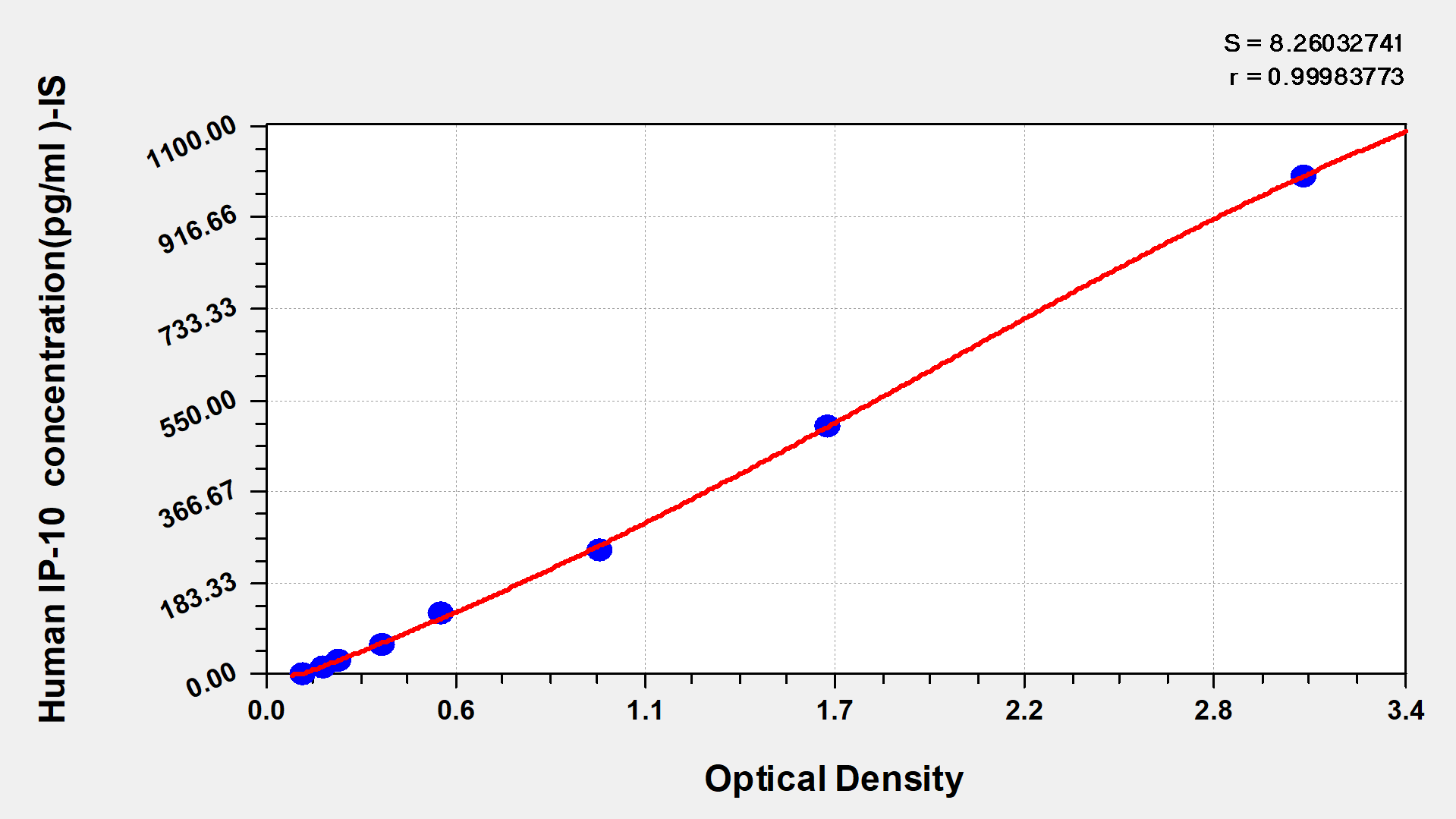
To assess the linearity of the assay, samples were spiked with high concentrations of human IP-10 in various matrices and diluted with the Sample Diluent to produce samples with values within the dynamic range of the assay. | ||||||
| Sample | Serum(n=4) | ||||
1:1 | Average % | 98 | ||||
Range % | 94-103 | |||||
1:2 | Average % | 89 | ||||
Range % | 85-95 | |||||
1:4 | Average % | 101 | ||||
Range % | 96-107 | |||||
1:8 | Average % | 97 | ||||
Range % | 92-103 | |||||
The recovery of human IP-10 spiked to levels throughout the range of the assay in various matrices was evaluated. Samples were diluted prior to assay as directed in the Sample Preparation section. | ||||||
Sample Type | Average % Recovery | Range | ||||
Serum (n=5) | 92 | 86-98 | ||||
EDTA plasma (n=4) | 97 | 90-100 | ||||