

.jpg "/Content/Upload/Product/Human_ELISA_kits_Diagnocine_1200_1200(30).jpg")
Human insulin-like growth factors binding protein 1,IGFBP-1 ELISA Kit
The Ultimate 1-Stop ELISA Marketplace:
60,000+ ELISA kits Available to Serve Scientists from All Fields of Life Science
Always Powered by Diagnocine for Precision Research.
Most comprehensive buffers, reagents and detection agents are provided with each kit to optimize data output.
All-inclusive format covers everything from sample preparation to signal detection. Every step can be customized and optimized for your precision research.
DiagnoCine Precision buffers and reagents are Made in USA ISO 13485 Certified
Why waste time searching for your ELISA kit when you can get everything in one place? Diagnocine can provide you with all the ELISA needs you have (customized ELISAs also available) on the planet through a single, streamlined ordering process.
* all types of species
* HRP and AP detection
* Low target signal enhancement
* Inquire about a trial version or a customized version
4 core reagents below are included with every order, plus 1 of the 2 detection-specific reagents (matched automatically to your kit type) — 5 components, every time.
+ the 5th component, matched to your kit's detection method:
If you have any questions or need additional information, please call us at 551-245-1033 or email us at support@diagnocine.com. Our team will be happy to assist you.
Universal Compatibility
All buffers and detection reagents work seamlessly across target proteins, bridging the gap in assay consistency.
1-Stop Convenience
Consolidate your lab's purchasing. Source all ELISA needs and experience optimal buffers and reagents in a single shipment.
Enhanced Precision
Designed by scientists for scientists, all components are engineered to deliver sharper results and an optical signal.
Human insulin-like growth factors binding protein 1,IGFBP-1 ELISA Kit
Quantitative immunoassay for insulin-like growth factor binding protein 1 in human serum, plasma, tissue homogenates available in multiple catalog sizes:
Note: Please send inquiries regarding Trial 24T orders to support@diagnocine.com.
| Target name | insulin-like growth factor binding protein 1 |
| Uniprot No. | P08833 |
| Species | Homo sapiens (Human) |
| Sample types | serum, plasma, tissue homogenates |
| Detection range | 1.56 ng/mL-100 ng/mL |
| Sensitivity | 0.39 ng/mL |
| Assay time | 1-5h |
| Sample loading volume | 50-100μL |
| Detection wavelength | 450 nm |
| Assay principle | Quantitative |
| Data analysis | Standard curve + Curve Expert software |
| Research area | Signal Transduction |
| Storage condition | 2-8°C (see protocol for full details) |
| Shipping condition | 4 °C |
| Shelf life | 6 months |
10 business days
Processing + 3-5 days shipping
In Stock : USA
Worldwide shipping available
Immunoreaction
450 nm detection
Standard curve
Quantification
Quantification uses a standard curve fitted with Curve Expert software, covering 1.56 ng/mL-100 ng/mL with a minimum detectable dose of 0.39 ng/mL.
The product CSB-E04586h is a sandwich ELISA kit developed to measure concentrations of human IGFBP1 in serum, plasma, or tissue homogenates. This assay uses the sandwich enzyme immunoassay technique in combination with the enzyme-substrate chromogenic reaction to quantify the analyte in the sample. The color develops positively to the amount of IGFBP1 in samples. The color intensity is measured at 450 nm via a microplate reader.
IGFBP1 is produced dominantly in the liver, heart, and kidney. It binds to insulin-like growth factor (IGF) and regulates IGF actions in somatic growth, development, and aging. IGFBP-1 not only is an important determinant of IGF activity but also enhances glucose uptake in peripheral tissues and decreases glucose output in the liver. It regulates cell proliferation, migration, and glucose metabolism by activating integrin-ILK/FAK/PTEN signaling through integrin receptors on the cell membrane. Low circulating levels of IGFBP1 are related to insulin resistance and predict the development of type 2 diabetes. Dysregulation of IGFBP1, as well as IGFs in serum and cervical secretions, induces metabolic disease and cardiovascular disease. Overexpression of IGFBP1 has been shown to improve impaired glucose tolerance.
- Results show that fibrinogen forms complexes with IGFBP-1 under physiological conditions. Several experimental approaches have confirmed that complexes are co-isolated with fibrinogen from plasma, they are relatively stable, and they appear as a general feature of human plasma. PMID: 27260393
- Study provides evidence that elevated values of IGFBP -1 in cervical secretion are highly correlated with preterm labor. PMID: 27452330
- Moreover, a prospective human study showed that having high IGFBP1 levels reduces the risk of developing type-2 diabetes by more than 85%. PMID: 27516442
- Levels of blood IGFBP-1 in pre- and post-menopausal rheumatoid arthritis patients were significantly higher in comparison to the control group. PMID: 27775453
- There was underexpression of the majority of genes after sunitinib treatment. The lower expression levels of IGFBP1, CCL20, CXCL6 and FGB were confirmed by qRT-PCR in all cases. The downregulation of gene expression leads us to search for methylation as a mechanism of action of the tyrosine kinase inhibitors PMID: 27834463
- The reduced affinity of fibrinogen for IGFBP-1 accompanying diabetes may potentially shift the equilibrium to liberate more IGFBP-1 PMID: 27919172
- Study shows that the 3'-untranslated region of IGFBP1 mRNA is targeted by miR-542-3p. The results suggest that miR-542-3p plays an important role in endometrial decidualization by regulating the expression of major decidual marker genes. PMID: 28051155
- Results show that IGFBP-1 transcription and FoxO1 expression are dysregulated in tamoxifen-resistant cancer cells. PMID: 28096479
- A panel consisting of IGFBP1, KIM1, GCLC and GSTM1 genes could be used in combination for early screening of CKDu, whereas these genes in addition with FN1, IGFBP3 and KLK1 could be used to monitor progression of CKDu. The regulation of these genes has to be studied on larger populations to validate their efficiency for further clinical use. PMID: 28103909
- Levels of serum IGFBP-1 were shown to be significantly higher in patients with NPCs. PMID: 28143425
- IGFBP1 levels were higher in patients with multivessel than those with single-vessel lesions; Circulating IGFBP1 level positively correlated with the severity of coronary artery disease. PMID: 28316362
- Vaginal PAMG-1 in patients with a cervical length of 15-30 mm is highly predictive of imminent spontaneous preterm delivery. PMID: 28613021
- Women with higher IGFBP-1 were more likely to have a low relative muscle mass. PMID: 28732569
- we demonstrated that IGFBP-1 suppress the migration of BGC-823 gastric cancer cells and play a protective role in the process of H. pylori-induced gastric cancer. PMID: 28864349
- We report interactions between CSNK-2beta and IGFBP-1 as well as mTOR and CSNK-2beta, providing strong evidence of a mechanistic link between mTOR and IGF-I signaling, two critical regulators of cell growth via CSNK-2. PMID: 29037858
- We conclude that low BDNF and high LCN2 and NF-L levels are associated with Multiple Sclerosis (MS) pathogenesis, and high IGFBP1level is a biomarker for female MS only, suggesting different MS progression pathways between the sexes. LCN2 is a candidate predictor of response to natalizumab treatment, and NF-L is a candidate predictor of clinically isolated syndrome's (CIS) conversion into MS. PMID: 29108879
- hIGFBP1 affects endothelial cell responses and acceleration of endothelial regeneration in transgenic mouse model. PMID: 29186427
- In patients with acute myocardial infarction without previously known diabetes, high insulin-like growth factor-binding protein 1 was associated with long-term all-cause and cancer mortality but not with cardiovascular events. PMID: 29992830
Intra-assay Precision (Precision within an assay): CV%<8% | ||||||||||||
Three samples of known concentration were tested twenty times on one plate to assess. | ||||||||||||
Inter-assay Precision (Precision between assays): CV%<10% | ||||||||||||
Three samples of known concentration were tested in twenty assays to assess. | ||||||||||||
| Intra-Assay Precision | Inter-Assay Precision | ||||||||||
Sample | 1 | 2 | 3 | 1 | 2 | 3 | ||||||
n | 20 | 20 | 20 | 20 | 20 | 20 | ||||||
Mean(ng/ml) | 12.616 | 12.563 | 12.347 | 12.861 | 12.777 | 12.563 | ||||||
SD | 0.030 | 0.029 | 0.028 | 0.040 | 0.039 | 0.041 | ||||||
CV(%) | 5.217 | 5.052 | 4.912 | 7.130 | 6.747 | 7.143 | ||||||
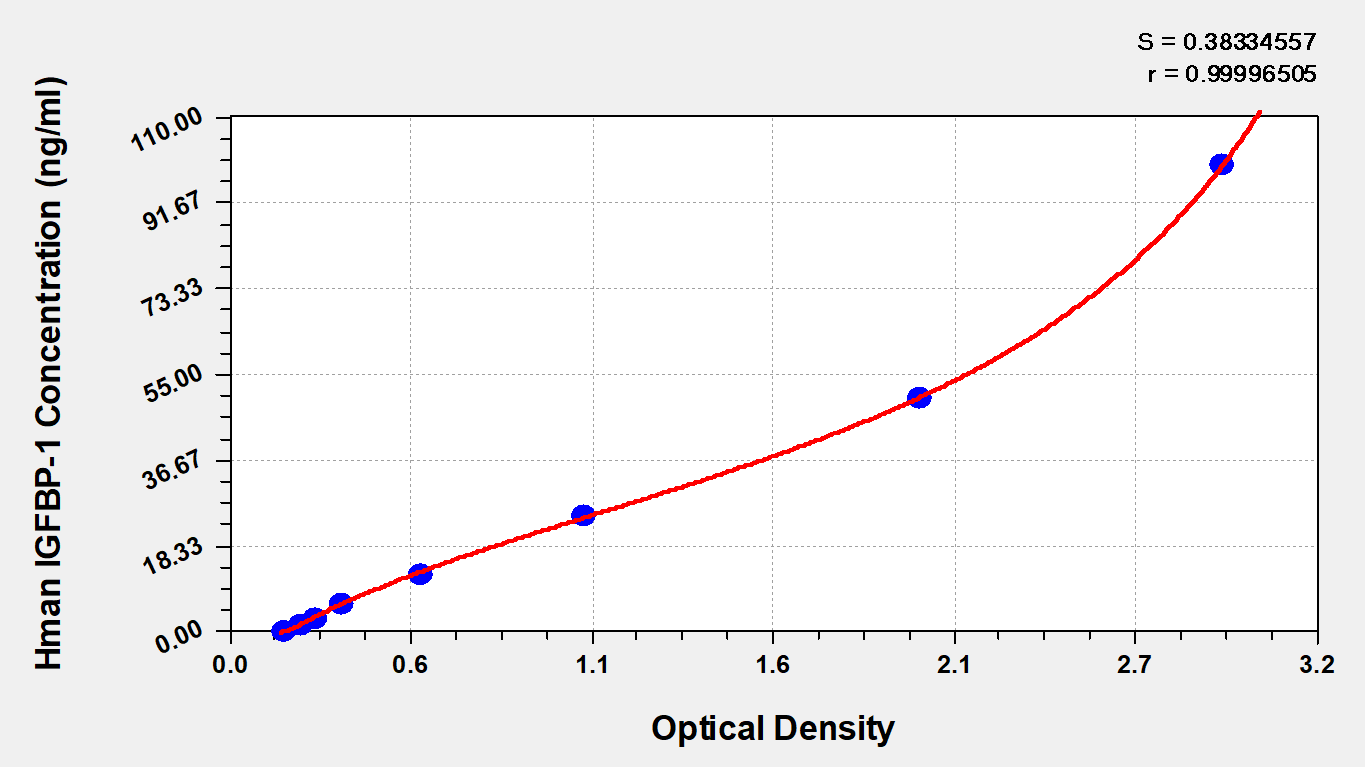
These standard curves are provided for demonstration only. A standard curve should be generated for each set of samples assayed. | |||||||||||||
| |||||||||||||
ng/ml | OD1 | OD2 | Average | Corrected | |||||||||
100 | 2.921 | 2.950 | 2.936 | 2.759 | |||||||||
50 | 2.017 | 2.073 | 2.045 | 1.868 | |||||||||
25 | 1.069 | 1.052 | 1.061 | 0.884 | |||||||||
12.5 | 0.585 | 0.574 | 0.580 | 0.403 | |||||||||
6.25 | 0.356 | 0.339 | 0.348 | 0.171 | |||||||||
3.12 | 0.272 | 0.261 | 0.267 | 0.090 | |||||||||
1.56 | 0.217 | 0.231 | 0.224 | 0.047 | |||||||||
0 | 0.178 | 0.176 | 0.177 |
| |||||||||
To assess the linearity of the assay, samples were spiked with high concentrations of human IGFBP-1 in various matrices and diluted with the Sample Diluent to produce samples with values within the dynamic range of the assay. | |||||||||||||
| Sample | Serum(n=4) | |||||||||||
1:1 | Average % | 95 | |||||||||||
Range % | 91-99 | ||||||||||||
1:2 | Average % | 96 | |||||||||||
Range % | 90-100 | ||||||||||||
1:4 | Average % | 98 | |||||||||||
Range % | 95-102 | ||||||||||||
1:8 | Average % | 97 | |||||||||||
Range % | 94-101 | ||||||||||||
The recovery of human IGFBP-1 spiked to levels throughout the range of the assay in various matrices was evaluated. Samples were diluted prior to assay as directed in the Sample Preparation section. | |||||||||||||
Sample Type | Average % Recovery | Range | |||||||||||
Serum (n=5) | 97 | 91-99 | |||||||||||
EDTA plasma (n=4) | 98 | 95-103 | |||||||||||