

.jpg "/Content/Upload/Product/Human_ELISA_kits_Diagnocine_1200_1200(23).jpg")
Human hepatocyte growth factor,HGF ELISA kit
The Ultimate 1-Stop ELISA Marketplace:
60,000+ ELISA kits Available to Serve Scientists from All Fields of Life Science
Always Powered by Diagnocine for Precision Research.
Most comprehensive buffers, reagents and detection agents are provided with each kit to optimize data output.
All-inclusive format covers everything from sample preparation to signal detection. Every step can be customized and optimized for your precision research.
DiagnoCine Precision buffers and reagents are Made in USA ISO 13485 Certified
Why waste time searching for your ELISA kit when you can get everything in one place? Diagnocine can provide you with all the ELISA needs you have (customized ELISAs also available) on the planet through a single, streamlined ordering process.
* all types of species
* HRP and AP detection
* Low target signal enhancement
* Inquire about a trial version or a customized version
4 core reagents below are included with every order, plus 1 of the 2 detection-specific reagents (matched automatically to your kit type) — 5 components, every time.
+ the 5th component, matched to your kit's detection method:
If you have any questions or need additional information, please call us at 551-245-1033 or email us at support@diagnocine.com. Our team will be happy to assist you.
Universal Compatibility
All buffers and detection reagents work seamlessly across target proteins, bridging the gap in assay consistency.
1-Stop Convenience
Consolidate your lab's purchasing. Source all ELISA needs and experience optimal buffers and reagents in a single shipment.
Enhanced Precision
Designed by scientists for scientists, all components are engineered to deliver sharper results and an optical signal.
Human hepatocyte growth factor,HGF ELISA kit
Sandwich quantitative immunoassay for hepatocyte growth factor (hepapoietin A; scatter factor) in human serum, plasma, tissue homogenates available in multiple catalog sizes:
Note: Please send inquiries regarding Trial 24T orders to support@diagnocine.com.
| Target name | hepatocyte growth factor (hepapoietin A; scatter factor) |
| Uniprot No. | P14210 |
| Species | Homo sapiens (Human) |
| Sample types | serum, plasma, tissue homogenates |
| Detection range | 15.6 pg/mL-1000 pg/mL |
| Sensitivity | 3.9 pg/mL |
| Assay time | 1-5h |
| Sample loading volume | 50-100μL |
| Detection wavelength | 450 nm |
| Assay principle | Sandwich (Quantitative) |
| Data analysis | Standard curve + Curve Expert software |
| Research area | Cancer |
| Storage condition | 2-8°C (see protocol for full details) |
| Shipping condition | 4 °C |
| Shelf life | 6 months |
10 business days
Processing + 3-5 days shipping
In Stock : USA
Worldwide shipping available
Antibody capture
450 nm detection
Standard curve
Quantification
In this sandwich ELISA, hepatocyte growth factor (hepapoietin A; scatter factor) in the sample is captured between a pre-coated capture antibody and a detection antibody. Signal intensity is proportional to analyte concentration. Quantification uses a standard curve fitted with Curve Expert software, covering 15.6 pg/mL-1000 pg/mL with a minimum detectable dose of 3.9 pg/mL.
The human HGF ELISA kit (CSB-E04573h) is designed for the quantitative measurement of human HGF protein in serum, plasma, or tissue homogenates. It quantitates human HGF with 3.9 pg/ml sensitivity and shows excellent specificity for human HGF. It uses the bi-antibody sandwich enzyme immunoassay technique. This assay employs a biotin-conjugated HGF antibody that recognizes the analyte bound by the immobilized HGF antibody, forming an antibody-analyte-antibody complex. The immune complex is further detected by avidin-conjugated HRP. The TMB solution is added into the wells and turns blue and finally turns yellow after the addition of the stop solution. Solution color develops in proportion to the amount of HGF in the sample. The O.D. value is measured using a microplate reader at 450 nm and is used to determine the concentration of the human HGF in the sample. HGF is a cytokine with pleiotropic functions during wound healing and repair. In the bleomycin model of lung fibrosis, HGF was demonstrated to exert anti-fibrotic effects and associated with improved survival and proliferation of epithelial cells and reduction of myofibroblast accumulation. HGF can induce epithelial-mesenchymal conversion of epithelial cells in culture, with the dissociated cells becoming highly motile. HGF/c-Met signaling pathway has been involved in different processes including development, organ regeneration, and cancer as well as in medulloblastoma pathogenesis.
- Lymph node metastasis is strongly associated with expression status of HGF and CD133 at the deep invasive front, suggesting the usefulness of these proteins as independent predictive markers of lymph node metastasis in early gastric cancer. PMID: 28595915
- In summary, a decrease in VEGF-A and an increase in sVEGFR1 during chemotherapy and bevacizumab exposure can contribute to both chemotherapy (due to c-MET/b-catenin activation) and bevacizumab (due to low VEGF requirements) resistance. Because HGF levels decrease also during acquired resistance, alternative strategies to HGF-ligand inhibition should be investigated PMID: 28621236
- Oxidative stress contributes to HGF-dependent pro-senescence activity of ovarian cancer cells. PMID: 28652056
- this study shows that decidual NK cells facilitate the interaction between trophoblastic and endothelial cells via VEGF-C and HGF PMID: 28653669
- miR-26a/mir-26b could suppress tumorigenesis and angiogenesis by targeting the HGF-VEGF axis, and could serve as a potential treatment modality for targeted therapy in the clinical treatment of gastric cancer. PMID: 28738343
- These data suggest that paxillin appears to influence major cell functions in a diverse range of prostate and breast cancer models. The responsiveness of cells to environmental factors such as HGF or BME may be influenced by paxillin status, although this seems to be dependent on cell type PMID: 28739717
- High glucose activated Met receptor in HK2 cells independently of HGF, via induction of integrin a5b1 and downstream signaling. This mode of Met activation was associated with tubular cell damage and apoptosis and it may represent a novel pathogenic mechanism and a treatment target in diabetic nephropathy. PMID: 28819999
- Reduction of fibroblast size upregulates HGF expression, which in turn contributes to loss of collagen, a prominent feature of aged skin. PMID: 28826691
- Results of our present study suggest that both IL-6 and HGF derived from Cancer-associated fibroblasts (CAFs)could contribute to the intratumoral androgen metabolism in ER-negative breast carcinoma patients. PMID: 28831645
- We also propose that full-length HGF and HGF-NK1 convey desirable wound healing properties, whilst fibroblasts preferentially expressing more HGF-NK2 readily undergo TGF-beta-driven differentiation into myofibroblasts. PMID: 28837064
- prolonged treatment of single HGF/c-Met or Hh inhibitor leads to resistance to these single inhibitors, likely because the single c-Met treatment leads to enhanced expression of Shh, and vice versa. Targeting both the HGF/c-Met and Hh pathways simultaneously overcame the resistance to the single-inhibitor treatment and led to a more potent antitumor effect in combination with the chemotherapy treatment. PMID: 28864680
- We identify HGF, acting through the c-Met receptor, as the key polarity-inducing morphogen, which acts to activate b1-integrin-dependent adhesion. HGF and ECM-derived integrin signals co-operate via a c-Src-dependent inhibition of the RhoA-ROCK1 signalling pathway via p190A RhoGAP. PMID: 28888686
- EGF-mediated lysosome trafficking, protease secretion, and invasion is regulated by the activity of p38 mitogen activated protein kinase (MAPK) and sodium hydrogen exchangers (NHEs). Interestingly, EGF stimulates anterograde lysosome trafficking through a different mechanism than previously reported for HGF, suggesting that there are redundant signaling pathways that control lysosome positioning PMID: 28978320
- a higher HGF serum level during hemodialysis treatment is associated with a slower loss of residual renal function PMID: 29227979
- TGF-beta negatively controls the HGF/c-MET pathway by regulating of stemness in glioblastoma. PMID: 29238047
- widely stained in sclerosing stromal tumours of the ovary PMID: 29433373
- These results suggest that gastric cancer progression is not associated with a unique signaling pathway and that a feedback loop may exist between the HGF/c-Met and Notch1 signaling pathways, which may result in therapeutic resistance. PMID: 29781036
- This novel study, in HIV-positive, preeclampsia, and normotensive pregnancies, demonstrates that HGF was two-fold higher in conducting compared to exchange villi irrespective of the pregnancy type. HIV infection does not influence HGF expression within the conducting and exchange villi. PMID: 29886319
- CAFderived HGF promotes angiogenesis. PMID: 29917165
- miR-449a suppresses hepatocellular carcinoma tumorigenesis by down-regulating activity in the c-Met/ERK pathway. PMID: 30108016
Intra-assay Precision (Precision within an assay): CV%<8% | ||||||
Three samples of known concentration were tested twenty times on one plate to assess. | ||||||
Inter-assay Precision (Precision between assays): CV%<10% | ||||||
Three samples of known concentration were tested in twenty assays to assess. | ||||||
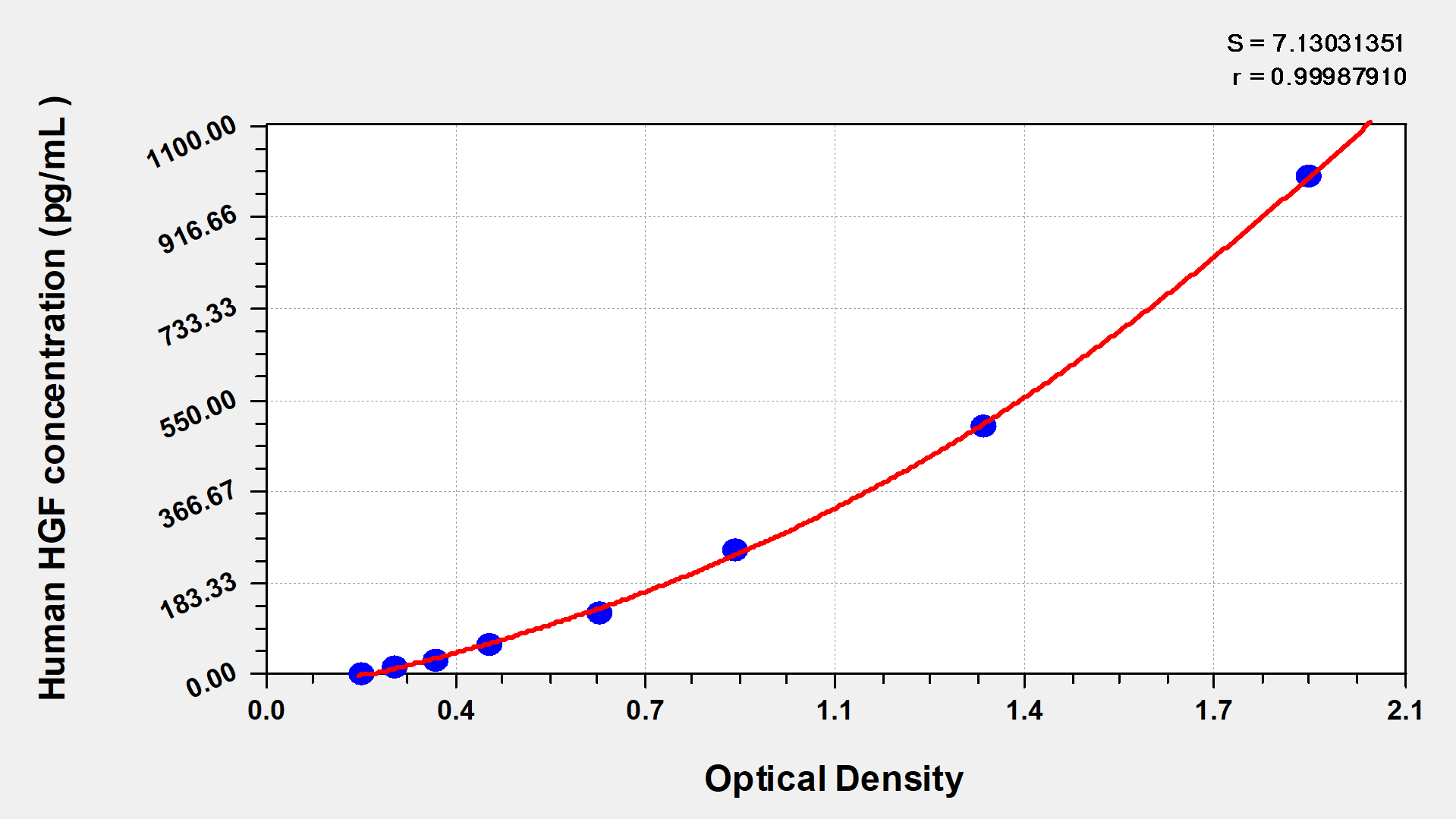
These standard curves are provided for demonstration only. A standard curve should be generated for each set of samples assayed. | |||||||
| |||||||
pg/ml | OD1 | OD2 | Average | Corrected | |||
1000 | 1.873 | 1.953 | 1.913 | 1.723 | |||
500 | 1.332 | 1.307 | 1.320 | 1.129 | |||
250 | 0.839 | 0.903 | 0.871 | 0.680 | |||
125 | 0.629 | 0.619 | 0.624 | 0.434 | |||
62.5 | 0.429 | 0.421 | 0.425 | 0.235 | |||
31.2 | 0.323 | 0.335 | 0.329 | 0.139 | |||
15.6 | 0.259 | 0.248 | 0.254 | 0.063 | |||
0 | 0.189 | 0.193 | 0.191 |
| |||
To assess the linearity of the assay, samples were spiked with high concentrations of human HGF in various matrices and diluted with the Sample Diluent to produce samples with values within the dynamic range of the assay. | ||||||
| Sample | Serum(n=4) | ||||
1:1 | Average % | 89 | ||||
Range % | 80-98 | |||||
1:2 | Average % | 90 | ||||
Range % | 85-100 | |||||
1:4 | Average % | 95 | ||||
Range % | 92-100 | |||||
1:8 | Average % | 93 | ||||
Range % | 86-98 | |||||
The recovery of human HGF spiked to levels throughout the range of the assay in various matrices was evaluated. Samples were diluted prior to assay as directed in the Sample Preparation section. | ||||||
Sample Type | Average % Recovery | Range | ||||
Serum (n=5) | 96 | 91-108 | ||||
EDTA plasma (n=4) | 99 | 94-105 | ||||