

Human apolipoprotein E (Apo-E) ELISA Kit
The Ultimate 1-Stop ELISA Marketplace:
60,000+ ELISA kits Available to Serve Scientists from All Fields of Life Science
Always Powered by Diagnocine for Precision Research.
Most comprehensive buffers, reagents and detection agents are provided with each kit to optimize data output.
All-inclusive format covers everything from sample preparation to signal detection. Every step can be customized and optimized for your precision research.
DiagnoCine Precision buffers and reagents are Made in USA ISO 13485 Certified
Why waste time searching for your ELISA kit when you can get everything in one place? Diagnocine can provide you with all the ELISA needs you have (customized ELISAs also available) on the planet through a single, streamlined ordering process.
* all types of species
* HRP and AP detection
* Low target signal enhancement
* Inquire about a trial version or a customized version
4 core reagents below are included with every order, plus 1 of the 2 detection-specific reagents (matched automatically to your kit type) — 5 components, every time.
+ the 5th component, matched to your kit's detection method:
If you have any questions or need additional information, please call us at 551-245-1033 or email us at support@diagnocine.com. Our team will be happy to assist you.
Universal Compatibility
All buffers and detection reagents work seamlessly across target proteins, bridging the gap in assay consistency.
1-Stop Convenience
Consolidate your lab's purchasing. Source all ELISA needs and experience optimal buffers and reagents in a single shipment.
Enhanced Precision
Designed by scientists for scientists, all components are engineered to deliver sharper results and an optical signal.
Human apolipoprotein E (Apo-E) ELISA Kit
Competitive quantitative immunoassay for apolipoprotein E in human serum, plasma, cell culture supernates, tissue homogenates available in multiple catalog sizes:
Note: Please send inquiries regarding Trial 24T orders to support@diagnocine.com.
| Target name | apolipoprotein E |
| Uniprot No. | P02649 |
| Species | Homo sapiens (Human) |
| Sample types | serum, plasma, cell culture supernates, tissue homogenates |
| Detection range | 15.62 ng/mL-1000 ng/mL |
| Sensitivity | 3.9 ng/mL |
| Assay time | 1-5h |
| Sample loading volume | 50-100μL |
| Detection wavelength | 450 nm |
| Assay principle | Competitive (Quantitative) |
| Data analysis | Standard curve + Curve Expert software |
| Research area | Cardiovascular |
| Storage condition | 2-8°C (see protocol for full details) |
| Shipping condition | 4 °C |
| Shelf life | 6 months |
10 business days
Processing + 3-5 days shipping
In Stock : USA
Worldwide shipping available
Competitive binding
450 nm detection
Standard curve
Quantification
In this competitive ELISA, free apolipoprotein E in the sample competes with plate-bound antigen for antibody binding. Signal intensity is inversely proportional to analyte concentration. Final quantification is derived from a standard curve fitted using Curve Expert software, covering 15.62 ng/mL-1000 ng/mL with a minimum detectable dose of 3.9 ng/mL.
This Human APOE ELISA Kit was designed for the quantitative measurement of Human APOE protein in serum, plasma, cell culture supernates, tissue homogenates. It is a Competitive ELISA kit, its detection range is 15.62 ng/mL-1000 ng/mL and the sensitivity is 3.9 ng/mL.
- In this study, detection of AD-related DNA oligonucleotide sequence associated with Apolipoprotein E4 gene sequence was achieved using localized-surface plasmon resonance (LSPR) on 2D-Photonic crystal (2D-PC) and Au-coated 2D-PC surfaces. PMID: 29291596
- APOE-epsilon4 is associated with a subtly faster rate of memory decline from midlife to early old age PMID: 29317609
- Apolipoprotein E Mutation is associated with Lipoprotein Glomerulopathy. PMID: 29398675
- t results point out that APOE4 genotype influences healthy aged cognition, although factors such age or educational attainment seem to modulate its effects PMID: 29414814
- The study demonstrated that the APOE epsilon3/epsilon3 and epsilon3/epsilon4 genotypes played a protective role against cerebral infarction in Chinese men, but not women. PMID: 29479056
- Hypertension and the ApoEepsilon4/epsilon4 genotype may be associated with the occurrence of MCA stenosis in the ischemic stroke Chinese patients. PMID: 29494434
- the APOEepsilon4 alleles were significantly higher in patients with Alzheimer's disease (AD) and there was a potential synergistic interaction between the CYP46A1 C allele and APOEepsilon4 allele in AD. PMID: 29516283
- Reduced expression of miR-98 may relate to LOX-1 expression and foam cell formation and lipid accumulation in aortas of ApoE(-/-) mice. PMID: 29549823
- APOE-epsilon4 modified the association between central arterial stiffening and cognition. PMID: 29656011
- Reduced content of ApoE in blood serum of men with arterial hypertension was associated with APOE4 gene polymorphism. PMID: 29658078
- In summary, our findings from the two cohorts confirm that genetic variations at the APOE locus influence plasma total cholesterol concentrations, however, the gene-diet interactions on lipids require further investigation in larger cohorts. PMID: 29712557
- results show great changes in men carrying ApoE2, mainly in TG and TC concentrations after treatment with hypocaloric diet and controlled exercise PMID: 29756962
- APOE polymorphism might be associated with the incidence of aneurysmal subarachnoid hemorrhage in Chinese Fujian Han population. PMID: 29769126
- Site-directed mutagenesis of Akt at Cys224 revealed that S-nitrosylation at this site was pivotal for the reduced phosphorylation at Akt Ser473, which led to impaired Akt signaling. Furthermore, on HHcy challenge, as compared with GSNOR(+/+)ApoE(-/-) littermate controls, GSNOR(-/-)ApoE(-/-) double knockout mice showed reduced T-cell activation with concurrent reduction of atherosclerosis. PMID: 29860106
- ApoE genetic polymorphisms conferred susceptibility to steroid-induced ONFH in Chinese Han population. PMID: 29892926
- This study aimed to assess the association between APOE genotype and saccade latency using a prosaccade and antisaccade task in young individuals (N=97, age: 17-35 years). Results showed that prosaccade latency was significantly delayed in a group of epsilon4 carriers in comparison to non-carriers, which was due to a lower rate of signal accumulation rather than a change in the criterion threshold. PMID: 30003976
- found that the ApoE genotype was significantly associated with aneurysmal subarachnoid hemorrhage risk, whereas its effect on certain ethnic populations differs PMID: 30010064
- Higher plasma ApoE concentrations (> 5.9 mg/dL) are the independent risk factor for hemorrhage during endobronchial biopsy in patients with lung cancer. PMID: 30031394
- Patients having Glutathione S-transferase M1 allele and Apolipoprotein E E2 allele are predisposed to oxidative stress-induced cardiac injury. PMID: 30095041
- There is the association between ApoE polymorphism and hypertension. [meta-analysis] PMID: 30180966
- familial hypercholesterolemia case-control study was associated with the E4 allele in the Saudi population. However, E4 allele was appeared as a reliable risk marker for lipid profiles, but not for ApoE alleles PMID: 30235358
- The rs7755 and rs3211956 loci polymorphisms of CD36 gene and genotype E2/E3, E3/E4, E4/E4 of ApoE gene, and E2 and E4 alleles were statistically related with Alzheimer disease. PMID: 30235742
| Intra-assay Precision (Precision within an assay): CV%<8% | ||||||
| Three samples of known concentration were tested twenty times on one plate to assess. | ||||||
| Inter-assay Precision (Precision between assays): CV%<10% | ||||||
| Three samples of known concentration were tested in twenty assays to assess. | ||||||
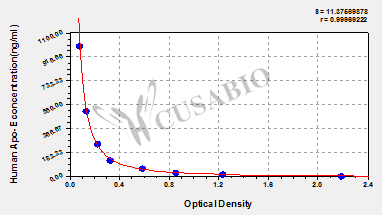
| These standard curves are provided for demonstration only. A standard curve should be generated for each set of samples assayed. | |||||||||||||||||||||||||||||||||||||||||||||||||||||||||||||||
| |||||||||||||||||||||||||||||||||||||||||||||||||||||||||||||||
| To assess the linearity of the assay, samples were spiked with high concentrations of human Apo-E in various matrices and diluted with the Sample Diluent to produce samples with values within the dynamic range of the assay. | ||||||
| Sample | Serum(n=4) | |||||
| 1:100 | Average % | 91 | ||||
| Range % | 86-95 | |||||
| 1:200 | Average % | 102 | ||||
| Range % | 97-107 | |||||
| 1:400 | Average % | 91 | ||||
| Range % | 85-97 | |||||
| 1:800 | Average % | 97 | ||||
| Range % | 91-103 | |||||
| The recovery of human Apo-E spiked to levels throughout the range of the assay in various matrices was evaluated. Samples were diluted prior to assay as directed in the Sample Preparation section. | ||||||
| Sample Type | Average % Recovery | Range | ||||
| Serum (n=5) | 95 | 89-98 | ||||
| EDTA plasma (n=4) | 97 | 90-100 | ||||