

Human acidic fibroblast growth factor,aFGF/FGF-1 ELISA Kit
The Ultimate 1-Stop ELISA Marketplace:
60,000+ ELISA kits Available to Serve Scientists from All Fields of Life Science
Always Powered by Diagnocine for Precision Research.
Most comprehensive buffers, reagents and detection agents are provided with each kit to optimize data output.
All-inclusive format covers everything from sample preparation to signal detection. Every step can be customized and optimized for your precision research.
DiagnoCine Precision buffers and reagents are Made in USA ISO 13485 Certified
Why waste time searching for your ELISA kit when you can get everything in one place? Diagnocine can provide you with all the ELISA needs you have (customized ELISAs also available) on the planet through a single, streamlined ordering process.
* all types of species
* HRP and AP detection
* Low target signal enhancement
* Inquire about a trial version or a customized version
4 core reagents below are included with every order, plus 1 of the 2 detection-specific reagents (matched automatically to your kit type) — 5 components, every time.
+ the 5th component, matched to your kit's detection method:
If you have any questions or need additional information, please call us at 551-245-1033 or email us at support@diagnocine.com. Our team will be happy to assist you.
Universal Compatibility
All buffers and detection reagents work seamlessly across target proteins, bridging the gap in assay consistency.
1-Stop Convenience
Consolidate your lab's purchasing. Source all ELISA needs and experience optimal buffers and reagents in a single shipment.
Enhanced Precision
Designed by scientists for scientists, all components are engineered to deliver sharper results and an optical signal.
Human acidic fibroblast growth factor,aFGF/FGF-1 ELISA Kit
Sandwich quantitative immunoassay for fibroblast growth factor 1 (acidic) in human serum, plasma, tissue homogenates available in multiple catalog sizes:
Note: Please send inquiries regarding Trial 24T orders to support@diagnocine.com.
| Target name | fibroblast growth factor 1 (acidic) |
| Uniprot No. | P05230 |
| Species | Homo sapiens (Human) |
| Sample types | serum, plasma, tissue homogenates |
| Detection range | 15.6 pg/mL-1000 pg/mL |
| Sensitivity | 3.9 pg/mL |
| Assay time | 1-5h |
| Sample loading volume | 50-100μL |
| Detection wavelength | 450 nm |
| Assay principle | Sandwich (Quantitative) |
| Data analysis | Standard curve + Curve Expert software |
| Research area | Cardiovascular |
| Storage condition | 2-8°C (see protocol for full details) |
| Shipping condition | 4 °C |
| Shelf life | 6 months |
10 business days
Processing + 3-5 days shipping
In Stock : USA
Worldwide shipping available
Antibody capture
450 nm detection
Standard curve
Quantification
In this sandwich ELISA, fibroblast growth factor 1 (acidic) in the sample is captured between a pre-coated capture antibody and a detection antibody. Signal intensity is proportional to analyte concentration. Quantification uses a standard curve fitted with Curve Expert software, covering 15.6 pg/mL-1000 pg/mL with a minimum detectable dose of 3.9 pg/mL.
This human FGF1 ELISA kit employs the quantitative sandwich enzyme immunoassay technique to measure the levels of human FGF1 in serum, plasma, or tissue homogenates. It also uses the enzyme-substrate chromogenic reaction to visualize and analyze the analyte levels through the color intensity. The intensity of the colored product is in direct proportion to the FGF1 levels in the sample and is measured at 450 nm through a microplate reader.
FGF1 provides additional protection against apoptosis and promotes cell survival within cells. FGF1 has been shown to play an important role in regulating the fate of bone marrow stromal cells (BMSCs) by suppressing osteogenesis and promoting adipogenesis. FGF1 expression is elevated during the formation of a cartilaginous callus in fracture, especially in fibroblast-like mesenchymal cells. FGF1 is considered a catabolic factor through down-regulating of CCN2 by interaction and enhancing the degradation of cartilaginous ECM by MMP13. FGF1 also stimulates lung epithelial cell proliferation and airway bud formation.
- The analysis identified a signaling axis between FGF signaling and the transcription factor Sox1, which is preferentially expressed in stem- and mesenchymal-like breast cancers. PMID: 26365194
- These findings suggest that the presence of FGF1 may serve as a prognostic indicator and a potential therapeutic target for non-small cell lung cancer patients, especially for lung squamous cell carcinoma. PMID: 26391572
- FGF-1 synthesis and secretion by synovial fibroblasts were significantly increased in osteoarthritis. PMID: 26400350
- expression of human FGF1 solely in beta-cells in fgf1(-/-) animals prevented overnutrition induced compensatory beta-cell differentiation. PMID: 26420862
- FGF1 may play a role in the pathogenesis of T2 diabetes mellitus. PMID: 26806193
- Data suggest folding of FGF1 is critical for its nonclassical secretion via permeability of lipid bilayer; mutation of proline135 in C-terminus of FGF1 leads to partial unfolding/decrease in FGF1's ability to permeabilize phosphatidylserine bilayers. PMID: 26836284
- The role of intracellular FGF1 is to protect the cell against stress conditions by providing an additional signal for cell survival, independently of receptor-activated signaling cascades. PMID: 26840910
- anti-importin alpha1 antibody treatment suppressed the importin alpha1-FGF1 complex formation and ERK1/2 activation, resulting in decreased cell growth. This study provides novel evidence that functional importin alpha1 is located at the cell surface, where it accelerates the proliferation of cancer cells. PMID: 26887791
- The mutational introduction of a novel Cys residue (Ala66Cys) that forms a stabilizing disulfide bond (i.e., cystine) with one of the extant Cys residues (Cys83) effectively eliminates one Cys while increasing overall stability. PMID: 27019961
- activation of AurA kinase through FGF1/FGFR signaling axis sustains the stem cell characteristics of glioblastoma cells. PMID: 27138904
- FGF1 and 2 strongly prevent the osteogenic commitment and differentiation of hBMSCs. PMID: 27305863
- Our study suggests that the genetic variants of FGF1 rs34011, more so than FGF2 rs2922979, may play a role in PE pathogenesis in Tunisian women. PMID: 27324104
- The results indicate that suramin blocks the interaction between hFGF1 and FGFR2 D2. PMID: 27387234
- fibroblast growth factor 1 (FGF1) to be synergistically induced by heat shock and wounding. PMID: 27638903
- Specific heparin derivatives molecular recognition patterns by FGF1 have been reported. PMID: 27858202
- Study showed that both aFGF and bFGF were highly expressed in cervical cancer tissues. In tumors of higher clinical stages, the expression of these factors was further enhanced, suggesting that they play a role in facilitating cervical cancer cell proliferation. PMID: 27966750
- Transfected FGF1 promotes angiogenic proliferation. PMID: 28281780
- Multiple stepwise linear regression analysis found serum level of FGF1 was dependent on anti-diabetic drugs, hemoglobin A1C, body mass index and sex. Serum level of FGF1 is associated with the decreased risk of obesity in human. PMID: 28303556
- Enzyme-linked immunosorbent assay was used to detect the levels of chemokine (C-X-C motif) ligand 12, chemokine (C-X-C motif) ligand 7, hepatocyte growth factor, and fibroblast growth factor 1 in the supernatants of the laryngeal squamous cell carcinoma and control cells. PMID: 28475003
- These observations suggest a crucial role for cancer-associated fibroblasts and fibroblast growth factor-1/fibroblast growth factor receptor 4 signaling in the progression of ovarian cancer. the expression level of Snail1 and MMP3 was reduced, while the expression level of E-cadherin increased PMID: 28718374
- Modification of the heparin-binding region of FGF1 significantly improves the cardioprotective efficacy, even in the presence of heparin, identifying a novel FGF ligand available for therapeutic use in ischemic heart disease. PMID: 29016740
- FGF1 protects neuroblastoma cells from p53-dependent apoptosis through an intracrine pathway regulated by FGF1 phosphorylation. PMID: 29048426
- Gas5 regulated proliferation and apoptosis in growth plate by controlling FGF1 expression via miR-21 regulation. PMID: 29490650
Intra-assay Precision (Precision within an assay): CV%<8% | ||||||
Three samples of known concentration were tested twenty times on one plate to assess. | ||||||
Inter-assay Precision (Precision between assays): CV%<10% | ||||||
Three samples of known concentration were tested in twenty assays to assess. | ||||||
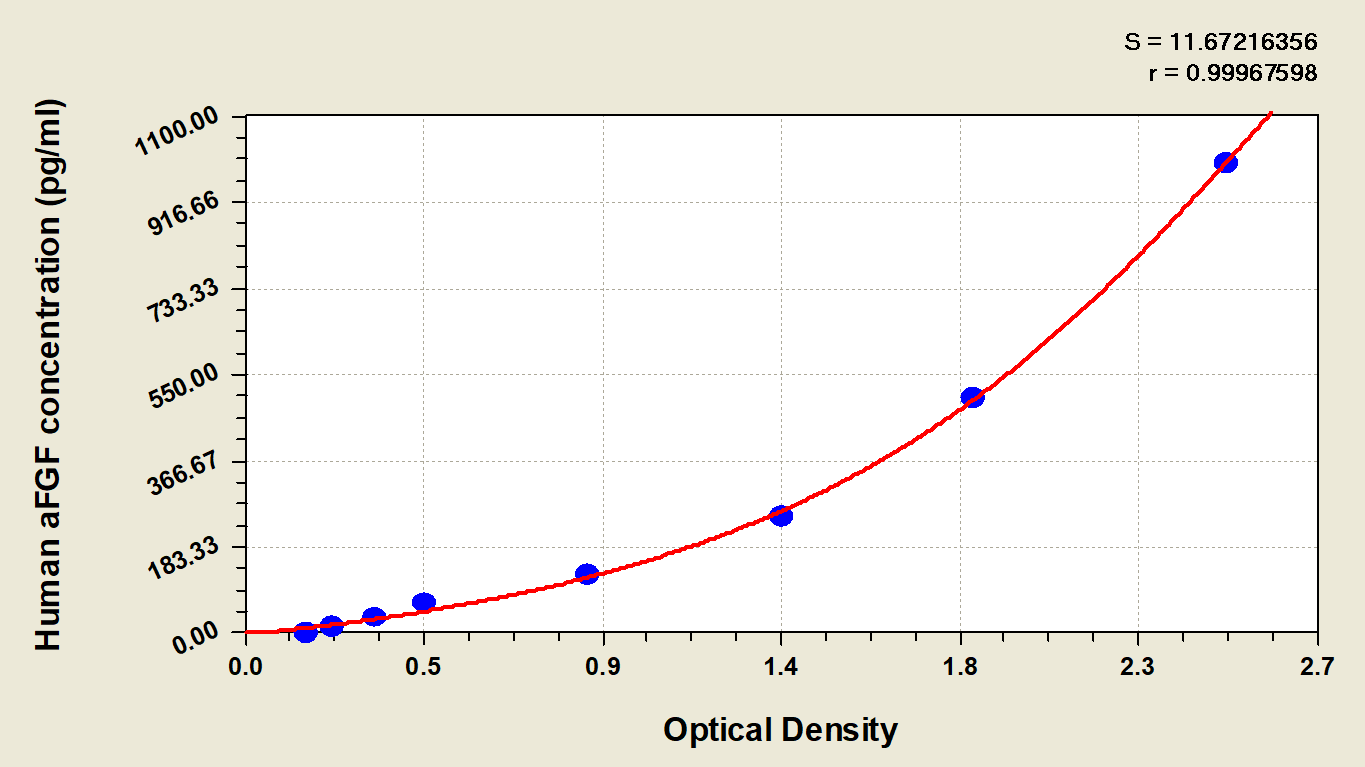
These standard curves are provided for demonstration only. A standard curve should be generated for each set of samples assayed. | |||||||
| |||||||
pg/ml | OD1 | OD2 | Average | Corrected | |||
1000 | 2.471 | 2.498 | 2.485 | 2.319 | |||
500 | 1.827 | 1.868 | 1.848 | 1.682 | |||
250 | 1.369 | 1.366 | 1.368 | 1.202 | |||
125 | 0.898 | 0.861 | 0.880 | 0.714 | |||
62.5 | 0.474 | 0.461 | 0.468 | 0.302 | |||
31.2 | 0.334 | 0.352 | 0.343 | 0.177 | |||
15.6 | 0.234 | 0.236 | 0.235 | 0.069 | |||
0 | 0.164 | 0.168 | 0.166 |
| |||
To assess the linearity of the assay, samples were spiked with high concentrations of human aFGF in various matrices and diluted with the Sample Diluent to produce samples with values within the dynamic range of the assay. | ||||||
| Sample | Serum(n=4) | ||||
1:1 | Average % | 91 | ||||
Range % | 86-95 | |||||
1:2 | Average % | 102 | ||||
Range % | 97-107 | |||||
1:4 | Average % | 91 | ||||
Range % | 85-97 | |||||
1:8 | Average % | 97 | ||||
Range % | 91-103 | |||||
The recovery of human aFGF spiked to levels throughout the range of the assay in various matrices was evaluated. Samples were diluted prior to assay as directed in the Sample Preparation section. | ||||||
Sample Type | Average % Recovery | Range | ||||
Serum (n=5) | 95 | 89-98 | ||||
EDTA plasma (n=4) | 97 | 90-100 | ||||