.jpg "/Content/Upload/Product/Human_ELISA_kits_Diagnocine_1200_1200(182).jpg")
Human Tissue factor pathway inhibitor,TFPI ELISA Kit
The Ultimate 1-Stop ELISA Marketplace:
60,000+ ELISA kits Available to Serve Scientists from All Fields of Life Science
Always Powered by Diagnocine for Precision Research.
Most comprehensive buffers, reagents and detection agents are provided with each kit to optimize data output.
All-inclusive format covers everything from sample preparation to signal detection. Every step can be customized and optimized for your precision research.
DiagnoCine Precision buffers and reagents are Made in USA ISO 13485 Certified
Why waste time searching for your ELISA kit when you can get everything in one place? Diagnocine can provide you with all the ELISA needs you have (customized ELISAs also available) on the planet through a single, streamlined ordering process.
* all types of species
* HRP and AP detection
* Low target signal enhancement
* Inquire about a trial version or a customized version
4 core reagents below are included with every order, plus 1 of the 2 detection-specific reagents (matched automatically to your kit type) — 5 components, every time.
+ the 5th component, matched to your kit's detection method:
If you have any questions or need additional information, please call us at 551-245-1033 or email us at support@diagnocine.com. Our team will be happy to assist you.
Universal Compatibility
All buffers and detection reagents work seamlessly across target proteins, bridging the gap in assay consistency.
1-Stop Convenience
Consolidate your lab's purchasing. Source all ELISA needs and experience optimal buffers and reagents in a single shipment.
Enhanced Precision
Designed by scientists for scientists, all components are engineered to deliver sharper results and an optical signal.
Human Tissue factor pathway inhibitor,TFPI ELISA Kit
Sandwich quantitative immunoassay for tissue factor pathway inhibitor (lipoprotein-associated coagulation inhibitor) in human serum, plasma, tissue homogenates available in multiple catalog sizes:
Note: Please send inquiries regarding Trial 24T orders to support@diagnocine.com.
| Target name | tissue factor pathway inhibitor (lipoprotein-associated coagulation inhibitor) |
| Uniprot No. | P10646 |
| Species | Homo sapiens (Human) |
| Sample types | serum, plasma, tissue homogenates |
| Detection range | 0.782 ng/mL-50 ng/mL |
| Sensitivity | 0.293 ng/mL |
| Assay time | 1-5h |
| Sample loading volume | 50-100μL |
| Detection wavelength | 450 nm |
| Assay principle | Sandwich (Quantitative) |
| Data analysis | Standard curve + Curve Expert software |
| Research area | Cardiovascular |
| Storage condition | 2-8°C (see protocol for full details) |
| Shipping condition | 4 °C |
| Shelf life | 6 months |
10 business days
Processing + 3-5 days shipping
In Stock : USA
Worldwide shipping available
Antibody capture
450 nm detection
Standard curve
Quantification
In this sandwich ELISA, tissue factor pathway inhibitor (lipoprotein-associated coagulation inhibitor) in the sample is captured between a pre-coated capture antibody and a detection antibody. Signal intensity is proportional to analyte concentration. Quantification uses a standard curve fitted with Curve Expert software, covering 0.782 ng/mL-50 ng/mL with a minimum detectable dose of 0.293 ng/mL.
This human TFPI ELISA kit employs the quantitative sandwich enzyme immunoassay technique to measure the levels of human TFPI in serum, plasma, or tissue homogenates. It also uses the enzyme-substrate chromogenic reaction to visualize and analyze the analyte levels through the color intensity. The intensity of the colored product is in direct proportion to the TFPI levels in the sample and is measured at 450 nm through a microplate reader.
TFPI is an anticoagulant protein produced primarily by the endothelium and megakaryocytes. It is the main inhibitor of the TF-dependent pathway of blood coagulation. TFPI mediates its anticoagulant activity by impeding early proteolytic events of the blood coagulation cascade, including those mediated by the TF-FVIIa catalytic complex, FXa, and early forms of the prothrombinase complex (FVa-FXa). TFPI can also enhance the effect of heparins. Studies have shown that TFPI exerts anti-angiogenic and anti-metastatic effects in vitro and in vivo. TFPI plays a significant role in the pathophysiology of many diseases, including cancer and inflammation.
- A significant degradation of TFPI was induced by ROS exposure, resulting in a decreased ability to bind FXa. ROS induce a procoagulant state in endothelial cells by altering TFPI structure, resulting in inhibition of TFPI binding to Factor Xa PMID: 25712553
- TNFalpha and Stx-1 compared to TNFalpha alone leads to an increase in procoagulant TF on endothelial cells, which is explained by a significant decrease in TFPI not co-localized with TF and not to an increase in TF not co-localized with TFPI PMID: 25864889
- rs5940 and rs7586970 moderate TFPI plasma levels and are candidate risk factors for thrombosis, but the regulation of TFPI plasma levels involves genetic factors beyond the TFPI gene. Review. PMID: 25879386
- This study indicates that genetic and phenotypic variation of both TFPIalpha and TFPIbeta, more than TF, are markers of cancer progression. PMID: 25882602
- coagulation system, TFPI play an important role in the pathogenesis of CRSwNP. PMID: 26163243
- Association between genetic polymorphisms and deep vein thrombosis in a Chinese population. PMID: 26233570
- the main finding of the current study is the remarkable elevation in the plasma levels of both total and free TFPI in septic patients at baseline. The levels of both forms of the inhibitor remained elevated throughout the first 24 h with further elevation after enoxaparin administration. PMID: 26377606
- Tissue factor pathway inhibitor-2 gene polymorphisms were associated with coronary atherosclerosis in the Chinese population PMID: 26496276
- HIF-1alpha is involved in the transcriptional regulation of the TFPI gene, and suggests that a hypoxic microenvironment inside a breast tumor may induce a procoagulant state in breast cancer patients. PMID: 26598923
- Tissue factor pathway inhibitor activity and APC resistance are related to coronary heart disease risk in women, but may not explain the increased CHD risk due to estrogen plus progestin therapy. PMID: 26681757
- Circulating FVII, FVIIa and TFPI were significantly elevated in women with severe preeclampsia in the absence of comparable changes in plasma TF levels. PMID: 26765308
- a concentration of tissue factor pathway inhibitor was significantly lower in patients with essential thrombocythemia with JAK2 V617F mutation as compared with patients without the mutation PMID: 26945263
- Tissue Factor Pathway Inhibitor Gene Polymorphism is associated with response to therapy in Colorectal Cancer. PMID: 26968713
- miR-27a/b and miR-494 regulate TFPIalpha expression; there may be a role of these miRNAs in the estrogen-mediated downregulation of TFPIalpha PMID: 26999003
- ERalpha can interact with all three ERE half-sites in the TFPI 5'-flanking region. PMID: 26999742
- This review presents a comprehensive understanding of TFPI structure, biochemistry, and cellular expression which is necessary to understand how it modulates bleeding in hemophilia and the physiological impact of therapeutic agents targeting TFPI. PMID: 27207418
- Cleavage of FV at Arg(1545) , which abolishes the anticoagulant properties of FV and commits FV to the procoagulant pathway, is inhibited by binding of the TFPIalpha C-terminus to the FV acidic region PMID: 27801970
- Developed functional protein S assays that measure both the activated protein C- and TFPI-cofactor activities of protein S in plasma, which are hardly if at all affected by the FV Leiden mutation. PMID: 28211163
- TFPI-1 was a valuable predictor of deep venous thrombosis and tumor metastasis in non-small cell lung cancer patients. PMID: 28246607
- Among high-risk women, the tissue factor pathway inhibitor activity of patients with gestational vascular complications is higher than that in other patients. Hence, these markers could augment a screening strategy. PMID: 28328938
- Among the various candidate genes involved in acute rejection, CD47 inhibits monocyte/macrophage-mediated phagocytosis by identifying the CD47 signal regulatory protein alpha (SIRP-alpha) as self/non-self. Tissue factor pathway inhibitor (TFPI) is involved in the regulation of the coagulation pathway and is able to bind to another ligand of CD47, thrombospondin-1 (TSP-1). PMID: 28393401
- TFPI single nucleotide polymorphism is associated with venous thromboembolism. PMID: 28421636
- These data indicate that both isoforms of TFPI are present in advanced plaques and that anti-inflammatory M2 macrophages may be a potential source of TFPI. PMID: 28482260
- plasma level not different between pre-eclampsia and normal pregnancy PMID: 28521572
- Patients with early onset preeclampsia are characterised by an attenuated coagulation response characterised by reduced thrombin generation stimulated by low-dose TF and elevated plasma TFPI activity. PMID: 28569919
- The results show that cholesterol crystals induce TFPI and cytokine expression in M2-polarized macrophages through activation of the endoplasmic reticulum stress pathway and that TFPI has a protective effect against TNF-alpha and IL-6 mediated inflammation. PMID: 28712870
- Genetic variations of the TFPI genes seem to be related with coronary artery disease, which likely cooperate with metabolic risk factor (diabetes mellitus) and play critical roles in the pathogenesis of coronary artery disease in Han Chinese. PMID: 28716011
- The aim of this study was to evaluate the concentration of TF and its inhibitor TFPI in blood plasma, the impact of traditional and non-traditional cardiovascular risk factors on their concentration and the impact of both markers of haemostasis on the severity of subclinical atherosclerosis. PMID: 28749986
- For the first time, we show that a TFPI variant is significantly associated with fibrinogen levels and risk of coronary artery disease. PMID: 28894953
| Intra-assay Precision (Precision within an assay): CV%<8% | ||||||
| Three samples of known concentration were tested twenty times on one plate to assess. | ||||||
| Inter-assay Precision (Precision between assays): CV%<10% | ||||||
| Three samples of known concentration were tested in twenty assays to assess. | ||||||
| These standard curves are provided for demonstration only. A standard curve should be generated for each set of samples assayed. | |||||||||||||||||||||||||||||||||||||||||||||||||||||||||||||||
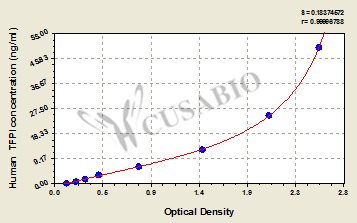
| |||||||||||||||||||||||||||||||||||||||||||||||||||||||||||||||
| To assess the linearity of the assay, samples were spiked with high concentrations of human TFPI in various matrices and diluted with the Sample Diluent to produce samples with values within the dynamic range of the assay. | ||||||
| Sample | Serum(n=4) | |||||
| 1:1 | Average % | 93 | ||||
| Range % | 88-97 | |||||
| 1:2 | Average % | 101 | ||||
| Range % | 97-105 | |||||
| 1:4 | Average % | 94 | ||||
| Range % | 89-98 | |||||
| 1:8 | Average % | 96 | ||||
| Range % | 91-102 | |||||
| The recovery of human TFPI spiked to levels throughout the range of the assay in various matrices was evaluated. Samples were diluted prior to assay as directed in the Sample Preparation section. | ||||||
| Sample Type | Average % Recovery | Range | ||||
| Serum (n=5) | 94 | 89-98 | ||||
| EDTA plasma (n=4) | 86 | 81-92 | ||||