.jpg "/Content/Upload/Product/Human_ELISA_kits_Diagnocine_1200_1200(72).jpg")
Human Osteoprotegerin,OPG ELISA KIT
The Ultimate 1-Stop ELISA Marketplace:
60,000+ ELISA kits Available to Serve Scientists from All Fields of Life Science
Always Powered by Diagnocine for Precision Research.
Most comprehensive buffers, reagents and detection agents are provided with each kit to optimize data output.
All-inclusive format covers everything from sample preparation to signal detection. Every step can be customized and optimized for your precision research.
DiagnoCine Precision buffers and reagents are Made in USA ISO 13485 Certified
Why waste time searching for your ELISA kit when you can get everything in one place? Diagnocine can provide you with all the ELISA needs you have (customized ELISAs also available) on the planet through a single, streamlined ordering process.
* all types of species
* HRP and AP detection
* Low target signal enhancement
* Inquire about a trial version or a customized version
4 core reagents below are included with every order, plus 1 of the 2 detection-specific reagents (matched automatically to your kit type) — 5 components, every time.
+ the 5th component, matched to your kit's detection method:
If you have any questions or need additional information, please call us at 551-245-1033 or email us at support@diagnocine.com. Our team will be happy to assist you.
Universal Compatibility
All buffers and detection reagents work seamlessly across target proteins, bridging the gap in assay consistency.
1-Stop Convenience
Consolidate your lab's purchasing. Source all ELISA needs and experience optimal buffers and reagents in a single shipment.
Enhanced Precision
Designed by scientists for scientists, all components are engineered to deliver sharper results and an optical signal.
Human Osteoprotegerin,OPG ELISA KIT
Sandwich quantitative immunoassay for tumor necrosis factor receptor superfamily, member 11b in human serum, plasma, tissue homogenates available in multiple catalog sizes:
Note: Please send inquiries regarding Trial 24T orders to support@diagnocine.com.
| Target name | tumor necrosis factor receptor superfamily, member 11b |
| Uniprot No. | O00300 |
| Species | Homo sapiens (Human) |
| Sample types | serum, plasma, tissue homogenates |
| Detection range | 7.8 pg/mL-500 pg/mL |
| Sensitivity | 1.95 pg/mL |
| Assay time | 1-5h |
| Sample loading volume | 50-100μL |
| Detection wavelength | 450 nm |
| Assay principle | Sandwich (Quantitative) |
| Data analysis | Standard curve + Curve Expert software |
| Research area | Cell Biology |
| Storage condition | 2-8°C (see protocol for full details) |
| Shipping condition | 4 °C |
| Shelf life | 6 months |
10 business days
Processing + 3-5 days shipping
In Stock : USA
Worldwide shipping available
Antibody capture
450 nm detection
Standard curve
Quantification
In this sandwich ELISA, tumor necrosis factor receptor superfamily, member 11b in the sample is captured between a pre-coated capture antibody and a detection antibody. Signal intensity is proportional to analyte concentration. Quantification uses a standard curve fitted with Curve Expert software, covering 7.8 pg/mL-500 pg/mL with a minimum detectable dose of 1.95 pg/mL.
Tumor necrosis factor receptor superfamily member 11b (TNFRSF11B), commonly known as osteoprotegerin (OPG), is a regulatory protein in bone metabolism and immune system function. As a decoy receptor for RANKL (receptor activator of nuclear factor kappa-B ligand), OPG blocks osteoclast differentiation and activation, preventing excessive bone resorption. This glycoprotein maintains bone homeostasis and has been linked to various pathological conditions including osteoporosis, rheumatoid arthritis, and certain malignancies. Research into OPG levels offers insights into bone turnover dynamics and inflammatory processes. The Human Osteoprotegerin ELISA Kit (CSB-E04692h) uses a quantitative sandwich measurement principle for detecting TNFRSF11B in human samples. This assay works with serum, plasma, and tissue homogenates with a detection range of 7.8 pg/mL to 500 pg/mL and shows sensitivity down to 1.95 pg/mL. The protocol needs 50-100 μL sample volume and can be completed within 1-5 hours. Detection occurs at 450 nm wavelength. Application Examples Note: The following application examples are drawn from a selection of publications citing this product. For additional applications, please refer to the full list of references in the "Citations" section. This ELISA kit has been used in research studying bone metabolism and inflammatory processes, particularly in studies examining the relationship between respiratory disease and bone health. The kit allows quantification of osteoprotegerin in serum samples from clinical populations and cell culture supernatants from in vitro experiments. • Respiratory disease research: Applied in studies comparing patients with chronic obstructive pulmonary disease to healthy controls, examining bone mineral density relationships and inflammatory marker profiles • Bone metabolism studies: Used to measure osteoprotegerin levels in osteoblast cell culture supernatants following treatment with bone-targeting compounds and growth factors • Clinical biomarker analysis: Applied for serum osteoprotegerin quantification in patient populations with varying bone mineral density status compared to healthy volunteers • Cell culture applications: Used in controlled in vitro experiments to assess osteoprotegerin production by cultured osteoblasts under different experimental conditions
- We conclude that non-small cell lung cancer patients have a higher content of OPG in bronchoalveolar lavage fluid than healthy people. PMID: 29052177
- Patients with metabolic syndrome have increased osteoprotegerin serum levels than healthy individuals; osteoprotegerin plays an important role in the development of arteriosclerosis, and the effect of osteoprotegerin on intima media thickness strongly depends on the extent of arteriosclerotic changes in metabolic syndrome PMID: 29077157
- OPG mRNA expression was higher in tumour tissue from patients with metastatic prostate cancer compared to local disease. The RANKL/OPG ratio was low in normal prostate tissue and high in tumours with bone metastases. Expression was high in BPH tissue but did not exceed as much as in the tumour tissue. PMID: 29204705
- results of this study concluded that the RANK, RANK-L and OPG system participates in bone remodeling after RME PMID: 29297549
- The study revealed an enhanced sensitivity of aortic valve interstitial cells to osteogenic inductors in aortic stenosis patients, which indicates probable implication of OPN, OPG, and BMP2 genes in pathogenesis of aortic valve calcification. PMID: 29308559
- Serum osteoprotegerin level is significantly associated with both the presence and severity of peripheral arterial disease in patients with type 2 diabetes. PMID: 29313442
- In cardiovascular risks, OPG serum level might increase as a preventive compensatory mechanism to neutralize the RANKL level increment. The determination of the OPG-RANKL system is a diagnostic indicator for the intensity of vascular calcification and atherosclerosis in SSc patients. PMID: 29336616
- Demonstrate that rs3134069 in TNFRSF11B increases risk of ischemic stroke by decreasing TNFRSF11B expression. PMID: 29501268
- Vascular smooth cells are a significant source of osteoprotegerin within the vasculature but that RANKL, once present, downregulates this production and appears capable of preventing the "protective" upregulation of OPG seen with VSMCs exposed to physiological levels of cyclic strain. PMID: 29635231
- The results indicated that mice treated with low levels of human recombinant OPG may have a more stable aneurysmal phenotype due to compensatory production of collagen and increased vessel wall thickness of the aorta, potentially protecting the aneurysm from rupture. PMID: 29749489
- positive correlation of OPG with age and an inverse correlation with IGF-I favor the compensatory response of OPG against bone loss in the aging skeleton PMID: 29895074
- The concentration of circulating osteoprotegerin can be a biomarker for both medial artery calcification and atherosclerosis in patients with chronic kidney disease (CKD); OPG might be an early indicator of all-cause mortality in CKD patients with advanced medial arterial calcification PMID: 29974642
Intra-assay Precision (Precision within an assay): CV%<8% | ||||||||||||||||||||||||||||||||||||||||||||||||||||||
Three samples of known concentration were tested twenty times on one plate to assess. | ||||||||||||||||||||||||||||||||||||||||||||||||||||||
Inter-assay Precision (Precision between assays): CV%<10% | ||||||||||||||||||||||||||||||||||||||||||||||||||||||
Three samples of known concentration were tested in twenty assays to assess. | ||||||||||||||||||||||||||||||||||||||||||||||||||||||
| ||||||||||||||||||||||||||||||||||||||||||||||||||||||
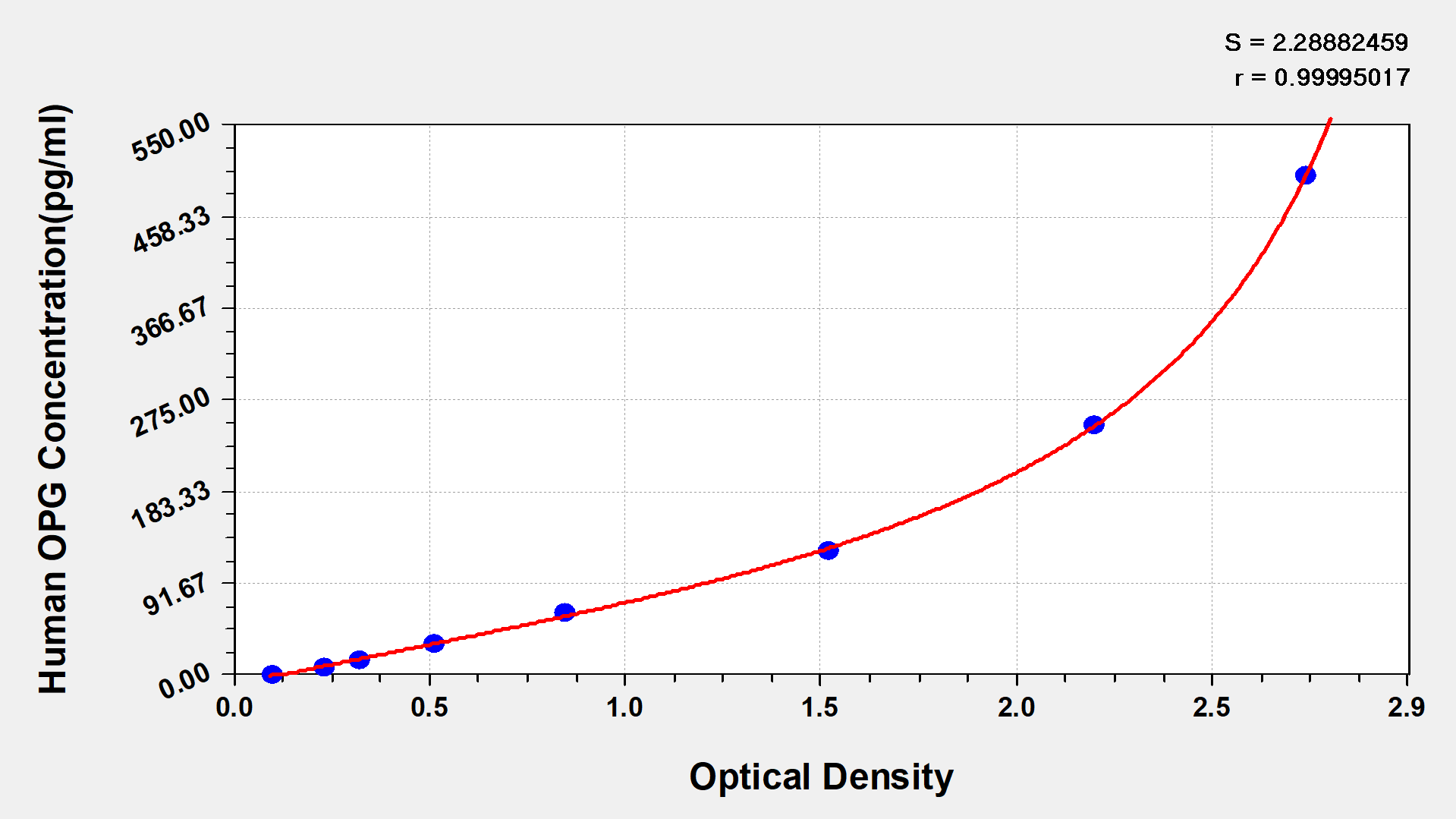
These standard curves are provided for demonstration only. A standard curve should be generated for each set of samples assayed. | |||||||||||||
| |||||||||||||
pg/ml | OD1 | OD2 | Average | Corrected | |||||||||
500 | 2.725 | 2.656 | 2.691 | 2.584 | |||||||||
250 | 2.215 | 2.108 | 2.162 | 2.055 | |||||||||
125 | 1.513 | 1.482 | 1.498 | 1.391 | |||||||||
62.5 | 0.845 | 0.834 | 0.840 | 0.733 | |||||||||
31.2 | 0.516 | 0.512 | 0.514 | 0.407 | |||||||||
15.6 | 0.324 | 0.321 | 0.323 | 0.216 | |||||||||
7.8 | 0.242 | 0.228 | 0.235 | 0.128 | |||||||||
0 | 0.111 | 0.103 | 0.107 |
| |||||||||
To assess the linearity of the assay, samples were spiked with high concentrations of human OPG in various matrices and diluted with the Sample Diluent to produce samples with values within the dynamic range of the assay. | ||||||||||||
| Sample | Serum(n=4) | ||||||||||
1:1 | Average % | 97 | ||||||||||
Range % | 91-105 | |||||||||||
1:2 | Average % | 86 | ||||||||||
Range % | 80-92 | |||||||||||
1:4 | Average % | 102 | ||||||||||
Range % | 97-108 | |||||||||||
1:8 | Average % | 94 | ||||||||||
Range % | 86-98 | |||||||||||
The recovery of human OPG spiked to levels throughout the range of the assay in various matrices was evaluated. Samples were diluted prior to assay as directed in the Sample Preparation section. | ||||||||||||
Sample Type | Average % Recovery | Range | ||||||||||
Serum (n=5) | 94 | 88-99 | ||||||||||
EDTA plasma (n=4) | 95 | 87-100 | ||||||||||