

.jpg "/Content/Upload/Product/Human_ELISA_kits_Diagnocine_1200_1200(61).jpg")
Human Macrophage-Derived Chemokine (MDC/CCL22) ELISA kit
The Ultimate 1-Stop ELISA Marketplace:
60,000+ ELISA kits Available to Serve Scientists from All Fields of Life Science
Always Powered by Diagnocine for Precision Research.
Most comprehensive buffers, reagents and detection agents are provided with each kit to optimize data output.
All-inclusive format covers everything from sample preparation to signal detection. Every step can be customized and optimized for your precision research.
DiagnoCine Precision buffers and reagents are Made in USA ISO 13485 Certified
Why waste time searching for your ELISA kit when you can get everything in one place? Diagnocine can provide you with all the ELISA needs you have (customized ELISAs also available) on the planet through a single, streamlined ordering process.
* all types of species
* HRP and AP detection
* Low target signal enhancement
* Inquire about a trial version or a customized version
4 core reagents below are included with every order, plus 1 of the 2 detection-specific reagents (matched automatically to your kit type) — 5 components, every time.
+ the 5th component, matched to your kit's detection method:
If you have any questions or need additional information, please call us at 551-245-1033 or email us at support@diagnocine.com. Our team will be happy to assist you.
Universal Compatibility
All buffers and detection reagents work seamlessly across target proteins, bridging the gap in assay consistency.
1-Stop Convenience
Consolidate your lab's purchasing. Source all ELISA needs and experience optimal buffers and reagents in a single shipment.
Enhanced Precision
Designed by scientists for scientists, all components are engineered to deliver sharper results and an optical signal.
Human Macrophage-Derived Chemokine (MDC/CCL22) ELISA kit
Sandwich quantitative immunoassay for chemokine (C-C motif) ligand 22 in human serum, plasma, cell culture supernates, tissue homogenates available in multiple catalog sizes:
Note: Please send inquiries regarding Trial 24T orders to support@diagnocine.com.
| Target name | chemokine (C-C motif) ligand 22 |
| Uniprot No. | O00626 |
| Species | Homo sapiens (Human) |
| Sample types | serum, plasma, cell culture supernates, tissue homogenates |
| Detection range | 15.625 pg/mL-1000 pg/mL |
| Sensitivity | 10.324 pg/mL |
| Assay time | 1-5h |
| Sample loading volume | 50-100μL |
| Detection wavelength | 450 nm |
| Assay principle | Sandwich (Quantitative) |
| Data analysis | Standard curve + Curve Expert software |
| Research area | Immunology |
| Storage condition | 2-8°C (see protocol for full details) |
| Shipping condition | 4 °C |
| Shelf life | 6 months |
10 business days
Processing + 3-5 days shipping
In Stock : USA
Worldwide shipping available
Antibody capture
450 nm detection
Standard curve
Quantification
In this sandwich ELISA, chemokine (C-C motif) ligand 22 in the sample is captured between a pre-coated capture antibody and a detection antibody. Signal intensity is proportional to analyte concentration. Quantification uses a standard curve fitted with Curve Expert software, covering 15.625 pg/mL-1000 pg/mL with a minimum detectable dose of 10.324 pg/mL.
This Human CCL22 ELISA Kit was designed for the quantitative measurement of Human CCL22 protein in serum, plasma, cell culture supernates, tissue homogenates. It is a Sandwich ELISA kit, its detection range is 15.625 pg/mL-1000 pg/mL and the sensitivity is 10.324 pg/mL .
- findings suggest that HBV infection and activity of the TGF-beta-miR-34a-CCL22 axis serve as potent etiological factors to predispose hepatocellular carcinoma patients for the development of portal vein tumor thrombus PMID: 22975373
- High cord blood levels of the Th2 related chemokine CCL22 were significantly associated with high total- IgE levels during the first 6 years of life, but not with specific sensitization, asthma, eczema or allergic rhinitis. PMID: 23106659
- lymph node metastasis of CCR4(+) HNSCC is promoted by CCL22 in an autocrine or M2-like macrophage-dependent paracrine manner. PMID: 23180648
- Data suggest that decreased levels of plasmatic CCL22 may contribute to CD4(+) lymphopaenia. PMID: 23265706
- genetic polymorphism is not associated with breast carcinoma in Southern Iranian population PMID: 23268288
- Autistic children had significantly higher serum levels of MDC than healthy controls PMID: 23782855
- both CCL22 and TGF-beta1 are candidate chemoattractants for intratumoral Foxp3 (+)Tregs infiltration; however, unlike the later, CCL22 is an independent prognostic predictor of BC patients. PMID: 24124553
- Suggest that lower CCL22 levels may play an important role in the pathogenesis of multiple sclerosis in women. PMID: 24254331
- Sesamin suppressed lipopolysaccharide induced CCL22 expression in monocytes through the ER/PPAR-a, the MAPK-p38 pathway, the NFkB-p65 pathway and the epigenetic regulation by suppressing histone H3/H4 acetylation in the CCL22 promoter region. PMID: 25117529
- CCL22 is a novel mediator of lung inflammation following hemorrhage and resuscitation PMID: 25136780
- CCR4 C1014T and CCL22 C16A genetic variations were neither associated with the risk, nor with the progression of colorectal cancer in Iranian population PMID: 25148803
- CCL22 could be an immune marker in ANCA-associated vasculitis. PMID: 25352172
- Circulating CCL22 levels are related to both glioma risk and survival duration independent of age, histology, grade and IDH mutation status. CCL22 should be considered a marker of immune status with potential prognostic value PMID: 25604093
- Elevated levels of CCL22 found in the ascites could create a chemokine gradient aiding in Treg cells migration. Increased Tregs percentage in the local microenvironment of ovarian cancer might be an important mechanism of immunosuppression. PMID: 25647263
- The serum CCL22 levels were affected by genetic variations at SNP rs223818. Accordingly, SNP rs223818 may play a role in the susceptibility to breast cancer. PMID: 25722218
- Our results demonstrate that CCL22 is expressed in human placenta. Decidual expression was only observed in miscarriage conditions and correlates with Treg infiltration. PMID: 25922986
- First-episode psychosis patients had higher serum CCL22, which decreased substantially following antipsychotic treatment. PMID: 25970596
- Distinctive Treg associated CCR4-CCL22 expression profile with altered frequency of Th17/Treg cell in the immunopathogenesis of Pemphigus Vulgaris. PMID: 26093920
- type I IFN blocks the regulatory T cell-attracting chemokine CCL22 and thus helps limit the recruitment of regulatory T cells to tumors PMID: 26432403
- CCL22 and IL-37 with a co-localization in non-small cell lung cancer A549 cells inhibited the proliferation and epithelial-mesenchymal transition process PMID: 27499437
- The CCL22-mediated enhancement of antitumor responses is however not due to conversion, but rather to redirection of existing regulatory T cells to the site of cutaneous overexpression. PMID: 27634754
- Elevations in serum MDC and BLC were independently associated with the significant risk of early stage lung adenocarcinoma, even in non-smokers and in stage IA patients. PMID: 27811371
- blood CCL22 levels were positively associated with IgE sensitization at age 2. A high cord blood CCL22/CXCL10 chemokine ratio was significantly associated with a higher risk of allergic sensitization at age 3. PMID: 27863395
- Tumor-associated macrophages promote prostate cancer migration through activation of the CCL22-CCR4 signaling axis. PMID: 28039457
- CCL22 plays an important role in supporting gastric cancer development presumably by increasing the percentage of regulatory T cells in the tumor microenvironments. CCL22 levels in sera have a predictive value for gastric cancer peritoneal metastasis and the early recurrence. PMID: 28501127
- MDC might serve as a marker of pharmacological therapy response in major depressive disorder PMID: 28898872
| Intra-assay Precision (Precision within an assay): CV%<8% | ||||||
| Three samples of known concentration were tested twenty times on one plate to assess. | ||||||
| Inter-assay Precision (Precision between assays): CV%<10% | ||||||
| Three samples of known concentration were tested in twenty assays to assess. | ||||||
| These standard curves are provided for demonstration only. A standard curve should be generated for each set of samples assayed. | |||||||||||||||||||||||||||||||||||||||||||||||||||||||||||||||
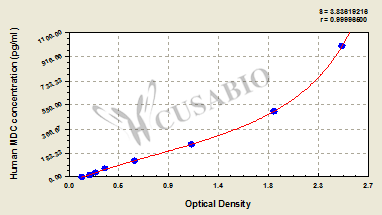
| |||||||||||||||||||||||||||||||||||||||||||||||||||||||||||||||
| To assess the linearity of the assay, samples were spiked with high concentrations of human MDC in various matrices and diluted with the Sample Diluent to produce samples with values within the dynamic range of the assay. | ||||||
| Sample | Serum(n=4) | |||||
| 1:1 | Average % | 86 | ||||
| Range % | 82-95 | |||||
| 1:2 | Average % | 92 | ||||
| Range % | 85-101 | |||||
| 1:4 | Average % | 100 | ||||
| Range % | 94-112 | |||||
| 1:8 | Average % | 93 | ||||
| Range % | 85-98 | |||||
| The recovery of human MDC spiked to levels throughout the range of the assay in various matrices was evaluated. Samples were diluted prior to assay as directed in the Sample Preparation section. | ||||||
| Sample Type | Average % Recovery | Range | ||||
| Serum (n=5) | 85 | 80-93 | ||||
| EDTA plasma (n=4) | 89 | 85-98 | ||||