.jpg "/Content/Upload/Product/Human_ELISA_kits_Diagnocine_1200_1200(64).jpg")
Human Macrophage Inflammatory Protein-3α,MIP-3α ELISA kit
The Ultimate 1-Stop ELISA Marketplace:
60,000+ ELISA kits Available to Serve Scientists from All Fields of Life Science
Always Powered by Diagnocine for Precision Research.
Most comprehensive buffers, reagents and detection agents are provided with each kit to optimize data output.
All-inclusive format covers everything from sample preparation to signal detection. Every step can be customized and optimized for your precision research.
DiagnoCine Precision buffers and reagents are Made in USA ISO 13485 Certified
Why waste time searching for your ELISA kit when you can get everything in one place? Diagnocine can provide you with all the ELISA needs you have (customized ELISAs also available) on the planet through a single, streamlined ordering process.
* all types of species
* HRP and AP detection
* Low target signal enhancement
* Inquire about a trial version or a customized version
4 core reagents below are included with every order, plus 1 of the 2 detection-specific reagents (matched automatically to your kit type) — 5 components, every time.
+ the 5th component, matched to your kit's detection method:
If you have any questions or need additional information, please call us at 551-245-1033 or email us at support@diagnocine.com. Our team will be happy to assist you.
Universal Compatibility
All buffers and detection reagents work seamlessly across target proteins, bridging the gap in assay consistency.
1-Stop Convenience
Consolidate your lab's purchasing. Source all ELISA needs and experience optimal buffers and reagents in a single shipment.
Enhanced Precision
Designed by scientists for scientists, all components are engineered to deliver sharper results and an optical signal.
Human Macrophage Inflammatory Protein-3α,MIP-3α ELISA kit
Sandwich quantitative immunoassay for chemokine (C-C motif) ligand 20 in human serum, plasma, cell culture supernates available in multiple catalog sizes:
Note: Please send inquiries regarding Trial 24T orders to support@diagnocine.com.
| Target name | chemokine (C-C motif) ligand 20 |
| Uniprot No. | P78556 |
| Species | Homo sapiens (Human) |
| Sample types | serum, plasma, cell culture supernates |
| Detection range | 15.6 pg/mL-1000 pg/mL |
| Sensitivity | 3.9 pg/mL |
| Assay time | 1-5h |
| Sample loading volume | 50-100μL |
| Detection wavelength | 450 nm |
| Assay principle | Sandwich (Quantitative) |
| Data analysis | Standard curve + Curve Expert software |
| Research area | Immunology |
| Storage condition | 2-8°C (see protocol for full details) |
| Shipping condition | 4 °C |
| Shelf life | 6 months |
10 business days
Processing + 3-5 days shipping
In Stock : USA
Worldwide shipping available
Antibody capture
450 nm detection
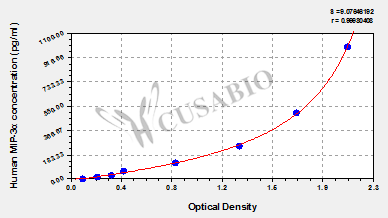
Standard curve
Quantification
In this sandwich ELISA, chemokine (C-C motif) ligand 20 in the sample is captured between a pre-coated capture antibody and a detection antibody. Signal intensity is proportional to analyte concentration. Quantification uses a standard curve fitted with Curve Expert software, covering 15.6 pg/mL-1000 pg/mL with a minimum detectable dose of 3.9 pg/mL.
The human macrophage inflammatory protein-3α (MIP-3α) ELISA Kit is used to quantitatively measure human MIP-3α concentrations in serum, plasma, or cell culture supernates. It performs well in important characteristics, including sensitivity and specificity. This assay is based on the sandwich ELISA mechanism and enzyme-substrate chromogenic reaction. The solution color develops proportionally to the amount of MIP-3α in the sample. And the intensity of the color can be measured at 450 nm via a microplate reader.
MIP-3α, also called CCL20, is primarily expressed in the liver, colon, prostate, cervix, and skin. CCL20 only binds to CCR6 and is involved in numerous diseases, including rheumatoid arthritis and human immunodeficiency virus infection. CCL20-CCR6 axis also plays a key role in tumor progression. In addition, CCL20 can also directly mediate the migration and/or invasion process of various cancer cells, including lung adenocarcinoma, cholangiocarcinoma, colon cancer, and HCC. CCL20 can also attract tumor-promoting immune-suppressive cells to the tumor microenvironment (TME), which may contribute to the immune-evasive potential of the tumor and tumor progression.
- There was underexpression of the majority of genes after sunitinib treatment. The lower expression levels of IGFBP1, CCL20, CXCL6 and FGB were confirmed by qRT-PCR in all cases. The downregulation of gene expression leads us to search for methylation as a mechanism of action of the tyrosine kinase inhibitors PMID: 27834463
- This study evaluated the role of CCL20 and CCR6 in the regulation of laryngeal neoplasms; it showed that these proteins acted on proliferation and metastasis via the p38 pathway and multiple microRNAs. PMID: 27916417
- CCL20-recruited immune cells further increase TRAIL resistance of CCL20-producing pancreatic ductal adenocarcinoma cells. PMID: 28188806
- primary cultures of human bronchial epithelial cells and the BEAS-2B cell line were used to examine the effects of bacterial-viral coexposure, as well as each stimulus alone, on epithelial expression of CXCL8 and, in particular, CCL20. PMID: 28283475
- Results demonstrated that F. nucleatum ssp. animalis and dysregulated CCL20 protein expression are important factors associated with human colorectal cancer progression. PMID: 28483840
- A gut-specific endogenously produced mediator with the capacity to modulate the IL-17/Th17 signaling response. PMID: 28526351
- HMC stimulated by IgA1 could produce CCL20 and consequently recruit inflammatory Th17 cells to the kidneys to induce further lesion in IgA nephropathy PMID: 28552941
- CCN1 stimulates CCL20 production in vitro and in vivo, and thus supports the notion that overexpressed CCN1 in hyperproliferating keratinocyte is functionally involved in the recruitment of inflammatory cells to skin lesions affected by psoriasis. PMID: 28602508
- CCL20 provoked a 2.5-fold increase of cell migration and invasion in human cancerous breast epithelial cells ; CCL20 also enhanced MMP- 2 and MMP-9 mRNAs/protein expression and activities. PMID: 28618084
| Intra-assay Precision (Precision within an assay): CV%<8% | ||||||
| Three samples of known concentration were tested twenty times on one plate to assess. | ||||||
| Inter-assay Precision (Precision between assays): CV%<10% | ||||||
| Three samples of known concentration were tested in twenty assays to assess. | ||||||
| These standard curves are provided for demonstration only. A standard curve should be generated for each set of samples assayed. | |||||||||||||||||||||||||||||||||||||||||||||||||||||||||||||||
| |||||||||||||||||||||||||||||||||||||||||||||||||||||||||||||||
| To assess the linearity of the assay, samples were spiked with high concentrations of human MIP-3α in various matrices and diluted with the Sample Diluent to produce samples with values within the dynamic range of the assay. | ||||||
| Sample | Serum(n=4) | |||||
| 1:1 | Average % | 90 | ||||
| Range % | 85-96 | |||||
| 1:2 | Average % | 94 | ||||
| Range % | 87-101 | |||||
| 1:4 | Average % | 99 | ||||
| Range % | 96-104 | |||||
| 1:8 | Average % | 95 | ||||
| Range % | 92-99 | |||||
| The recovery of human MIP-3α spiked to levels throughout the range of the assay in various matrices was evaluated. Samples were diluted prior to assay as directed in the Sample Preparation section. | ||||||
| Sample Type | Average % Recovery | Range | ||||
| Serum (n=5) | 92 | 85-99 | ||||
| EDTA plasma (n=4) | 96 | 92-101 | ||||