

.jpg "/Content/Upload/Product/Human_ELISA_kits_Diagnocine_1200_1200(62).jpg")
Human Macrophage Inflammatory Protein-1α,MIP-1α ELISA kit
The Ultimate 1-Stop ELISA Marketplace:
60,000+ ELISA kits Available to Serve Scientists from All Fields of Life Science
Always Powered by Diagnocine for Precision Research.
Most comprehensive buffers, reagents and detection agents are provided with each kit to optimize data output.
All-inclusive format covers everything from sample preparation to signal detection. Every step can be customized and optimized for your precision research.
DiagnoCine Precision buffers and reagents are Made in USA ISO 13485 Certified
Why waste time searching for your ELISA kit when you can get everything in one place? Diagnocine can provide you with all the ELISA needs you have (customized ELISAs also available) on the planet through a single, streamlined ordering process.
* all types of species
* HRP and AP detection
* Low target signal enhancement
* Inquire about a trial version or a customized version
4 core reagents below are included with every order, plus 1 of the 2 detection-specific reagents (matched automatically to your kit type) — 5 components, every time.
+ the 5th component, matched to your kit's detection method:
If you have any questions or need additional information, please call us at 551-245-1033 or email us at support@diagnocine.com. Our team will be happy to assist you.
Universal Compatibility
All buffers and detection reagents work seamlessly across target proteins, bridging the gap in assay consistency.
1-Stop Convenience
Consolidate your lab's purchasing. Source all ELISA needs and experience optimal buffers and reagents in a single shipment.
Enhanced Precision
Designed by scientists for scientists, all components are engineered to deliver sharper results and an optical signal.
Human Macrophage Inflammatory Protein-1α,MIP-1α ELISA kit
Sandwich quantitative immunoassay for Human Macrophage Inflammatory Protein-1α,MIP-1α ELISA kit in human serum, plasma, tissue homogenates available in multiple catalog sizes:
Note: Please send inquiries regarding Trial 24T orders to support@diagnocine.com.
| Uniprot No. | P10147 |
| Species | Homo sapiens (Human) |
| Sample types | serum, plasma, tissue homogenates |
| Detection range | 39 pg/ml - 2500 pg/ml |
| Sensitivity | 9.75 pg/ml |
| Assay time | 1-5h |
| Sample loading volume | 50-100μL |
| Detection wavelength | 450 nm |
| Assay principle | Sandwich (Quantitative) |
| Data analysis | Standard curve + Curve Expert software |
| Research area | Immunology |
| Storage condition | 2-8°C (see protocol for full details) |
| Shipping condition | 4 °C |
| Shelf life | 6 months |
10 business days
Processing + 3-5 days shipping
In Stock : USA
Worldwide shipping available
Antibody capture
450 nm detection
Standard curve
Quantification
In this sandwich ELISA, Human Macrophage Inflammatory Protein-1α,MIP-1α ELISA kit in the sample is captured between a pre-coated capture antibody and a detection antibody. Signal intensity is proportional to analyte concentration. Quantification uses a standard curve fitted with Curve Expert software, covering 39 pg/ml - 2500 pg/ml with a minimum detectable dose of 9.75 pg/ml.
The product CSB-E04662h is a sandwich ELISA kit developed to measure concentrations of human macrophage inflammatory protein-1α (MIP-1α) in serum, plasma, or tissue homogenates. This assay uses the sandwich enzyme immunoassay technique in combination with the enzyme-substrate chromogenic reaction to quantify the analyte in the sample. The color develops positively to the amount of MIP-1α in samples. The color intensity is measured at 450 nm via a microplate reader.
MIP-1α, also called CCL3, is a pro-inflammatory chemokine expressed constitutively in the bone marrow, including by osteoblasts. It is induced during inflammation. CCL3 is a chemotactic cytokine crucial for inflammatory cell recruitment in homeostatic and pathological conditions. In addition to its proinflammatory activities, CCL3 negatively regulates the proliferation of hematopoietic stem/progenitor cells (HSPCs) in the bone marrow (BM). CCL3 and its receptor CCR1 are reported to mediate the bone remodeling that occurs during orthodontic tooth movement, and may also regulate osteoclastogenesis in osteomyelitis. CCL3 might stimulate cancer progression by promoting leukocyte accumulation, angiogenesis, and tumor growth.
- Serum/urinary MIP-1a responds to infection but cannot be used as reliable biomarker in childhood urinary tract infections. PMID: 25618120
- A significantly higher percentage of healthy asymptomatic persons possibly exposed to asbestos had detectable levels of serum CCL3 compared to healthy unexposed control subjects. PMID: 25940505
- AEG-1 mediates CCL3/CCR5-induced EMT development via both Erk1/2 and Akt signaling pathway in CM patients, which indicates CCL3/CCR5-AEG-1-EMT pathway could be suggested as a useful target to affect the progression of CM. PMID: 26134542
- we demonstrate an association of CCL3 expression by CLL cells with increased numbers of CD3+ T cells and CD57+ cells in the lymph node microenvironment, which may promote CLL cell survival and proliferation. PMID: 26458057
- The residues on the N-loop and beta-sheets of MIP-1a are close to both CCR1 and CCR5, and those in the C-terminal helix region are close to CCR5. PMID: 26472202
- An increased MIP-1alpha level in nasopharyngeal aspirates from patients with acute respiratory symptoms during the first wheezing episode caused by viral infections might predict recurrent wheezing. PMID: 26494023
- Pleural and serum MIP1a were lower in patients with lung cancer compared to lung metastasis, pneumonia, tuberculosis, and transudate pleural effusion. PMID: 26620310
- CCL3 promotes VEGF-A expression and angiogenesis in human osteosarcoma cells by down-regulating miR-374b expression via JNK, ERK, and p38 signaling pathways. PMID: 26713602
- Tregs from subjects with established type 1 diabetes were impaired in their ability to produce CCL3 and CCL4. PMID: 26854929
- The serum levels of IL-8, MIP-1 alpha, MIP-1 beta, MMP-8, Resistin, FLRG, and BCAM were significantly higher in breast cancer patients, but LAP and TSH-beta levels were lower. PMID: 26898119
- serum levels of MIP-1alpha could predict survival outcomes in patients with ENKTL. PMID: 26928433
- analysis of sudden infant death syndrome brains shows downregulation of MyD88 in tissue from SIDS brains, as well as the downregulation of the genes encoding CCL3 and UNC13 in the liver PMID: 26959483
- The N termini of CC chemokines are shown to be involved in receptor binding and oligomerization. We also report an alternative CCL3 oligomer structure that reveals how conformational changes in CCL3 N termini profoundly alter its surface properties and dimer-dimer interactions to affect GAG binding and oligomerization. Such complexity in oligomerization and GAG binding enables intricate, physiologically relevant regulatio PMID: 27091995
- elevated CCL3 in the leukemic environment suppresses erythropoiesis via CCR1-p38 activation PMID: 27109512
- The CCL3 and CCL4 chemokines might not be involved in differential susceptibility to the digestive and cardiac clinical forms of chronic Chagas disease, and it seems they do not influence the development of LVSD. PMID: 28002786
- the DR3/TL1A pathway directly enhances human OC formation and resorptive activity, controlling expression and activation of CCL3 and MMP-9. PMID: 28062298
- Telomere length and mRNA expressions of IL6 and MIP1alpha were significantly longer or higher in bone marrow mesenchymal stem cells of multiple myeloma than those of controls. PMID: 28677723
- As depression became more severe the serum levels of MIP-1alpha increased. PMID: 29339257
- During early remission from methamphetamine (MA), model mice exhibited increased anxiety-like behavior and reduced expression of chemokine (C-C motif) ligand 3 (ccl3) in the hippocampus relative to saline-treated mice. Human adults actively dependent on MA and those in early remission had elevated symptoms of anxiety as well as reductions in plasma levels of CCL3, relative to adults with no history of MA abuse. PMID: 29402784
- results suggested that genetic variants at the CCL3 and CCL4 loci may be marker SNPs for risk of HCV treatment outcome. PMID: 29705123
- Tumor levels of CCL2 (mean +/- standard deviation = 530.1 +/- 613.9 pg/mg), CCL3 (102.7 +/- 106.0 pg/mg), and CCL4 (64.98 +/- 48.09 pg/mg) were higher than those found in healthy tissue PMID: 30419802
Intra-assay Precision (Precision within an assay): CV%<8% | ||||||
Three samples of known concentration were tested twenty times on one plate to assess. | ||||||
Inter-assay Precision (Precision between assays): CV%<10% | ||||||
Three samples of known concentration were tested in twenty assays to assess. | ||||||
These standard curves are provided for demonstration only. A standard curve should be generated for each set of samples assayed. | |||||||
| |||||||
pg/ml | OD1 | OD2 | Average | Corrected | |||
2500 | 2.483 | 2.468 | 2.476 | 2.372 | |||
1250 | 1.999 | 1.923 | 1.961 | 1.857 | |||
625 | 1.256 | 1.286 | 1.271 | 1.167 | |||
312.5 | 0.639 | 0.691 | 0.665 | 0.561 | |||
156.25 | 0.424 | 0.439 | 0.432 | 0.328 | |||
78 | 0.292 | 0.279 | 0.286 | 0.182 | |||
39 | 0.196 | 0.187 | 0.192 | 0.088 | |||
0 | 0.105 | 0.103 | 0.104 |
| |||
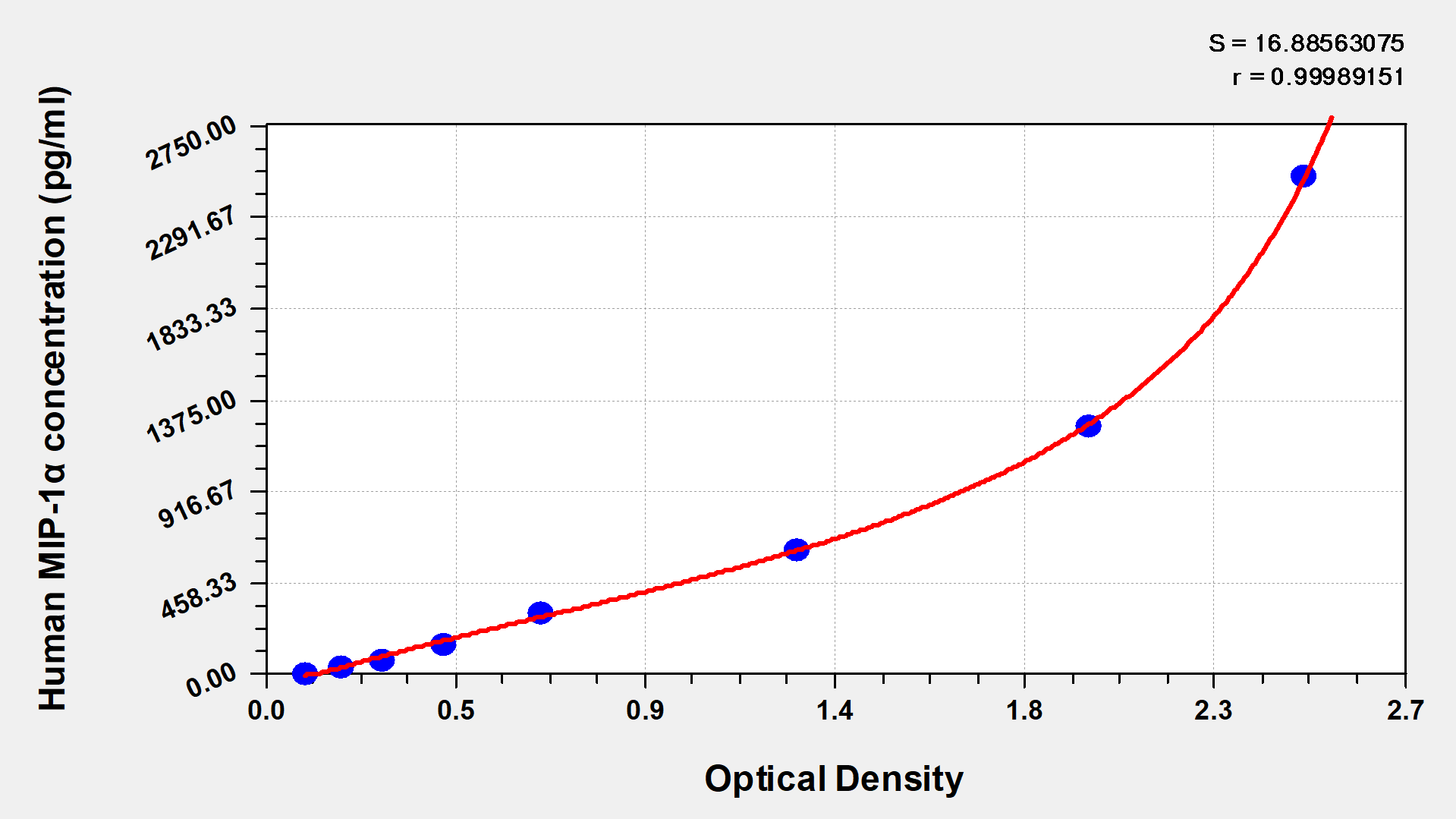
To assess the linearity of the assay, samples were spiked with high concentrations of human MIP-1α in various matrices and diluted with the Sample Diluent to produce samples with values within the dynamic range of the assay. | ||||||
| Sample | Serum(n=4) | ||||
1:1 | Average % | 86 | ||||
Range % | 81-90 | |||||
1:2 | Average % | 99 | ||||
Range % | 94-102 | |||||
1:4 | Average % | 99 | ||||
Range % | 97-101 | |||||
1:8 | Average % | 94 | ||||
Range % | 90-98 | |||||
The recovery of human MIP-1α spiked to levels throughout the range of the assay in various matrices was evaluated. Samples were diluted prior to assay as directed in the Sample Preparation section. | ||||||
Sample Type | Average % Recovery | Range | ||||
Serum (n=5) | 93 | 89-96 | ||||
EDTA plasma (n=4) | 96 | 94-99 | ||||