

Human Kidney injury molecule 1,Kim-1 ELISA Kit
The Ultimate 1-Stop ELISA Marketplace:
60,000+ ELISA kits Available to Serve Scientists from All Fields of Life Science
Always Powered by Diagnocine for Precision Research.
Most comprehensive buffers, reagents and detection agents are provided with each kit to optimize data output.
All-inclusive format covers everything from sample preparation to signal detection. Every step can be customized and optimized for your precision research.
DiagnoCine Precision buffers and reagents are Made in USA ISO 13485 Certified
Why waste time searching for your ELISA kit when you can get everything in one place? Diagnocine can provide you with all the ELISA needs you have (customized ELISAs also available) on the planet through a single, streamlined ordering process.
* all types of species
* HRP and AP detection
* Low target signal enhancement
* Inquire about a trial version or a customized version
4 core reagents below are included with every order, plus 1 of the 2 detection-specific reagents (matched automatically to your kit type) — 5 components, every time.
+ the 5th component, matched to your kit's detection method:
If you have any questions or need additional information, please call us at 551-245-1033 or email us at support@diagnocine.com. Our team will be happy to assist you.
Universal Compatibility
All buffers and detection reagents work seamlessly across target proteins, bridging the gap in assay consistency.
1-Stop Convenience
Consolidate your lab's purchasing. Source all ELISA needs and experience optimal buffers and reagents in a single shipment.
Enhanced Precision
Designed by scientists for scientists, all components are engineered to deliver sharper results and an optical signal.
Human Kidney injury molecule 1,Kim-1 ELISA Kit
Sandwich quantitative immunoassay for hepatitis A virus cellular receptor 1 in human serum, urine, tissue homogenates available in multiple catalog sizes:
Note: Please send inquiries regarding Trial 24T orders to support@diagnocine.com.
| Target name | hepatitis A virus cellular receptor 1 |
| Uniprot No. | Q96D42 |
| Species | Homo sapiens (Human) |
| Sample types | serum, urine, tissue homogenates |
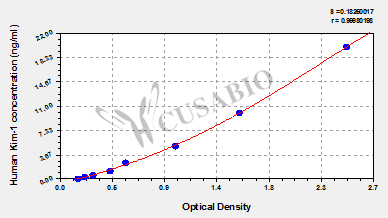
| Detection range | 0.312 ng/mL-20 ng/mL |
| Sensitivity | 0.043 ng/mL |
| Assay time | 1-5h |
| Sample loading volume | 50-100μL |
| Detection wavelength | 450 nm |
| Assay principle | Sandwich (Quantitative) |
| Data analysis | Standard curve + Curve Expert software |
| Research area | Immunology |
| Storage condition | 2-8°C (see protocol for full details) |
| Shipping condition | 4 °C |
| Shelf life | 6 months |
10 business days
Processing + 3-5 days shipping
In Stock : USA
Worldwide shipping available
Antibody capture
450 nm detection
Standard curve
Quantification
In this sandwich ELISA, hepatitis A virus cellular receptor 1 in the sample is captured between a pre-coated capture antibody and a detection antibody. Signal intensity is proportional to analyte concentration. Quantification uses a standard curve fitted with Curve Expert software, covering 0.312 ng/mL-20 ng/mL with a minimum detectable dose of 0.043 ng/mL.
This Human Kim-1 ELISA Kit was designed for the quantitative measurement of Human Kim-1 protein in serum, urine, tissue homogenates. It is a Sandwich ELISA kit, its detection range is 0.312 ng/mL-20 ng/mL and the sensitivity is 0.043 ng/mL .
- Study suggests that TIM1 -416G>C and -1454G>A single nucleotide polymorphisms are associated with dilated cardiomyopathy susceptibility and prognosis in this Han Chinese population. PMID: 27818477
- in the current meta-analysis, based on ten prospective studies involving 29366 participants, we evaluated the role of urinary tubular injury markers (NGAL, KIM-1 and NAG) in predicting clinical outcomes including CKD stage 3, end stage renal disease and mortality. PMID: 27907168
- Urinary excretion of KIM-1 correlates with blood lead levels better than other traditional renal injury biomarkers, including N-acetyl-beta-(D)-glucosaminidase, alpha1-microglobulin, and beta2-microglobulin. PMID: 27966578
- A panel consisting of IGFBP1, KIM1, GCLC and GSTM1 genes could be used in combination for early screening of CKDu, whereas these genes in addition with FN1, IGFBP3 and KLK1 could be used to monitor progression of CKDu. The regulation of these genes has to be studied on larger populations to validate their efficiency for further clinical use. PMID: 28103909
- TIM-1 is a unique marker for the identification of a human IL-10(+) Breg subpopulation which is partially superimposed with transitional B cells PMID: 28103916
- Urine KIM-1 level in acute kidney injury patients was significantly higher than that in the healthy controls. PMID: 28212617
- Urinary NGAL is a good predictor of mortality in established pediatric acute kidney injury (AKI) of heterogeneous etiology and outperforms calprotectin and KIM-1. Urinary calprotectin and KIM-1 predict renal replacement therapy requirement in pediatric AKI. PMID: 28409285
- The present study shows that serum and urine levels of NGAL and KIM-1 are higher in patients with acute kidney injury than in those without acute kidney injury, and that serum NGAL and the presence of chronic kidney disease are significant predictors of acute kidney injury in scrub typhus. PMID: 28419138
- Review/Meta-analysis: suggest that TIM-1-416G[C single nucleotide polymorphism is associated with the risk of asthma for the Asian ethnicity in the codominant (G/G vs. G/C) and dominant (G/G vs. G/C + C/C) genetic models. PMID: 28434117
- Quantification of TIM-3 and KIM-1 mRNA expressions, along with KIM-1 protein measurements in urine and blood could be employed as promising tools for noninvasive diagnosis of allograft dysfunction. PMID: 28757398
- findings show that TIM1 is not an essential cellular receptor for hepatitis A virus entry into cultured cells PMID: 28874468
- Elevated plasma NT-proBNP and KIM-1 in patients with stage 5 chronic kidney disease (CKD5) undergoing maintenance hemodialysis (HD) and HF (+) (heart failure)CKD5-HD patients suggest that natriuretic peptides and KIM-1 may contribute to the pathogenesis of HF in CKD5-HD patients. PMID: 28990414
- High KIM1 expression is associated with decreased proximal tubular epithelial cell function. PMID: 29045706
- total flavone of Desmodium styracifolium inhibited HK-2 cell apoptosis and autophagy by regulating KIM-1 via p38/MAPK pathway. PMID: 29071538
- measurement of urinary and renal KIM-1 level may be helpful to evaluate severity of renal pathological damage and prognosis in adult Henoch-Schonlein purpura patients with nephritis PMID: 29122357
- Polymorphism +4259A>C in exon 3 of the TIM-3 gene is associated with susceptibility to multiple sclerosis but polymorphism -1637C>T in the promoter region of TIM-1 is not. PMID: 29141799
- These findings suggest that the TIMD4-HAVCR1 variants may be the genetic risk factors for coronary heart disease and ischemic strok PMID: 29208769
- High KIM1 expression is associated with Clear Cell Renal Cell Carcinoma. PMID: 29295730
- data show that in addition to the phospholipid-binding function of HAVCR1, the enhancement of HCV infection involves other determinants in the IgV domain of HAVCR1. These findings expand the repertoire of molecules that HCV uses for cell entry, adding to the already complex mechanism of HCV infection and pathogenesis. PMID: 29321304
- Human oligodendrocytes undergo apoptosis when exposed to Sema4A and take up H-ferritin for meeting iron requirements and that these functions are mediated via the Tim-1 receptor. H-ferritin can block Sema4A-mediated cytotoxicity. Sema4A is detectable in the CSF of multiple sclerosis patients and HIV-seropositive persons and can induce oligodendrocyte cell death. PMID: 29457657
- These studies provide evidence that, in the absence of a functional alpha-dystroglycan, TIM-1 mediates the entry of Lassa virus pseudoviral particles through interactions of virions with the IgV PtdSer-binding pocket of TIM-1. PMID: 29875238
- neither the inflammatory biomarker calprotectin, nor the tubular biomarkers NGAL and KIM-1, provide robust prognostic information on the loss of renal function in a heterogeneous CKD population. All of them, however, are candidate prognostic biomarkers in primarily inflammatory renal diseases. PMID: 30078006
| Intra-assay Precision (Precision within an assay): CV%<8% | ||||||
| Three samples of known concentration were tested twenty times on one plate to assess. | ||||||
| Inter-assay Precision (Precision between assays): CV%<10% | ||||||
| Three samples of known concentration were tested in twenty assays to assess. | ||||||
| These standard curves are provided for demonstration only. A standard curve should be generated for each set of samples assayed. | |||||||||||||||||||||||||||||||||||||||||||||||||||||||||||||||
| |||||||||||||||||||||||||||||||||||||||||||||||||||||||||||||||
| To assess the linearity of the assay, samples were spiked with high concentrations of human Kim-1 in various matrices and diluted with the Sample Diluent to produce samples with values within the dynamic range of the assay. | ||||||
| Sample | Serum(n=4) | |||||
| 1:1 | Average % | 89 | ||||
| Range % | 82-96 | |||||
| 1:2 | Average % | 104 | ||||
| Range % | 99-109 | |||||
| 1:4 | Average % | 100 | ||||
| Range % | 94-106 | |||||
| 1:8 | Average % | 92 | ||||
| Range % | 85-98 | |||||
| The recovery of human Kim-1 spiked to levels throughout the range of the assay in various matrices was evaluated. Samples were diluted prior to assay as directed in the Sample Preparation section. | ||||||
| Sample Type | Average % Recovery | Range | ||||
| Serum (n=5) | 102 | 96-108 | ||||
| EDTA plasma (n=4) | 90 | 84-96 | ||||
- A micro ELISA plate ---The 96-well plate has been pre-coated with an anti-human Kim-1 antibody.
- Six vials standard (5 ml/bottle) ---Dilute a bottle of the standard at dilution series, read the OD values, and then draw a standard curve.
- One vial HRP-conjugated Kim-1 antibody (6 ml/bottle) ---Bind to the MSTN in the samples or standards and react with the substrate to make the solution chromogenic.
- Substrate A (1 x 7 ml)
- Substrate B (1 x 7 ml)
- One vial Stop Solution (7ml/bottle) ---Stop the color reaction. The solution color immediately turns from blue to yellow.
- Four Adhesive Strips (For 96 wells) ---Cover the microplate when incubation.
- An instruction manual
- A microplate reader capable of measuring absorbance at 450 nm, with the correction wavelength set at 600 nm or 630 nm.
- An incubator can provide stable incubation conditions up to 37°C±5°C.
- Centrifuge
- Vortex
- Squirt bottle, manifold dispenser, or automated microplate washer
- Absorbent paper for blotting the microtiter plate
- 50-300ul multi-channel micropipette
- Pipette tips
- Single-channel micropipette with different ranges
- 100ml and 500ml graduated cylinders
- Deionized or distilled water
- Timer
- Test tubes for dilution