

.jpg "/Content/Upload/Product/Human_ELISA_kits_Diagnocine_1200_1200(177).jpg")
Human Epithelial neutrophil activating peptide 78 (ENA-78/CXCL5) ELISA Kit
The Ultimate 1-Stop ELISA Marketplace:
60,000+ ELISA kits Available to Serve Scientists from All Fields of Life Science
Always Powered by Diagnocine for Precision Research.
Most comprehensive buffers, reagents and detection agents are provided with each kit to optimize data output.
All-inclusive format covers everything from sample preparation to signal detection. Every step can be customized and optimized for your precision research.
DiagnoCine Precision buffers and reagents are Made in USA ISO 13485 Certified
Why waste time searching for your ELISA kit when you can get everything in one place? Diagnocine can provide you with all the ELISA needs you have (customized ELISAs also available) on the planet through a single, streamlined ordering process.
* all types of species
* HRP and AP detection
* Low target signal enhancement
* Inquire about a trial version or a customized version
4 core reagents below are included with every order, plus 1 of the 2 detection-specific reagents (matched automatically to your kit type) — 5 components, every time.
+ the 5th component, matched to your kit's detection method:
If you have any questions or need additional information, please call us at 551-245-1033 or email us at support@diagnocine.com. Our team will be happy to assist you.
Universal Compatibility
All buffers and detection reagents work seamlessly across target proteins, bridging the gap in assay consistency.
1-Stop Convenience
Consolidate your lab's purchasing. Source all ELISA needs and experience optimal buffers and reagents in a single shipment.
Enhanced Precision
Designed by scientists for scientists, all components are engineered to deliver sharper results and an optical signal.
Human Epithelial neutrophil activating peptide 78 (ENA-78/CXCL5) ELISA Kit
Sandwich quantitative immunoassay for chemokine (C-X-C motif) ligand 5 in human serum, plasma, tissue homogenates available in multiple catalog sizes:
Note: Please send inquiries regarding Trial 24T orders to support@diagnocine.com.
| Target name | chemokine (C-X-C motif) ligand 5 |
| Uniprot No. | P42830 |
| Species | Homo sapiens (Human) |
| Sample types | serum, plasma, tissue homogenates |
| Detection range | 0.625 ng/mL-40 ng/mL |
| Sensitivity | 0.567 ng/mL |
| Assay time | 1-5h |
| Sample loading volume | 50-100μL |
| Detection wavelength | 450 nm |
| Assay principle | Sandwich (Quantitative) |
| Data analysis | Standard curve + Curve Expert software |
| Research area | Immunology |
| Storage condition | 2-8°C (see protocol for full details) |
| Shipping condition | 4 °C |
| Shelf life | 6 months |
10 business days
Processing + 3-5 days shipping
In Stock : USA
Worldwide shipping available
Antibody capture
450 nm detection
Standard curve
Quantification
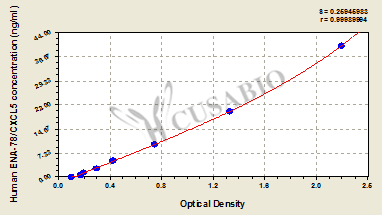
In this sandwich ELISA, chemokine (C-X-C motif) ligand 5 in the sample is captured between a pre-coated capture antibody and a detection antibody. Signal intensity is proportional to analyte concentration. Quantification uses a standard curve fitted with Curve Expert software, covering 0.625 ng/mL-40 ng/mL with a minimum detectable dose of 0.567 ng/mL.
The product CSB-E08178h is a sandwich ELISA kit developed to measure levels of human ENA-78 in multiple samples, including serum, plasma, or tissue homogenates. This assay uses the sandwich enzyme immunoassay technique in combination with the enzyme-substrate chromogenic reaction to quantify the analyte in the sample. The color develops positively to the amount of ENA-78 in samples. The color intensity is measured at 450 nm via a microplate reader.
ENA-78, alternatively referred to as CXCL5, is identified as an inflammatory mediator with a powerful role in neutrophil chemotaxis. CXCL5 is upregulated in many cancers including gastric cancer, hepatocellular carcinoma (HCC), breast cancer, and bladder cancer, and is involved in tumor growth and metastasis. In the tumor microenvironment (TME), CXCL5 binds to CXCR2 and participates in the recruitment of immune cells, and promotes angiogenesis, tumor growth, and metastasis. The CXCL5/CXCR2 axis can act as a bridge between tumor cells and host cells in TME. Blocking the transmission of CXCL5/CXCR2 signals can increase the sensitivity and effectiveness of immunotherapy and slow down tumor progression.
- Analysis of monocultured dermal fibroblasts and keratinocytes revealed that only fibroblasts but not keratinocytes displayed up regulated CXCL5 levels after UV stimulation. PMID: 25690483
- High CXCL5 expression is associated with pediatric ulcerative colitis. PMID: 25738378
- There was an inverse correlation between DACH1 mRNA levels and CXCL5 in both lung cancer cell lines and human NSCLC tissues. PMID: 25788272
- Serum levels of ENA-78 were elevated in autistic children and they were significantly associated with the increased levels of serum antineuronal auto-antibodies PMID: 25871636
- Study shows that CXCL5 expression is elevated in positive correlation to bladder cancer grade and promotes cell migration and invasion via binding to its receptor CXCR2. PMID: 26058729
- CXCL5 expression is enriched in human atherosclerotic coronary artery. The CXCL5 variant might be a genetic risk factor for the susceptibility of CAD and the CXCL5 promoter -156 G/C C allele might be an independent predictor for CAD. PMID: 26287498
- CXCL5 expression in urine is related to bladder cancer TNM stage, lymph node metastasis, tumor size, and tumor grade. PMID: 26503215
- ENA 78 plasma levels were correlated with Expanded Disability Status Scale scores in neuromyelitis optica (NMO) patients; elevated secretion of ENA 78 may be a critical step in neutrophil recruitment during the remission of NMO. PMID: 27401736
- a finely tuned balance between the GAG-bound dimer and free soluble monomer regulates CXCL5-mediated receptor signaling and function. PMID: 27471273
- Serum CXCL5 levels from pemphigus vulgaris patients are significantly higher than those in bullous pemphigoid patients and healthy controls. PMID: 27501402
- Curcumin suppressed CXCL5 expression by direct inhibition of IKKbeta phosphorylation, and inhibition of p38 MAPK via induction of negative regulator MKP-1. PMID: 27538525
- CXCL5 plays a promoting role in glioma in autocrine- and paracrine-dependent manners. PMID: 27748886
- Mechanistically, AR modulated cytokine CXCL5 expression by altering AKT --> NF-kappaB signaling, and interruption of AKT --> NF-kappaB --> CXCL5 signaling using either specific inhibitors or siRNA suppressed AR-enhanced EC recruitment and AR-EC-promoted RCC progression. PMID: 27848972
- CXCL5 levels were decreased in LSCC patient serum. PMID: 27876461
- The expression of CXCL5 is up-regulated in osteosarcoma cells. PMID: 28277189
- our findings support CXCL5 as a promoter of colorectal cancer metastasis and a predictor of poor clinical outcomes in colorectal cancer patients. PMID: 28356111
- findings for the first time provided evidence that ENA78 may play a key role of mediator in pathogenesis of Major Depressive Disorder(MDD) and in the mechanism of vinlafaxine effects on MDD. PMID: 28441588
- The CXCL5 and the overexpression of miR-141 reduced levels of MMP-2 and MMP-9 in tumor necrosis factor-alpha-treated HT29 cells by means of repressing the inhibitory AKT. PMID: 28854064
- PERK-p-eIF2alpha pathway could suppress metastasis in triple-negative breast cancer by inhibiting expression of PDL1 and CXCL5 in tumor cells. PMID: 29053414
- activated CXCL5-CXCR2 axis contributes to the metastatic phenotype of PTC cells by modulating Akt/GSK-3beta/beta-catenin pathway PMID: 29471001
- study elucidates the important role of CXCL5 in the progression and prognosis of NSCLC. These findings suggested that CXCL5 might be a potential biomarker and novel therapeutic target for lung cancer PMID: 29526026
- CXCL5 may promote mitomycin resistance by activating EMT and NF-kappaB pathway. Thus, this study identifies CXCL5 as a novel chemoresistance-related marker in non-muscle invasive bladder cancer PMID: 29545183
- These data demonstrated that CXCL5 expression was upregulated in prostate cancer tissues and that exogenous CXCL5 protein exposure or CXCL5 overexpression promoted malignant phenotypes of prostate cancer cells in vitro and in vivo. PMID: 29749439
| Intra-assay Precision (Precision within an assay): CV%<8% | |||||||
| Three samples of known concentration were tested twenty times on one plate to assess. | |||||||
| Inter-assay Precision (Precision between assays): CV%<10% | |||||||
| Three samples of known concentration were tested in twenty assays to assess. | |||||||
| These standard curves are provided for demonstration only. A standard curve should be generated for each set of samples assayed. | ||||||||||||||||||||||||||||||||||||||||||||||||||||||||||||||||||||||||
| ||||||||||||||||||||||||||||||||||||||||||||||||||||||||||||||||||||||||
| To assess the linearity of the assay, samples were spiked with high concentrations of human ENA-78/CXCL5 in various matrices and diluted with the Sample Diluent to produce samples with values within the dynamic range of the assay. | |||||||
| Sample | Serum(n=4) | ||||||
| 1:1 | Average % | 98 | |||||
| Range % | 94-103 | ||||||
| 1:2 | Average % | 102 | |||||
| Range % | 97-105 | ||||||
| 1:4 | Average % | 86 | |||||
| Range % | 83-89 | ||||||
| 1:8 | Average % | 97 | |||||
| Range % | 94-100 | ||||||
| The recovery of human ENA-78/CXCL5 spiked to levels throughout the range of the assay in various matrices was evaluated. Samples were diluted prior to assay as directed in the Sample Preparation section. | |||||||
| Sample Type | Average % Recovery | Range | |||||
| Serum (n=5) | 85 | 81-89 | |||||
| EDTA plasma (n=4) | 98 | 94-103 | |||||