

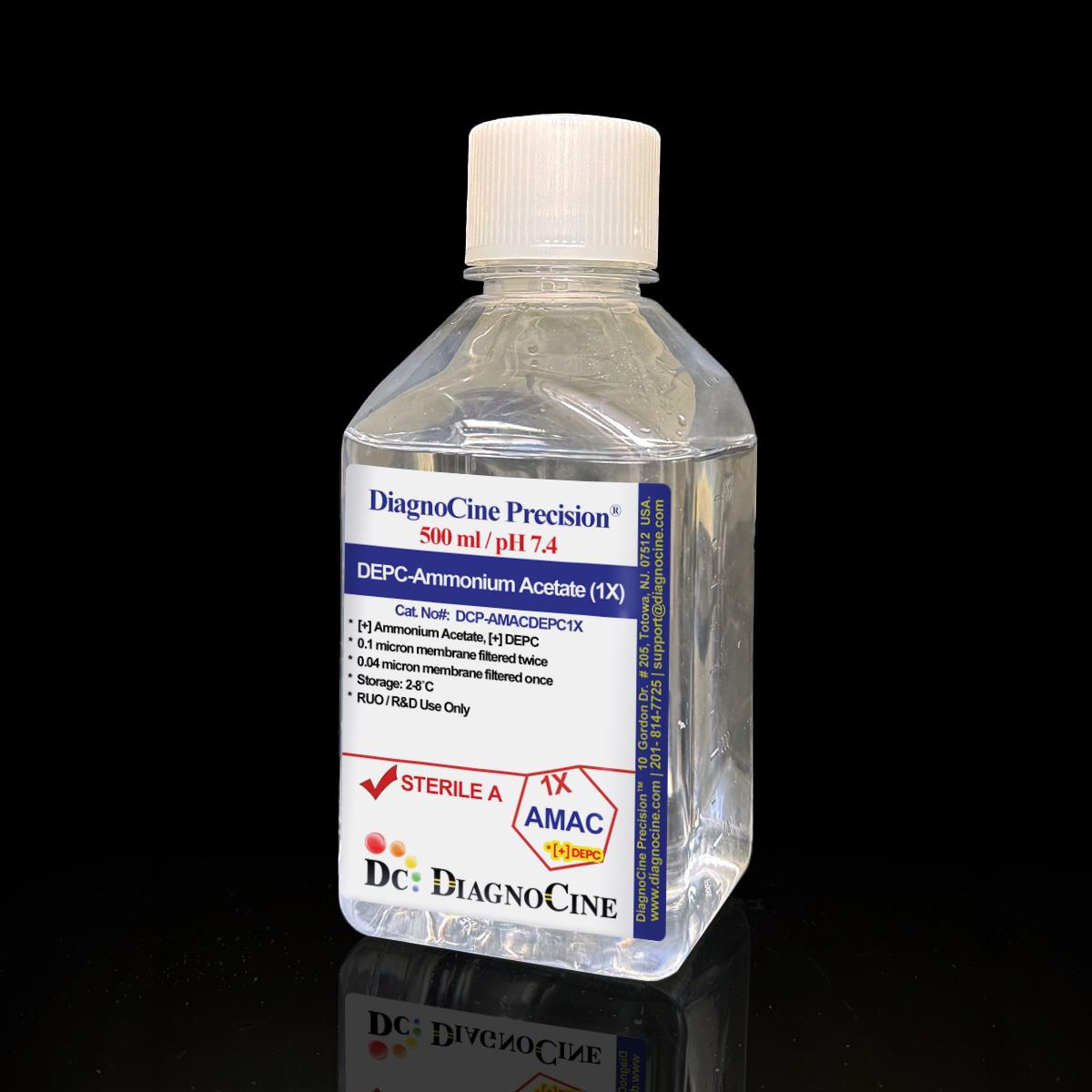
UltraClean DEPC-Ammonium Acetate Buffer
FluxMPS™ UltraClean DEPC-Ammonium Acetate Buffer
FluxMPS™ UltraClean DEPC-Ammonium Acetate Buffer is a ready-to-use, DEPC-treated, nuclease-controlled 200 mM ammonium acetate solution engineered for high-purity RNA and DNA precipitation, cleanup, and molecular biology workflows. It is manufactured with sequential 0.1 µm and 0.04 µm membrane filtration for RNase-reduced, microchannel-safe purity.
- Filtered 0.1-micron membrane twice and 0.04-micron membrane twice for ultra-low particulate, RNase-reduced purity
- 200 mM ammonium acetate at pH 7.4 in DEPC-treated, nuclease-free water
- Phenol-free precipitation chemistry for RNA and DNA cleanup and concentration
- Ready-to-use 1X working strength for consistent, low-variability results
- Manufactured under ISO 13485-certified, CE-approved facilities
- Sterile, colorless, clear solution free of visible particulates
- Store at 2-8°C; do not freeze; 12-month shelf life
- Custom concentrations, pH, and additives available on request
- Molarity200 mM Ammonium Acetate
- pH7.4
- Water QualityDEPC-treated, nuclease-free
- Filtration0.1 µm membrane twice, 0.04 µm membrane twice
- SterilitySterile (USP <71>)
- AppearanceColorless, clear solution
- Storage2-8°C, do not freeze
- Shelf Life12 months
- FormatReady-to-use 1X
- Intended UseRUO - RNA/DNA precipitation & cleanup
Engineered where standard buffers fail
Conventional 0.22 µm-filtered buffers can carry subvisible particulates, inconsistent RNase control, and lot-to-lot variability into precipitation workflows. FluxMPS™ UltraClean DEPC-Ammonium Acetate Buffer is built to remove those failure points.
Microchannel-safe purity
Quadruple-stage filtration removes particulates down to 0.04 µm, protecting microfluidic channels and downstream enzymatic reactions.
Precise, stable pH
Formulated at pH 7.4 in a defined 200 mM ammonium acetate matrix suited to nucleic acid precipitation.
Ultrapure-grade water
Prepared with DEPC-treated, nuclease-free Ultrapure Type 1 water (18.2 MΩ·cm) to control RNase contamination.
Low background for assays
Phenol-free precipitation chemistry leaves only volatile ammonium acetate residues, minimizing background in downstream nucleic acid assays.
Defined, traceable composition
Manufactured from molecular biology-grade reagents for reproducible precipitation performance lot to lot.
Customization on demand
Alternate concentrations, pH, or supplement additions are available on request - contact support@diagnocine.com.
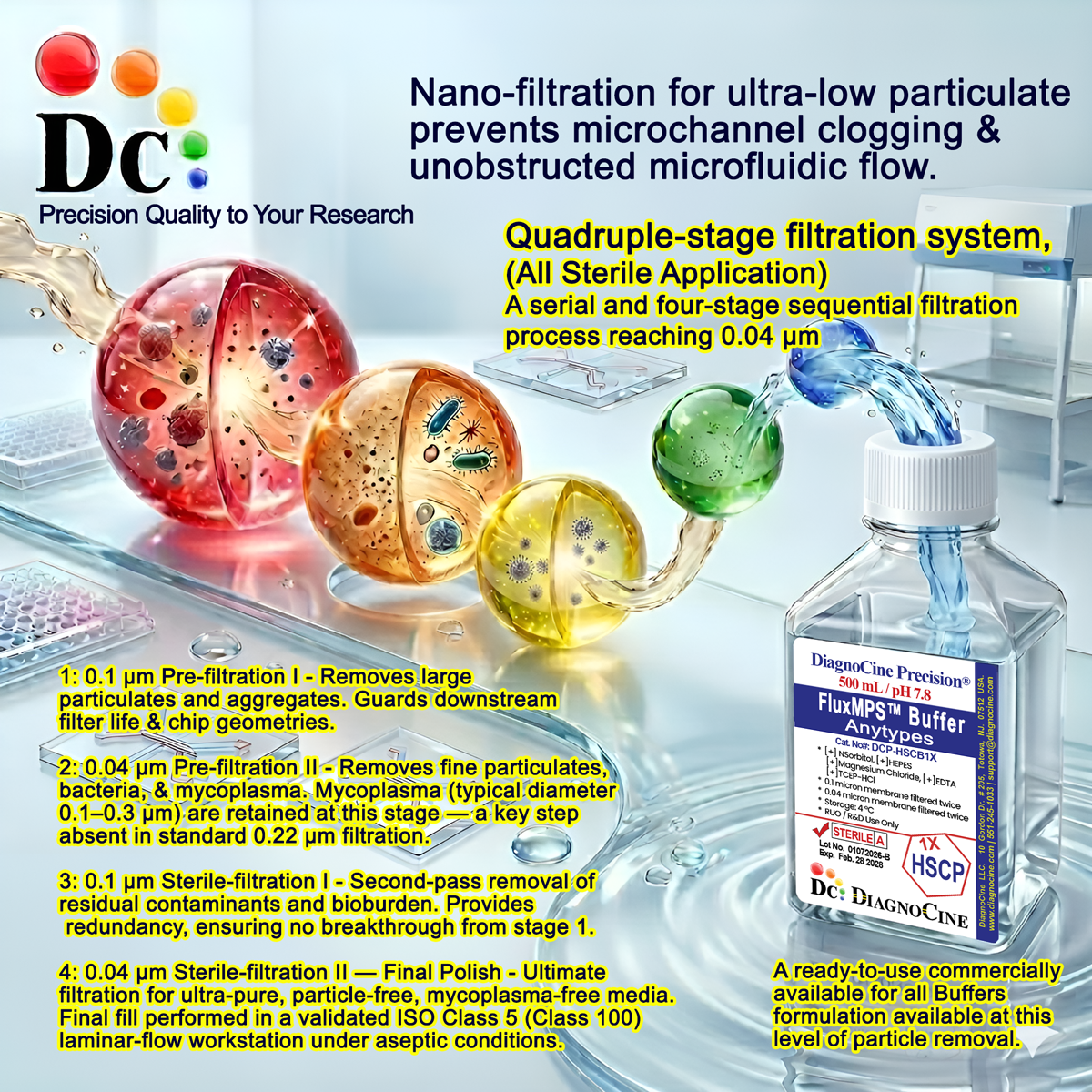
Quadruple-stage filtration system
This buffer is manufactured with sequential 0.1 µm and 0.04 µm membrane filtration, each applied twice, delivering RNase-reduced, ultra-low-particulate purity suited to sensitive nucleic acid workflows.
-
1
0.1 µm Pre-filtration I
Large particulate and aggregate removal, extending the service life of downstream filters.
-
2
0.04 µm Pre-filtration II
Fine particulate and bioburden retention ahead of final sterile filtration.
-
3
0.1 µm Sterile-filtration I
Second-pass 0.1 µm redundancy for consistent sterility assurance.
-
4
0.04 µm Sterile-filtration II — Final Polish
Final 0.04 µm polish performed under ISO Class 5 (Class 100) conditions for aseptic fill.
Performance vs. conventional buffer
Sequential 0.1 µm and 0.04 µm filtration, each applied twice, removes finer particulates than a single-pass 0.22 µm filtered buffer, supporting RNase-reduced handling of RNA and DNA.
© Diagnocine® — DCP-AMACDEPC1X
Where UltraClean DEPC-Ammonium Acetate Buffer performs
Formulated as a phenol-free, nuclease-controlled 1X ammonium acetate solution, this buffer supports RNA and DNA precipitation, cleanup, and concentration across a wide range of molecular biology and on-chip workflows.
Automated Bioreactors & Robotics
For labs adopting automated liquid handling and robotic nucleic acid prep, an optional 0.01 µm (10 nm) ultra-filtered grade of this buffer is available to protect fine-bore valves, sensors, and microfluidic components across extended runs.
- Total Particulate Exclusion: Near-complete removal of sub-visible particulates for robotic liquid-handling reliability.
- Valve & Sensor Protection: Protects fine-bore valves and optical sensors from particulate fouling.
- Extended Perfusion Stability: Stable pH and low particulate load across extended automated runs.
Inquiry Required: The 0.01 µm ultra-filtered grade is produced to order — contact support@diagnocine.com to request this configuration.
Micro Physiological System (MPS) & Chip
Compatible with on-chip nucleic acid extraction and precipitation modules used in microphysiological and lab-on-a-chip platforms.
Wash, Dilution & Reconstitution
Serves as the ammonium acetate component for ethanol/isopropanol precipitation, sample cleanup, and reconstitution of RNA and DNA.
iPSC-Derived Model Handling
Supports RNA/DNA extraction workflows from iPSC-derived neuronal, cardiomyocyte, and hepatocyte cultures.
Endothelial & Primary Cell Perfusion
Used in nucleic acid recovery protocols following perfusion-based culture of endothelial and primary cell models.
ELISA, Blotting & Blocking
Applicable to nucleic acid cleanup steps preceding probe-based blotting and hybridization assays.
Microscopy & Optical Sensing
Low-background composition supports downstream fluorescence-based nucleic acid quantification following live-cell imaging studies.
Full specification sheet
Every value below reflects the manufactured properties of UltraClean DEPC-Ammonium Acetate Buffer.
| Parameter | Specification |
|---|---|
| Formulation / Composition | Ammonium Acetate 200 mM in DEPC-treated, nuclease-free water |
| Appearance | Colorless, clear solution; free of visible particulates |
| pH USP <791> | 7.4 |
| Molarity / Concentration | 200 mM Ammonium Acetate |
| Parameter | Specification |
|---|---|
| Sterility USP <71> | Sterile |
| Water Quality | DEPC-treated, nuclease-free Ultrapure Type 1 water (18.2 MΩ·cm) |
| Filtration | 0.1 µm membrane twice, 0.04 µm membrane twice |
| Manufacturing Standard ISO 13485 | ISO 13485-certified, CE-approved facilities |
| Fill Environment | ISO Class 5 (Class 100) |
| Parameter | Specification |
|---|---|
| Storage Temperature | 2-8°C |
| Freeze-Thaw | Do not freeze |
| Shelf Life | 12 months |
| Parameter | Specification |
|---|---|
| Raw Material Grade | Molecular biology-grade reagents |
| Manufacturing QMS | ISO 13485-certified |
| Regulatory Alignment | CE-approved |
| Production Method | DEPC-treated, nuclease-controlled formulation |
| Intended Use | Research Use Only (RUO) |
Full composition
UltraClean DEPC-Ammonium Acetate Buffer is a single-component ammonium acetate system in DEPC-treated, nuclease-free water, manufactured under per-lot release testing.
| Component | CAS Number | Concentration |
|---|---|---|
| Ammonium Acetate | 631-61-8 | 200 mM |
| Water (DEPC-treated, nuclease-free) | 7732-18-5 | To volume |
Manufactured to ISO 13485 standards
Every lot is produced, filtered, and released under a controlled quality system with full documentation.
ISO 13485:2016 QMS
Manufactured under an ISO 13485-certified quality management system with full lot traceability.
Ultrapure Type 1 Water
Prepared with DEPC-treated, nuclease-free Ultrapure Type 1 water (18.2 MΩ·cm).
ISO Class 5 Fill & Finish
Final 0.04 µm polish and fill performed under ISO Class 5 (Class 100) conditions.
Micro-Batch Precision
Customization, packaging, and quality testing completed at the DiagnoCine R&D and Quality Testing Center in Totowa, New Jersey, USA.
Endotoxin USP <85> BET
Endotoxin control practices reference USP <85> Bacterial Endotoxin Test methodology as part of routine quality assurance.
Particulate USP <788> Method 2
Particulate control follows USP <788> Method 2 practices, supported by sequential 0.1 µm and 0.04 µm filtration.
Osmolality USP <785>
Formulated to a defined 200 mM ammonium acetate concentration; osmolality testing follows USP <785> methodology where applicable.
Documentation / CoA
A Certificate of Analysis is available for each lot upon request.
How DCP-AMACDEPC1X compares
A side-by-side look at filtration architecture and formulation control versus conventional ammonium acetate buffers.
| Parameter | DCP-AMACDEPC1X (FluxMPS™) | Conventional Buffer (0.22 µm filtered) | Standard Alternative (0.22 µm filtered) |
|---|---|---|---|
| Defined 200 mM Ammonium Acetate, pH 7.4 | check_circle | cancel | cancel |
| Final filtration pore size | 0.04 µm | 0.22 µm | 0.22 µm |
| Number of filtration stages | 4 | 1 | 1 |
| DEPC-treated, nuclease-free water | check_circle | cancel | cancel |
| Sterility (USP <71>) | check_circle | check_circle | cancel |
| ISO 13485-certified manufacturing | check_circle | check_circle | cancel |
| Microfluidic/robotic channel compatibility | check_circle | cancel | cancel |
| Phenol-free precipitation chemistry | check_circle | check_circle | cancel |
| Custom formulation | check_circle | cancel | cancel |
Frequently asked questions
Answers to common questions about UltraClean DEPC-Ammonium Acetate Buffer.
Supporting literature
Curated references on ammonium acetate precipitation chemistry, nuclease control, and microfluidic nucleic acid handling.
- Sambrook J, Russell DW. Molecular Cloning: A Laboratory Manual. Precipitation of nucleic acids with ammonium acetate and ethanol. doi:10.1101/pdb.prot4456
- Crowley TE, et al. Purification of nucleic acids by extraction and precipitation. doi:10.1002/0471142727.mb0201s60
- Green MR, Sambrook J. Precipitation of RNA with ammonium acetate. Cold Spring Harb Protoc. doi:10.1101/pdb.prot101717
- Farrell RE. RNA Methodologies: Laboratory Guide for Isolation and Characterization. doi:10.1016/C2009-0-61854-1
- Bhatia SN, Ingber DE. Microfluidic organs-on-chips. Nat Biotechnol. doi:10.1038/nbt.2989
- Huh D, et al. Reconstituting organ-level lung functions on a chip. Science. doi:10.1126/science.1188302
- Wilfinger WW, et al. Effect of RNase inhibition and DEPC treatment on nucleic acid recovery. Biotechniques. doi:10.2144/97223st01
- Low LA, Tagle DA. Organs-on-chips for drug development and toxicology testing. Exp Biol Med. doi:10.1177/1535370217700523