

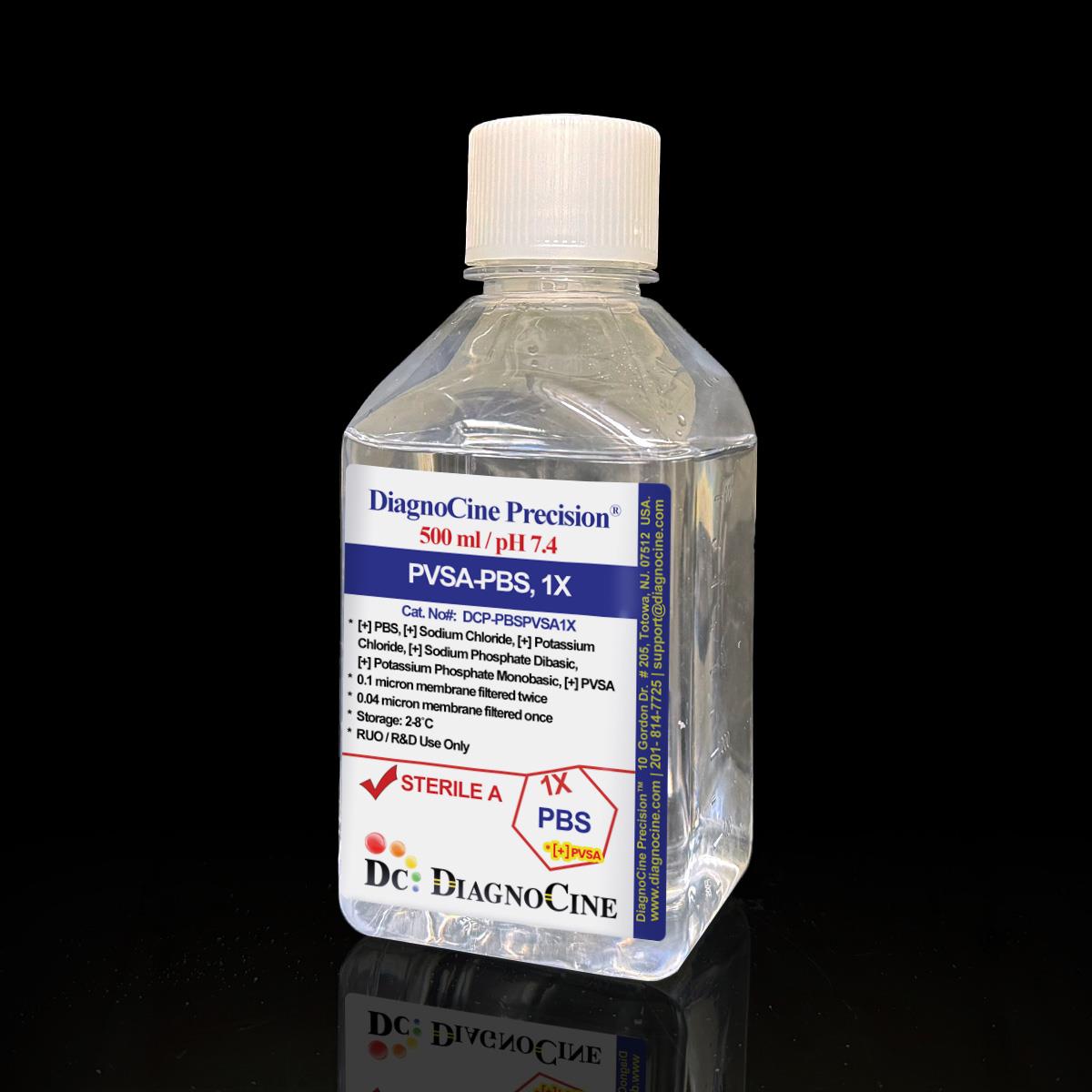
UltraClean PVSA-PBS, 1X
FluxMPS™ UltraClean PVSA-PBS, 1X — RNase-Safe Phosphate Buffered Saline
UltraClean PVSA-PBS, 1X is an MPS-grade, ready-to-use phosphate buffered saline supplemented with polyvinylsulfonic acid (PVSA), a potent polymeric RNase inhibitor formulated to protect RNA integrity during handling, washing, and storage. Manufactured to precise, stable pH and defined molarity, it is quadruple-stage filtered through 0.1 µm and 0.04 µm membranes — each pass applied twice — for microchannel-safe use in RNA workflows, organ-on-a-chip (OoC), and microphysiological system (MPS) applications.
- Quadruple-stage filtration: 0.1 µm membrane twice and 0.04 µm membrane twice
- RNase-safe formulation via PVSA (polyvinylsulfonic acid) supplementation
- Isotonic, physiological pH 7.4
- Free of added calcium and magnesium
- Formulated with ultrapure, nuclease-free water
- Ready-to-use 1X solution — no dilution or mixing required
- Manufactured under ISO 13485-certified, CE-approved facilities
- Customization available on request — contact support@diagnocine.com
- pH7.4
- FormulationPBS + PVSA (RNase-safe)
- Buffer TypeIsotonic, physiological
- Divalent CationsFree of added Ca2+/Mg2+
- PVSA Concentration1 g/L
- Water QualityUltrapure, nuclease-free (Type 1, 18.2 MΩ·cm)
- Filtration0.1 µm x2 + 0.04 µm x2
- Storage2–8°C, do not freeze
- Shelf Life12 months
- FormatReady-to-use 1X solution
Engineered where standard PBS fails RNA-sensitive work
Conventional 0.22 µm-filtered PBS carries subvisible particulates, adventitious nucleases, and pH/ionic drift that can compromise RNA integrity and accumulate inside microfluidic channels. UltraClean PVSA-PBS, 1X is built to remove these failure modes at the source.[1,2]
Microchannel-safe purity
Final 0.04 µm pore size from a quadruple-stage filtration sequence minimizes particulate loading in microfluidic channels and OoC devices.
Precise, stable pH
Formulated at pH 7.4 with defined phosphate and chloride salt molarity for isotonic, physiological compatibility with cells and tissues.
Ultrapure-grade water
Formulated with ultrapure, nuclease-free water (Type 1, 18.2 MΩ·cm) to minimize adventitious RNase and DNase carry-over.
Low background for RNA assays
RNase-safe formulation via PVSA supports cleaner backgrounds in RNA FISH, RT-qPCR, and RNA library prep workflows.[3]
Defined, traceable composition
Every salt and additive is lot-controlled and disclosed — NaCl, KCl, Na2HPO4, KH2PO4, and PVSA at declared concentrations.
Customization on demand
Alternate concentrations, additional chemicals, compounds, proteins, supplements, or pH values are available by inquiry.
Quadruple-stage filtration system
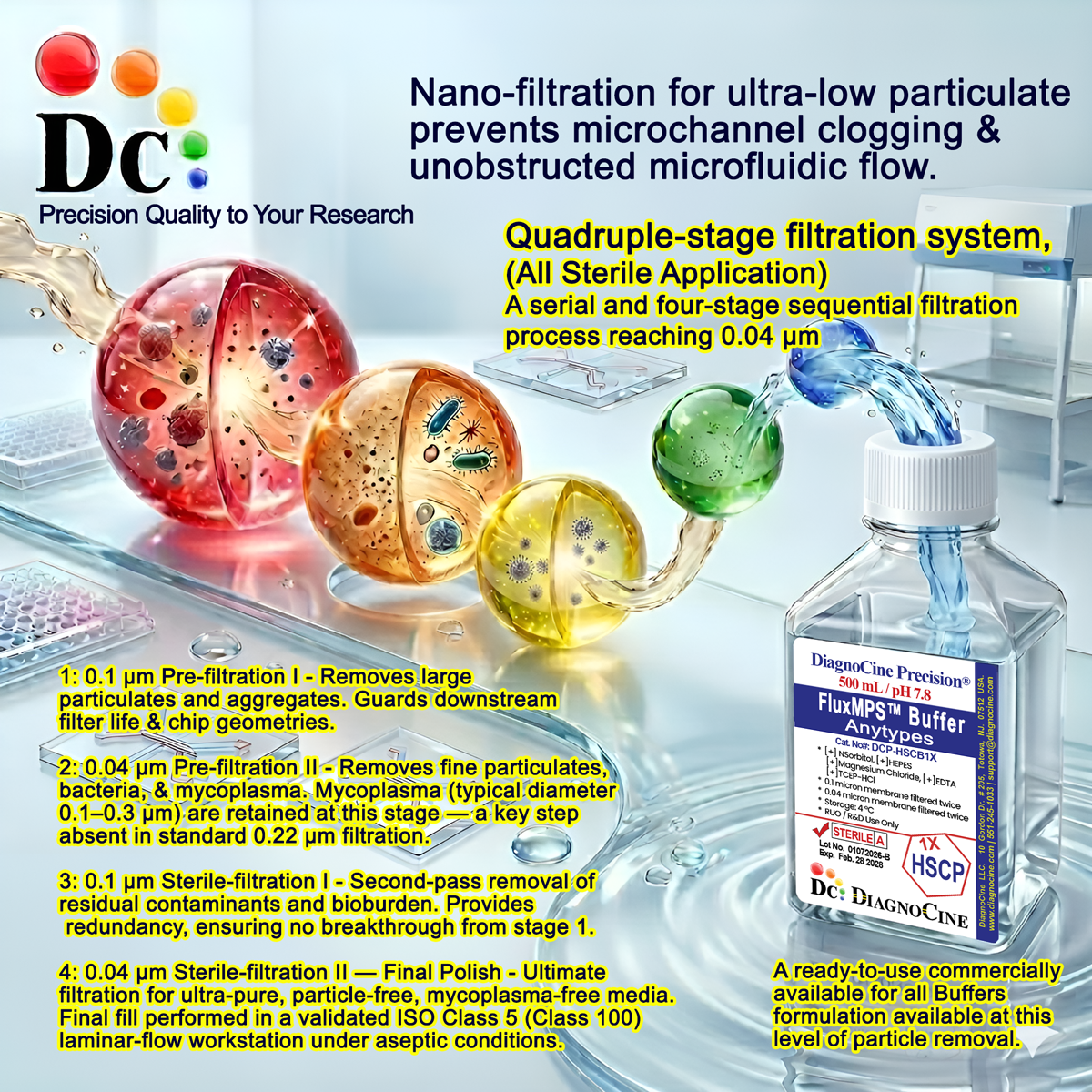
UltraClean PVSA-PBS, 1X is sterile-filtered through a 0.1 µm membrane twice and a 0.04 µm membrane twice, a four-stage sequence engineered to minimize particulate load and exclude bioburden from RNA-sensitive preparations.
-
1
0.1 µm Pre-filtration I
First-pass removal of large particulates and aggregates, extending the service life of downstream membranes.
-
2
0.04 µm Pre-filtration II
Fine particulate and bioburden retention ahead of the second filtration pass.
-
3
0.1 µm Sterile-filtration I
Second-pass redundancy through a 0.1 µm membrane for consistent sterility assurance.
-
4
0.04 µm Sterile-filtration II — Final Polish
Final 0.04 µm polish helps exclude organisms as small as mycoplasma, the smallest of which can measure about 0.2 microns, supporting a mycoplasma-controlled buffer.
Performance vs. conventional buffer
Sequential 0.1 µm and 0.04 µm filtration, each applied twice, removes finer particulates than a single 0.22 µm pass typical of conventional PBS, without added calcium or magnesium that could otherwise activate nucleases or affect cell adhesion.
© Diagnocine® — DCP-PBSPVSA1X
Where UltraClean PVSA-PBS, 1X performs
An isotonic, RNase-safe 1X PBS formulated for RNA-sensitive molecular biology and cell biology workflows requiring strict nuclease control.
Automated Bioreactors & Robotics
For automated perfusion and robotic liquid-handling platforms, an optional 0.01 µm (10 nm) ultra-filtered variant of this buffer is available on request to further protect fine valves and sensors.
- Total Particulate Exclusion for closed-loop perfusion systems
- Valve & Sensor Protection in automated dispensing hardware
- Extended Perfusion Stability for long-duration bioreactor runs
Inquiry Required: Contact support@diagnocine.com to request the 0.01 µm ultra-filtered grade of this buffer.
Micro Physiological System (MPS) & Chip
Isotonic, RNase-safe PBS suited to microfluidic channels and RNA-containing preparations in chip-based systems.
RNA Extraction and Purification
RNase-safe wash and resuspension buffer for columns, magnetic beads, or cell pellets in RNA isolation workflows.
RNA Handling and Storage
Washing, resuspension, and temporary storage of RNA-containing samples, cells, or tissues where RNase control is critical.
General Molecular Biology & Gentle Cell Handling
Isotonic PBS with enhanced RNA protection for gentle handling of cells and primary tissue preparations.
Immunostaining on RNA-Sensitive Samples
RNase-safe buffer for immunostaining steps performed alongside RNA-containing sample preparations.
RNA FISH / In Situ Hybridization
Preparation and washing of samples and probes in RNA fluorescence in situ hybridization and related hybridization assays.[4]
Specifications at a glance
Values as declared for UltraClean PVSA-PBS, 1X (Cat. No. DCP-PBSPVSA1X).
| Parameter | Specification |
|---|---|
| Formulation | PBS supplemented with PVSA (RNase-safe) |
| Appearance | Colorless, clear solution; free of visible particulates |
| pH USP <791> | 7.4 |
| Buffer salt molarity | NaCl 137 mM; KCl 2.7 mM; Na2HPO4 10.1 mM; KH2PO4 1.76 mM |
| PVSA concentration | 1 g/L |
| Divalent cations | Free of added calcium and magnesium |
| Parameter | Specification |
|---|---|
| Sterility | Sterile |
| Filtration system | 0.1 µm membrane twice and 0.04 µm membrane twice |
| Water quality | Ultrapure, nuclease-free water (Type 1, 18.2 MΩ·cm) |
| Manufacturing standard ISO 13485 | ISO 13485-certified, CE-approved facilities |
| Parameter | Specification |
|---|---|
| Storage temperature | 2–8°C |
| Freeze-thaw | Do not freeze |
| Shelf life | 12 months |
| Parameter | Specification |
|---|---|
| Raw material grade | Molecular biology-grade components |
| Manufacturing QMS | ISO 13485-certified |
| Regulatory alignment | CE-approved facilities |
| Production & QA site | Final packaging, QA, and testing at the Diagnocine R&D and Quality Testing Center; customization and assembly at Diagnocine Precision, Totowa, New Jersey, USA |
| Intended use | Research Use Only (RUO) |
Full composition
Ready-to-use 1X buffer formulated from molecular biology-grade components with per-lot quality control.
| Component | CAS Number | Concentration |
|---|---|---|
| Sodium Chloride (NaCl) | 7647-14-5 | 137 mM |
| Potassium Chloride (KCl) | 7447-40-7 | 2.7 mM |
| Sodium Phosphate Dibasic (Na2HPO4) | 7558-79-4 | 10.1 mM |
| Potassium Phosphate Monobasic (KH2PO4) | 7778-77-0 | 1.76 mM |
| PVSA (Polyvinylsulfonic Acid) | 1 g/L | |
| Water (Ultrapure, nuclease-free) | 7732-18-5 | To volume |
Manufacturing & compliance
Produced under a controlled quality system with per-lot verification prior to release.
ISO 13485:2016 QMS
Manufactured under ISO 13485-certified, CE-approved facilities (suppliers of Diagnocine Precision).
Ultrapure Type 1 Water
Formulated with ultrapure, nuclease-free water (18.2 MΩ·cm) to protect RNA integrity.
ISO Class 5 Fill & Finish
Final packaging, quality assurance, and testing performed at the Diagnocine R&D and Quality Testing Center.
Micro-Batch Precision
Customization and assembly for specific requests are accomplished at Diagnocine Precision in Totowa, New Jersey, USA.
RNase Control & Sterility USP <71>
PVSA-supplemented, sterile formulation for RNase-safe handling of RNA-containing preparations.
Filtration Validation
0.1 µm membrane twice and 0.04 µm membrane twice, preventing mycoplasma contamination.
pH Verification USP <791>
Formulated and verified at pH 7.4 for physiological compatibility.
Documentation & CoA
Certificate of Analysis available for lot-specific appearance, pH, and manufacturing data.
How DCP-PBSPVSA1X compares
Comparing UltraClean PVSA-PBS, 1X against conventional 0.22 µm-filtered PBS formulations.
| Parameter | DCP-PBSPVSA1X (FluxMPS™) | Conventional PBS (0.22 µm filtered) | Standard Alternative (0.22 µm filtered) |
|---|---|---|---|
| RNase inhibition (PVSA) | check_circle | cancel | cancel |
| Final filtration pore size | 0.04 µm | 0.22 µm | 0.22 µm |
| Number of filtration stages | 4 | 1 | 1 |
| Divalent cation content | Free of added Ca2+/Mg2+ | Varies | Varies |
| Water quality | Ultrapure Type 1 (18.2 MΩ·cm) | Standard purified water | Standard purified water |
| Manufacturing QMS | check_circle ISO 13485 | cancel | cancel |
| RNA workflow compatibility | check_circle | cancel | cancel |
| pH reproducibility | 7.4 defined | Variable | Variable |
| Custom formulation | check_circle | cancel | cancel |
Frequently asked questions
Answers to common questions about UltraClean PVSA-PBS, 1X.
Supporting literature
Curated peer-reviewed literature relevant to RNase-safe buffer design, PVSA-based RNase inhibition, and microfluidic / organ-on-a-chip perfusion.
- Bhatia SN, Ingber DE. Microfluidic organs-on-chips. Nat Biotechnol. 2014. doi:10.1038/nbt.2989
- Zhang B, Radisic M. Organ-on-a-chip devices advance to market. Lab Chip. 2017. doi:10.1039/C6LC01554A
- Blackburn P, Wilson G, Moore S. Ribonuclease inhibitor from human placenta: interaction with derivatives of ribonuclease A. J Biol Chem. 1977.
- Femino AM, Fay FS, Fogarty K, Singer RH. Visualization of single RNA transcripts in situ. Science. 1998. doi:10.1126/science.280.5363.585
- Bustin SA, et al. The MIQE guidelines: minimum information for publication of quantitative real-time PCR experiments. Clin Chem. 2009. doi:10.1373/clinchem.2008.112797
- Dulbecco R, Vogt M. Plaque formation and isolation of pure lines with poliomyelitis viruses. J Exp Med. 1954.
- Van Meer BJ, et al. Small molecule absorption by PDMS in the context of drug response bioassays. Biochem Biophys Res Commun. 2017. doi:10.1016/j.bbrc.2016.11.062
- Sanjana NE, Fuller SB. A fast flexible ink-jet printing method for patterning dissociated neurons in culture. J Neurosci Methods. 2004.
- Huh D, et al. Reconstituting organ-level lung functions on a chip. Science. 2010. doi:10.1126/science.1188302
- Srinivasan B, et al. TEER measurement techniques for in vitro barrier model systems. J Lab Autom. 2015. doi:10.1177/2211068214561025