CATAROSEV™, Multi-Pack, 5 pcs
CATAROSEV™, Multi-Pack, 5 pcs
Purify and recover high-yield exosomes in approximately 30 minutes through three simple steps—adsorption, washing, and elution.
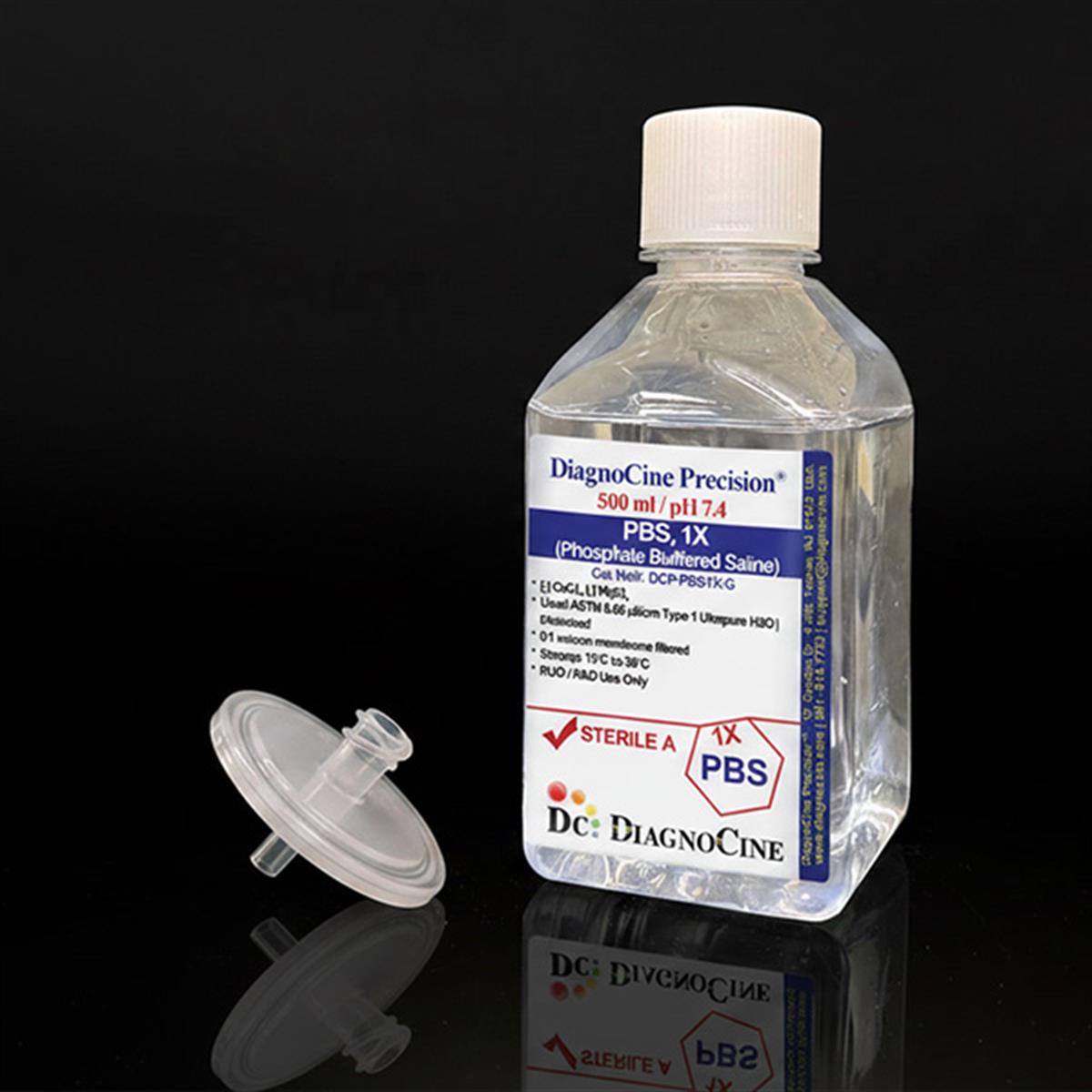
Free gift included. This kit includes a free 500 mL bottle of FluxMPS Phosphate-Buffered Saline (PBS) for your convenience.
What are exosomes?
Exosomes are a type of extracellular vesicle, typically about 100 nanometers in diameter, enclosed by a lipid bilayer membrane and secreted by cells. They are present in various bodily fluids, such as blood and urine, and circulate throughout the body.
Exosomes are rich in biologically active substances and are increasingly recognized as crucial messengers in intercellular communication.
There are high expectations for their application in diagnosing and treating a wide range of diseases, including cancer, as well as in regenerative medicine, driving intensive research worldwide and attracting significant attention.
What Makes Our Exosome Recovery Technology Outstanding!
Refining technology
Exosome recovery steps
Without cumbersome pretreatment, our technology enables purification and recovery of exosomes in approximately 30 minutes* through three simple steps: adsorption, washing, and elution.
*The time required for recovery process from 5 mL of culture supernatant (HEK293.2sus).
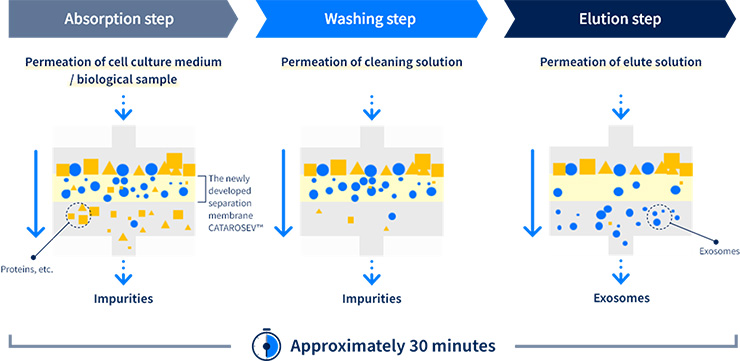
Toyobo’s CATAROSEV™ exosome recovery kit purifies and recovers exosomes through a straightforward workflow of adsorption, washing, and elution—steps that involve solution permeation.
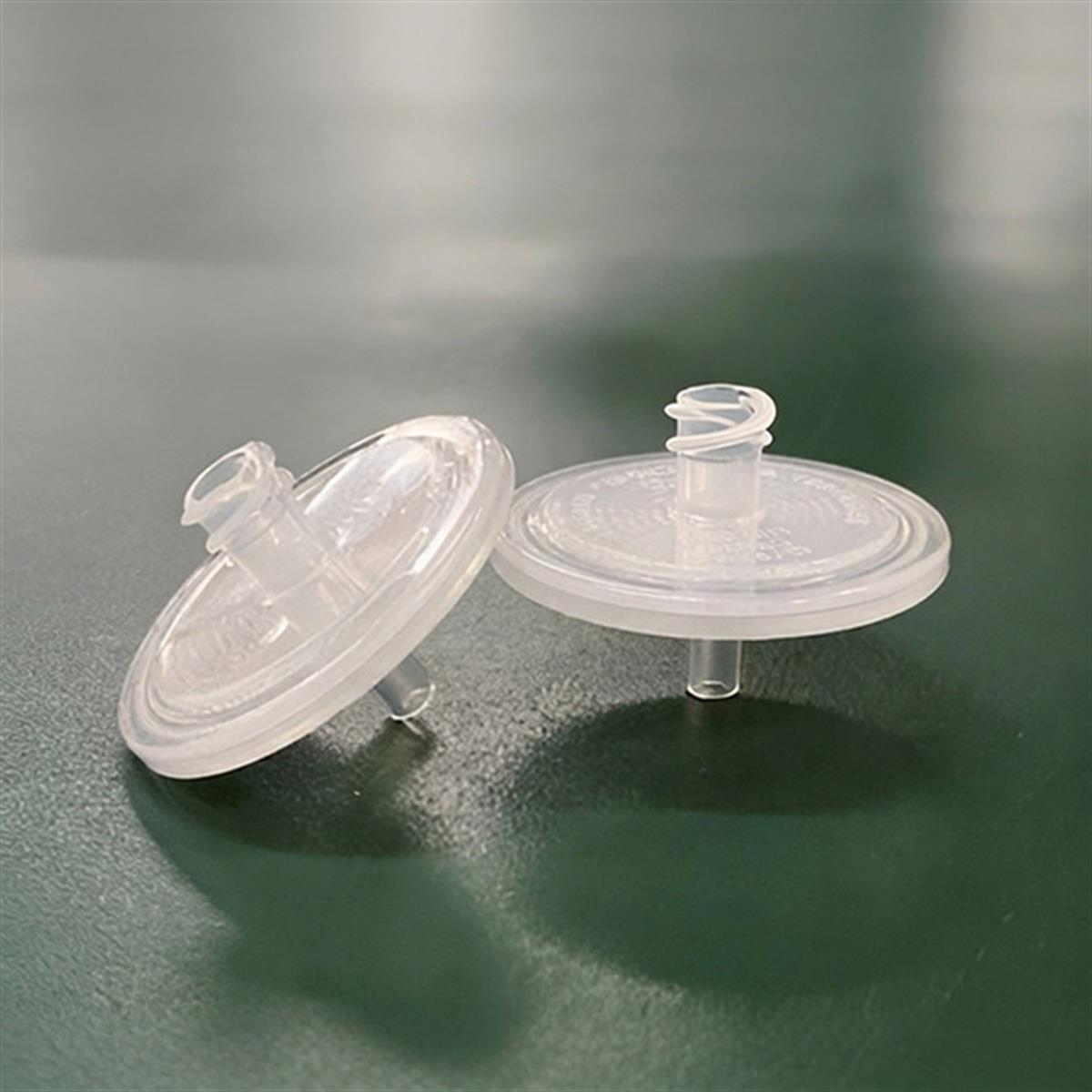
CATAROSEV™ is a separation membrane with positively charged pores approximately 200 nanometers in diameter. In the adsorption step, it selectively captures fine particles such as exosomes and microvesicles by exploiting the electrostatic attraction between negatively charged exosomes and the positively charged membrane. Through this process, most impurities, such as proteins in biological samples, are removed.
In the washing step, any remaining impurities are removed using a washing solution.
Finally, in the elution step, high-purity exosomes are recovered by selectively eluting the adsorbed exosomes with a salt-containing elution solution.
Comparison of CATAROSEV™ with other exosome recovery methods
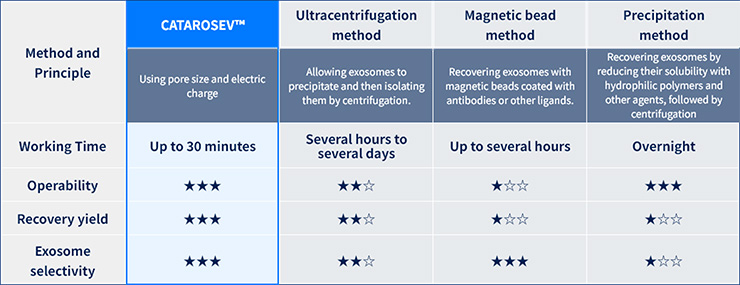
CATAROSEV™, a novel technique developed by Toyobo, requires a shorter working time and offers superior operability and yield compared with conventional methods. It can also selectively recover particles 50 to 150 nanometers in diameter, which are rich in exosomes.
Comparison of exosome yield
Compared with other methods, CATAROSEV™ delivers superior exosome yield, an advantage expected to shorten processing times and improve the efficiency of exosome purification for research and development.
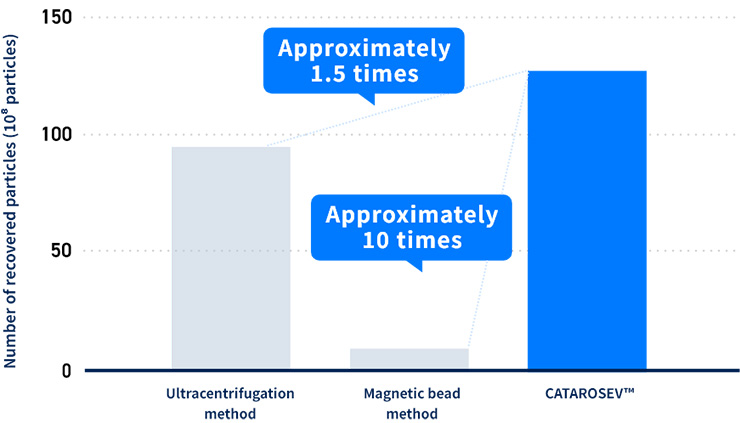
The exosome yield achieved by Toyobo’s novel technique is approximately 50% higher than that of the ultracentrifugation method and more than 10 times higher than that of a competing method.
Comparison of exosome particle diameters
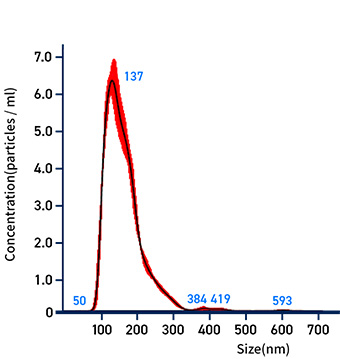
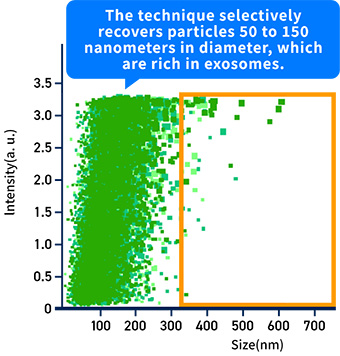
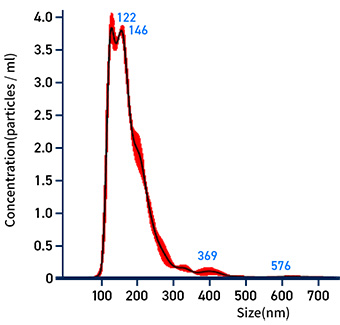
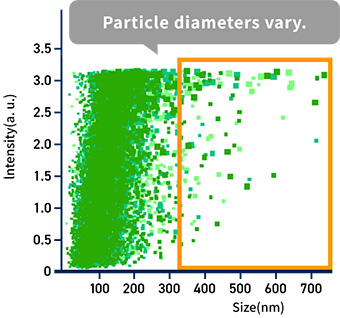
Compared with the ultracentrifugation method, CATAROSEV™ selectively recovers particles 50 to 150 nanometers in diameter, which are rich in exosomes.
Particle analysis by NanoSight
Exosomes recovered from cell culture supernatants by the ultracentrifugation method and by the novel CATAROSEV™ technique were each diluted to an appropriate concentration with ultrapure water. Particle diameter and concentration were then analyzed using a NanoSight NS300.
* These values are based on our internal test data and are not guaranteed.
- Toyobo’s novel technique fractionates particles within the typical exosome diameter range (50–150 nanometers).
- Compared with the centrifugation method, exosome purity is higher with CATAROSEV™.
Comparison of recovered exosome amounts by Western blotting
Samples recovered from HEK293 cell culture supernatant using ultracentrifugation and the new technology (CATAROSEV™) were electrophoresed and subsequently analyzed by Western blotting using anti-Tsg101, anti-CD63, and anti-CD9 antibodies.
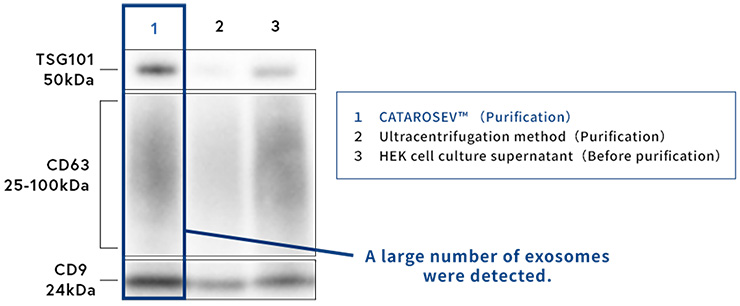
Larger amounts of exosomes were recovered with the CATAROSEV™ technique than with the ultracentrifugation method.
Frequently Asked Questions
Everything you need to know about CATAROSEV™ and its technology.