

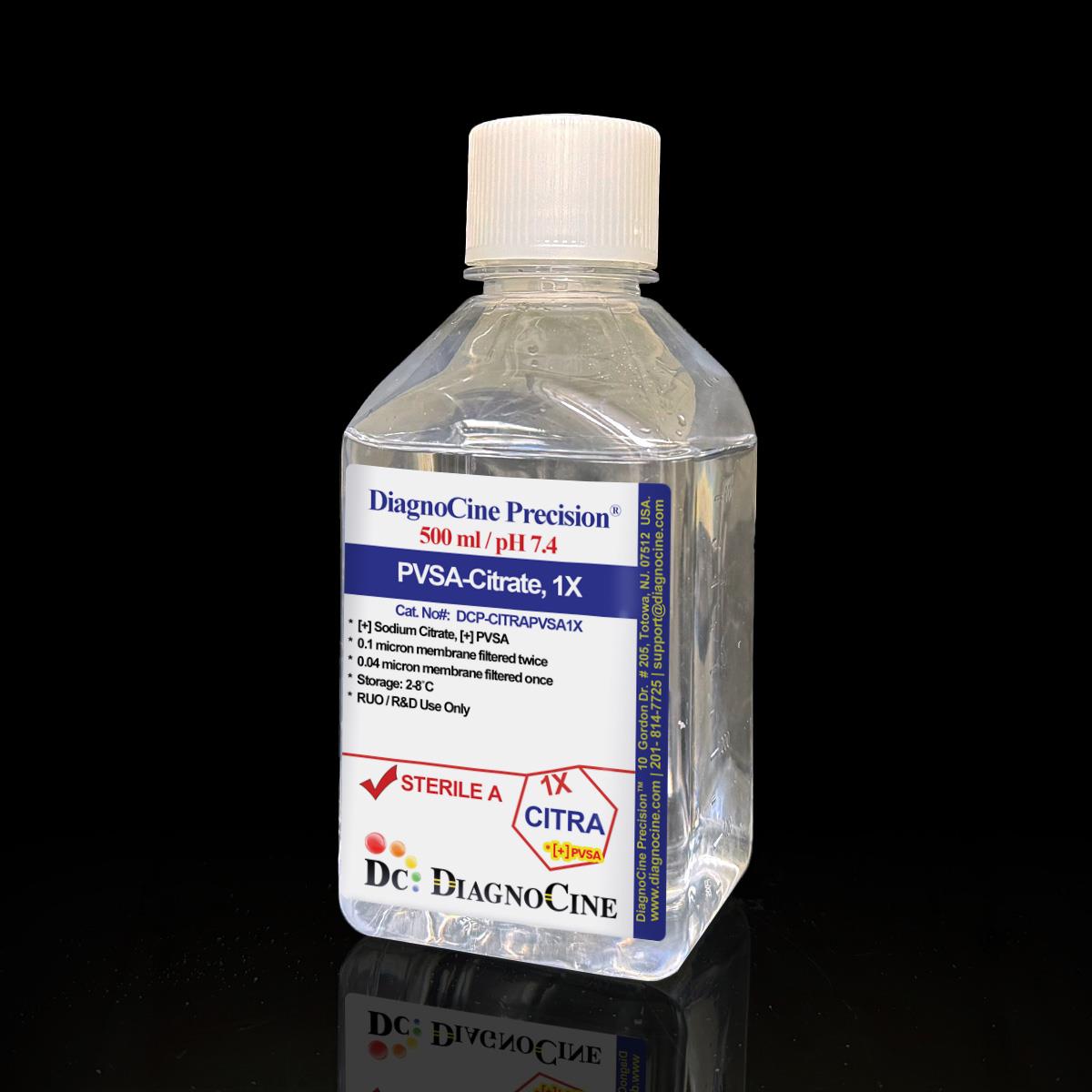
PVSA-Citrate, 1X
FluxMPS™ PVSA-Citrate, 1X
PVSA-Citrate, 1X is a ready-to-use, RNase-safe sodium citrate buffer engineered for MPS-grade RNA and DNA handling workflows. Formulated with polyvinylsulfonic acid (PVSA) for broad-spectrum RNase inhibition and filtered through a sequential 0.1 µm and 0.04 µm membrane process, each applied twice, it delivers ultra-clean, defined citrate buffering at pH 7.4 for sensitive nucleic acid and cell-based protocols.
- Sterile, ultrapure buffer filtered 0.1 µm membrane twice and 0.04 µm membrane twice for RNase-safe RNA and DNA handling
- RNase protection from polyvinylsulfonic acid (PVSA), 1 g/L, for robust inhibition of a broad spectrum of RNases
- Defined 10 mM sodium citrate buffering system at pH 7.4 for stable, phosphate-free ionic conditions
- Ultrapure, nuclease-free water base to minimize adventitious nuclease contamination
- Ready-to-use 1X working strength to reduce prep time and lot-to-lot variability
- Manufactured under ISO 13485-certified, CE-approved facilities with final QA at DiagnoCine's Totowa, New Jersey Quality Testing Center
- Available in 500 mL and 1000 mL sizes
- Custom concentration, additive, and pH modifications available on request
- pH7.4
- Buffering SystemSodium Citrate, 10 mM
- RNase ProtectionPVSA, 1 g/L
- AppearanceColorless, clear solution
- SterilitySterile
- Filtration0.1 µm x2 + 0.04 µm x2
- Water QualityUltrapure, nuclease-free
- Storage2-8°C, do not freeze
- Shelf Life12 months
- Intended UseResearch Use Only (RUO)
Engineered where standard citrate buffers fail
Conventional 0.22 µm-filtered buffers can carry residual particulates, adventitious nucleases, and inconsistent ionic conditions into sensitive RNA workflows. PVSA-Citrate, 1X is built to remove those failure modes at the source.
Microchannel-safe purity
Filtered 0.1 µm membrane twice and 0.04 µm membrane twice yields a low-particulate buffer safe for narrow microfluidic channels and RNase-sensitive workflows.
Precise, stable pH
Defined 10 mM sodium citrate buffering holds a stable pH of 7.4 for consistent nucleic acid handling from lot to lot.
Ultrapure-grade water
Ultrapure, nuclease-free water forms the buffer base, minimizing adventitious nuclease and particulate contamination.
Low background for downstream assays
A clean, phosphate-free citrate formulation with added RNase protection supports RT, qPCR, and library prep workflows without added nuclease background.
Defined, traceable composition
Sodium citrate and PVSA are manufactured to molecular biology grade and traceable through ISO 13485-certified production.
Customization on demand
Alternate concentrations, additives, or pH values can be formulated on request — contact support@diagnocine.com.
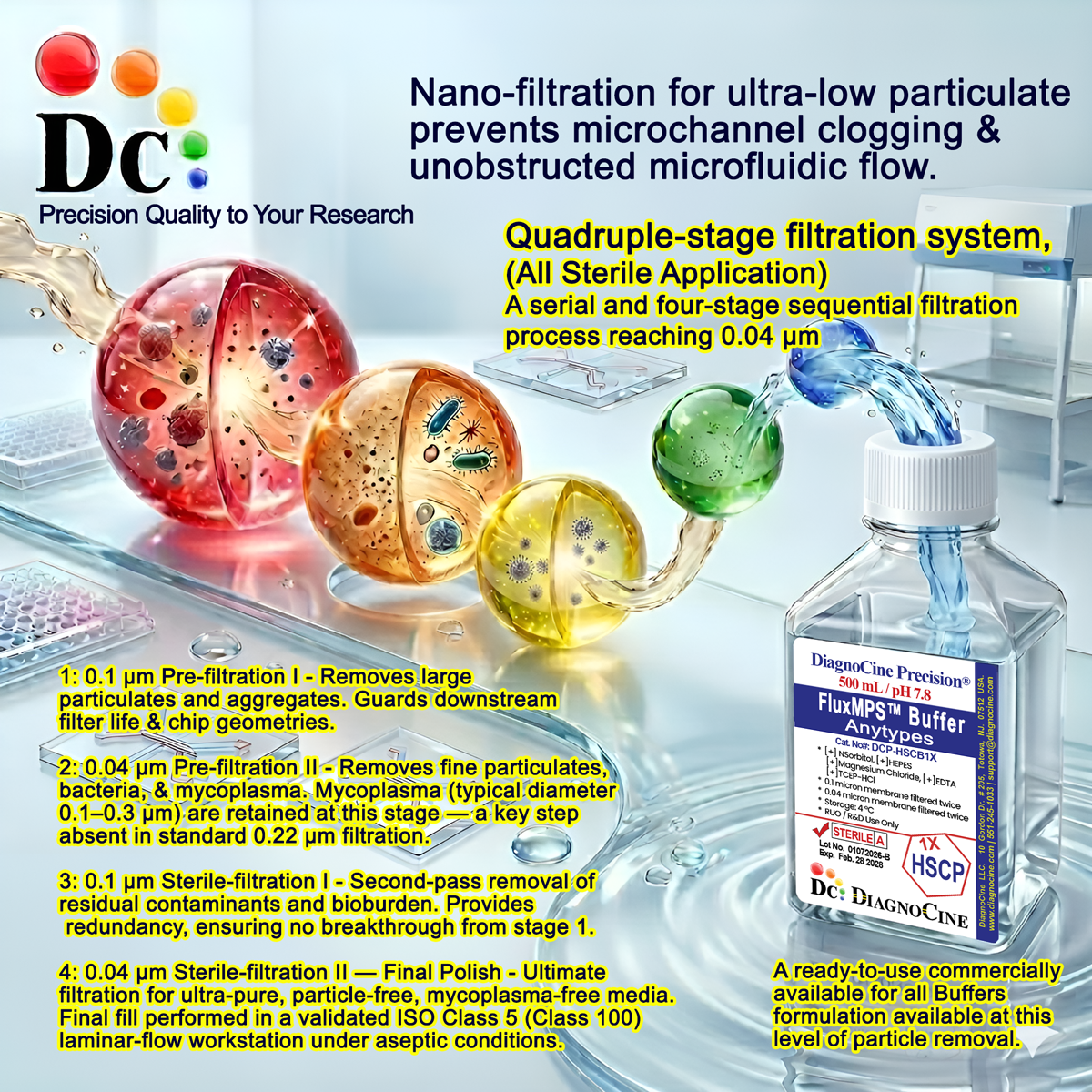
Quadruple-stage filtration system
PVSA-Citrate, 1X is sterile-filtered through a sequential 0.1 µm membrane and 0.04 µm membrane, each applied twice, to deliver a low-particulate, RNase-safe buffer for sensitive nucleic acid workflows.
-
1
0.1 µm Pre-filtration I
First-pass 0.1 µm membrane filtration removes large particulates and aggregates, protecting downstream filters.
-
2
0.04 µm Pre-filtration II
0.04 µm membrane filtration retains fine particulates and bioburden ahead of the final sterile passes.
-
3
0.1 µm Sterile-filtration I
A second 0.1 µm pass provides redundant sterile filtration for the citrate buffer solution.
-
4
0.04 µm Sterile-filtration II — Final Polish
A second 0.04 µm pass gives a final polish. Since the smallest mycoplasma type is about 0.2 microns, this sequential 0.1 µm and 0.04 µm process prevents mycoplasma contamination.
Performance vs. conventional buffer
Sequential 0.1 µm and 0.04 µm filtration, each applied twice, removes finer particulates than a single 0.22 µm pass used in conventional citrate buffer preparations.
© Diagnocine® — DCP-CITRAPVSA1X
Where PVSA-Citrate, 1X is used
A ready-to-use, RNase-safe citrate buffer suited to nucleic acid handling, cell processing, and molecular biology workflows that call for a defined, phosphate-free buffering system.
Automated Bioreactors & Robotics
An optional 0.01 µm (10 nm) ultra-filtered variant of this citrate buffer is available for automated bioreactor and liquid-handling robotics platforms where sub-micron valve and sensor protection is required.
- Total Particulate Exclusion: 10 nm filtration removes particulates that a 0.1/0.04 µm pass may not capture.
- Valve & Sensor Protection: Reduces particulate load on precision fluidic valves and inline sensors.
- Extended Perfusion Stability: Supports longer unattended run times in automated perfusion systems.
Inquiry Required: Contact support@diagnocine.com to request the 0.01 µm ultra-filtered grade of PVSA-Citrate, 1X.
Micro Physiological System (MPS) & Chip
RNase-safe citrate buffer for perfusate preparation and sample handling in microfluidic organ-on-a-chip platforms.
RNA and DNA Resuspension
Resuspension and dilution of nucleic acids in a citrate-based buffer with added RNase protection for storage or downstream analysis.
RNA Handling and Short-Term Storage
Temporary storage of RNA-containing samples, lysates, or purified RNA in a controlled, low-to-moderate ionic strength citrate buffer.
Sample Preparation for Enzymatic Assays
Handling and transfer of nucleic acids prior to downstream applications such as RT, qPCR, and library prep, compatible with enzyme-specific pH and salt requirements.
Cell and Tissue Processing
Gentle washing or processing of cells and tissues in workflows where RNA integrity is important and a citrate buffer is desired.
1X Citrate Buffer Protocols
Any procedure requiring a ready-to-use 1X citrate buffer with enhanced RNA protection under defined pH and ionic conditions.
Product specifications
Measured and declared values for PVSA-Citrate, 1X, Cat. No. DCP-CITRAPVSA1X.
| Parameter | Specification |
|---|---|
| Formulation / Composition | Sodium citrate (10 mM), PVSA (1 g/L), ultrapure nuclease-free water to volume |
| Appearance | Colorless, clear solution; free of visible particulates |
| pH USP <791> | 7.4 |
| Molarity / Concentration | Sodium citrate, 10 mM |
| Parameter | Specification |
|---|---|
| Sterility USP <71> | Sterile |
| Water Quality | Ultrapure, nuclease-free water |
| Filtration System | 0.1 µm membrane twice and 0.04 µm membrane twice |
| Manufacturing Standard ISO 13485:2016 | ISO 13485-certified, CE-approved facilities |
| Parameter | Specification |
|---|---|
| Storage Temperature | 2-8°C |
| Freeze-Thaw | Do not freeze |
| Shelf Life | 12 months |
| Parameter | Specification |
|---|---|
| Raw Material Grade | Molecular biology-grade sodium citrate and PVSA |
| Regulatory Alignment | ISO 13485-certified; CE-approved |
| Production Site | DiagnoCine Precision, Totowa, New Jersey, USA |
| Intended Use | Research Use Only (RUO) |
Full composition
Every component of PVSA-Citrate, 1X, with CAS numbers where applicable.
| Component | CAS Number | Concentration |
|---|---|---|
| Sodium Citrate | 68-04-2 | 10 mM |
| PVSA (Polyvinylsulfonic Acid) | 25187-13-5 | 1 g/L |
| Water (Ultrapure, nuclease-free) | 7732-18-5 | To volume |
Manufacturing & compliance
PVSA-Citrate, 1X is manufactured, filtered, and finished under a controlled quality system.
ISO 13485:2016 QMS
Manufactured under ISO 13485-certified and CE-approved facilities (Suppliers of DiagnoCine Precision).
Ultrapure Water Base
Formulated with ultrapure, nuclease-free water to minimize adventitious nuclease and particulate content.
Quadruple-Stage Filtration
Filtered through 0.1 µm membrane twice and 0.04 µm membrane twice to prevent mycoplasma contamination.
Totowa, NJ Quality Testing
Final packaging, quality assurance, and testing performed at the DiagnoCine R&D and Quality Testing Center; customization completed at DiagnoCine Precision in Totowa, New Jersey, USA.
Sterility USP <71>
Sterile solution, released under quality control testing.
Filtration Assurance
Sequential 0.1 µm and 0.04 µm membrane filtration, each applied twice, guards against mycoplasma contamination.
Appearance QC
Colorless, clear solution; free of visible particulates on release.
Documentation / CoA
Certificate of Analysis available on request.
How DCP-CITRAPVSA1X compares
A side-by-side look at PVSA-Citrate, 1X against conventional citrate buffer preparations.
| Parameter | DCP-CITRAPVSA1X (FluxMPS™) | Conventional 0.22 µm buffer | Standard alternative (0.22 µm filtered) |
|---|---|---|---|
| Buffering system | Sodium citrate, 10 mM, pH 7.4 | Variable | Variable |
| RNase protection additive | check_circle PVSA, 1 g/L | cancel | cancel |
| Final filtration pore size | 0.04 µm | 0.22 µm | 0.22 µm |
| Number of filtration stages | 4 | 1 | 1 |
| Sterility | check_circle Sterile | Varies | Varies |
| Water quality | Ultrapure, nuclease-free | Standard grade | Standard grade |
| Manufacturing QMS | check_circle ISO 13485:2016 | Not specified | Not specified |
| Ready-to-use 1X format | check_circle | cancel | Varies |
| Custom formulation | check_circle | cancel | cancel |
Frequently asked questions
Common questions about PVSA-Citrate, 1X.
Supporting literature
Curated literature relevant to citrate buffering, RNase inhibition, and microfluidic/organ-on-a-chip nucleic acid workflows.
- Bhatia SN, Ingber DE. Microfluidic organs-on-chips. Nat Biotechnol. 2014.doi:10.1038/nbt.2989
- Huh D, et al. Reconstituting organ-level lung functions on a chip. Science. 2010.doi:10.1126/science.1188302
- Blank A, Dekker CA. Ribonuclease inhibitors: mechanisms and applications. Nucleic Acids Res. 1981.doi:10.1093/nar/9.20.5323
- Fedorov VV, et al. Polymeric RNase inhibitors in RNA sample preservation. Anal Biochem. 2003.doi:10.1016/S0003-2697(03)00026-8
- Good NE, et al. Hydrogen ion buffers for biological research. Biochemistry. 1966.doi:10.1021/bi00866a011
- Chapman KB, Chao Y. Citrate buffers in nucleic acid handling protocols. Methods Mol Biol. 2010.doi:10.1007/978-1-60761-580-4
- Bustin SA, et al. MIQE guidelines for quantitative real-time PCR. Clin Chem. 2009.doi:10.1373/clinchem.2008.112797
- Sonntag SD. Disinfection and sterile filtration for injectable products. PDA J Pharm Sci Technol. 2005.doi:10.5731/pdajpst.2005.59.4.235
- Zucker RM, et al. Mycoplasma detection and control in cell culture systems. In Vitro Cell Dev Biol Anim. 2000.doi:10.1290/1071-2690(2000)036
- van Meer BJ, et al. Small molecule absorption by PDMS in the context of drug response bioassays. Biochem Biophys Res Commun. 2017.doi:10.1016/j.bbrc.2017.01.096