

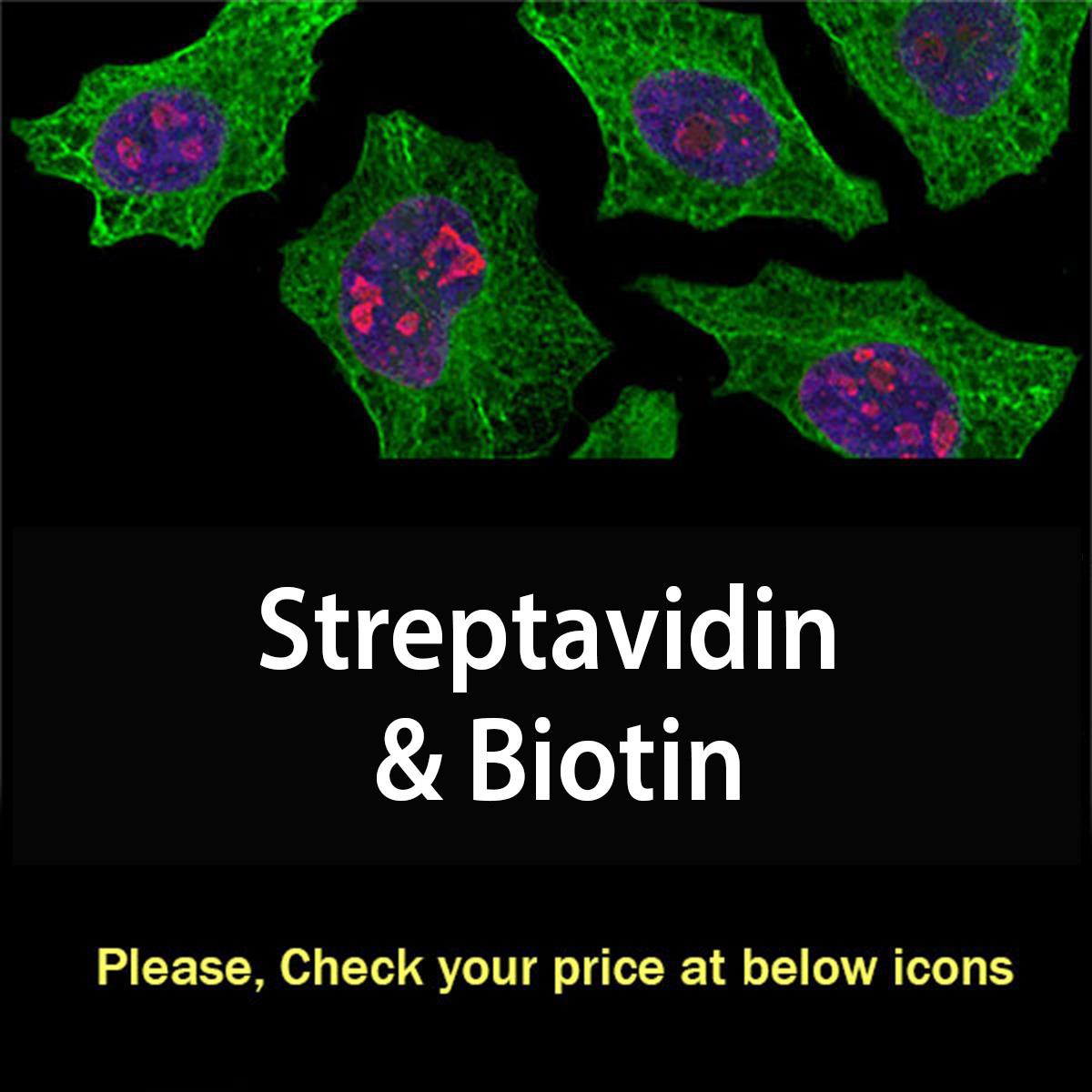
Streptavidin & Biotin
Product#: DC-Streptavidin-Biotin
$0.00
Select BIOACT
- Check below icons
Availability:
Ships in 24 hours
Fluorescent Streptavidin & Biotin
Avidin and streptavidin are both tetrameric proteins composed of four identical subunits, each bind four biotins (vitamin H) per molecule with high binding affinity and specificity (Kd ~ 1015 M for avidin and ~ 1014 M for streptavidin). Although the primary sequence homogeneity of both proteins are 30%, their tertiary and quaternary structure are almost identical, and anti-avidin and anti-streptavidin antibodies are not immunologically cross reactive. Avidin, a 67 KDa glycoprotein with an isoelectric point of about 10.5, has the higher affinity than streptavidin, however it also displays more nonspecific binding and aggregation due to its oligosaccharide component (mannose and N-acetylglucosamine) and positive charge. Streptavidin is smaller (53 KDa) and has a little lower affinity than avidin yet displays less non-specific binding due to near-neutral pI value and lack of carbohydrates. Biotin, a 244 dalton vitamin found in all living cells, binds with high affinity to avidin and streptavidin. In biotechnology, biotin is conjugated to antibodies, enzymes, reporter to form the tetravalent binding nature of biotin-avidin/streptavidin complex. The valeric acid side of biotin can be incorporated with various functional groups, reporters and fluorophores that can be utilized in a wide range of biological structures and processes. Biotin-avidin/streptavidin binding has high affinity, which has been utilized in diverse applications such as ELISA, immunohistochemistry, cell surface labeling, affinity purification, FACS, EMSA, etc. The bond formation between biotin and avidin/streptavidin is very rapid, and once formed, is stable at high temperature and in a wide range of pH, organic solvents and denaturing agents. The system is a simple yet elegant and can be incorporated into virtually every immunoassay where an antibody is conjugated with biotin and then detected with avidin or streptavidin conjugated to various commercially available fluorophores and reporters. These features of biotin and avidin/streptavidin are useful for purifying or detecting proteins conjugated to either component of the interaction. Although biotin-avidin/streptavidin system is simple and easy to use, it also has some limitations: biotinylated compounds might non-selectively bind to any biotin-binding protein, endogenous biotin can cause background noise, and harsh conditions are needed to break their interaction that might limit its application. BioActs offers a variety of fluorescent dye conjugated avidin, streptavidin and biotin as effective detecting and analytic probes for diverse applications in biochemical and biological research fields. |
|||||||||||||||||||||||||||||||||
Fluorescent Streptavidin |
|||||||||||||||||||||||||||||||||
 |
 |
 |
 |
 |
|
||||||||||||||||||||||||||||
| 496/516 | 550/565 | 648/663 | 675/691 | 749/774 | 774/806 | ||||||||||||||||||||||||||||
Fluorescent Biotin |
|||||||||||||||||||||||||||||||||
 |
 |
 |
 |
 |
|
||||||||||||||||||||||||||||
| 496/516 | 550/565 | 648/663 | 675/691 | 749/774 | 774/806 | ||||||||||||||||||||||||||||
| Quick link (Cat.#) | Series | Ex * (nm) | Em* (nm) | Molar mass (g/mol) |
| RFP0616 | Biotin, Flamma® 496 | 496 | 516 | 654.64 |
| RFP0605 | Biotin, Flamma® 552 | 550 | 565 | 913.18 |
| RFP0611 | Biotin, Flamma® 648 | 648 | 663 | 927.20 |
| RFP0612 | Biotin, Flamma® 675 | 675 | 691 | 1185.43 |
| RFP0613 | Biotin, Flamma® 749 | 749 | 774 | 951.22 |
| RFP0614 | Biotin, Flamma® 774 | 774 | 806 | 1169.25 |
