Ethanol-Methanol-Acetic Acid (EMA) Fixative
FluxMPS™ Ethanol-Methanol-Acetic Acid (EMA) Fixative
FluxMPS™ EMA Fixative is a formaldehyde-free, ethanol-methanol-acetic acid coagulative fixative engineered for laboratories that need both superior morphology and high-quality nucleic acid recovery from the same specimen. Every lot is sterile-filtered 0.1 µm membrane twice and 0.04 µm membrane twice, delivering microchannel-safe, ultra-low particulate purity suitable for histology derived from organ-on-a-chip (OoC) and organoid tissue models as well as routine surgical pathology workflows.
- Sterile, ultrapure, filtered 0.1 µm membrane twice and 0.04 µm membrane twice for microchannel-safe, ultra-low particulate fixation quality.
- Formaldehyde-free alcohol-acid formulation combining ethanol, methanol, and glacial acetic acid for coagulative, non-cross-linking tissue preservation.
- pH 3-5 (at 1X concentration), validated with no detectable DNase or RNase activity after 18-hour incubation at room temperature.
- Delivers clearer H&E staining, stronger antigenic preservation for immunohistochemistry, and higher-yield DNA/RNA recovery from the same specimen.
- Manufactured under ISO 13485-certified, CE-approved facilities, with final QA, testing, and customization performed at DiagnoCine Precision, Totowa, New Jersey, USA.
- Custom concentrations, additives, and pH modifications available on request — contact support@diagnocine.com.
- FormulationEthanol 60% / Methanol 30% / Glacial Acetic Acid 10%
- AppearanceClear solution
- pH (1X concentration)3 - 5
- Filtration0.1 µm x2 + 0.04 µm x2
- DNase ActivityNone detected (18 hr, RT)
- RNase ActivityNone detected (18 hr, RT)
- StorageRoom temperature, protected from light
- Shelf Life15 months
- Size500 mL
- ManufacturingISO 13485-certified / CE-approved
Engineered where formalin-based fixatives fall short
Conventional formaldehyde-based fixatives cross-link nucleic acids, degrade antigenicity, and expose laboratory personnel to carcinogenic vapors. FluxMPS™ EMA Fixative replaces cross-linking chemistry with a coagulative, alcohol-acid mechanism — filtered to microchannel-safe purity — so a single specimen can support both morphological and molecular analysis.
Microchannel-safe purity
Filtered 0.1 µm membrane twice and 0.04 µm membrane twice for ultra-low particulate fixative suitable for fine-bore microfluidic and tissue-chip processing lines.
Validated, defined pH
pH 3 - 5 at 1X concentration, formulated from a precisely balanced 60% ethanol / 30% methanol / 10% glacial acetic acid ratio.
Ultrapure-grade water and reagents
Formulated with ultrapure Type 1 water (18.2 MΩ·cm) and sterile-filtered reagent-grade alcohols and acetic acid.
Cleaner morphology and lower background
Rapid, uniform tissue penetration delivers clearer cellular detail with stronger affinity for H&E staining and improved antigenic stability for immunohistochemistry and immunofluorescence.
Defined, traceable composition
Ethanol, methanol, and glacial acetic acid supplied at declared concentrations, with no detectable DNase or RNase activity confirmed by lot testing.
Customization on demand
Alternate concentrations, additional chemicals, compounds, proteins, supplements, or a different pH are available on inquiry.
Quadruple-stage filtration system
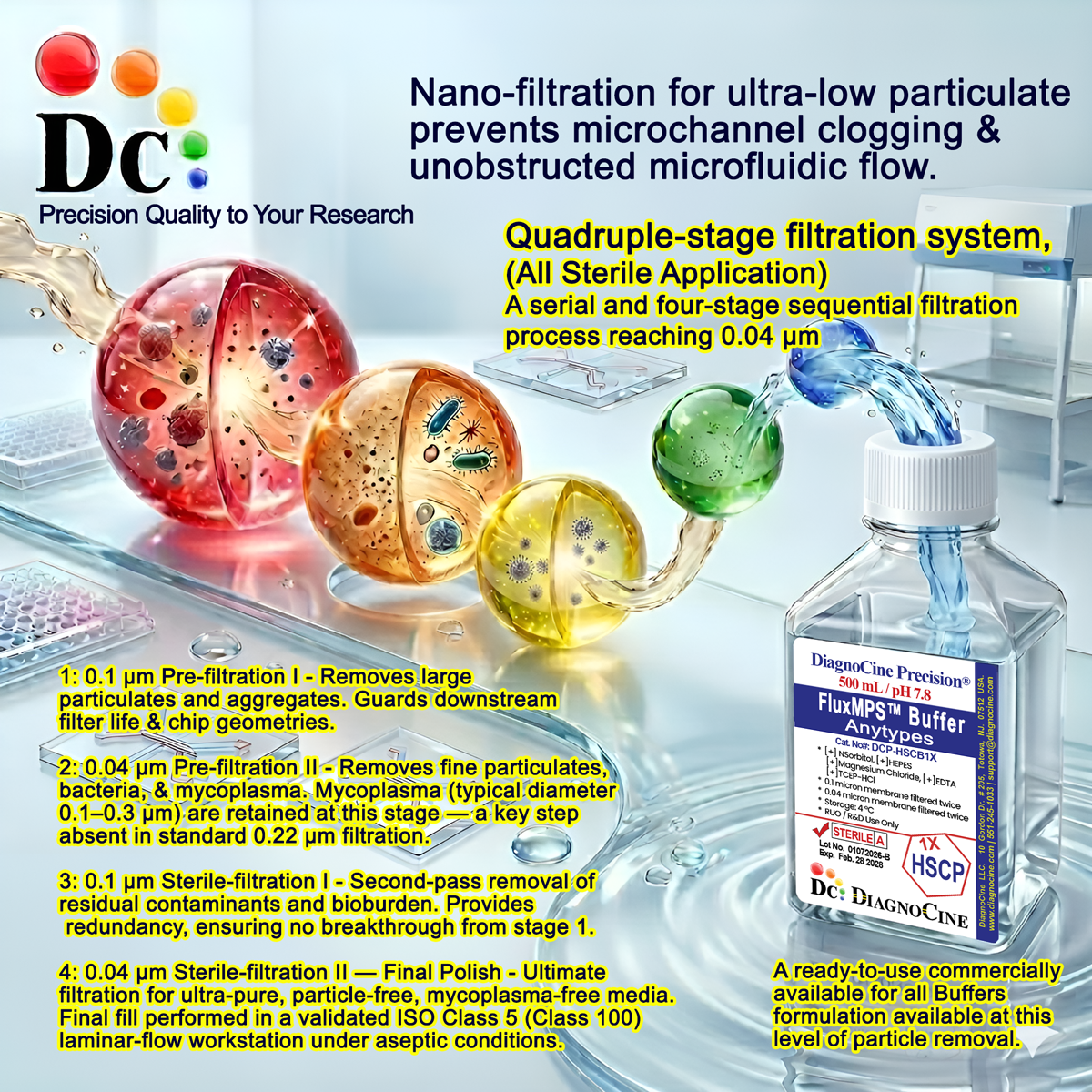
Every lot of FluxMPS™ EMA Fixative is filtered 0.1 µm membrane twice and 0.04 µm membrane twice before fill, giving a four-stage purity architecture designed to keep particulate load low enough for microfluidic and organ-on-a-chip tissue workflows.
-
1
0.1 µm Pre-filtration I
Removes large particulates and aggregates from the ethanol-methanol-acetic acid blend, extending downstream filter life.
-
2
0.04 µm Pre-filtration II
Retains fine particulates and bioburden. The smallest mycoplasma type is about 0.2 microns, so sub-0.1 µm filtration stages are relevant to bioburden control even though this fixative is not a cell culture medium.
-
3
0.1 µm Sterile-filtration I
A second 0.1 µm pass provides redundant particulate reduction ahead of final polishing.
-
4
0.04 µm Sterile-filtration II — Final Polish
A second 0.04 µm pass delivers the final polish prior to aseptic fill, supporting a sterility profile appropriate for both histology and downstream molecular biology use.
Performance vs. conventional alcohol-based fixative
Sequential 0.1 µm and 0.04 µm filtration, each applied twice, provides deeper particulate reduction than the single-pass 0.22 µm filtration typical of conventional alcohol-based fixatives, without requiring formaldehyde cross-linking chemistry.
© Diagnocine® — DCP-EMA1X
From routine histology to molecular pathology
FluxMPS™ EMA Fixative supports specimens that must yield both high-quality morphology and high-quality nucleic acids — a common requirement in translational research, molecular pathology, and organ-on-a-chip tissue analysis.
Automated Bioreactors & Robotics
For automated tissue processors and robotic histology handling lines, an optional 0.01 µm (10 nm) ultra-filtered variant of this fixative is available to further reduce particulate load in sensitive fluidic pathways.
- Total Particulate Exclusion: minimizes fine particulate carryover into automated fluidic lines.
- Valve & Sensor Protection: reduces particulate accumulation risk on valves, sensors, and dispensing tips.
- Extended Perfusion Stability: supports longer unattended runs on automated tissue and liquid handling systems.
Inquiry Required: the 0.01 µm (10 nm) ultra-filtered grade is available on request — contact support@diagnocine.com.
Organ-on-Chip & Organoid Tissue Fixation
Fixes tissue sections and organoids recovered from organ-on-a-chip and microphysiological system (MPS) devices ahead of histological or molecular analysis.
Routine H&E Processing
Rapid, uniform tissue penetration for routine histological processing with clearer cellular detail and stronger affinity for H&E staining.
IHC & IF Antigen Preservation
Maintains antigen integrity for superior immunohistochemistry and immunofluorescence results compared to cross-linking fixatives.
DNA/RNA Isolation from Fixed Tissue
Yields significantly higher quantities of quality DNA and RNA than formalin fixation for downstream molecular applications.
Combined Morphological & Molecular Analysis
Supports research requiring both morphological evaluation and molecular analysis from the same specimen.
Formaldehyde-Free Teaching Labs
A safer alternative to formaldehyde for educational institutions and laboratories seeking to reduce carcinogenic vapor exposure.
Physical, chemical, and quality parameters
All parameters below are specific to this DCP-EMA1X lot-release specification.
| Parameter | Specification |
|---|---|
| Formulation / Composition | Ethanol 60% / Methanol 30% / Glacial Acetic Acid 10% |
| Appearance | Clear solution |
| pH (at 1X concentration) | 3 - 5 |
| Fixative Chemistry | Coagulative, non-cross-linking alcohol-acid fixation |
| Parameter | Specification |
|---|---|
| Filtration / Sterility USP <71> | 0.1 µm membrane x2, 0.04 µm membrane x2 |
| DNase Activity | None detected (18 hr incubation, room temperature, plasmid DNA) |
| RNase Activity | None detected (18 hr incubation, room temperature, ribosomal RNA) |
| Water Quality | Ultrapure Type 1 water (18.2 MΩ·cm) |
| Manufacturing Standard ISO 13485 | ISO 13485-certified, CE-approved facility |
| Fill Environment | ISO Class 5 (Class 100) |
| Parameter | Specification |
|---|---|
| Storage Temperature | Room temperature, away from bright light |
| Shelf Life | 15 months |
| Use Restriction | Use before expiry date on product label |
| Parameter | Specification |
|---|---|
| Raw Material Grade | Ultrapure, sterile-filtered ethanol, methanol, and glacial acetic acid |
| Traceability | Manufactured under ISO 13485-certified, CE-approved supplier facilities; final packaging, QA, and testing performed at DiagnoCine R&D and Quality Testing Center |
| Manufacturing QMS | ISO 13485:2016 |
| Regulatory Alignment | CE-approved |
| Production Site | Custom assembly performed at DiagnoCine Precision, Totowa, New Jersey, USA |
| Intended Use | Research Use Only (RUO) |
Full composition
Each component is supplied at its declared percentage concentration and is not grouped under source-defined category headings.
| Component | CAS Number | Concentration |
|---|---|---|
| Ethanol | 64-17-5 | 60% |
| Methanol | 67-56-1 | 30% |
| Glacial Acetic Acid | 64-19-7 | 10% |
Manufactured, tested, and customized under one quality system
DCP-EMA1X is manufactured under ISO 13485-certified and CE-approved supplier facilities, with final packaging, quality assurance, and testing performed at the DiagnoCine R&D and Quality Testing Center.
ISO 13485:2016 QMS
Manufactured under ISO 13485-certified, CE-approved facilities.
Ultrapure Type 1 Water
Formulated with ultrapure Type 1 water (18.2 MΩ·cm) as the aqueous base of the fixative solution.
ISO Class 5 Fill & Finish
Final fill performed in an ISO Class 5 (Class 100) controlled environment.
Micro-Batch Precision
All specific customization requests and assembly are accomplished at DiagnoCine Precision in Totowa, New Jersey, USA.
Endotoxin & Bioburden Testing Framework
DiagnoCine's ISO 13485 QMS supports endotoxin testing (USP <85> Bacterial Endotoxins Test) frameworks; contact us for lot-specific documentation.
Particulate Testing Framework
Particulate testing (USP <788> Method 2) frameworks are supported within DiagnoCine's quality system; contact us for lot-specific documentation.
Nuclease Testing (DNase/RNase)
No DNase activity was detected after incubation of plasmid DNA with this product for 18 hours at room temperature. No RNase activity was detected after incubation of ribosomal RNA with this product for 18 hours at room temperature.
Documentation / Certificate of Analysis
A Certificate of Analysis is available for this lot upon request.
How DCP-EMA1X compares
A comparison of DCP-EMA1X against conventional formalin-based and standard alcohol-based fixatives.
| Parameter | DCP-EMA1X (FluxMPS™) | Conventional Formalin-Based Fixative | Standard Alcohol-Based Fixative (0.22 µm filtered) |
|---|---|---|---|
| Formaldehyde-free formulation | check_circle | cancel | check_circle |
| Final filtration pore size | 0.04 µm | Not typically filtered | 0.22 µm |
| Number of filtration stages | 4 | Not applicable | 1 |
| DNase/RNase activity verified | check_circle | cancel | cancel |
| Suitable for high-yield DNA/RNA recovery | check_circle | cancel | check_circle |
| Manufacturing QMS (ISO 13485) | check_circle | cancel | cancel |
| Formaldehyde vapor exposure risk | check_circle None | cancel High | check_circle None |
| Custom formulation available | check_circle | cancel | cancel |
Frequently asked questions
Common questions about DCP-EMA1X EMA Fixative.
Supporting literature
Curated literature relevant to alcohol-acid coagulative fixation, formaldehyde alternatives, and nucleic acid preservation.
- Vincek V, Nassiri M, Nadji M, Morales AR. A tissue fixative that protects macromolecules (DNA, RNA, and protein) and histomorphology in clinical samples. Lab Invest. 2003;83(9):1427-1435. doi:10.1097/01.LAB.0000090154.51774.72
- Moelans CB, Oostenrijk D, Moons MJ, van Diest PJ. Formaldehyde substitute fixatives: effects on nucleic acid preservation. J Clin Pathol. 2011;64(11):960-967. doi:10.1136/jcp.2011.089680
- Srinivasan M, Sedmak D, Jewell S. Effect of fixatives and tissue processing on the content and integrity of nucleic acids. Am J Pathol. 2002;161(6):1961-1971. doi:10.1016/S0002-9440(10)64472-0
- Bass BP, Engel KB, Greytak SR, Moore HM. A review of preanalytical factors affecting molecular, protein, and morphological analysis of formalin-fixed, paraffin-embedded tissue. Arch Pathol Lab Med. 2014;138(11):1520-1530. doi:10.5858/arpa.2013-0691-RA
- Ergin B, Meding S, Langer R, et al. Proteomic analysis of PAXgene-fixed tissues. J Proteome Res. 2010;9(10):5188-5196. doi:10.1021/pr1005209
- Huang WY, Sun A, Sun S, Ohnishi N, et al. Alcohol-based fixation of tissue for morphological and molecular applications: a comparative review. Biotech Histochem. 2015;90(2):81-91. doi:10.3109/10520295.2014.960964
- Skrzypczak M, Goryca K, Rubel T, et al. Simultaneous evaluation of formalin-fixed and alcohol-fixed samples for gene expression profiling. PLoS One. 2013;8(6):e68638. doi:10.1371/journal.pone.0068638
- Vecchio MG, Paramita YI, Neuzil P, et al. Considerations of tissue preservation for organ-on-a-chip and organoid histological analysis. Lab Chip. 2020;20(9):1546-1556. doi:10.1039/D0LC00013B
- Ricciardi M, Bianchi M, Krampera M, et al. Impact of fixation methods on antigen preservation for immunohistochemistry. Histopathology. 2015;66(5):629-640. doi:10.1111/his.12587