

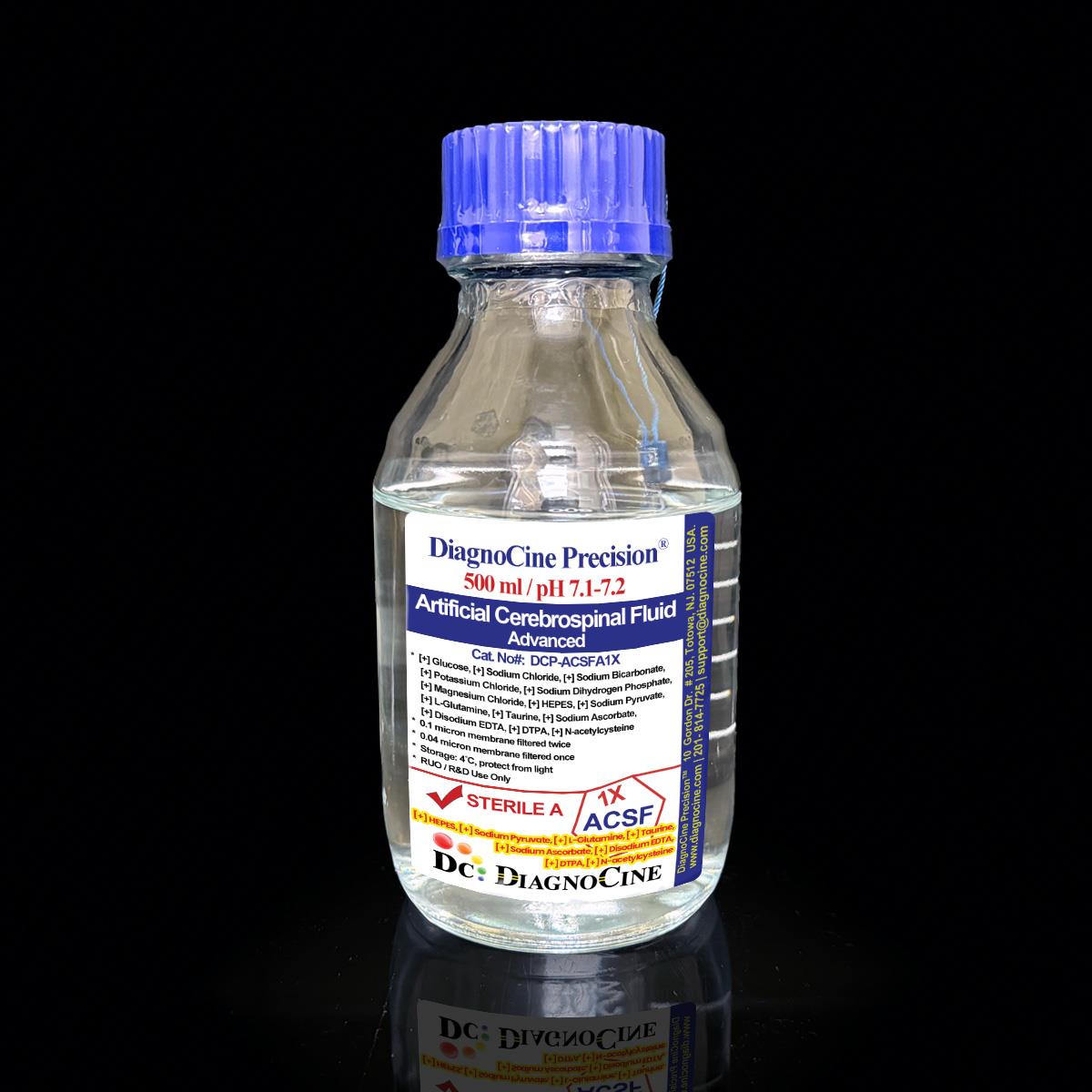
Artificial Cerebrospinal Fluid (ACSF), Advanced
FluxMPS™ Artificial Cerebrospinal Fluid (ACSF), Advanced
An MPS-grade, dual-buffered artificial cerebrospinal fluid engineered for acute brain slice electrophysiology, iPSC-neuron perfusion, and CSF-mimetic microfluidic workflows. Quadruple-stage 0.1 µm / 0.04 µm membrane filtration and a chelator-stabilized antioxidant system deliver microchannel-safe purity while preserving the full physiological ion profile of standard ACSF.
- Quadruple-stage filtration: 0.1 µm membrane filtered TWICE and 0.04 µm membrane filtered TWICE for microchannel-safe purity
- Dual buffering system (HEPES + NaHCO3) for pH stability during handling gaps and after carbogen bubbling
- Endotoxin specification <0.5 EU/mL, sterility tested to USP <71>
- Full physiological ion profile preserved (no NMDG in the final perfusate)
- Elevated glucose, added pyruvate, taurine, and glutamine for extended tissue viability
- Chelator-stabilized (EDTA + DTPA) moderate-ascorbate antioxidant system for realistic shelf stability
- Available in 500 mL fill; pH, molarity, salts, and additives customizable on request
- pH (sealed, 25°C)~7.1-7.2
- pH (post-carbogen, 32-34°C)7.35-7.45
- Osmolality300-315 mOsm/kg
- Buffer SystemDual: HEPES + NaHCO3
- Endotoxin<0.5 EU/mL
- SterilityUSP <71> Pass
- Filtration0.1 µm x2 + 0.04 µm x2
- Storage4°C, protected from light
- Shelf Life (sealed)4 months at 4°C
- ShippingBlue Ice
Engineered where standard ACSF falls short
Conventional 0.22 µm-filtered ACSF can carry subvisible particulates and residual bioburden into fine microfluidic channels and patch pipettes, and single-buffer formulations drift in pH between preparation and use. FluxMPS™ Advanced ACSF is built to address both failure modes at once.
Microchannel-safe purity
Quadruple-stage 0.1 µm x2 / 0.04 µm x2 filtration meets USP <788> particulate limits of ≤25/mL at ≥10 µm and ≤3/mL at ≥25 µm, protecting narrow perfusion lines and slice chambers from clogging.
Precise, stable pH
Dual buffering with HEPES and NaHCO3 holds pH near ~7.1-7.2 sealed at 25°C and settles to 7.35-7.45 within 10-15 minutes of carbogen bubbling, without relying on bicarbonate alone.
Ultrapure-grade water
Formulated in Type 1 water (18.2 MΩ·cm) per USP <85> practice, minimizing trace-ion and organic background in downstream imaging and electrophysiology assays.
Low background for imaging & assays
Clear, colorless, particulate-controlled formulation supports clean confocal imaging and low-noise patch-clamp recordings on acute slices and iPSC-neuron networks.
Defined, traceable composition
A lot-released formulation containing sodium and potassium salts, a dual phosphate/bicarbonate/HEPES buffer set, divalent cations, glucose, pyruvate, taurine, glutamine, sodium ascorbate, and a synergistic EDTA/DTPA chelator pair — keeping the full physiological ion profile of standard ACSF with no NMDG in the final perfusate.
Customization on demand
pH target, molarity, salt composition, and additive content can be adjusted for your protocol — contact support@diagnocine.com.
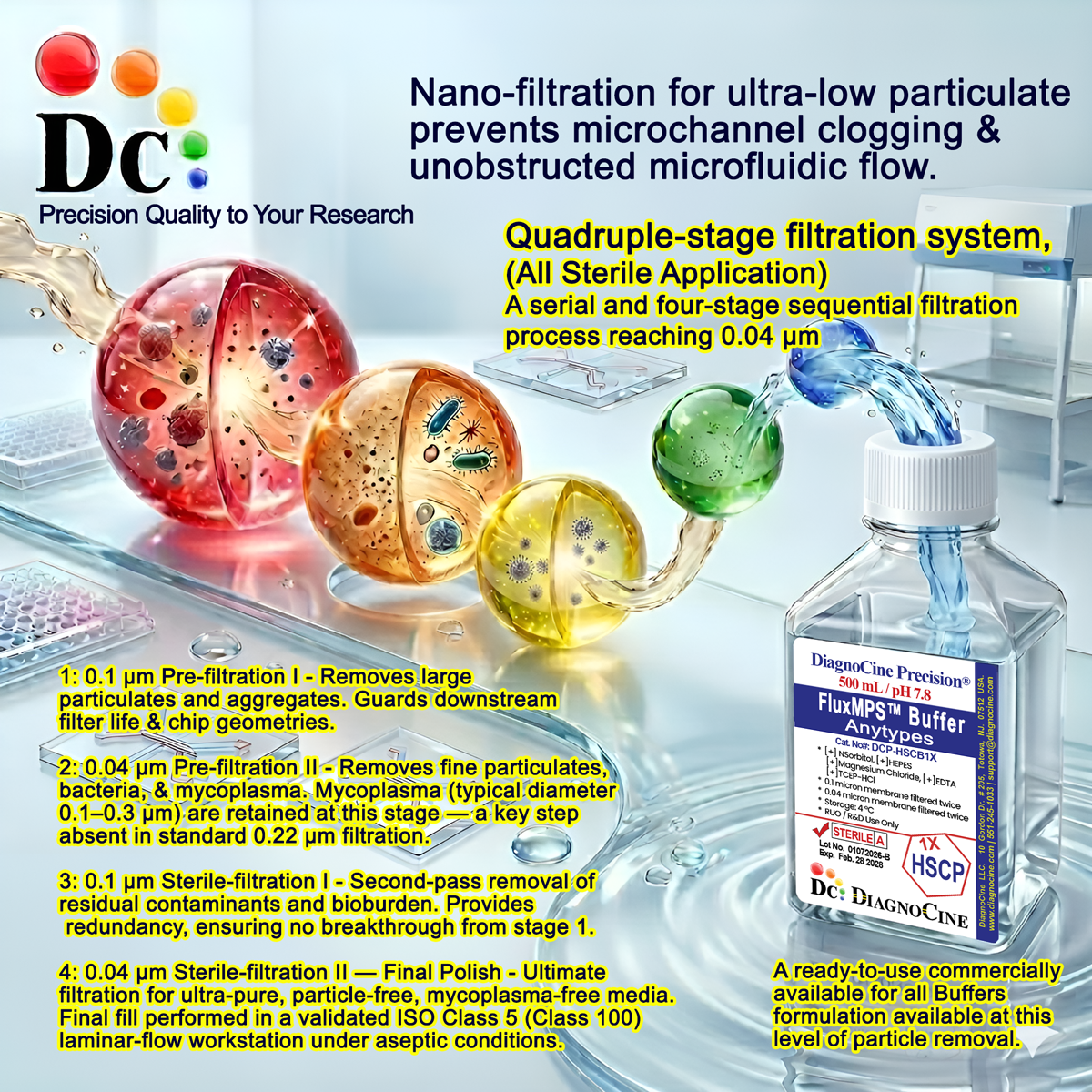
Quadruple-stage filtration system
Every lot of FluxMPS™ Advanced ACSF passes through four sequential filtration stages — 0.1 µm membrane filtration performed TWICE and 0.04 µm membrane filtration performed TWICE — before ISO Class 5 (Class 100) aseptic fill.
-
1
0.1 µm Pre-filtration I
First-pass removal of large particulates and salt/precipitate aggregates, extending the working life of downstream filters.
-
2
0.04 µm Pre-filtration II
Fine-particulate and bioburden retention ahead of final sterile processing.
-
3
0.1 µm Sterile-filtration I
Second-pass 0.1 µm redundancy immediately before final polish, reducing the chance of any single-filter breach reaching the fill line.
-
4
0.04 µm Sterile-filtration II — Final Polish
Final 0.04 µm pass under ISO Class 5 (Class 100) conditions. Because the smallest known mycoplasma organisms are approximately 0.2 micron, a final cutoff at 0.04 µm sits well below that threshold, guarding against mycoplasma-scale contamination.
Performance vs. conventional buffer
A single 0.22 µm pass, typical of conventional ACSF, retains bioburden and particulates that a sequential 0.1 µm / 0.04 µm train removes across four discrete stages, reducing the particulate and bioburden load reaching microfluidic channels and slice chambers.
© Diagnocine® — DCP-ACSFA1X
Where FluxMPS™ Advanced ACSF is used
Formulated for acute brain slice electrophysiology, iPSC-neuron network perfusion, and CSF-mimetic microfluidic and organ-on-a-chip workflows requiring physiological ion balance and stable pH.
Automated Bioreactors & Robotics
An optional 0.01 µm (10 nm) ultra-filtered variant is available for closed-loop automated bioreactors and robotic liquid-handling systems where valve and sensor protection is critical.
- Total Particulate Exclusion — sub-10 nm retention for the most sensitive fluidic pathways
- Valve & Sensor Protection — reduces micro-deposit buildup on precision components
- Extended Perfusion Stability — supports long, unattended perfusion runs
Inquiry Required: the 0.01 µm ultra-filtered grade is available on request — contact support@diagnocine.com.
Micro Physiological System (MPS) & Chip
Physiological ACSF perfusion for CSF-mimetic microfluidic channels and neural organ-on-a-chip platforms.
Wash, Dilution & Reconstitution
Physiologically balanced rinse and dilution medium for neural tissue handling prior to recording or fixation.
iPSC-Derived Model Handling
Elevated glucose, pyruvate, taurine, and glutamine support metabolic demand during perfusion of iPSC-derived neuronal networks.
Endothelial & Primary Cell Perfusion
Physiological divalent cation levels support primary cell and endothelial perfusion adjacent to neural tissue models.
ELISA, Blotting & Blocking
Low-particulate, low-background buffer suitable as a wash or dilution vehicle in downstream immunoassay workflows.
Microscopy & Optical Sensing
Clear, colorless, particulate-controlled formulation supports patch-clamp electrophysiology and confocal imaging of acute brain slices.
Troubleshooting guide
| Problem | Likely Cause | Solution |
|---|---|---|
| Poor seal formation (>30 sec) | Aged tissue, insufficient recovery time | Use NMDG protocol; extend recovery to 15 min |
| High series resistance | Damaged cells, divalent cation imbalance | Check Ca2+/Mg2+ concentrations; reduce slice thickness |
| Rapid rundown | Oxidative stress, insufficient antioxidants | Increase ascorbate to 10 mM; check fresh preparation |
| Precipitation after Ca2+ addition | pH too high, Ca2+ added before pH adjustment | Adjust pH to 7.3-7.4 first, then add Ca2+ slowly while stirring |
| Cloudy solution | Contamination, expired components | Discard; sterilize equipment; use fresh antioxidants |
| Low viable neuron yield | Poor slicing technique, inadequate oxygenation | Use glycerol cutting solution; check carbogen flow rate |
Full specification sheet
All values below reflect DiagnoCine's release specification for this product, as tested at manufacture.
| Parameter | Specification |
|---|---|
| Formulation type | Modified ACSF; dual buffer (HEPES + NaHCO3) |
| Appearance | Clear, colorless, no visible particles |
| pH (sealed, 25°C) USP <791> | ~7.1-7.2 |
| pH (32-34°C, post-carbogen) | 7.35-7.45 |
| Osmolality USP <785> | 300-315 mOsm/kg |
| Glucose concentration | 24-26 mM |
| Pyruvate concentration | 2.7-3.3 mM |
| Parameter | Specification |
|---|---|
| Endotoxin USP <85> BET | <0.5 EU/mL |
| Sterility USP <71> | Pass |
| Particulate ≥10 µm USP <788> | ≤25/mL |
| Particulate ≥25 µm USP <788> | ≤3/mL |
| Water quality | Ultrapure Type 1 water (18.2 MΩ·cm) |
| Fill environment | ISO Class 5 (Class 100) |
| Parameter | Specification |
|---|---|
| Storage temperature | 4°C, protected from light |
| Shipping condition | Blue Ice |
| Shelf life (sealed) | 4 months at 4°C, dark/light-protected case, oxygen-control container |
| Shelf life (opened) | 4 weeks at 4°C, dark, aluminum-foiled condition |
| pH re-equilibration | Carbogen (95% O2 / 5% CO2) bubbling, 10-15 minutes, via 0.1 µm disc filter |
| Parameter | Specification |
|---|---|
| Manufacturing QMS ISO 13485:2016 | Certified |
| Regulatory alignment | CE-approved facility |
| Production & QA site | DiagnoCine R&D and Quality Testing Center, Totowa, New Jersey, USA |
| Intended use | Research Use Only (RUO); not for clinical use |
Full composition
A dual-buffered, chelator-stabilized modified ACSF formulation released per lot; concentrations shown are as specified where disclosed, with formulation details available on the Certificate of Analysis.
| Component | CAS Number | Concentration |
|---|---|---|
| NaCl | 7647-14-5 | – |
| NaHCO3 | 144-55-8 | – |
| KCl | 7447-40-7 | – |
| NaH2PO4·H2O | 10049-21-5 | – |
| MgCl2·6H2O | 7791-18-6 | – |
| CaCl2·2H2O | 10035-04-8 | – |
| Glucose | 50-99-7 | 24-26 mM |
| HEPES (Na salt) | 75277-39-3 | – |
| Na-pyruvate | 113-24-6 | 2.7-3.3 mM |
| L-Glutamine | 56-85-9 | – |
| Taurine | 107-35-7 | – |
| Na-ascorbate | 134-03-2 | – |
| Disodium EDTA | 6381-92-6 | – |
| DTPA | 67-43-6 | – |
| N-acetylcysteine (NAC) | 616-91-1 | – |
Component rationale
- NaCl
- Main extracellular Na+ source; osmotic backbone of ACSF.
- NaHCO3
- Primary CO2/HCO3- buffer; requires carbogen bubbling to reach final pH.
- KCl
- Maintains the physiological K+ gradient across the membrane.
- NaH2PO4·H2O
- Secondary phosphate buffer; stabilizes pH during storage.
- MgCl2·6H2O
- Divalent cation; limits NMDA excitotoxicity, neuroprotective.
- CaCl2·2H2O
- Physiological Ca2+ for synaptic transmission; added last during manufacturing to avoid precipitation.
- Glucose
- Elevated from a 10 mM baseline; surplus energy for long recording windows.
- HEPES (Na salt)
- Dual buffer with bicarbonate; stabilizes pH during handling gaps and storage.
- Na-pyruvate
- ROS scavenger; alternative TCA cycle substrate; neuroprotective.
- L-Glutamine
- Most abundant CSF amino acid; metabolic and neurotransmitter support.
- Taurine
- Osmoregulator, mild antioxidant, neuromodulator in CSF.
- Na-ascorbate
- Moderate antioxidant level chosen for stability in a ready-to-use format; chelators protect it from oxidation.
- Disodium EDTA
- Chelates Fe3+/Cu2+; prevents metal-catalyzed ascorbate oxidation.
- DTPA
- Additional chelator, synergistic with EDTA for robust metal control.
- N-acetylcysteine (NAC)
- Additional chelator, synergistic with EDTA for robust metal control.
Manufacturing & compliance
FluxMPS™ Advanced ACSF is manufactured under an ISO 13485-certified, CE-approved quality system, with final packaging and testing completed at DiagnoCine's own facility.
ISO 13485:2016 QMS
Manufactured under ISO 13485-certified and CE-approved supplier facilities.
Ultrapure Type 1 Water
Formulated using 18.2 MΩ·cm Type 1 water consistent with USP <85> practice.
ISO Class 5 Fill & Finish
Final fill performed under ISO Class 5 (Class 100) conditions following quadruple-stage filtration.
Micro-Batch Precision
All specific customization requests and final assembly are completed at DiagnoCine Precision in Totowa, New Jersey, USA.
Endotoxin USP <85> BET
Release specification: <0.5 EU/mL.
Particulate USP <788>
≤25/mL at ≥10 µm; ≤3/mL at ≥25 µm.
Osmolality USP <785>
Release specification: 300-315 mOsm/kg.
Documentation / CoA
Certificate of Analysis available for every lot, covering appearance, pH, osmolality, ion levels, glucose, pyruvate, ascorbate, taurine/glutamine, sterility, endotoxin, and particulate results.
How DCP-ACSFA1X compares
A side-by-side view of Advanced ACSF against conventional ACSF and standard laboratory-grade buffer alternatives.
| Parameter | DCP-ACSFA1X (FluxMPS™) | Conventional ACSF (0.22 µm filtered) | Standard alternative (0.22 µm filtered buffer) |
|---|---|---|---|
| Dual buffering (HEPES + bicarbonate) | check_circle | cancel | cancel |
| Final filtration pore size | 0.04 µm | 0.22 µm | 0.22 µm |
| Number of filtration stages | 4 | 1 | 1 |
| Endotoxin specification | <0.5 EU/mL | Not specified | Not specified |
| USP <788> particulate compliance | check_circle | cancel | cancel |
| Ultrapure Type 1 water | check_circle | cancel | cancel |
| ISO 13485:2016 manufacturing | check_circle | cancel | cancel |
| Microfluidic channel compatibility | check_circle | cancel | cancel |
| Chelator-stabilized antioxidant system | check_circle | cancel | cancel |
| Custom formulation on request | check_circle | cancel | cancel |
Frequently asked questions
Common questions about FluxMPS™ Advanced ACSF (DCP-ACSFA1X).
Supporting literature
Curated references relevant to ACSF composition, brain slice electrophysiology, buffer chemistry, and chelation science.
- Ting JT, et al. Preparation of acute brain slices using an optimized N-methyl-D-glucamine protective recovery method. doi:10.3791/53825
- Bourque CW. Central mechanisms of osmosensation and systemic osmoregulation. doi:10.1038/nrn2400
- Somjen GG. Ion regulation in the brain: implications for pathophysiology. doi:10.1177/107385840200800410
- Rice ME. Ascorbate regulation and its neuroprotective role in the brain. doi:10.1016/S0166-2236(99)01543-X
- Buskila Y, et al. Extending the viability of acute brain slices. doi:10.1038/srep05309
- Good NE, et al. Hydrogen ion buffers for biological research. doi:10.1021/bi00866a011
- Halliwell B, Gutteridge JMC. Free Radicals in Biology and Medicine (chelation and Fenton chemistry). doi:10.1093/acprof:oso/9780198717478.001.0001
- Ingram J, et al. Chemical and physical properties of cerebrospinal fluid. doi:10.1016/B978-0-12-804279-3.00002-3
- Kettenmann H, et al. Physiology of microglia. doi:10.1152/physrev.00011.2010
- Huang YL, et al. Microfluidic devices for the study of neural cells and networks. doi:10.1038/s41378-019-0107-9