

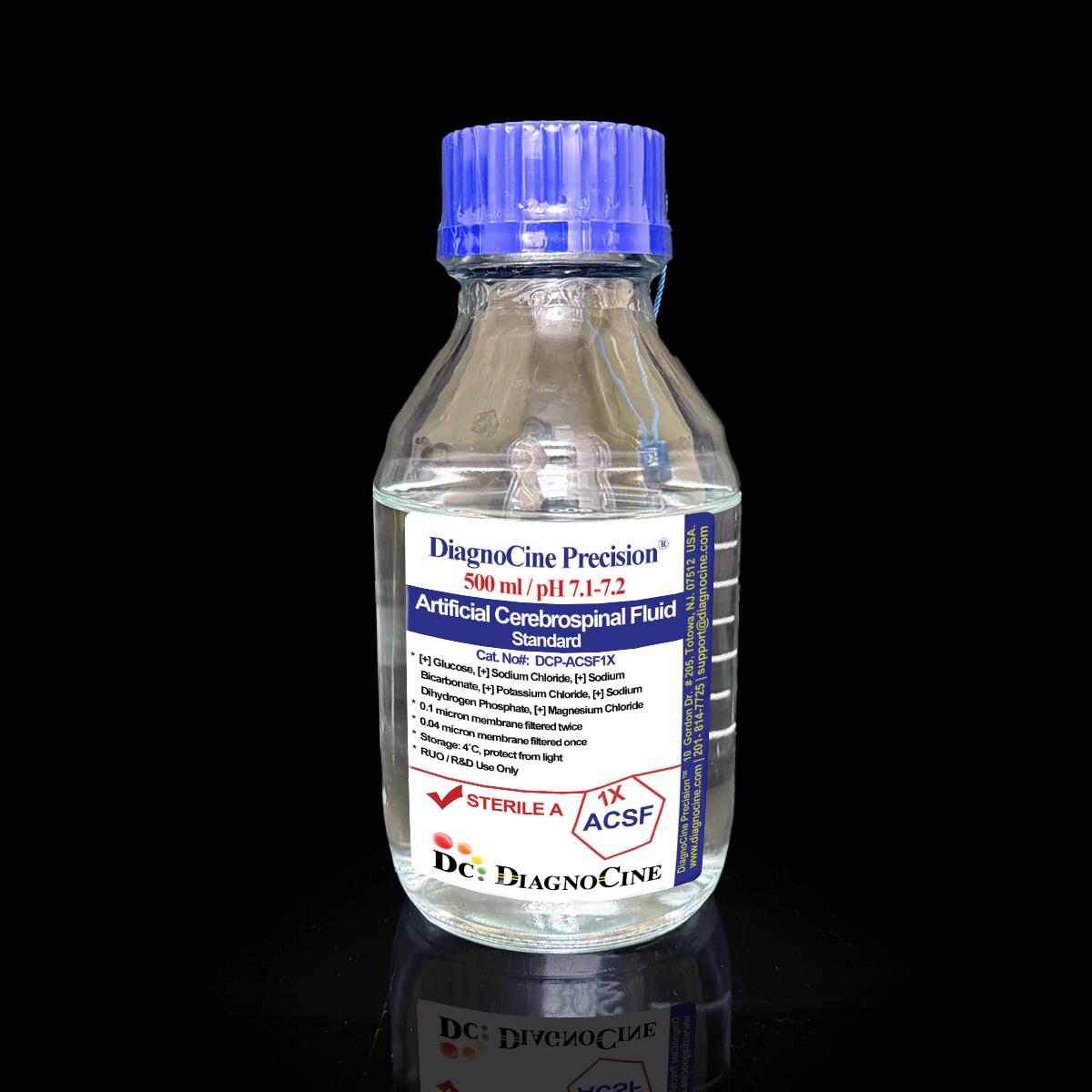
Artificial Cerebrospinal Fluid (ACSF), Standard
FluxMPS™ Artificial Cerebrospinal Fluid (ACSF), Standard
FluxMPS™ Artificial Cerebrospinal Fluid (ACSF), Standard is an MPS-grade, physiologically balanced buffer formulated to closely mimic the ionic composition, osmolality, and pH of native cerebrospinal fluid. Each 500 mL unit is quadruple-stage filtered (0.1 µm membrane twice and 0.04 µm membrane twice) and aseptically filled to support neuronal viability during brain slice electrophysiology, in vivo perfusion, and microdialysis workflows, including emerging microfluidic neural tissue chip applications.
- Quadruple-stage filtration: 0.1 µm membrane twice, 0.04 µm membrane twice for ultra-low particulate and bioburden
- Endotoxin <0.5 EU/mL, verified per USP <85> Bacterial Endotoxins Test
- Physiological pH 7.35–7.45 achieved after carbogen (95% O2/5% CO2) equilibration at 32–34°C
- Balanced ionic profile: NaCl, NaHCO3, KCl, NaH2PO4, MgCl2, and glucose at defined molarity
- Aseptically filled under ISO Class 5 (Class 100) conditions using Ultrapure Type 1 water (18.2 MΩ·cm)
- Microchannel-safe purity suitable for microfluidic neural perfusion and slice-chamber systems
- Custom pH, molarity, ionic strength, and additive formulations available on request
- pH (sealed, 25°C)~7.1–7.2
- pH (post-carbogen, 32–34°C)7.35–7.45
- Osmolality300–315 mOsm/kg
- NaCl119 mM
- NaHCO326.2 mM
- Endotoxin<0.5 EU/mL
- SterilityPass USP <71>
- Filtration0.1 µm x2, 0.04 µm x2
- Storage4°C, protected from light
- Shelf Life4 months sealed / 4 weeks opened
Engineered where standard ACSF falls short
Conventional single-pass, 0.22 µm-filtered ACSF can carry subvisible particulates, drift in pH and ionic strength during storage, and introduce endotoxin carry-over that compromises neuronal viability and electrophysiological stability. FluxMPS™ DCP-ACSF1X is engineered to close these gaps for demanding neuroscience and microfluidic workflows.
Microchannel-safe purity
Final 0.04 µm filtration stage and USP <788> Method 2 particulate compliance (≤25/mL ≥10 µm, ≤3/mL ≥25 µm) protect fine microfluidic channels and slice chambers from occlusion.
Precise, stable pH
Bicarbonate/phosphate buffering delivers a defined pH of ~7.1–7.2 in sealed storage and 7.35–7.45 after carbogen equilibration, matching physiological cerebrospinal fluid chemistry.
Ultrapure-grade water
Formulated with Ultrapure Type 1 water (18.2 MΩ·cm) meeting USP <85> water quality expectations, minimizing trace contaminants in sensitive neuronal preparations.
Low background for imaging & assays
Clear, colorless, particulate-controlled formulation supports confocal imaging, patch-clamp electrophysiology, and biosensor recordings without optical or electrical interference.
Defined, traceable composition
Every salt and additive is lot-released against nominal concentration (Na+, K+, Ca2+, Mg2+, Cl- within ±5% of nominal) for reproducible tissue physiology.
Customization on demand
pH, molarity, ionic strength, salt composition, and additive content can be adjusted to match specific slice, perfusion, or microdialysis protocols — contact support@diagnocine.com.
Quadruple-stage filtration system
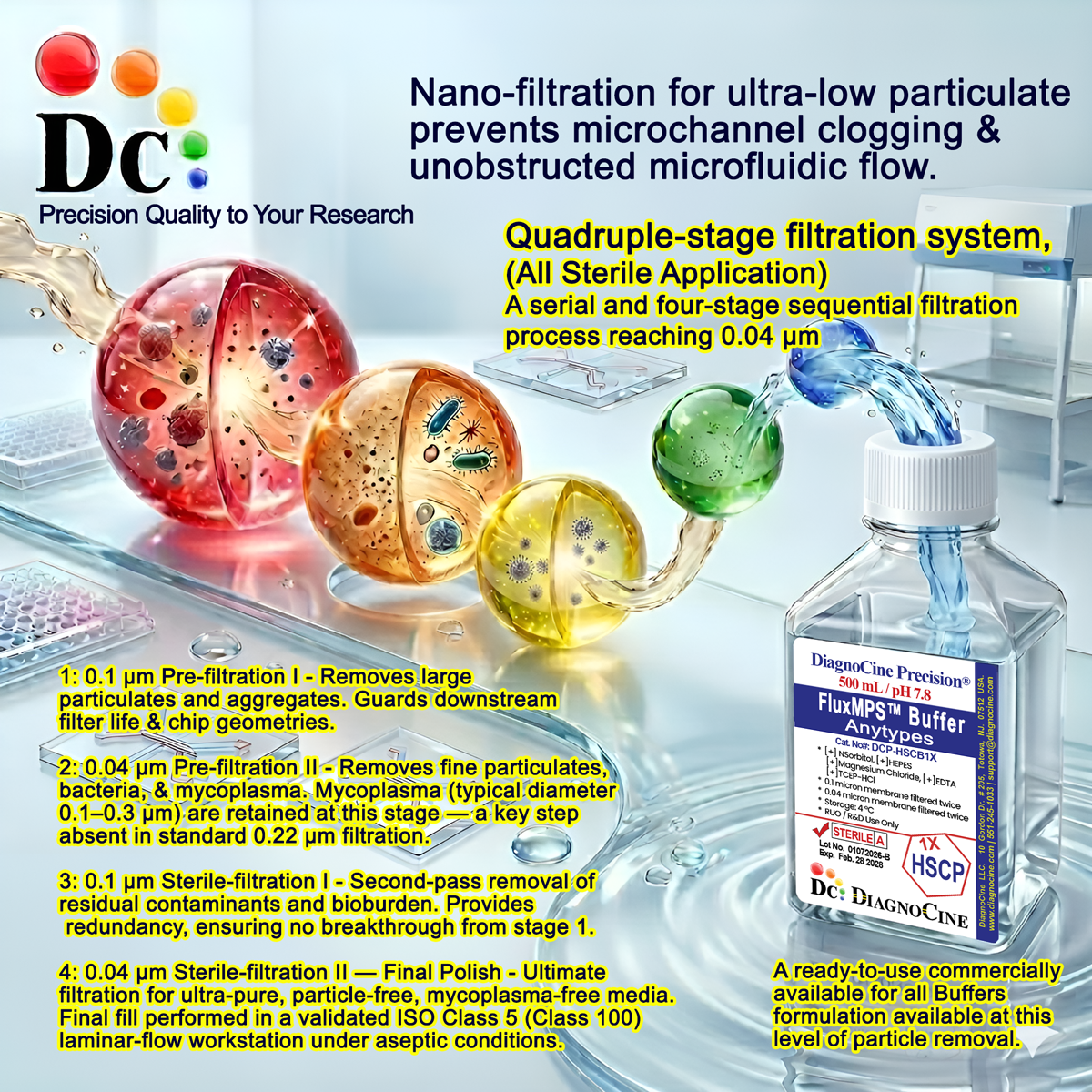
DCP-ACSF1X is manufactured with a four-stage sequential membrane filtration process — 0.1 µm membrane filtration performed twice and 0.04 µm membrane filtration performed twice — prior to ISO Class 5 aseptic fill, delivering ultra-low particulate and bioburden control for sensitive neuronal and microfluidic applications.
-
1
0.1 µm Pre-filtration I
Removes large particulates and aggregates from the raw formulated buffer, extending the service life of downstream sterilizing-grade filters.
-
2
0.04 µm Pre-filtration II
Retains fine particulates and reduces bioburden ahead of final sterile filtration, protecting the integrity of the bicarbonate/phosphate buffer system.
-
3
0.1 µm Sterile-filtration I
Provides second-pass redundancy through a fresh 0.1 µm membrane immediately before the final polishing stage.
-
4
0.04 µm Sterile-filtration II — Final Polish
Final 0.04 µm polish reduces bioburden, including organisms in the mycoplasma size range (reported as small as approximately 0.2 micron), immediately before ISO Class 5 (Class 100) aseptic fill.
Performance vs. conventional buffer
Sequential 0.1 µm and 0.04 µm filtration removes finer particulates and bioburden than a single 0.22 µm filtration pass typically used for standard ACSF, supporting cleaner perfusion in slice chambers and microfluidic neural systems.
© Diagnocine® — DCP-ACSF1X
Built for neuroscience and microphysiological workflows
Artificial cerebrospinal fluid closely matches the ion concentrations, pH, and oncotic pressure of human cerebrospinal fluid. In research, ACSF acts as a CSF substitute to protect intermediate neurons during brain slice perfusion while maintaining pH balance and tissue oxygenation — supporting applications such as rat brain microdialysis, hippocampal slice cultures, in vitro brain slice electrophysiology, in vivo cerebral perfusion, and local irrigation for treating rat brain trauma lesions. It also serves as a vehicle for intracerebral or intrathecal administration, supporting tissue homeostasis and stable electrophysiological properties throughout an experiment.
Automated Bioreactors & Robotics
For automated perfusion platforms and robotic liquid-handling systems supporting brain organoid or neural microfluidic culture, an optional 0.01 µm (10 nm) ultra-filtered variant of this ACSF formulation is available on request to further minimize valve and sensor fouling during continuous, unattended operation.
- Total Particulate Exclusion — sub-10 nm filtration for long-duration automated perfusion runs
- Valve & Sensor Protection — minimizes microfluidic valve and flow-sensor fouling
- Extended Perfusion Stability — supports uninterrupted robotic dosing and slice-chamber perfusion cycles
Inquiry Required: the 0.01 µm ultra-filtered grade is produced to order — contact support@diagnocine.com to request this configuration.
Micro Physiological System (MPS) & Chip
Physiologically balanced, ultra-filtered ACSF supports neural microfluidic chip perfusion where microchannel-safe purity and stable ionic strength are required.
Wash, Dilution & Reconstitution
Used as a physiological wash and perfusion vehicle in brain slice preparation and microdialysis probe equilibration protocols.
iPSC-Derived Model Handling
Supports perfusion and handling of iPSC-derived neuronal cultures requiring a defined, low-endotoxin ionic environment.
Endothelial & Primary Cell Perfusion
Compatible with primary neuronal and endothelial perfusion protocols requiring tight control of divalent cation concentration (Mg2+, Ca2+).
ELISA, Blotting & Blocking
Low-particulate, low-endotoxin formulation is suitable as a physiological diluent buffer in downstream immunoassay workflows.
Microscopy & Optical Sensing
Clear, colorless, particulate-controlled ACSF supports patch-clamp electrophysiology and confocal imaging of acute brain slices without optical interference.
Troubleshooting guide for slice electrophysiology
Common issues encountered during acute brain slice electrophysiology using ACSF, and their likely causes and solutions.
| Problem | Likely Cause | Solution |
|---|---|---|
| Poor seal formation (>30 sec) | Old animal tissue, insufficient recovery time | Use NMDG protocol, extend recovery to 15 min |
| High series resistance | Damaged cells, divalent cation imbalance | Check Ca2+/Mg2+ concentrations, reduce slice thickness |
| Rapid rundown | Oxidative stress, insufficient antioxidants | Increase ascorbate to 10 mM, check fresh preparation |
| Precipitation after Ca2+ addition | pH too high, added Ca2+ before pH adjustment | Adjust pH to 7.3-7.4 first, then add Ca2+ slowly while stirring |
| Cloudy solution | Contamination, expired components | Discard, sterilize equipment, use fresh antioxidants |
| Low viable neuron yield | Poor slicing technique, inadequate oxygenation | Use glycerol cutting solution, check carbogen flow rate |
Detailed product specifications
Physical, chemical, sterility, and logistics parameters for DCP-ACSF1X, as tested and released per lot.
| Parameter | Specification |
|---|---|
| Formulation / Composition | Balanced salt ACSF containing NaCl, NaHCO3, KCl, NaH2PO4, MgCl2, and glucose (see full composition table below) |
| Appearance | Clear, colorless, no visible particles |
| pH, sealed storage (USP <791>) USP <791> | ~7.1–7.2 at 25°C |
| pH, post-carbogen equilibration | 7.35–7.45 at 32–34°C |
| Osmolality (USP <785>) USP <785> | 300–315 mOsm/kg |
| Molarity / Concentration | See full composition table below |
| Buffering system | Bicarbonate (CO2/HCO3-) primary buffer; requires carbogen (95% O2/5% CO2) equilibration to reach final pH |
| Ionic composition | See full composition table below |
| Parameter | Specification |
|---|---|
| Endotoxin (USP <85> BET) USP <85> | <0.5 EU/mL |
| Sterility (USP <71>) USP <71> | Pass |
| Particulate ≥10 µm (USP <788>) USP <788> | ≤25/mL |
| Particulate ≥25 µm (USP <788>) USP <788> | ≤3/mL |
| Water quality | Ultrapure Type 1 water (18.2 MΩ·cm) |
| Manufacturing standard ISO 13485 | ISO 13485-certified, CE-approved facility |
| Fill environment | ISO Class 5 (Class 100) aseptic fill |
| Ion accuracy (Na+, K+, Ca2+, Mg2+, Cl-) | Within ±5% of nominal |
| Parameter | Specification |
|---|---|
| Storage temperature | 4°C, protected from light |
| Shelf life, sealed | 4 months at 4°C, dark-light-protected case, oxygen-control container |
| Shelf life, after opening | 4 weeks; store at 4°C in dark, aluminum-foiled condition |
| Shipping condition | Blue Ice |
| pH re-equilibration note | Bubble with 95% O2/5% CO2 via 0.1 µm disc filter for 10–15 minutes to reach pH 7.35–7.45 |
| Parameter | Specification |
|---|---|
| Traceability | Final packaging, QA, and testing performed at the DiagnoCine R&D and Quality Testing Center |
| Manufacturing QMS ISO 13485 | ISO 13485-certified facility |
| Regulatory alignment | CE-approved facility (Suppliers of DiagnoCine Precision) |
| Production method | Custom assembly and packaging completed at DiagnoCine Precision, Totowa, New Jersey, USA |
| Intended use | Research Use Only; not for clinical, diagnostic, or therapeutic use in humans |
Full composition (mM)
DCP-ACSF1X is released against a defined, per-lot bicarbonate/phosphate-buffered salt composition. Calcium is intentionally withheld from the shipped formulation to prevent precipitation and is added by the end user immediately before use (see preparation notes below).
| Component | CAS Number | Concentration |
|---|---|---|
| NaCl | 7647-14-5 | 119 mM |
| NaHCO3 | 144-55-8 | 26.2 mM |
| KCl | 7447-40-7 | 2.5 mM |
| NaH2PO4 | 7558-80-7 | 1 mM |
| MgCl2 | 7786-30-3 | 1.3 mM |
| Glucose | 50-99-7 | 10 mM |
- NaCl — main extracellular Na+, osmotic backbone of ACSF
- NaHCO3 — primary CO2/HCO3- buffer; requires carbogen bubbling to reach final pH
- KCl — maintains physiological K+ gradient across the neuronal membrane
- NaH2PO4 — secondary phosphate buffer; stabilizes pH during storage
- MgCl2 — divalent cation; limits NMDA excitotoxicity, neuroprotective
- Glucose — supports synaptic transmission and neuronal energy metabolism; added last during manufacturing to avoid precipitation
Manufacturing & compliance
DCP-ACSF1X is manufactured, filtered, and aseptically filled under a controlled quality system with full lot traceability.
ISO 13485:2016 QMS
Manufactured under ISO 13485-certified and CE-approved facilities (Suppliers of DiagnoCine Precision).
Ultrapure Type 1 Water
Formulated using Ultrapure Type 1 water (18.2 MΩ·cm) to minimize trace contaminants in the finished buffer.
ISO Class 5 Fill & Finish
Quadruple-stage filtered and aseptically filled under ISO Class 5 (Class 100) conditions.
Micro-Batch Precision
Final packaging, quality assurance, and testing performed at the DiagnoCine R&D and Quality Testing Center; specific customization requests and assembly are completed at DiagnoCine Precision in Totowa, New Jersey, USA.
Endotoxin (USP <85> BET)
Each lot is tested to confirm endotoxin below 0.5 EU/mL.
Particulate (USP <788> Method 2)
Particulate matter controlled to ≤25/mL ≥10 µm and ≤3/mL ≥25 µm.
Osmolality (USP <785>)
Released at 300–315 mOsm/kg per lot.
Documentation / CoA
Certificate of Analysis available per lot, including pH, osmolality, endotoxin, sterility, and particulate results.
How DCP-ACSF1X compares
A side-by-side comparison of DCP-ACSF1X against conventional single-pass filtered ACSF products.
| Parameter | DCP-ACSF1X (FluxMPS™) | Conventional ACSF (0.22 µm filtered) | Standard alternative (0.22 µm filtered) |
|---|---|---|---|
| Physiological ionic match to native CSF | check_circle | check_circle | check_circle |
| Final filtration pore size | 0.04 µm | 0.22 µm | 0.22 µm |
| Number of filtration stages | 4 | 1 | 1 |
| Endotoxin specification | <0.5 EU/mL | Not typically disclosed | Not typically disclosed |
| USP <788> particulate compliance | check_circle | cancel | cancel |
| Water quality | Ultrapure Type 1 (18.2 MΩ·cm) | Standard purified water | Standard purified water |
| Manufacturing QMS | ISO 13485:2016 | Not specified | Not specified |
| Microfluidic channel compatibility | check_circle | cancel | cancel |
| Ion accuracy vs. nominal | ±5% | Not specified | Not specified |
| Custom formulation available | check_circle | cancel | cancel |
Frequently asked questions
Answers to common questions about DCP-ACSF1X formulation, filtration, and use.
Supporting literature
Curated references on ACSF formulation, brain slice electrophysiology, and buffer chemistry supporting the use of DCP-ACSF1X.
- Ting JT, et al. Preparation of acute brain slices using an optimized N-methyl-D-glucamine protective recovery method. J Vis Exp. 2018. doi:10.3791/53825
- Ting JT, et al. Preparation of acute brain slices using an optimized N-Methyl-D-glucamine protective recovery method. eLife. 2014. doi:10.7554/eLife.19052
- Bickler PE, Buck LT. Hypoxia tolerance in reptiles, amphibians, and fishes: life with variable oxygen availability. Annu Rev Physiol. 2007. doi:10.1146/annurev.physiol.69.031905.162529
- Huang W, Uusisaari MY. Physiological temperature during brain slicing enhances the quality of acute slice preparations. Front Cell Neurosci. 2013. doi:10.3389/fncel.2013.00048
- de Lange ECM, et al. Cerebrospinal fluid dynamics and its role in central nervous system drug delivery. Adv Drug Deliv Rev. 2017. doi:10.1016/j.addr.2017.05.005
- Westerink RHS, Ewing AG. The PC12 cell as model for neurosecretion. Acta Physiol. 2008. doi:10.1111/j.1748-1716.2008.01858.x
- Bhatt A, et al. Microfluidic platforms for organ-on-a-chip and neural tissue modeling. Lab Chip. 2020. doi:10.1039/D0LC00355G
- Westergren I, Johansson BB. Altering the blood-brain barrier in the rat by intracarotid infusion of polycations: a comparison between protamine, poly-L-lysine and poly-L-arginine. Acta Physiol Scand. 1993. doi:10.1111/j.1748-1716.1993.tb09628.x
- United States Pharmacopeia. USP <788> Particulate Matter in Injections, Method 2 (Light Obscuration). USP-NF.
- United States Pharmacopeia. USP <85> Bacterial Endotoxins Test. USP-NF.