FluxMPS™ DMEM / Ham's F-12 Nutrient Mixture (1:1) with Trace Elements
Select DMEM/HamsF-12(1:1)-TraceElements
- see below the table
FluxMPS™ DMEM / Ham's F-12 Nutrient Mixture (1:1) with Trace Elements
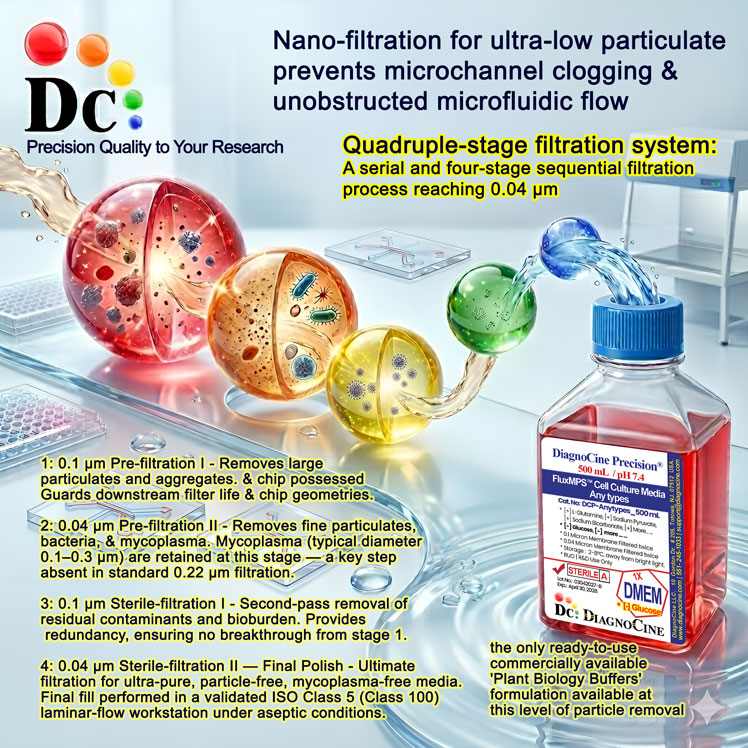
Dulbecco's Modified Eagle Medium (DMEM)/Ham's F-12 Nutrient Mixture (1:1) is a versatile cell culture medium widely used in research laboratories for supporting the growth of various mammalian cell types. This medium combines the nutrient-rich composition of DMEM with the diverse components of Ham's F-12, resulting in a balanced formulation that provides high concentrations of glucose, amino acids, vitamins, and other essential nutrients. Trace Elements are supplemented to provide a more comprehensive and optimized growth environment, supplying essential micronutrients that cells require in small quantities for enzyme function, cell signaling, and metabolism. Every FluxMPS™ variant is purified through quadruple-stage 0.04 micron filtration, engineered for organ-on-chip (OoC), tissue-on-chip (ToC), and lab-on-chip (LoC) microfluidic culture systems.
- 16 variants across L-Glutamine, Sodium Bicarbonate, HEPES (15 mM), and Phenol Red inclusion/exclusion (Sodium Pyruvate included in every variant)
- DMEM/F-12 (1:1): 21 amino acids, 10 vitamins (restoring biotin and B12 to DMEM's 8), glucose, iron, and zinc
- Trace Elements supplemented for enzyme function, cell signaling, and metabolism support
- Particularly suitable for MDCK cells, glial cells, fibroblasts, and human endothelial cells
- Sodium bicarbonate buffer system requiring a 5-10% CO2 environment to maintain physiological pH
- FluxMPS™ quadruple-stage 0.04 micron filtration — finer than any ready-to-use cell culture media currently available
- Available in 500 mL and 1000 mL sizes; 2-8°C storage away from bright light; fully customizable on request
- Concentration1X
- Glucose3.151 g/L (~17.5 mM)
- L-GlutamineConfigurable (+/-)
- Sodium PyruvateIncluded (all variants)
- Sodium Bicarbonate / HEPESConfigurable (+/- ; HEPES 15 mM)
- Phenol RedConfigurable (+/-)
- Trace elementsCu2+, Zn2+, dual Fe3+/Fe2+ iron sources
- Sizes500 mL / 1000 mL
- Storage2-8 C, away from light
Select Your DMEM/F-12 (1:1) with Trace Elements Configuration
Please select the supplement(s) of interest, then click Search. Check the supplement(s) you need below and press Search to instantly highlight every matching variant. Each row links straight through to its product page via the catalog number or the View button.
| Name | Cat No. | L-Glutamine | Pyruvate | Bicarbonate | HEPES | Phenol Red | Product Page |
|---|---|---|---|---|---|---|---|
| DMEM/F12 | DCP-DM121X | check | check | check | remove | check | Viewarrow_forward |
| DMEM/F12 w/o Glutamine | DCP-DM12-Q1X | remove | check | check | remove | check | Viewarrow_forward |
| DMEM/F12 w/o Bicarbonate | DCP-DM12-B1X | check | check | remove | remove | check | Viewarrow_forward |
| DMEM/F12 w/o Phenol Red | DCP-DM12-R1X | check | check | check | remove | remove | Viewarrow_forward |
| DMEM/F12 w/o Glutamine, Bicarbonate | DCP-DM12-QB1X | remove | check | remove | remove | check | Viewarrow_forward |
| DMEM/F12 w/o Glutamine, Phenol Red | DCP-DM12-QR1X | remove | check | check | remove | remove | Viewarrow_forward |
| DMEM/F12 w/o Bicarbonate, Phenol Red | DCP-DM12-BR1X | check | check | remove | remove | remove | Viewarrow_forward |
| DMEM/F12 w/o Glutamine, Bicarbonate, Phenol Red | DCP-DM12-QBR1X | remove | check | remove | remove | remove | Viewarrow_forward |
| DMEM/F12 + HEPES | DCP-DM12H1X | check | check | check | check | check | Viewarrow_forward |
| DMEM/F12 + HEPES w/o Glutamine | DCP-DM12H-Q1X | remove | check | check | check | check | Viewarrow_forward |
| DMEM/F12 + HEPES w/o Bicarbonate | DCP-DM12H-B1X | check | check | remove | check | check | Viewarrow_forward |
| DMEM/F12 + HEPES w/o Phenol Red | DCP-DM12H-R1X | check | check | check | check | remove | Viewarrow_forward |
| DMEM/F12 + HEPES w/o Glutamine, Bicarbonate | DCP-DM12H-QB1X | remove | check | remove | check | check | Viewarrow_forward |
| DMEM/F12 + HEPES w/o Glutamine, Phenol Red | DCP-DM12H-QR1X | remove | check | check | check | remove | Viewarrow_forward |
| DMEM/F12 + HEPES w/o Bicarbonate, Phenol Red | DCP-DM12H-BR1X | check | check | remove | check | remove | Viewarrow_forward |
| DMEM/F12 + HEPES w/o Glutamine, Bicarbonate, Phenol Red | DCP-DM12H-QBR1X | remove | check | remove | check | remove | Viewarrow_forward |
About DMEM/Ham's F-12 Nutrient Mixture
DMEM/Ham's F-12 refers to blended basal media combining Dulbecco's Modified Eagle Medium (DMEM) with Ham's Nutrient Mixture F-12 in fixed volumetric ratios. The two commercially standardized ratios — 1:1 (DMEM:F-12) and 3:1 (DMEM:F-12) — serve distinct biological purposes and are not interchangeable: the 1:1 mixture is the widely distributed general-purpose and stem cell basal medium, while the 3:1 blend is the historical FAD medium optimized for keratinocyte culture.
Background: Ham's F-12 Nutrient Mixture
Ham's F-12 was formulated by Richard G. Ham of the Department of Biophysics, University of Colorado Medical Center, and first published in 1965: "Clonal Growth of Mammalian Cells in a Chemically Defined, Synthetic Medium," Proc. Natl. Acad. Sci. USA 53(2): 288-293 (PMID 14294058). It was developed specifically for serum-free, single-cell clonal plating of Chinese Hamster Ovary (CHO) cells, a demanding application that had previously required protein-rich supplements.
F-12 is an evolution of Ham's F-10 medium (1963), with key differences including a substantially higher zinc sulfate concentration, the addition of putrescine, linoleic acid, and lipoic acid (thioctic acid), and broader amino acid coverage, which together improved plating efficiency and reduced dependence on albumin. F-12 was designed primarily for clonal (low-density) plating and not for supporting dense populations on its own; it has since been adopted widely for CHO cells, HeLa, mouse L-cells, primary rat hepatocytes, prostate epithelial cells, and hybridoma/myeloma cloning.
Ham's F-12 Distinctive Components
F-12 carries several components absent from DMEM that become critical in the blended media:
- Trace metals: Cupric sulfate (CuSO4), ferrous sulfate (FeSO4), zinc sulfate (ZnSO4); DMEM uses only ferric nitrate as its iron source
- Lipids: Linoleic acid and lipoic acid (thioctic acid); absent from DMEM
- Nucleotide precursors: Hypoxanthine and thymidine; absent from DMEM
- Polyamine: Putrescine; absent from DMEM
- Vitamins: Biotin and vitamin B12; both absent from DMEM, restored by F-12
- Amino acids absent from DMEM: L-Alanine, L-Asparagine, L-Aspartic acid, L-Glutamic acid, L-Proline, and L-Cysteine; DMEM supplies the oxidized dimer L-cystine, whereas F-12 adds the reduced monomer L-cysteine, so the blend carries both as separate entries
- Sodium pyruvate: Included in standard F-12 (110 mg/L)
DMEM/F-12 (1:1 Mixture) — Origins and Development
The 1:1 mixture emerged from serum-free cell biology research in the late 1970s and early 1980s. The formulation's adoption as a general basal medium is most directly traced to Mather and Sato (1979-1985), who systematically demonstrated that defined hormone supplements (insulin, transferrin, EGF, growth hormone, FSH/LH, and somatomedin) could replace serum entirely for Leydig and Sertoli cells, and that the optimal synthetic basal medium for these experiments was a 1:1 mixture of DMEM and Ham's F-12. Sigma-Aldrich's technical literature documents this as the foundational demonstration that drove the 1:1 DMEM/F-12 formulation into broad use as the platform for serum-free and low-serum formulation work. (Sigma cites the specific Leydig/Sertoli 1:1 demonstration to Mather & Sato's 1985 BBRC report; the 1979 Exp. Cell Res. paper is the broader primary-culture reference.)
The rationale for the mixture was explicitly nutritional complementarity: DMEM provides high concentrations of amino acids, vitamins (at approximately 4x the original Eagle baseline), and glucose, while F-12 contributes trace elements (Cu, Zn), lipids, nucleotide precursors, polyamines, and the vitamins missing from DMEM (biotin, B12). Together, the 1:1 blend yields a substantially more complete nutritional environment than either parent medium alone — Sigma-Aldrich characterizes DMEM/F-12 as containing 21 amino acids, 10 vitamins (restoring biotin and B12 to DMEM's 8), glucose, iron, and zinc.
Among its earliest validated applications, the 1:1 mixture supported demanding neural and epithelial cell types — including rat neuroblastoma (Bottenstein & Sato, 1979) and MDCK cells (Taub et al., 1979) — that require richer nutritional support than DMEM alone could provide.
Composition (1:1 Mixture)
The values below reflect the Gibco/Thermo Fisher standard formulation (Cat. No. 11320), which is the reference formulation cited in the primary literature. Per-lot Certificate of Analysis (CoA) requests can be directed to support@diagnocine.com.
| Component | DMEM/F-12 (1:1) Details |
|---|---|
| Amino acids | 21 amino acids: DMEM's 15 plus six from F-12 — L-Alanine, L-Asparagine, L-Aspartic acid, L-Glutamic acid, L-Proline, and L-Cysteine (F-12 adds reduced cysteine in addition to DMEM's cystine). |
| Vitamins | 10 vitamins: DMEM's 8 (choline, folic acid, myo-inositol, niacinamide, pantothenate, pyridoxine, riboflavin, thiamine) plus biotin and vitamin B12 restored by F-12. |
| Glucose | 3151 mg/L (approximately 17.5 mM) — the average of DMEM high-glucose (4500 mg/L) and F-12 (1802 mg/L). |
| Inorganic salts | Combined salt set from both parents; includes ferric nitrate (from DMEM), ferrous sulfate (from F-12), cupric sulfate, zinc sulfate, sodium bicarbonate 2438 mg/L. |
| Trace elements | Cu2+, Zn2+ (from F-12); Fe3+ (from DMEM ferric nitrate) and Fe2+ (from F-12 ferrous sulfate) — dual iron sources. |
| Lipids | Linoleic acid (0.042 mg/L) and lipoic acid (0.105 mg/L) — both from F-12, absent in DMEM. |
| Nucleotide precursors | Hypoxanthine (2.39 mg/L) and thymidine (0.365 mg/L) — from F-12. |
| Polyamine | Putrescine * 2HCl (0.081 mg/L) — from F-12. |
| Sodium pyruvate | 55 mg/L (approximately 0.5 mM) — F-12 contributes 110 mg/L of pyruvate, diluted 1:1 in the standard blend (the DMEM base used in this formulation is pyruvate-free). |
| Serum requirement | Typically 10% FBS; optimized for low-serum (1-5%) or serum-free work with growth factor supplements. |
| pH buffering | Bicarbonate-based (NaHCO3, approximately 2438 mg/L); 5-10% CO2; phenol red pH indicator; HEPES (15 mM) optionally included in select formulations. |
| pH / osmolality | pH 7.0-7.6; osmolality approximately 280-335 mOsm/kg (varies by formulation and manufacturer). |
Advanced DMEM/F-12
Advanced DMEM/F-12 (Gibco, Cat. No. 12634) is a proprietary enriched variant of the standard 1:1 mixture formulated to permit 50-90% reduction in FBS supplementation without altering cell growth rate or morphology. It incorporates additional components not in classical DMEM/F-12:
- Ethanolamine, glutathione, and ascorbic acid (antioxidant/membrane support)
- Insulin and transferrin (growth factor replacements)
- AlbuMAX(TM) II (lipid-rich BSA fraction)
- Trace elements: sodium selenite, ammonium metavanadate, cupric sulfate, manganous chloride
Advanced DMEM/F-12 requires supplementation with 1-5% FBS and 4 mM L-glutamine (or L-alanyl-L-glutamine), uses the same NaHCO3/CO2 buffer system (3.7 g/L NaHCO3; 5-10% CO2), and does not require cell-line adaptation for most lines. It is widely used as the basal medium for 3D organoid cultures and iPSC-derived systems.
Validated Cell Lines (1:1 Mixture)
DMEM/F-12 (1:1) is recommended or standard for:
MDCK Cells
Madin-Darby Canine Kidney cells — the canonical validated line for DMEM/F-12 1:1; epithelial morphology and tight junction formation reliably supported.
Glial Cells
Primary and immortalized glial and astrocyte cultures.
Human & Rat Fibroblasts
Including hTERT-RPE1 (human retinal pigment epithelial cells).
Human Endothelial Cells
Primary and line-derived vascular endothelial cells.
Rat Neuroblastoma Cells
Among the earliest documented applications of this blend.
OSCC Lines
Oral cavity squamous cell carcinoma lines — documented in mixed culture with CHO on F-12.
iPSC / hESC
Human induced pluripotent and embryonic stem cells — DMEM/F-12 1:1 is the basal component of defined media for feeder-free pluripotent stem cell culture.
Neural Progenitor Cells / NSCs
Used in neural induction medium (DMEM/F-12 + N-2 + Glutamine).
3D Organoids
Intestinal, brain, and other organoid systems consistently use Advanced DMEM/F-12 as the base.
Scientific Applications (1:1 Mixture)
Serum-Free & Low-Serum Culture
The primary design intent of the DMEM/F-12 1:1 mixture is to serve as a nutritionally complete enough basal medium to sustain cells when serum is reduced or eliminated and growth factors/hormones are substituted. The richer lipid, trace element, and vitamin profile of the blend makes it substantially better suited for this than DMEM alone.
Pluripotent Stem Cell Maintenance
DMEM/F-12 1:1 is the universal basal medium for feeder-free human ESC and iPSC culture. All major defined media in this space — mTeSR1, mTeSR Plus, StemFlex, Essential 8 (E8), and TeSR-E8 — are formulated on a DMEM/F-12 base supplemented with FGF2, TGF-beta, insulin, L-ascorbic acid, transferrin, and selenium. The E8 formulation (Chen et al., Nature Methods, 2011) reduced the medium to 8 essential components, including the DMEM/F-12 base, demonstrating that the blend provides a sufficient nutritional background, with very few additions required to sustain pluripotency.
Neural Differentiation & Organoids
Neural induction protocols routinely use DMEM/F-12 supplemented with N-2 supplement, L-alanyl-L-glutamine, and SMAD inhibitors (dual SMAD inhibition). Brain organoid generation protocols (Lancaster-type and derivatives) use DMEM/F-12 as the basal medium throughout neural induction and organoid expansion phases.
Transfection Optimization
DMEM/F-12 is used in transfection workflows requiring low-serum or serum-free conditions, as its richer formulation better sustains cell viability during reduced-serum incubation than DMEM alone.
DMEM/F-12 (3:1 Mixture) — FAD Medium
The following 3:1 DMEM:F-12 FAD medium information is provided for reference and comparison. It is a distinct, historically specific keratinocyte formulation from the 1:1 mixture family sold above.
Origins and Development
The 3:1 DMEM:F-12 mixture has a more specific and historically traceable origin than the 1:1 blend. It is the basal component of FAD medium — the keratinocyte culture system developed in Howard Green's laboratory at Harvard/MIT for serial cultivation of human epidermal keratinocytes. ("FAD" is used throughout the literature without a standardized expansion; the name points to the medium's DMEM/Ham's-F12 base plus Adenine.)
The foundation was laid by Rheinwald and Green (1975), who first established the serial culture of human keratinocytes by co-culturing them with lethally irradiated 3T3 mouse fibroblast feeder layers in a DMEM-based medium supplemented with 20% serum. The 1975 paper, "Serial cultivation of strains of human epidermal keratinocytes: the formation of keratinizing colonies from single cells," Cell 6(3): 331-343 (PMID 1052771), is the foundational keratinocyte culture reference.
Through refinements from the late 1970s through the 1980s, Green's laboratory improved the system by adding defined growth factors (EGF, hydrocortisone, cholera toxin, insulin), reducing serum from 20% toward 5-10%, and substituting the DMEM-only basal medium with the 3:1 DMEM:F-12 combination, which substantially increased the number of nutrient components and enabled serum reduction while maintaining robust keratinocyte proliferation. The adenine-supplemented 3:1 FAD formulation was established through the Green-lab line of work (e.g., Wu & Rheinwald, 1981; Allen-Hoffmann & Rheinwald, 1984) and was later codified in Rheinwald's 1989 methods chapter.
The 3:1 ratio is a deliberate asymmetry: it preserves most of DMEM's high amino acid and glucose content, which is better suited for the metabolically active basal keratinocytes, while incorporating enough F-12 to supply trace elements, lipids, and the missing vitamins. F-12 at 25% of the blend contributes its distinctive lipid and trace-element profile (at one-quarter of F-12's standalone concentration) without diluting DMEM's core nutrient density to the extent that the 1:1 mixture does.
FAD Medium Full Composition
FAD medium is the 3:1 DMEM:F-12 base supplemented with a defined set of growth factors and additives. The complete formulation, as documented in the Green-lab protocols and subsequent literature, is: Basal medium — 3 parts high-glucose DMEM + 1 part Ham's F-12.
| Supplement | Concentration | Function |
|---|---|---|
| Fetal bovine serum | 5-10% (v/v) | Growth and attachment factors |
| Adenine | 24 µg/mL (1.8 x 10⁻⁴ M) | Stimulates keratinocyte proliferation |
| Hydrocortisone | 0.4 µg/mL | Colony morphology, proliferation support |
| Insulin | 5 µg/mL | Glucose uptake, growth factor signaling |
| Cholera toxin | 0.1 nM (10-10 M) | cAMP elevation, mitogenic for keratinocytes |
| EGF (human recombinant) | 2-10 ng/mL | Primary mitogen for basal keratinocytes |
| Transferrin (optional) | 5 µg/mL | Iron delivery in low-serum variants |
| L-glutamine | 2 mM (if not in base) | Nitrogen source |
Validated Cell Types (3:1 Mixture)
The 3:1 DMEM:F-12 mixture is specifically and almost exclusively used for:
- Primary human epidermal keratinocytes — the founding application; neonatal foreskin and adult skin-derived keratinocytes on 3T3 feeder layers or feeder-free
- HPV-immortalized keratinocyte lines — maintained in FAD conditions
- Reconstructed human epidermis / skin equivalents — organotypic cultures and 3D skin models for wound healing research, toxicology, and transplantation
- Co-culture systems with dermal fibroblasts — vascularized skin substitutes and bilayered skin models
- Other stratified epithelial types — some esophageal and oral mucosal epithelial cells that share keratinocyte biology, as well as limbal/corneal epithelial cells, are maintained in FAD-type medium
The 3:1 ratio has also been observed in specialized co-culture systems, notably pre-vascularized 3D gel scaffolds, where a DMEM/F-12 (3:1) + EBM-2 co-culture medium supports endothelial progenitor and fibroblast co-cultures in skin substitute engineering.
Comparative Overview: DMEM/F-12 (1:1) vs. (3:1) FAD Base
| Feature | DMEM/F-12 (1:1) | DMEM/F-12 (3:1) — FAD Base |
|---|---|---|
| DMEM:F-12 ratio | 50% : 50% | 75% : 25% |
| Amino acids | 21 AAs | 21 AAs — same set; F-12-derived AAs at approximately 25% of their 1:1 level |
| Vitamins | 10 (restores biotin and B12) | 10 — biotin and B12 present, at reduced concentration |
| Glucose | approximately 3151 mg/L (approximately 17.5 mM) | approximately 3825 mg/L (approximately 21.2 mM) — closer to DMEM high-glucose |
| Trace elements | F-12 Zn, Cu at 50% of standalone level | F-12 Zn, Cu at 25% of standalone level |
| Lipids | Linoleic + lipoic acid (50% of F-12 levels) | Same lipids at 25% of F-12 levels |
| Serum requirement | 10% FBS standard; 1-5% with advanced formulation; serum-free with supplements | 5-10% FBS + defined supplements (adenine, HC, insulin, CT, EGF) |
| Key supplements | GFs for stem cells (FGF2, TGF-beta); N-2/B-27 for neural | Adenine, hydrocortisone, insulin, cholera toxin, EGF |
| pH buffering | NaHCO3 approximately 2438 mg/L; +/- 15 mM HEPES; 5-10% CO2 | NaHCO3 (DMEM-dominant); 5-10% CO2 |
| Osmolality | approximately 280-335 mOsm/kg | approximately 285-335 mOsm/kg (DMEM-dominated) |
| Primary applications | iPSC/ESC maintenance, neural organoids, serum-free culture, MDCK, transfection optimization | Keratinocyte serial culture, reconstructed epidermis, skin equivalents, co-culture with fibroblasts |
| Founding reference | Mather & Sato (approximately 1979-1985); Ham (1965) | Rheinwald & Green (1975); Green-lab refinements (1981-1989) |
Why FluxMPS™ DMEM/F-12 (1:1) with Trace Elements
Quadruple-Stage 0.04 Micron Filtration
Purified to 0.04 microns — finer than any ready-to-use cell culture media currently available — removing the microscopic particulates and protein aggregates that silently block micro-channels.
Built for OoC / ToC / LoC Platforms
Engineered from the ground up for Organ-on-Chip, Tissue-on-Chip, and Lab-on-Chip platforms, where the medium itself is part of the instrument and cannot be an afterthought.
Particulate & Aggregate Removal
Eliminates particulates and protein aggregates that disrupt laminar flow and generate false biological signals before the media ever reaches the chip.
Optical Clarity
Supports real-time imaging and integrated biosensing on Organ-on-Chip platforms, where optical clarity of the medium is essential to data quality.
FDA-Recognized Physiological Modeling Standards
Formulated to support FDA-recognized physiological modeling standards, providing a validated, reproducible media foundation for regulatory-facing studies.
Drug Discovery, Toxicology & Translational Research
A validated foundation for drug discovery, toxicology screening, and translational research, where downstream data must stand up to regulatory scrutiny.
Quadruple-Stage Filtration System
Every FluxMPS™ DMEM/F-12 (1:1) with Trace Elements variant passes through the same four-stage architecture before reaching your chip.
-
01
Pre-Filtration Stage 1 0.1 µm
Initial coarse particulate removal.
-
02
Pre-Filtration Stage 2 0.1 µm
Secondary particulate and aggregate reduction.
-
03
Sterile Filtration Stage 1 0.04 µm
Fine sterile filtration below standard 0.22 micron practice.
-
04
Sterile Filtration Stage 2 0.04 µm
Final polish for microfluidic-grade clarity.
Engineered for Flow, Not Just Growth
Every component is optimized for consistent, laminar flow performance across complex micro-channel geometries, capillary-bed and vascular simulations, and long-term automated perfusion studies running continuously for weeks.
Frequently Asked Questions
Verified Bibliography
- Ham, R.G. (1965). Clonal growth of mammalian cells in a chemically defined, synthetic medium. Proc. Natl. Acad. Sci. USA, 53(2), 288-293. PMID: 14294058; PMC219509
- Ham, R.G. (1963). An improved nutrient solution for diploid Chinese hamster and human cell lines. Exp. Cell Res., 29, 515-526.
- Rheinwald, J.G. & Green, H. (1975). Serial cultivation of strains of human epidermal keratinocytes: the formation of keratinizing colonies from single cells. Cell, 6(3), 331-343. PMID: 1052771
- Wu, Y.-J. & Rheinwald, J.G. (1981). A new small (40 kd) keratin filament protein made by some cultured human squamous cell carcinomas. Cell, 25(3), 627-635. Part of the Green-lab line that established adenine-supplemented keratinocyte medium.
- Allen-Hoffmann, B.L. & Rheinwald, J.G. (1984). Polycyclic aromatic hydrocarbon mutagenesis of human epidermal keratinocytes in culture. Proc. Natl. Acad. Sci. USA, 81(23), 7802-7806.
- Rheinwald, J.G. (1989). Methods for clonal growth and serial cultivation of normal human epidermal keratinocytes and mesothelial cells. In: R. Baserga (Ed.), Cell Growth and Division: A Practical Approach (pp. 81-94). IRL Press, Oxford. Codified protocol describing the 3:1 DMEM:F-12 FAD formulation.
- Mather, J.P. & Sato, G.H. (1979). The use of hormone-supplemented serum-free media in primary cultures. Exp. Cell Res., 124(1), 215-221. PMID: 499383
- Chen, G., Gulbranson, D.R., Hou, Z., et al. (2011). Chemically defined conditions for human iPSC derivation and culture. Nature Methods, 8(5), 424-429. PMID: 21478862; doi:10.1038/nmeth.1593. Defines E8 medium on a DMEM/F-12 base.
- Dulbecco, R. & Freeman, G. (1959). Plaque production by the polyoma virus. Virology, 8(3), 396-397. PMID: 13669362. Origin of DMEM, the dominant parent medium in both blends.
- Morton, H.J. (1970). A survey of commercially available tissue culture media. In Vitro, 6(2), 89-108. PMID: 5523183; doi:10.1007/BF02616112
FluxMPS™ — Precision Cell Culture Media for Microphysiological Systems
Built for the architecture of the future. Not the flask of the past.
Traditional cell culture media were formulated for static well plates and flasks — environments that tolerate impurities, precipitates, and particle loads that would immediately compromise a microfluidic system. FluxMPS™ was designed from the ground up for Organ-on-Chip (OoC), Tissue-on-Chip (ToC), and Lab-on-Chip (LoC) platforms, where the medium itself is part of the instrument.
Purity That Protects Your Platform
FluxMPS™ is purified to 0.04 microns — finer than any ready-to-use cell culture media currently available. At this level, the microscopic particulates and protein aggregates that silently block micro-channels, disrupt laminar flow, and generate false biological signals are eliminated before the media ever reaches your chip.
The result: your platform stays operational, your data stays clean, and your biology drives the result — not your media.
Engineered for Flow, Not Just Growth
The name FluxMPS™ reflects its core design principle. Every component is optimized for consistent, laminar flow performance across:
- Complex micro-channel geometries
- Capillary-bed and vascular simulations
- Long-term automated perfusion studies running continuously for weeks
Zero-clogging performance is not a feature — it is the baseline specification.
Applications & Performance
| Application | What FluxMPS™ Delivers |
|---|---|
| Microfluidics | Stable shear stress; no channel blockage |
| Metabolic Tracing | Ultra-pure matrix with no contaminant interference |
| Long-term Perfusion | Consistent formulation stability over weeks of continuous flow |
| Organ-on-Chip | Optical clarity for real-time imaging and integrated biosensing |
Regulatory Foundation
FluxMPS™ is formulated to support FDA-recognized physiological modeling standards, providing a validated, reproducible media foundation for drug discovery, toxicology screening, and translational research. When your downstream data needs to stand up to regulatory scrutiny, your upstream media cannot be an afterthought.
The Bottom Line
Microfluidic platforms are precision instruments. They require precision inputs.
FluxMPS™ is the only ready-to-use cell culture medium engineered specifically to meet that standard — protecting your chip, your cells, and your science.