Earle's Balanced Salt Solution
Select See the table below
- See the table below
Earle's Balanced Salt Solution (EBSS)
Five 1X configurations of Earle's salts on a single page. This is a category page, not a product page — select the supplements you need, then open the configuration's own product page with View.
| Cat No. | Name | Calcium | Magnesium | Sodium Bicarbonate | Phenol Red | Product Page |
|---|---|---|---|---|---|---|
| DCP-EBSSRB1XComplete formulation | EBSS w/ Phenol red | + | + | + | + | Viewarrow_forward |
| DCP-EBSSB-R1XPhenol red free | EBSS w/o Phenol red | + | + | + | − | Viewarrow_forward |
| DCP-EBSSBR-CM1XCalcium- & magnesium-free | EBSS w/ Phenol Red w/o Calcium, Magnesium |
− | − | + | + | Viewarrow_forward |
| DCP-EBSSB-CMR1XCalcium-, magnesium- & phenol-red-free | EBSS w/o Calcium, Magnesium, Phenol Red |
− | − | + | − | Viewarrow_forward |
| DCP-EBSSR-B1XSodium-bicarbonate-free | EBSS w/ Phenol Red w/o Sodium Bicarbonate |
+ | + | − | + | Viewarrow_forward |
Not sure which configuration? See what each supplement does · See applications by configuration · Read the FAQ
What Earle's salts do, and what changes between the five
Earle's Balanced Salt Solution (EBSS) is a foundational isotonic buffer system widely employed in cell biology and tissue culture to maintain physiological conditions for mammalian cells in vitro. Formulated with inorganic salts, glucose, and sodium bicarbonate, EBSS provides osmotic balance, pH stabilization, and metabolic support during short-term cell maintenance, transportation, or experimental procedures. A distinguishing feature of EBSS is its higher sodium bicarbonate concentration compared to similar solutions like Hanks' Balanced Salt Solution (HBSS), enabling pH stability under 5 % CO2 environments — a critical requirement for incubating cells in standard culture conditions.
- Five 1X configurations differing only in calcium, magnesium, sodium bicarbonate, and phenol red content — the base Earle's formulation is shared.
- Bicarbonate is the buffering system: its higher concentration versus HBSS is what holds pH under 5 % CO2.
- Calcium and magnesium are present in three of the five configurations and omitted in two.
- Phenol red is present in three of the five and omitted in two.
- Sodium bicarbonate is present in four of the five; one configuration is supplied without it.
- Sterility: filtered 0.1 µm twice and 0.04 µm twice in a sterile environment.
- Storage: 4 °C.
- Customization of concentration, pH, and added chemicals, compounds, proteins, or supplements is available on inquiry.
- Configurations in this family5
- Format1X liquid
- Base formulationEarle's salts · inorganic salts, glucose, sodium bicarbonate
- Buffer systemsodium bicarbonate / 5 % CO2
- Configurations with calcium3 of 5
- Configurations with magnesium3 of 5
- Configurations with sodium bicarbonate4 of 5
- Configurations with phenol red3 of 5
- Sterility0.1 µm ×2, 0.04 µm ×2
- Storage4 °C
Four switches, and each one changes a different protocol
Every configuration in this family shares the same Earle's base. What differs is which of four components is present — and each of the four is decisive for a different kind of experiment.
Bicarbonate sets the gas environment
The sodium bicarbonate level is what makes EBSS a 5 % CO2 solution: the bicarbonate in the liquid and the CO2 in the incubator work as one buffer pair. HBSS is formulated with less bicarbonate for use without CO2.[1]
Calcium and magnesium hold cells down
The divalent cations support adhesion, so a modified EBSS without calcium and magnesium is the version used to wash and re-suspend cells during dissociation, where residual Ca2+/Mg2+ would inhibit trypsin action.[2]
Phenol red is a read-out, not an ingredient
Phenol red reports pH change by colour, which is useful at the bench. It is also a visible-wavelength dye that can quench fluorescent signal, which is why phenol-red-free versions of media and salt solutions exist.[3]
Support, not growth
EBSS supplies osmotic balance, pH stabilization, and metabolic support during short-term cell maintenance, transportation, or experimental procedures. Balanced salt solutions are classified separately from basal, complex, and serum-free growth media.[4]
Particulate control is built in
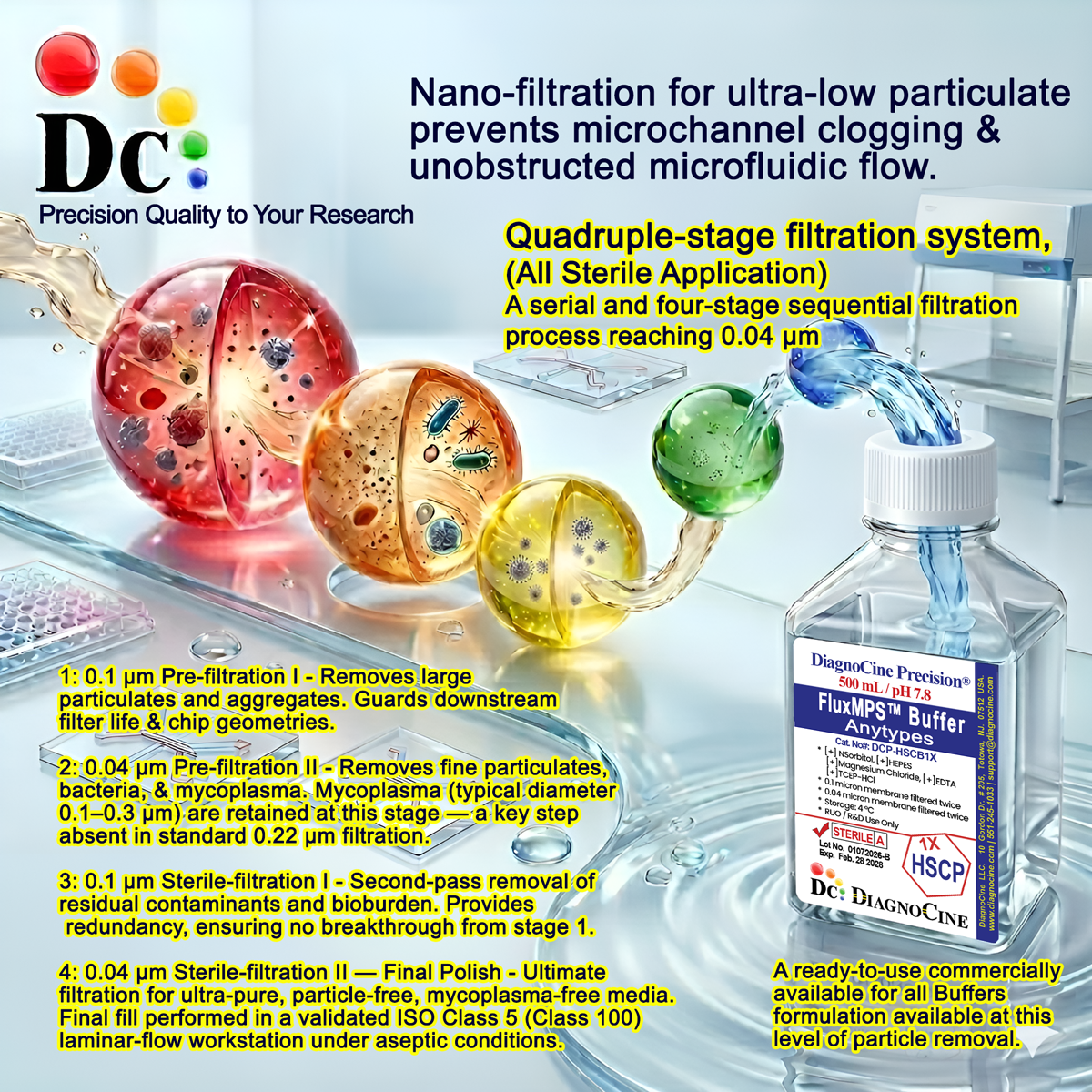
Every configuration is filtered 0.1 µm twice and 0.04 µm twice in a sterile environment — a sub-0.1 µm polish that matters for microfluidic, organ-on-a-chip, and imaging workflows where particulates block channels and raise background.
The five are a starting point
If none of the five matches the protocol, other concentrations, additions of chemicals, compounds, proteins, or supplements, a different pH, and further modifications can be requested rather than worked around.
The one question that decides the configuration
Where will the solution sit while cells are in it? Inside a 5 % CO2 incubator, the bicarbonate-containing configurations are the ones designed for that atmosphere. Everything else — calcium and magnesium, phenol red — follows from what comes next in the protocol: dissociation, or a fluorescence read.
Four membrane passes, two of them sub-0.1 µm
The source specifies the same sterility process for the whole family: filtered 0.1 µm twice and 0.04 µm twice, in a sterile environment. That is a quadruple-stage architecture — two coarse passes and two sub-0.1 µm polishing passes.
-
1
0.1 µm Pre-filtration I
First 0.1 µm membrane pass. Removes bulk particulates and the microbial load carried in from raw materials and make-up water before any polishing step sees the solution.
-
2
0.04 µm Pre-filtration II
First sub-0.1 µm pass. Takes out the fine fraction that a 0.1 µm or 0.2 µm membrane lets through — the size range that accumulates in microchannels and on imaging surfaces.
-
3
0.1 µm Sterile-filtration I
Second 0.1 µm pass, performed in a sterile environment. This is the sterilizing step of the sequence rather than a clarifying one.
-
4
0.04 µm Sterile-filtration II — Final Polish
Second sub-0.1 µm pass, immediately before fill. The final polish is what distinguishes this architecture from a conventional single-membrane sterile filtration.
Why the sub-0.1 µm passes matter here
EBSS is frequently the last liquid in contact with cells before an imaging step, a dissociation step, or a transfer into a microfluidic device. Particulate carry-over at that point is not recoverable, so the polishing passes are placed at the end of the sequence rather than the beginning.
What each of the four components does
The source catalog states which components are present in which configuration. The role column below is externally sourced and footnoted so it can be verified — or removed — independently of the catalog data.
| Component | Present in | Role in the solution | Configurations that omit it |
|---|---|---|---|
| Calcium (Ca2+) | 3 of 5 | Divalent cation supporting cell adhesion; omitted so that cells can be washed and re-suspended during dissociation without inhibiting trypsin.[2] | DCP-EBSSBR-CM1X, DCP-EBSSB-CMR1X |
| Magnesium (Mg2+) | 3 of 5 | Paired with calcium in every configuration of this family; removed together with calcium for the same dissociation-support reason.[2] | DCP-EBSSBR-CM1X, DCP-EBSSB-CMR1X |
| Sodium bicarbonate (NaHCO3) | 4 of 5 | The buffering component. Its level in EBSS is set to maintain pH under 5 % CO2, which is what separates EBSS from the lower-bicarbonate HBSS.[1] | DCP-EBSSR-B1X |
| Phenol red | 3 of 5 | pH indicator dye giving a visual read of acidification. Absorbs and can quench signal in the visible range, so it is omitted for fluorescence work.[3] | DCP-EBSSB-R1X, DCP-EBSSB-CMR1X |
Which of the five belongs in which workflow
The source states the family-level uses: maintaining physiological conditions for mammalian cells in vitro, and short-term cell maintenance, transportation, or experimental procedures. Configuration-specific uses below are footnoted to their external source.
- Maintaining physiological conditions for mammalian cells in vitro.
- Short-term cell maintenance inside a 5 % CO2 incubator, where the bicarbonate–CO2 pair holds pH.[1]
- Transportation of cells or tissue.
- Experimental procedures requiring osmotic balance, pH stabilization, and metabolic support.
- Reagent preparation — formulations carrying calcium and magnesium are generally used as transport media or for preparing reagents.[5]
- Washing cells before dissociation.[5]
- Washing and re-suspending cells during the dissociation process, where calcium and magnesium would inhibit trypsin action.[2]
- Rinsing chelators out of the culture before cell dissociation.[5]
- Diluting cells for counting.[5]
- Short-term maintenance and experimental procedures where adhesion support is not wanted.
- Fluorescence and luminescence read-outs, where a visible-range indicator dye can quench signal or raise background.[3]
- Live-cell imaging steps carried out in the salt solution rather than in growth medium.[3]
- Any of the family-level uses above, when the colour read-out is not needed.
- DCP-EBSSB-CMR1X combines the phenol-red-free and calcium/magnesium-free properties in one configuration.
- Supplied with calcium, magnesium, and phenol red, but without sodium bicarbonate — the bicarbonate–CO2 buffer pair described above is therefore not part of this configuration.
- Use where the buffering component is supplied separately, or is set by the protocol rather than by the solution.
- Confirm the intended handling conditions for this configuration and request the Certificate of Analysis at support@diagnocine.com before substituting it for a bicarbonate-containing configuration.
Identical across all five configurations
Only the four supplement switches change between catalog numbers. Everything below is common to the family.
| Attribute | Specification, as stated by the source |
|---|---|
| Format | 1X liquid |
| Base formulation | Earle's salts — inorganic salts, glucose, and sodium bicarbonate |
| Function | Osmotic balance, pH stabilization, and metabolic support |
| Storage | 4 °C |
| Sterility | Filtered 0.1 µm twice and 0.04 µm twice, in a sterile environment |
| Customization | Other concentrations; additions of chemicals, compounds, proteins, or supplements; different pH; further modifications — on inquiry |
| Intended use | Research Use Only (RUO) |
EBSS or HBSS — the distinction the source draws
| Property | EBSS (this family) | HBSS |
|---|---|---|
| Sodium bicarbonate level | Higher | Lower[1] |
| Gas environment it is formulated for | 5 % CO2 | Incubation without CO2[1] |
| pH stability under 5 % CO2 | check_circle Designed for it | cancel Not the intended environment[1] |
| Shared characteristics | Glucose and sodium bicarbonate for short-term maintenance of cells outside growth medium | Glucose and sodium bicarbonate for short-term maintenance of cells outside growth medium[1] |
| Supplement options offered | With / without calcium and magnesium; with / without phenol red; with / without sodium bicarbonate | With / without calcium and magnesium; with / without phenol red[1] |
Questions this catalog gets asked
Primary literature and cited sources
The source description carries no citation or reference list. The entries below are supporting literature for the Earle's formulation itself, followed by the external technical sources footnoted on this page.
Supporting Literature
- Earle WR, Schilling EL, Stark TH, Straus NP, Brown MF, Shelton E. Production of malignancy in vitro. IV. The mouse fibroblast cultures and changes seen in the living cells. Journal of the National Cancer Institute. 1943;4(2):165–212. doi:10.1093/jnci/4.2.165
- Bryant JC. Earle's balanced salt solution: preparation of the saline. TCA Manual. 1975;1:185–187. doi:10.1007/BF00916996
- Hanks JH, Wallace RE. Relation of oxygen and temperature in the preservation of tissues by refrigeration. Proceedings of the Society for Experimental Biology and Medicine. 1949;71(2):196–200. doi:10.3181/00379727-71-17131
Footnoted Technical Sources
- Thermo Fisher Scientific. Balanced Salt Solutions — bicarbonate levels, CO2 environment, and available formulations. thermofisher.com
- Biowest. Earle's Balanced Salts Solution without Calcium and Magnesium (L0601) — use during the dissociation process. biowest.net
- Thermo Fisher Scientific. Product FAQ on phenol red and fluorescent read-outs, and phenol-red-free formulations. thermofisher.com
- Media and Buffer Preparation for Cell Culture — classification of balanced salt solutions relative to basal, complex, and serum-free media. Springer. link.springer.com
- Thermo Fisher Scientific. Gibco EBSS product records (catalog 14155063 and 24010043) — stated applications for calcium/magnesium-containing and calcium/magnesium-free formulations. thermofisher.com