

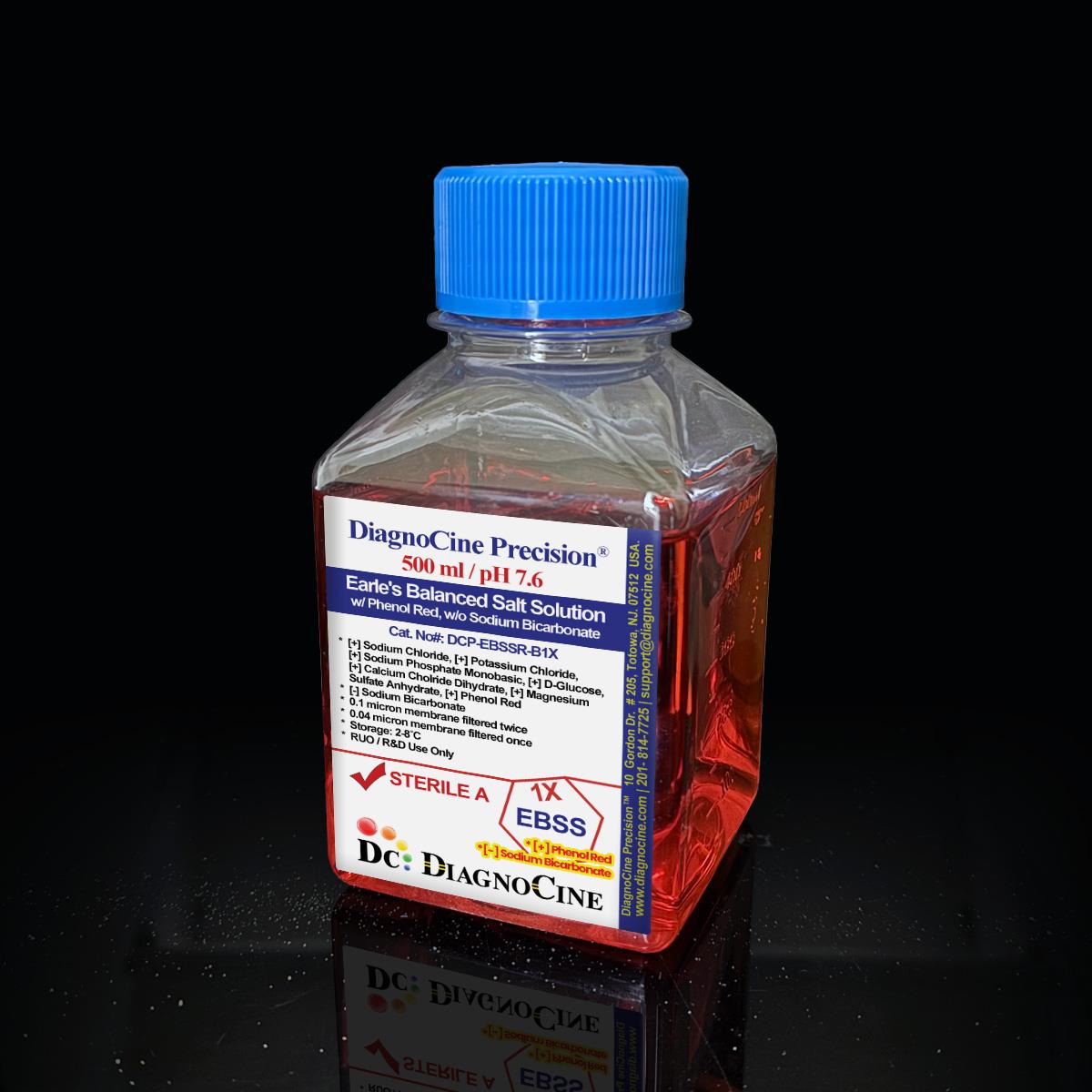
Earle's Balanced Salt Solution w/ Phenol Red w/o Sodium bicarbonate: 1X
FluxMPS™ Earle's Balanced Salt Solution w/ Phenol Red w/o Sodium Bicarbonate: 1X
An MPS-grade, isotonic 1X balanced salt solution formulated with phenol red as a visual pH indicator and manufactured without sodium bicarbonate for flexible, CO2-independent buffering. Ultrapure and sterile-filtered with a quadruple-stage 0.1 µm / 0.04 µm membrane architecture, this buffer is engineered for microchannel-safe use across cell culture, wash, and dilution workflows, including microfluidic and organ-on-a-chip (OoC) systems.
- Sterile, ultrapure buffer filtered 0.1-micron membrane twice and 0.04-micron membrane twice — the world's cleanest buffer for cell and molecular biology experiments
- Contains Phenol Red pH indicator; formulated without Sodium Bicarbonate for flexible, CO2-independent buffering
- Physiological ion balance from calcium chloride, magnesium sulfate, potassium chloride, and sodium chloride plus D-Glucose as an energy substrate
- QC-verified pH 7.6 and osmolality approximately 240 mOsm/kg H2O
- Endotoxin NMT 1EU/ml; sterility confirmed by 14-day USP incubation with no bacterial or fungal growth
- Manufactured under ISO 13485-certified and CE-approved facilities
- Microchannel-safe purity suited to OoC, ToC, BoC, LoC, and MPS platforms
- Customization available — alternate pH, concentrations, or additions on request
- pH7.6
- OsmolalityApproximately 240 mOsm/kg H2O
- EndotoxinNMT 1EU/ml
- SterilityNo growth after 14-day USP incubation
- Filtration0.1 µm membrane twice & 0.04 µm membrane twice
- AppearanceRed colored, clear solution
- Storage2-8 °C, away from bright light
- Shelf Life24 months
- FormulationPhenol Red included; Sodium Bicarbonate-free
- Toxicity TestPasses
Engineered where standard buffers fail
Conventional 0.22 µm-filtered balanced salt solutions can carry subvisible particulates that accumulate in microchannels, contribute to pH and ionic drift, and elevate assay background. FluxMPS™ addresses each failure mode with a defined, traceable formulation and a multi-stage filtration architecture.
Microchannel-safe purity
Sequential 0.1 µm and 0.04 µm membrane filtration is designed to minimize the subvisible particulates that a single 0.22 µm pass can leave behind, protecting narrow-bore microfluidic channels.
Precise, stable pH
QC-verified at pH 7.6 with phenol red included as a visual pH indicator, and formulated without sodium bicarbonate so researchers can select the buffering system their protocol requires.
Ultrapure-grade water
Prepared with Ultrapure Type 1 water (18.2 MΩ·cm), consistent with USP <85> water-quality expectations for sensitive cell and molecular biology work.
Low background for imaging & assays
A red, clear, phenol-red-indicated solution supports easy visual pH monitoring during live-cell handling, washing, and dilution steps ahead of imaging or downstream assays.
Defined, traceable composition
Every inorganic salt and energy substrate — calcium chloride, magnesium sulfate, sodium phosphate monobasic, potassium chloride, sodium chloride, D-Glucose, and phenol red sodium salt — is disclosed at its exact concentration.
Customization on demand
Other concentrations, additions of chemicals, compounds, proteins, or supplements, different pH, and other modifications can be produced on inquiry.
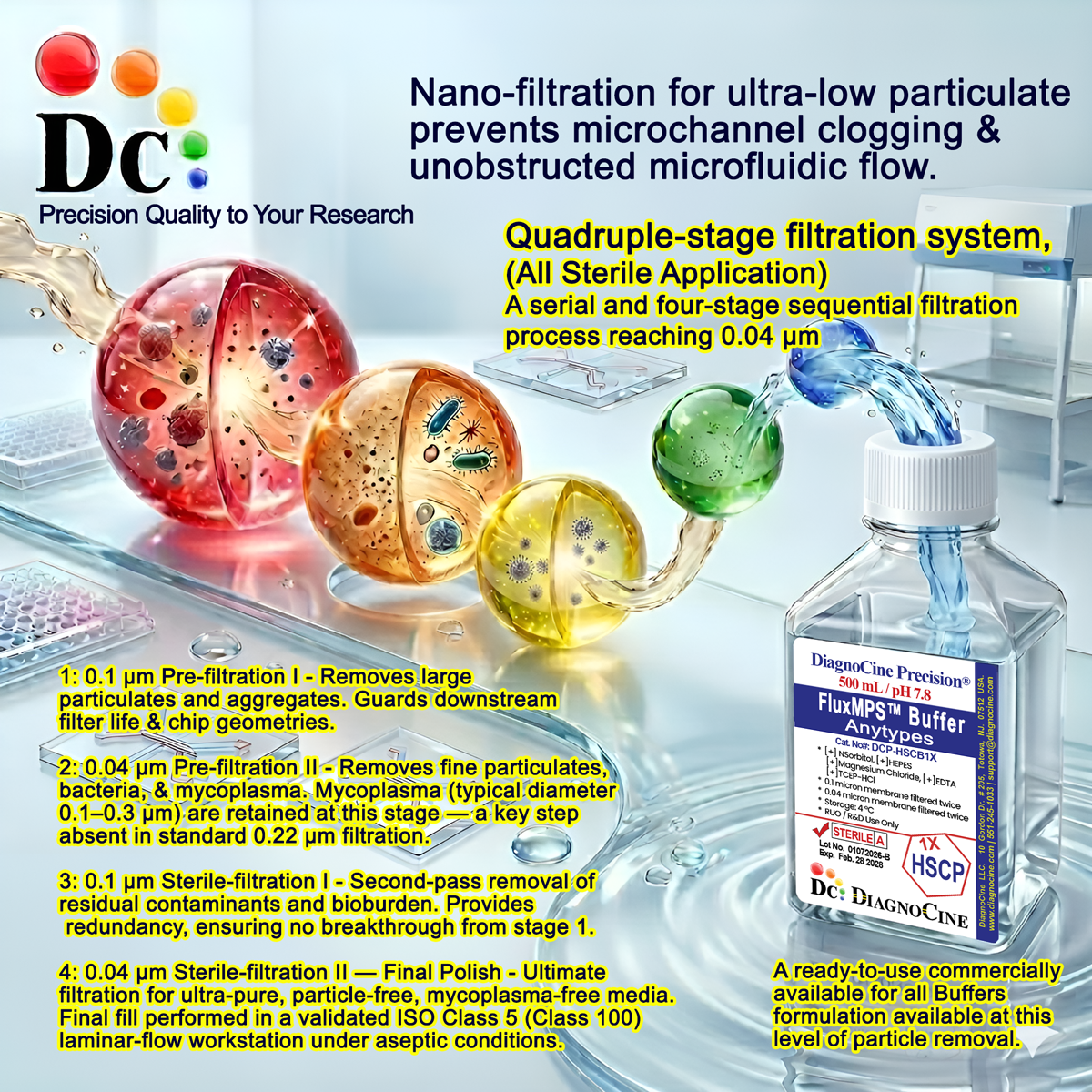
Quadruple-stage filtration system
This buffer is sterile-filtered 0.1-micron membrane twice and 0.04-micron membrane twice, a four-pass architecture intended to reduce particulate and bioburden carry-over beyond what a single conventional filtration pass achieves.
-
1
0.1 µmPre-filtration I
First-pass 0.1 µm membrane filtration removes large particulates and aggregates, extending the working life of the downstream membranes.
-
2
0.04 µmPre-filtration II
A 0.04 µm pass retains finer particulates and bioburden ahead of final sterile filtration — a pore size well below the approximately 0.2 micron size of the smallest mycoplasma, helping guard against mycoplasma-scale contamination.
-
3
0.1 µmSterile-filtration I
A second 0.1 µm sterile pass provides filtration redundancy prior to final polishing.
-
4
0.04 µmSterile-filtration II — Final Polish
A second 0.04 µm pass delivers the final polish under aseptic fill conditions, completing the quadruple-stage architecture.
Performance vs. conventional buffer
Sequential 0.1 µm and 0.04 µm filtration, applied twice each, removes finer particulates than a single conventional 0.22 µm pass, supporting the world's cleanest buffer standard referenced for cell and molecular biology experiments.
© Diagnocine® — DCP-EBSSR-B1X
Cell culture maintenance and beyond
This sodium-bicarbonate-free EBSS formulation supports cell washing, transport, and dilution steps across a range of in vitro and microfluidic workflows.
Automated Bioreactors & Robotics
An optional 0.01 µm (10 nm) ultra-filtered variant is available for automated bioreactor and robotics platforms where valve and sensor protection from residual particulates is critical.
- Total Particulate Exclusion — targets residual particulates beyond standard multi-stage filtration
- Valve & Sensor Protection — reduces the risk of particulate fouling in automated fluidic hardware
- Extended Perfusion Stability — supports longer unattended perfusion runs
Inquiry Required: contact support@diagnocine.com to request the 0.01 µm ultra-filtered grade.
Micro Physiological System (MPS) & Chip
Isotonic, ultrapure buffer suited to microchannel-based platforms.
Wash, Dilution & Reconstitution
Removes residual enzymes, serum proteins, or metabolic byproducts prior to subculturing or analysis.
iPSC-Derived Model Handling
Physiological ion balance supports handling of sensitive iPSC-derived cell models.
Endothelial & Primary Cell Perfusion
Maintains viability during cell transport between laboratories or equipment.
ELISA, Blotting & Blocking
Safely dilutes cell suspensions for counting or seeding without altering osmotic pressure.
Microscopy & Optical Sensing
Phenol red indicator supports visual pH monitoring during live-cell imaging workflows.
Full specification sheet
All values below are as measured or declared for this product.
| Parameter | Specification |
|---|---|
| Formulation / Composition | Balanced salt solution with Phenol Red, without Sodium Bicarbonate |
| Appearance | Red colored, clear solution |
| pH USP <791> | 7.6 |
| Osmolality USP <785> | Approximately 240 mOsm/kg H2O |
| Parameter | Specification |
|---|---|
| Endotoxin USP <85> BET | NMT 1EU/ml |
| Sterility USP <71> | No bacterial or fungal growth after 14 days of incubation |
| Toxicity Test | Passes |
| Water Quality | Ultrapure Type 1 water (18.2 MΩ·cm) |
| Fill Environment | ISO Class 5 (Class 100) |
| Parameter | Specification |
|---|---|
| Storage Temperature | 2-8 °C, away from bright light |
| Shelf Life | 24 months |
| Parameter | Specification |
|---|---|
| Manufacturing QMS ISO 13485:2016 | ISO 13485-certified and CE-approved facilities (Suppliers of DiagnoCine Precision) |
| Traceability | Final packaging, quality assurance, and testing performed at the DiagnoCine R&D and Quality Testing Center; customization and assembly performed at DiagnoCine Precision, Totowa, New Jersey, USA |
| Production Method | Filtered 0.1-micron membrane twice and 0.04-micron membrane twice |
| Intended Use | Research Use Only (RUO) |
Full composition
Component concentrations are expressed in mg/L as released for this lot-manufactured formulation.
| Component | CAS Number | Concentration |
|---|---|---|
| Calcium Chloride Dihydrate | 10035-04-8 | 265.000 mg/L |
| Magnesium Sulfate Anhydrous | 7487-88-9 | 97.720 mg/L |
| Sodium Phosphate Monobasic | 7558-80-7 | 122.000 mg/L |
| Potassium Chloride | 7447-40-7 | 400.000 mg/L |
| Sodium Chloride | 7647-14-5 | 6800.000 mg/L |
| D-Glucose | 50-99-7 | 1000.000 mg/L |
| Phenol Red Sodium Salt | 34487-61-1 | 11.000 mg/L |
Physiological Compatibility: maintains intracellular and extracellular osmotic equilibrium (240 mOsm/kg H2O ± 5%), with calcium chloride, magnesium sulfate, potassium chloride, and sodium chloride at concentrations mirroring physiological conditions. Glucose (1.0 g/L) serves as an energy substrate, while phenol red acts as a pH indicator (yellow at pH ≤6.8, transitioning to pink at ≥8.2).
Flexible Buffering System: excluding sodium bicarbonate makes this formulation suited to applications where CO2-independent buffering is preferred. Researchers can customize buffering capacity by adding sodium bicarbonate (2.2 g/L recommended) or alternative buffers such as HEPES, depending on experimental requirements.
Manufacturing & compliance
Manufactured, packaged, and tested under a controlled quality management system.
ISO 13485:2016 QMS
Manufactured under ISO 13485-certified and CE-approved facilities (Suppliers of DiagnoCine Precision).
Ultrapure Type 1 Water
Prepared with Ultrapure Type 1 water (18.2 MΩ·cm) consistent with USP <85> expectations.
ISO Class 5 Fill & Finish
Final polish filtration and fill are performed under ISO Class 5 (Class 100) conditions.
Micro-Batch Precision
All final packaging, quality assurance, and testing are completed at the DiagnoCine R&D and Quality Testing Center; customization and assembly at DiagnoCine Precision, Totowa, New Jersey, USA.
Endotoxin USP <85> BET
NMT 1EU/ml.
Sterility USP <71>
No bacterial or fungal growth is observed after 14 days of incubation.
Osmolality USP <785>
Approximately 240 mOsm/kg H2O.
Documentation / CoA
Certificate of Analysis available on request.
How DCP-EBSSR-B1X compares
A comparison of this formulation against conventional single-pass filtered balanced salt solutions.
| Parameter | DCP-EBSSR-B1X (FluxMPS™) | Conventional EBSS (0.22 µm filtered) | Standard Alternative (0.22 µm filtered) |
|---|---|---|---|
| Sodium Bicarbonate-Free / Flexible Buffering | check_circle | cancel | cancel |
| Final Filtration Pore Size | 0.04 µm | 0.22 µm | 0.22 µm |
| Number of Filtration Stages | 4 | 1 | 1 |
| Endotoxin Specification | NMT 1EU/ml | Not specified | Not specified |
| USP Sterility Testing | check_circle | cancel | cancel |
| Ultrapure Type 1 Water | check_circle | cancel | cancel |
| ISO 13485 Manufacturing QMS | check_circle | cancel | cancel |
| Microfluidic Channel Compatibility | check_circle | cancel | cancel |
| Custom Formulation Available | check_circle | cancel | cancel |
Frequently asked questions
Common questions about DCP-EBSSR-B1X.
Supporting literature
Curated literature relevant to balanced salt solutions, buffering chemistry, and microfluidic cell culture.
- Bhatia SN, Ingber DE. Microfluidic organs-on-chips. Nat Biotechnol. 2014. doi:10.1038/nbt.2989
- Earle WR. Production of malignancy in vitro. IV. The mouse fibroblast cultures and changes seen in the living cells. J Natl Cancer Inst. 1943.
- Halldorsson S, et al. Advantages and challenges of microfluidic cell culture in polydimethylsiloxane devices. Biosens Bioelectron. 2015. doi:10.1016/j.bios.2014.07.029
- Freshney RI. Culture of Animal Cells: A Manual of Basic Technique and Specialized Applications. Wiley; 2015.
- Waymouth C. Osmolality of mammalian blood and of media for culture of mammalian cells. In Vitro. 1970. doi:10.1007/BF02615117
- Sun D, et al. Effect of pH on endothelial cell behavior in vascular models. Biomaterials Sci. 2018. doi:10.1039/C8BM00043C
- USP General Chapter <85> Bacterial Endotoxins Test. United States Pharmacopeia.
- USP General Chapter <71> Sterility Tests. United States Pharmacopeia.
- USP General Chapter <785> Osmolality and Osmolarity. United States Pharmacopeia.
- Uphoff CC, Drexler HG. Detection of mycoplasma contamination in cell cultures. Curr Protoc Mol Biol. 2014. doi:10.1002/0471142727.mb2804s106