

- Home
- Earle's Balanced Salt Solution w/ Sodium bicarbonate and Phenol red w/o Calcium and Magnesium: 1X
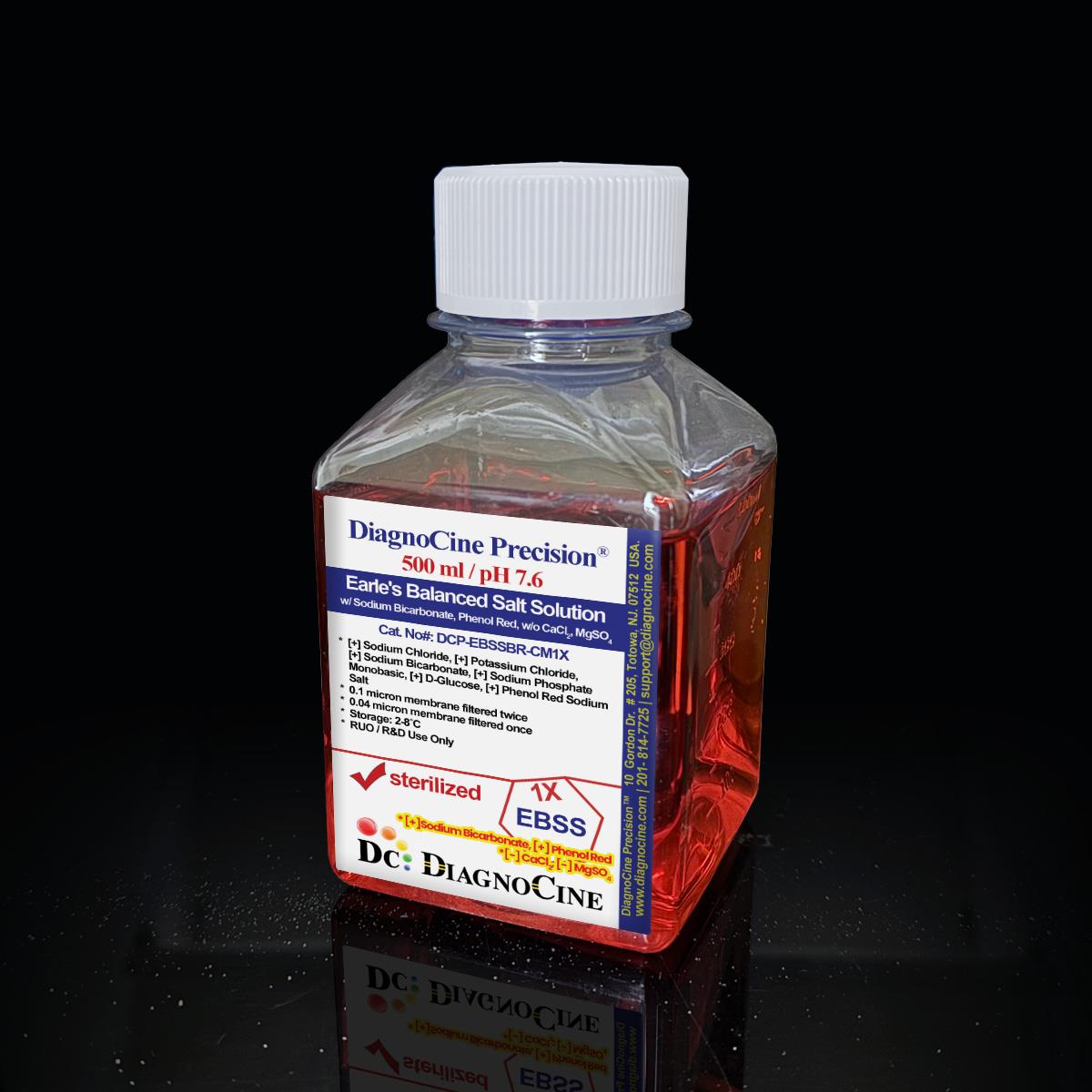
Earle's Balanced Salt Solution w/ Sodium bicarbonate and Phenol red w/o Calcium and Magnesium: 1X
FluxMPS™ Earle's Balanced Salt Solution w/ Sodium Bicarbonate and Phenol Red w/o Calcium and Magnesium: 1X
DCP-EBSSBR-CM1X is a ready-to-use, calcium- and magnesium-free Earle's Balanced Salt Solution (EBSS) formulated with sodium bicarbonate and phenol red for precise, stable pH monitoring. Manufactured with quadruple-stage 0.1 µm and 0.04 µm membrane filtration, this MPS-grade buffer delivers ultra-clean, microchannel-safe performance for organ-on-a-chip, microfluidic, and general cell culture workflows.
- Sterile, ultrapure, quadruple-stage filtered: 0.1 µm membrane filtration performed twice and 0.04 µm membrane filtration performed twice
- Calcium- and magnesium-free formulation enhances enzymatic cell dissociation and EDTA-based passaging
- Contains sodium bicarbonate and phenol red pH indicator for visual pH monitoring
- Ready-to-use 1X working concentration — no dilution or preparation required
- Endotoxin content NMT 1 EU/mL
- Manufactured with Ultrapure Type 1 water (18.2 MΩ·cm)
- Microchannel-safe purity supports organ-on-a-chip (OoC) and lab-on-a-chip (LoC) systems
- Custom pH, chemistries, and formulations available on request
- pH7.6
- OsmolalityApproximately 265-305 mOsm/kg H2O
- Concentration1X (ready-to-use)
- Calcium/MagnesiumFree
- EndotoxinNMT 1 EU/mL
- SterilityNo growth, 14-day incubation
- Filtration0.1 µm x2 + 0.04 µm x2
- Storage2-8°C, protect from light
- Shelf Life24 months
- FormatLiquid, ready-to-use
Engineered where standard buffers fail
Conventional 0.22 µm-filtered balanced salt solutions can carry subvisible particulates and bioburden that accumulate in microfluidic channels, disturb visual pH indication, and introduce assay background. FluxMPS™ DCP-EBSSBR-CM1X is manufactured to a tighter purity standard purpose-built for sensitive cell and molecular biology work.
Microchannel-safe purity
Quadruple-stage 0.1 µm and 0.04 µm membrane filtration removes particulates that can obstruct fine microfluidic channels and valves.
Precise, visible pH monitoring
Sodium bicarbonate buffering paired with a phenol red indicator gives immediate visual feedback on culture pH at pH 7.6.
Ultrapure-grade water
Formulated with Ultrapure Type 1 water (18.2 MΩ·cm) consistent with USP <85> quality expectations.
Low background for sensitive assays
Calcium- and magnesium-free chemistry avoids divalent-cation interference in signaling and dissociation studies.
Defined, traceable composition
Every inorganic salt, buffer component, and indicator is lot-documented, with pH, osmolality, and sterility tested per lot.
Customization on demand
Alternate concentrations, added chemicals/compounds/proteins/supplements, different pH, or other modifications are available on inquiry.
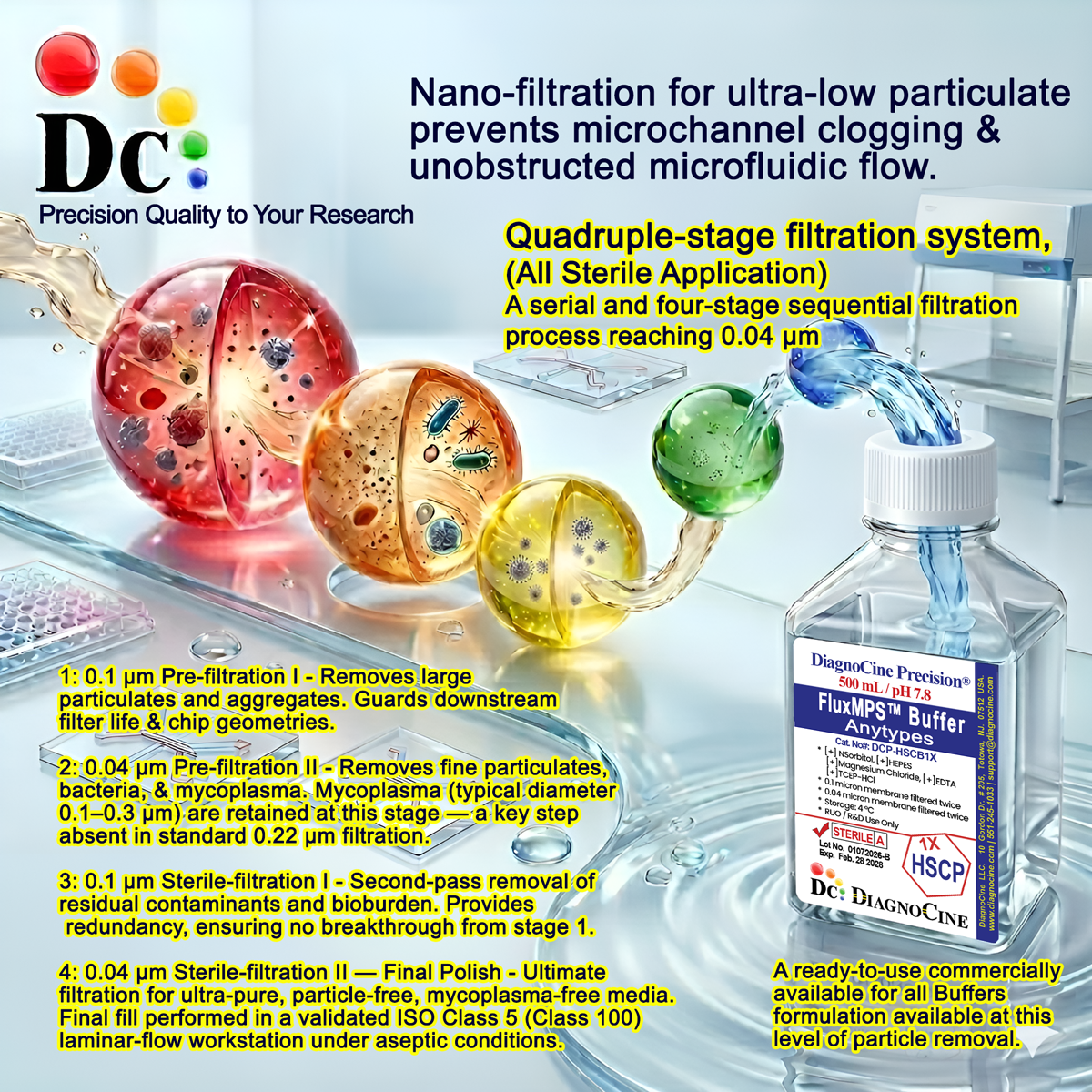
Quadruple-stage filtration system
DCP-EBSSBR-CM1X is filtered through a validated quadruple-stage process — 0.1 µm membrane filtration performed twice and 0.04 µm membrane filtration performed twice — positioning it well beyond the purity of standard single-pass 0.22 µm-filtered balanced salt solutions.
-
1
0.1 µm Pre-filtration I
Removes large particulates and aggregates, extending the life of downstream filtration stages.
-
2
0.04 µm Pre-filtration II
Retains fine particulates and bioburden ahead of final sterile filtration.
-
3
0.1 µm Sterile-filtration I
A second 0.1 µm pass provides redundancy ahead of the final polishing stage.
-
4
0.04 µm Sterile-filtration II — Final Polish
Final 0.04 µm polish supports mycoplasma risk reduction; the smallest mycoplasma species measure about 0.2 µm, larger than this final pore size.
Performance vs. conventional buffer
Sequential 0.1 µm and 0.04 µm membrane filtration, each applied twice, removes finer particulates than a single 0.22 µm pass typically used for conventional balanced salt solutions, supporting cleaner downstream microfluidic channels.
© Diagnocine® — DCP-EBSSBR-CM1X
Where a calcium- and magnesium-free EBSS matters
Removing divalent cations from the balanced salt formulation supports workflows where calcium and magnesium would otherwise interfere with enzymatic dissociation, chelation chemistry, or specific cellular signaling responses.
Automated Bioreactors & Robotics
An optional 0.01 µm (10 nm) ultra-filtered variant of this formulation is available on request for automated bioreactor and robotic liquid-handling systems where valve and sensor protection is critical.
- Total Particulate Exclusion for closed-loop automated systems
- Valve & Sensor Protection in robotic liquid-handling platforms
- Extended Perfusion Stability for long-duration automated runs
Inquiry Required: the 0.01 µm (10 nm) ultra-filtered grade is produced to order — contact support@diagnocine.com to request this variant.
Micro Physiological System (MPS) & Chip
Buffer exchange and wash steps in organ-on-a-chip and tissue chip platforms.
Enzymatic Cell Dissociation Wash
Washing cells before trypsinization or enzymatic dissociation; absence of divalent cations enhances detachment efficiency.
EDTA-Based Cell Passaging
Complements EDTA treatments by preventing calcium and magnesium ion interference during chelation-based passaging.
Divalent-Cation-Sensitive Signaling Studies
Supports experiments where calcium and magnesium may interfere with specific cellular responses or signaling pathways.
Serum & Component Removal
Gentle yet effective removal of serum components before downstream experimental procedures.
Molecular & Cell Biology Assays
A clean, well-buffered isotonic base for molecular and cell biology assay workflows.
Physical, chemical & quality parameters
Every lot of DCP-EBSSBR-CM1X is tested against the parameters below prior to release.
| Parameter | Specification |
|---|---|
| Formulation | Calcium- and magnesium-free Earle's Balanced Salt Solution with sodium bicarbonate and phenol red |
| Appearance | Red colored, clear solution |
| pH | 7.6 |
| Osmolality USP <785> | Approximately 265-305 mOsm/kg H2O |
| Concentration | 1X (ready-to-use) |
| Parameter | Specification |
|---|---|
| Endotoxin USP <85> | NMT 1 EU/mL |
| Sterility | No bacterial or fungal growth after 14 days of incubation, per USP specification |
| Toxicity Test | Passes |
| Water Purity | Ultrapure Type 1 water (18.2 MΩ·cm) |
| Manufacturing Standard ISO 13485 | ISO 13485-certified, CE-approved facilities |
| Parameter | Specification |
|---|---|
| Storage Temperature | 2-8°C, away from bright light |
| Shelf Life | 24 months |
| Expiry | Use before expiry date given on the product label |
| Parameter | Specification |
|---|---|
| Manufacturing QMS | ISO 13485-certified, CE-approved facilities (Suppliers of DiagnoCine Precision) |
| Regulatory Alignment | ISO 13485:2016 |
| Production Method | Final packaging, quality assurance, and testing performed at the DiagnoCine R&D and Quality Testing Center; customization and assembly performed at DiagnoCine Precision, Totowa, New Jersey, USA |
| Intended Use | Research Use Only (RUO) |
Full composition (mg/L)
Earle's Balanced Salt Solution combines inorganic salts, D-glucose as an energy source, sodium bicarbonate buffering, and a phenol red pH indicator — formulated without calcium chloride or magnesium sulfate.
| Component | CAS Number | Concentration (mg/L) |
|---|---|---|
| Sodium Phosphate Monobasic | 7558-80-7 | 122.00 |
| Potassium Chloride | 7447-40-7 | 400.000 |
| Sodium Bicarbonate | 144-55-8 | 2200.000 |
| Sodium Chloride | 7647-14-5 | 6800.000 |
| D-Glucose | 50-99-7 | 1000.000 |
| Phenol Red Sodium Salt | 34487-61-1 | 11.000 |
Manufacturing & compliance
DCP-EBSSBR-CM1X is produced under a controlled quality system spanning raw materials, filtration, fill, and final release testing.
ISO 13485:2016 QMS
Manufactured under ISO 13485-certified and CE-approved facilities (Suppliers of DiagnoCine Precision).
Ultrapure Type 1 Water
Formulated with Ultrapure Type 1 water (18.2 MΩ·cm) consistent with USP <85> expectations.
Quadruple-Stage Filtration
0.1 µm membrane filtration performed twice and 0.04 µm membrane filtration performed twice.
Final Release Testing
Final packaging, quality assurance, and testing are done at the DiagnoCine R&D and Quality Testing Center.
Endotoxin — USP <85> BET
Endotoxin content NMT 1 EU/mL, tested per lot.
Sterility
No bacterial or fungal growth observed after 14 days of incubation, as per USP specification.
Osmolality — USP <785>
Approximately 265-305 mOsm/kg H2O per lot.
Documentation / CoA
A Certificate of Analysis is available for every lot upon request.
How DCP-EBSSBR-CM1X compares
A side-by-side look at purity and quality attributes versus conventional balanced salt solutions.
| Parameter | DCP-EBSSBR-CM1X (FluxMPS™) | Conventional 0.22 µm-Filtered EBSS | Standard Alternative EBSS |
|---|---|---|---|
| Calcium/Magnesium-Free Formulation | check_circle | cancel | cancel |
| Final Filtration Pore Size | 0.04 µm | 0.22 µm | 0.22 µm |
| Number of Filtration Stages | 4 | 1 | 1 |
| Endotoxin Specification | NMT 1 EU/mL | Not specified | Not specified |
| 14-Day USP Sterility Testing | check_circle | cancel | cancel |
| Water Quality | Ultrapure Type 1 (18.2 MΩ·cm) | Standard purified water | Standard purified water |
| Manufacturing QMS | ISO 13485-certified | Not certified | Not certified |
| Microfluidic Channel Compatibility | check_circle | cancel | cancel |
| Custom Formulation Available | check_circle | cancel | cancel |
Frequently asked questions
Common questions about DCP-EBSSBR-CM1X.
Supporting literature
Curated references on balanced salt solutions, organ-on-a-chip perfusion, and buffer chemistry relevant to this product's applications.
- Earle WR. Production of malignancy in vitro. IV. The mouse fibroblast cultures and changes seen in the living cells. J Natl Cancer Inst. 1943.doi:10.1093/jnci/4.2.165
- Bhatia SN, Ingber DE. Microfluidic organs-on-chips. Nat Biotechnol. 2014;32(8):760-772.doi:10.1038/nbt.2989
- Huh D, Hamilton GA, Ingber DE. From 3D cell culture to organs-on-chips. Trends Cell Biol. 2011;21(12):745-754.doi:10.1016/j.tcb.2011.09.005
- Freshney RI. Culture of Animal Cells: A Manual of Basic Technique and Specialized Applications. 7th ed. Wiley-Blackwell; 2016.doi:10.1002/9781118873686
- Phelan K, May KM. Basic techniques in mammalian cell tissue culture. Curr Protoc Cell Biol. 2015;66:1.1.1-1.1.22.doi:10.1002/0471143030.cb0101s66
- Williams DL, Risbud MV. Calcium and magnesium as modulators of cell adhesion and detachment. Cell Adh Migr. 2010.doi:10.4161/cam.4.4.11923
- Malda J, et al. Of mice, men and elephants: the relation between endotoxin, cell culture systems, and detection methods. Biomaterials. 2013.doi:10.1016/j.biomaterials.2013.02.056
- Uphoff CC, Drexler HG. Detection of mycoplasma contamination in cell cultures. Curr Protoc Mol Biol. 2014.doi:10.1002/0471142727.mb2804s106