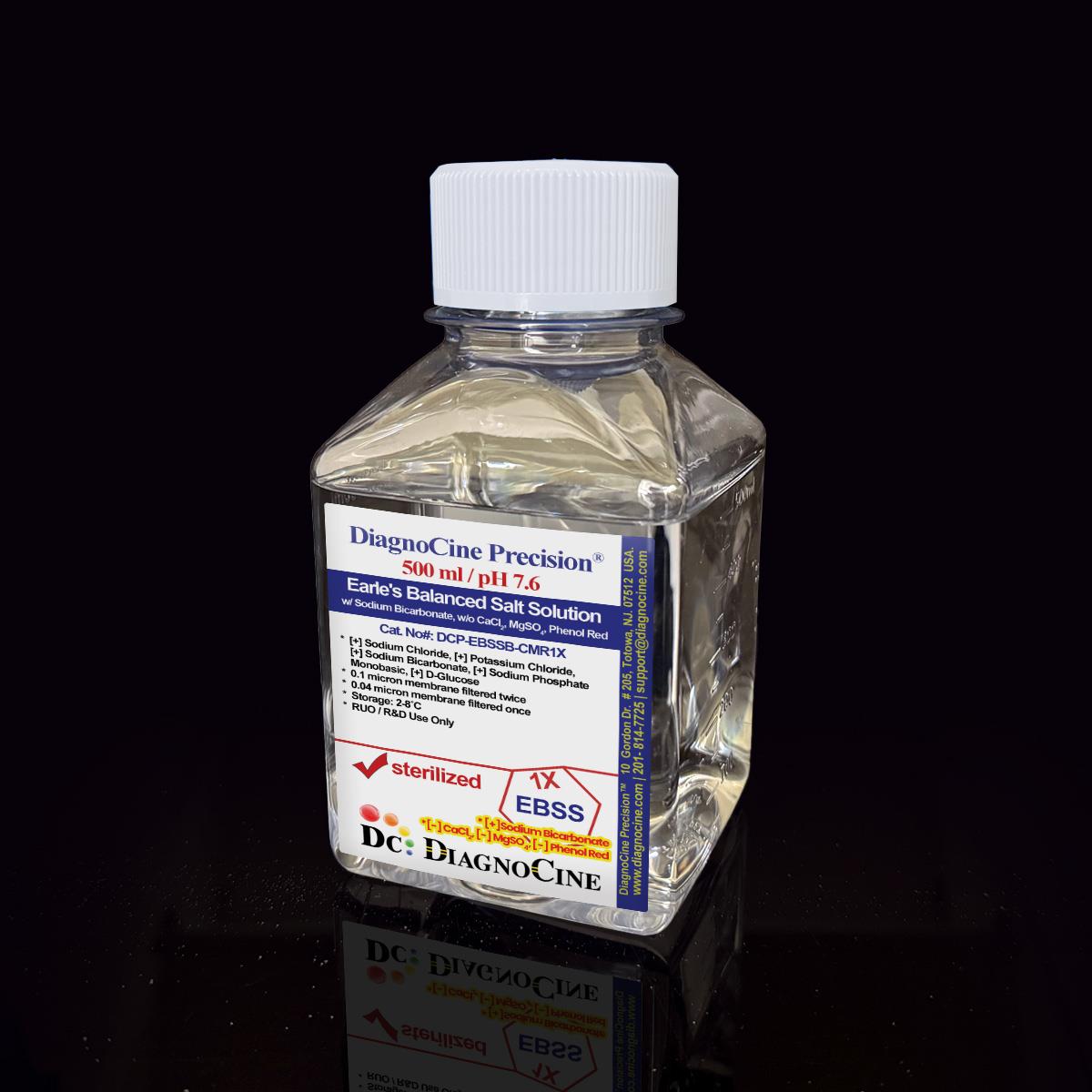
Earle's Balanced Salt Solution w/ Sodium bicarbonate w/o Calcium, Magnesium and Phenol red: 1X
FluxMPS™ Earle's Balanced Salt Solution w/ Sodium Bicarbonate w/o Calcium, Magnesium and Phenol Red: 1X
An MPS-grade, ready-to-use 1X Earle's Balanced Salt Solution (EBSS) supplemented with sodium bicarbonate and formulated without calcium, magnesium, or phenol red for chelation-sensitive protocols and optically clean imaging. Quadruple-stage filtered (0.1 µm membrane twice and 0.04 µm membrane twice) for microchannel-safe purity in organ-on-a-chip (OoC) and microphysiological system (MPS) workflows.
- Quadruple-stage filtration: 0.1 µm membrane twice and 0.04 µm membrane twice for ultra-low particulate purity
- Calcium- and magnesium-free formulation compatible with chelating agents and cell dissociation protocols
- Phenol red-free for enhanced optical clarity in imaging and fluorescence-based assays
- Endotoxin NMT 1 EU/mL; sterility confirmed per USP with no bacterial or fungal growth after 14 days
- Manufactured with Ultrapure Type 1 water (18.2 MΩ·cm)
- Microchannel-safe purity suitable for OoC, ToC, BoC, and LoC platforms
- Ready-to-use 1X liquid format, 500 mL, saves preparation time and reduces error
- Custom pH, additives, and formulation modifications available on request
- pH
- 7.6
- Osmolality
- Approximately 265-305 mOsm/kg H2O
- Formulation
- Ca/Mg-free, phenol red-free, NaHCO3-supplemented
- Endotoxin
- NMT 1 EU/mL
- Sterility
- No growth at 14 days (USP)
- Filtration
- 0.1 µm membrane twice + 0.04 µm membrane twice
- Storage
- 2-8°C, away from bright light
- Shelf Life
- 24 months
- Format
- Ready-to-use 1X liquid
- Size
- 500 mL
Engineered where standard buffers fail
Conventional 0.22 µm-filtered balanced salt solutions carry subvisible particulate, variable endotoxin load, and batch-to-batch pH drift that accumulate in narrow microfluidic channels and interfere with imaging and biosensor readouts. FluxMPS™ balanced salt solution is engineered specifically for microphysiological system (MPS) and organ-on-a-chip (OoC) workflows.
Microchannel-safe purity
Final 0.04 µm membrane pass targets fine particulates that a single 0.22 µm filtration pass cannot exclude, protecting narrow microfluidic channels and valves.
Precise, stable pH
Batch-tested to pH 7.6, formulated without calcium and magnesium for compatibility with chelating agents and dissociation protocols.
Ultrapure-grade water
Manufactured with Ultrapure Type 1 water (18.2 MΩ·cm), meeting USP <85> water quality expectations.
Low background for imaging & assays
Phenol red-free formulation enhances optical clarity for confocal microscopy, biosensor readouts, and fluorescence-based assays.
Defined, traceable composition
Lot-released inorganic salts and D-glucose energy source, supplemented with sodium bicarbonate, with calcium chloride, magnesium sulfate, and phenol red intentionally excluded.
Customization on demand
Alternate concentrations, additional chemicals, compounds, proteins, supplements, or pH modifications available on request.
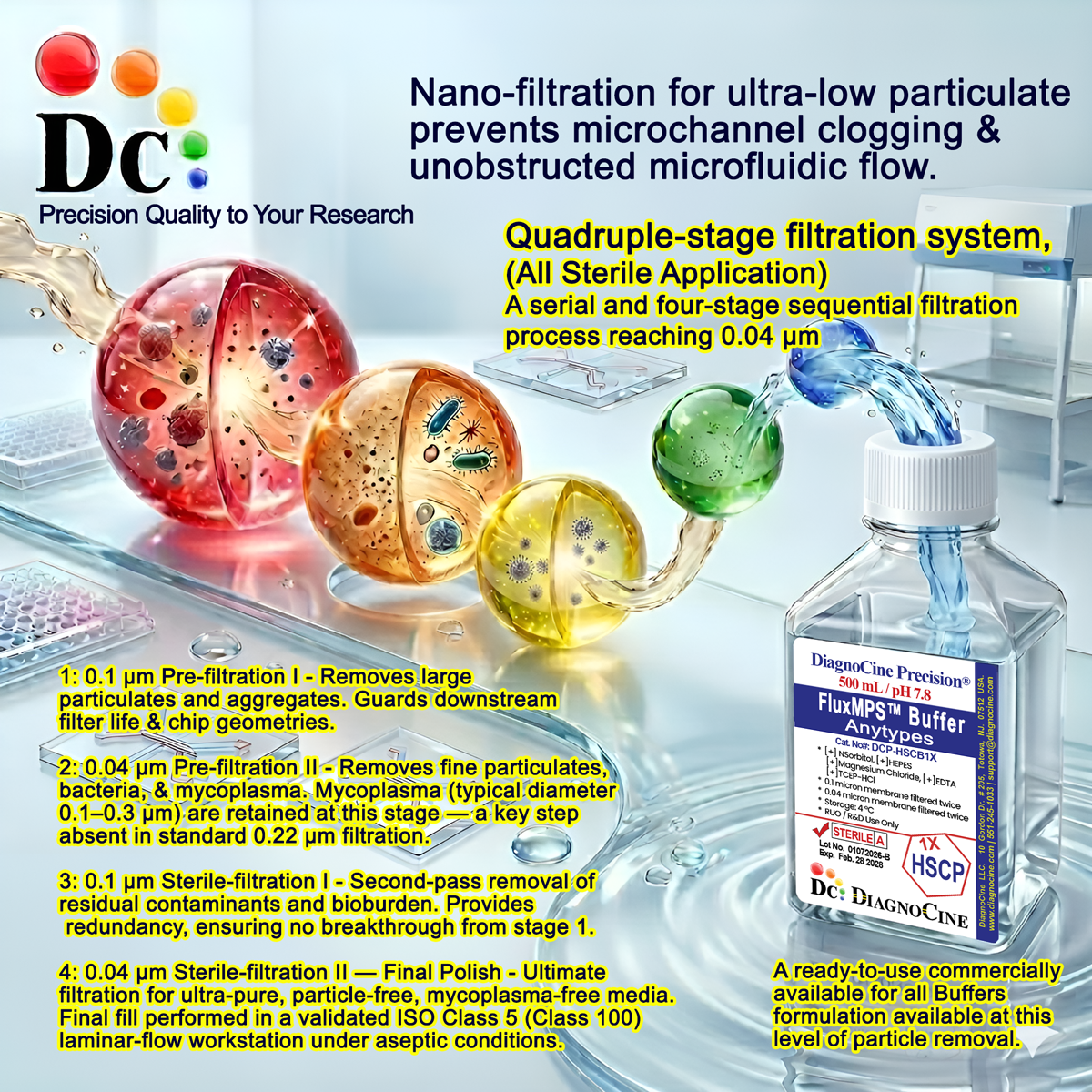
Quadruple-stage filtration system
Every lot of DCP-EBSSB-CMR1X is filtered through a 0.1 µm membrane twice and a 0.04 µm membrane twice — a four-stage sequence engineered to protect microfluidic channels and prevent mycoplasma-scale contamination in MPS and OoC applications.
-
1
0.1 µm Pre-filtration I
First 0.1 µm membrane pass removes large particulates and aggregates, extending the service life of downstream filters.
-
2
0.04 µm Pre-filtration II
First 0.04 µm membrane pass retains fine particulates and bioburden, including organisms in the mycoplasma size range, generally cited near 0.2 microns.
-
3
0.1 µm Sterile-filtration I
Second 0.1 µm membrane pass provides redundant particulate exclusion ahead of final polishing.
-
4
0.04 µm Sterile-filtration II — Final Polish
Second 0.04 µm membrane pass delivers a final polish under aseptic fill conditions, helping prevent mycoplasma contamination.
Performance vs. conventional buffer
Sequential 0.1 µm and 0.04 µm filtration, applied twice each, removes finer particulates than a single 0.22 µm filtration pass typically used in conventional balanced salt solutions.
© Diagnocine® — DCP-EBSSB-CMR1X
Versatile support for calcium- and magnesium-sensitive workflows
This EBSS variant is formulated for cell washing prior to dissociation, short-term maintenance during experimental manipulation, chelation-dependent protocols, and phenol red-free imaging.
Automated Bioreactors & Robotics
An optional 0.01 µm (10 nm) ultra-filtered variant is available for automated bioreactor and robotic liquid-handling systems where valve and sensor protection is critical.
- Total Particulate Exclusion — supports closed-loop automated systems
- Valve & Sensor Protection — reduces fouling risk in microvalves and inline sensors
- Extended Perfusion Stability — supports long-duration automated perfusion runs
Inquiry Required: Contact support@diagnocine.com to request the 0.01 µm ultra-filtered grade of this formulation.
Micro Physiological System (MPS) & Chip
Calcium- and magnesium-free, phenol red-free wash and maintenance buffer for chip-based culture platforms.
Cell Washing Prior to Dissociation
Chelating-agent-compatible wash step ahead of enzymatic or mechanical dissociation procedures.
iPSC-Derived Model Handling
Short-term maintenance buffer during experimental manipulation of sensitive iPSC-derived cell models.
Endothelial & Primary Cell Handling
Calcium/magnesium-free environment supports specialized protocols requiring divalent cation absence.
ELISA, Blotting & Blocking
Phenol red-free base supports assays sensitive to background color interference.
Microscopy & Optical Sensing
Absence of phenol red enhances imaging quality for fluorescence-based and confocal assays.
Full technical specification sheet
All parameters below are measured or declared for this specific lot-released formulation.
| Parameter | Specification |
|---|---|
| Formulation | Earle's Balanced Salt Solution w/ sodium bicarbonate, w/o calcium, magnesium and phenol red |
| Appearance | Red colored, clear solution |
| pH | 7.6 |
| Osmolality | Approximately 265-305 mOsm/kg H2O |
| Parameter | Specification |
|---|---|
| Endotoxin USP <85> | NMT 1 EU/mL |
| Sterility USP | No bacterial or fungal growth after 14 days of incubation |
| Toxicity Test | Passes |
| Water Quality | Ultrapure Type 1 water (18.2 MΩ·cm) |
| Fill Environment | ISO Class 5 (Class 100) |
| Manufacturing Standard ISO 13485 | ISO 13485-certified, CE-approved facilities |
| Parameter | Specification |
|---|---|
| Storage Temperature | 2-8°C, away from bright light |
| Shelf Life | 24 months |
| Expiry | Use before expiry date given on the product label |
| Parameter | Specification |
|---|---|
| Manufacturing QMS | ISO 13485-certified and CE-approved supplier facilities (DiagnoCine Precision) |
| Traceability | Final packaging, QA, and testing performed at the DiagnoCine R&D and Quality Testing Center; customization and assembly performed at DiagnoCine Precision, Totowa, New Jersey, USA |
| Production Method | 0.1 µm membrane filtration twice, 0.04 µm membrane filtration twice |
| Intended Use | Research Use Only (RUO) |
Full composition (mg/L)
Sodium bicarbonate is included in this formulation. Phenol red, calcium chloride, and magnesium sulfate are intentionally excluded. Every component below is lot-released and reproduced exactly as declared.
| Component | CAS Number | Concentration |
|---|---|---|
| Sodium Phosphate Monobasic | 7558-80-7 | 122.000 mg/L |
| Potassium Chloride | 7447-40-7 | 400.000 mg/L |
| Sodium Bicarbonate | 144-55-8 | 2200.000 mg/L |
| Sodium Chloride | 7647-14-5 | 6800.000 mg/L |
| D-Glucose | 50-99-7 | 1000.000 mg/L |
Manufacturing & compliance
Manufactured under ISO 13485-certified and CE-approved supplier facilities, with final packaging, quality assurance, and testing performed at the DiagnoCine R&D and Quality Testing Center.
ISO 13485:2016 QMS
Manufactured under an ISO 13485-certified and CE-approved facility quality management system.
Ultrapure Type 1 Water
Formulated with Ultrapure Type 1 water (18.2 MΩ·cm).
ISO Class 5 Fill & Finish
Aseptic fill performed under ISO Class 5 (Class 100) conditions following quadruple-stage filtration.
Micro-Batch Precision
Customization and assembly performed at DiagnoCine Precision, Totowa, New Jersey, USA.
Endotoxin USP <85> BET
NMT 1 EU/mL.
Sterility USP
No bacterial or fungal growth observed after 14 days of incubation.
Osmolality USP <785>
Approximately 265-305 mOsm/kg H2O.
Documentation / CoA
Certificate of Analysis available upon request.
How DCP-EBSSB-CMR1X compares
A side-by-side look at filtration architecture and quality attributes versus conventional balanced salt solutions.
| Parameter | DCP-EBSSB-CMR1X (FluxMPS™) | Conventional EBSS (0.22 µm filtered) | Standard alternative (0.22 µm filtered) |
|---|---|---|---|
| Formulation | Ca/Mg-free, phenol red-free, NaHCO3-supplemented | Varies by supplier | Varies by supplier |
| Final filtration pore size | 0.04 µm | 0.22 µm | 0.22 µm |
| Number of filtration stages | 4 | 1 | 1 |
| Endotoxin specification | NMT 1 EU/mL | Not typically specified | Not typically specified |
| USP sterility testing | check_circle | cancel | cancel |
| Water quality | Ultrapure Type 1 (18.2 MΩ·cm) | Purified water | Purified water |
| Manufacturing QMS | ISO 13485-certified, CE-approved | Varies | Varies |
| Microfluidic channel compatibility | check_circle | cancel | cancel |
| Custom formulation available | check_circle | cancel | cancel |
Frequently asked questions
Common questions about DCP-EBSSB-CMR1X for MPS and OoC workflows.
Supporting literature
Curated references relevant to balanced salt solutions, filtration purity, and microphysiological system applications.
- Earle WR. Production of malignancy in vitro. IV. The mouse fibroblast cultures and changes seen in the living cells. J Natl Cancer Inst. 1943. doi:10.1093/jnci/4.2.165
- Bhatia SN, Ingber DE. Microfluidic organs-on-chips. Nat Biotechnol. 2014;32(8):760-772. doi:10.1038/nbt.2989
- Huh D, Hamilton GA, Ingber DE. From 3D cell culture to organs-on-chips. Trends Cell Biol. 2011;21(12):745-754. doi:10.1016/j.tcb.2011.09.005
- Freshney RI. Culture of Animal Cells: A Manual of Basic Technique and Specialized Applications. 7th ed. Wiley; 2016.
- Phelan K, May KM. Basic techniques in mammalian cell tissue culture. Curr Protoc Cell Biol. 2015;66:1.1.1-1.1.22. doi:10.1002/0471143030.cb0101s66
- Ryan JA. Understanding and Managing Cell Culture Contamination. Corning Technical Bulletin.
- United States Pharmacopeia. USP <85> Bacterial Endotoxins Test. USP-NF.
- United States Pharmacopeia. USP <788> Particulate Matter in Injections. USP-NF.
- United States Pharmacopeia. USP <785> Osmolality and Osmolarity. USP-NF.
- Merten OW. Advances in cell culture: anchorage dependence. Philos Trans R Soc Lond B Biol Sci. 2015;370(1661):20140040. doi:10.1098/rstb.2014.0040
- Rasmussen SB, et al. Elimination of mycoplasma-like organisms from culture systems via sequential membrane filtration. Cytotechnology. 2010;62:499-507. doi:10.1007/s10616-010-9302-0