

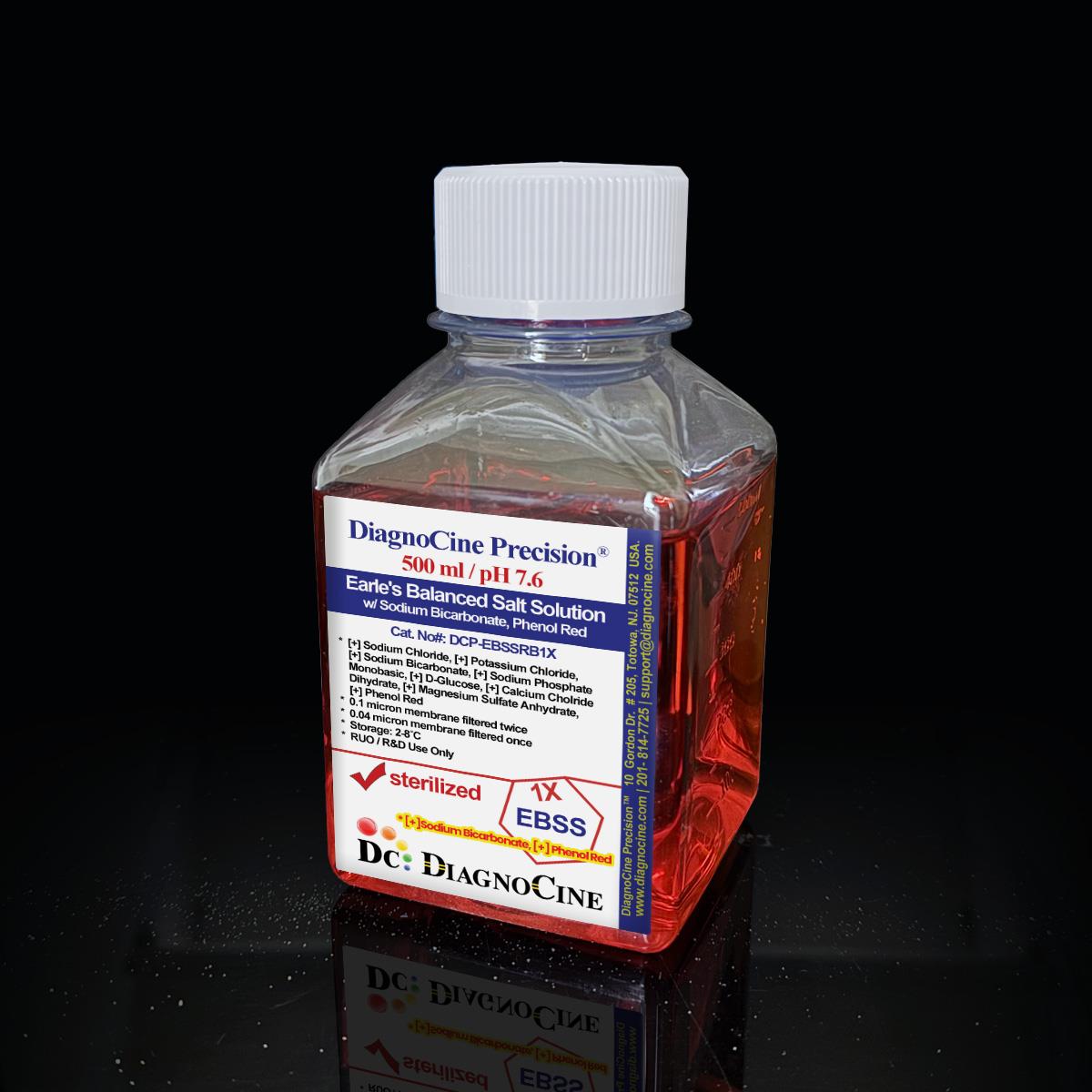
Earle's Balanced Salt Solution w/ Phenol red and Sodium bicarbonate: 1X
FluxMPS™ Earle's Balanced Salt Solution w/ Phenol Red and Sodium Bicarbonate: 1X
DCP-EBSSRB1X is an MPS-grade Earle's Balanced Salt Solution (EBSS) formulated with sodium bicarbonate and phenol red for CO2-dependent pH buffering and visual pH monitoring in mammalian cell culture. Sterile-filtered through a quadruple-stage 0.1 µm and 0.04 µm membrane process, this ready-to-use 1X solution delivers ultra-clean, microchannel-safe purity for organ-on-a-chip (OoC), microfluidic, and general cell culture workflows.
- Quadruple-stage filtration: 0.1 µm membrane twice and 0.04 µm membrane twice for ultra-clean, microchannel-safe purity
- Endotoxin content NMT 1 EU/mL
- pH 7.6 maintained by a sodium bicarbonate CO2-dependent buffering system
- Osmolality approximately 265-305 mOsm/kg H2O
- Phenol red sodium salt included for visual pH monitoring
- Ultrapure Type 1 water (18.2 MΩ·cm) base
- Ready-to-use 1X liquid format, 500 mL
- Customization available: alternate concentrations, pH, additions of chemicals, compounds, proteins, and supplements on request
- pH7.6
- OsmolalityApproximately 265-305 mOsm/kg H2O
- Concentration1X
- EndotoxinNMT 1 EU/mL
- SterilityNo growth after 14 days (USP)
- Filtration0.1 µm x2 + 0.04 µm x2
- Storage2-8 °C, away from light
- Shelf Life24 months
- AppearanceRed colored, clear solution
- FormatReady-to-use liquid, 500 mL
Engineered where standard buffers fail
Conventional 0.22 µm-filtered balanced salt solutions can carry subvisible particulates, pH drift, and endotoxin carry-over that accumulate in microchannels and interfere with sensitive assays. DCP-EBSSRB1X is built to eliminate those failure modes at the source.
Microchannel-safe purity
Final 0.04 µm pore filtration across a quadruple-stage process reduces particulate load for narrow microfluidic channels and biosensor surfaces.
Precise, stable pH
pH 7.6 is maintained by a sodium bicarbonate CO2-dependent buffering system, with phenol red for immediate visual confirmation.
Ultrapure-grade water
Formulated with Ultrapure Type 1 water (18.2 MΩ·cm), consistent with USP <85> water-quality expectations.
Low background for imaging & assays
Ultra-clean formulation supports confocal imaging, biosensor readouts, and other optical assays where particulate background matters.
Defined, traceable composition
Every inorganic salt, glucose, and indicator component is lot-released against a fixed formulation for reproducible cell culture results.
Customization on demand
Alternate concentrations, pH, and additions of chemicals, compounds, proteins, or supplements are available upon inquiry.
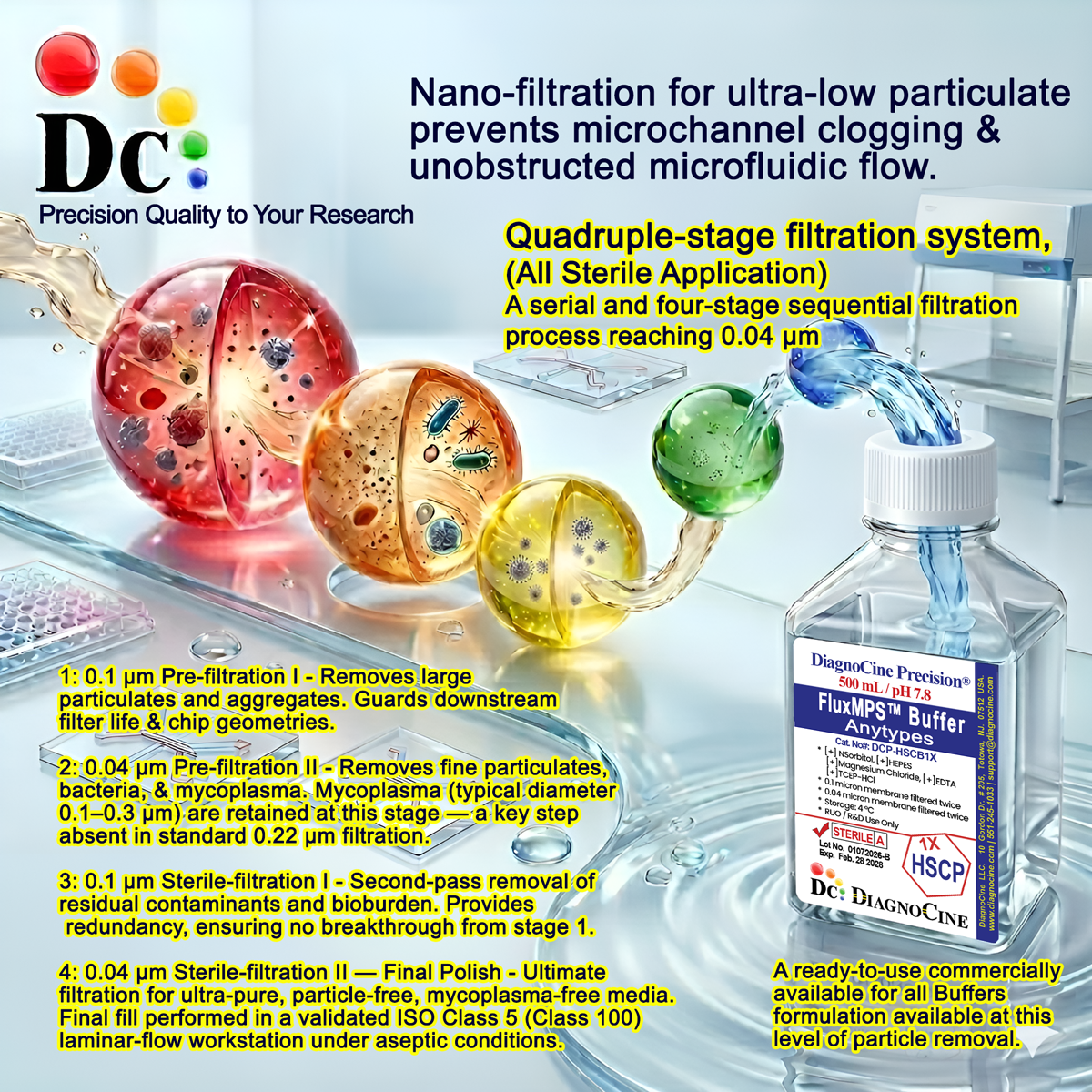
Quadruple-stage filtration system
Every lot of DCP-EBSSRB1X passes through four sequential membrane filtration stages -- 0.1 µm membrane twice followed by 0.04 µm membrane twice -- so the world's cleanest buffer standard for cell and molecular biology experiments is met before final aseptic fill.
-
1
0.1 µm Pre-filtration I
Removes large particulates and aggregates, extending the service life of the downstream membranes.
-
2
0.04 µm Pre-filtration II
Retains fine particulates and bioburden ahead of the second filtration pass.
-
3
0.1 µm Sterile-filtration I
Provides a second-pass redundancy step ahead of final polishing.
-
4
0.04 µm Sterile-filtration II -- Final Polish
Delivers the final polish under aseptic fill conditions, helping prevent mycoplasma contamination; the smallest mycoplasma types are about 0.2 microns.
Performance vs. conventional buffer
Sequential 0.1 µm and 0.04 µm filtration, repeated across four stages, removes finer particulates and bioburden than a single 0.22 µm filtration pass used in conventional balanced salt solutions.
© Diagnocine® -- DCP-EBSSRB1X
Where DCP-EBSSRB1X performs
DCP-EBSSRB1X supports short-term cell maintenance in CO2 environments, washing cells before dissociation or counting, transporting cells or tissues, and general-purpose physiological buffering for cell culture procedures.
Automated Bioreactors & Robotics
An optional 0.01 µm (10 nm) ultra-filtered variant of this balanced salt solution is available for automated bioreactor and robotic liquid-handling platforms where valve and sensor protection is critical.
- Total Particulate Exclusion for sensitive fluidic pathways
- Valve & Sensor Protection against microchannel occlusion
- Extended Perfusion Stability for long-duration automated runs
Inquiry Required: contact support@diagnocine.com to request the 0.01 µm ultra-filtered grade.
Micro Physiological System (MPS) & Chip
A quadruple-filtered, defined-composition balanced salt solution suited to microfluidic channel priming and perfusion.
Wash, Dilution & Reconstitution
Used for washing cells before dissociation or counting, and for general dilution steps in cell culture protocols.
iPSC-Derived Model Handling
Defined salt and glucose composition supports gentle handling of sensitive stem-cell-derived models.
Endothelial & Primary Cell Perfusion
Isotonic, CO2-buffered formulation suitable for short-term maintenance and transport of primary cell types.
ELISA, Blotting & Blocking
Ultra-clean, low-background formulation appropriate for wash steps in immunoassay and blotting workflows.
Microscopy & Optical Sensing
Low-particulate, phenol-red-indicated formulation supports live-cell imaging and optical sensor readouts.
Full specification sheet
Measured, declared, and stated parameters for DCP-EBSSRB1X, 500 mL, 1X.
| Parameter | Specification |
|---|---|
| Formulation / Composition | Balanced salt solution with sodium bicarbonate and phenol red indicator |
| Appearance | Red colored, clear solution |
| pH (USP <791>) | 7.6 |
| Osmolality (USP <785>) | Approximately 265-305 mOsm/kg H2O |
| Concentration | 1X |
| Parameter | Specification |
|---|---|
| Endotoxin (USP <85> BET) USP | NMT 1 EU/mL |
| Sterility (USP <71>) USP | No bacterial or fungal growth observed after 14 days of incubation |
| Toxicity Test | Passes |
| Water Quality | Ultrapure Type 1 water, 18.2 MΩ·cm |
| Manufacturing Standard ISO | ISO 13485-certified, CE-approved facility |
| Parameter | Specification |
|---|---|
| Storage Temperature | 2-8 °C, away from bright light |
| Shelf Life | 24 months |
| Expiry | Use before expiry date given on product label |
| Parameter | Specification |
|---|---|
| Manufacturing QMS ISO | ISO 13485-certified facility |
| Regulatory Alignment | CE-approved facility |
| Traceability | Final packaging, quality assurance, and testing performed at the DiagnoCine R&D and Quality Testing Center |
| Production & Customization Site | DiagnoCine Precision, Totowa, New Jersey, USA |
| Intended Use | Research Use Only (RUO); not for clinical, diagnostic, or therapeutic use in humans |
Full composition (mg/L)
Every inorganic salt, energy source, and indicator component in DCP-EBSSRB1X is lot-released against the formulation below.
| Component | CAS Number | Concentration |
|---|---|---|
| Calcium Chloride Dihydrate | 10035-04-8 | 265.000 mg/L |
| Magnesium Sulfate Anhydrous | 7487-88-9 | 97.720 mg/L |
| Sodium Phosphate Monobasic | 7558-80-7 | 122.000 mg/L |
| Potassium Chloride | 7447-40-7 | 400.000 mg/L |
| Sodium Bicarbonate | 144-55-8 | 2200.000 mg/L |
| Sodium Chloride | 7647-14-5 | 6800.000 mg/L |
| D-Glucose | 50-99-7 | 1000.000 mg/L |
| Phenol Red Sodium Salt | 34487-61-1 | 11.000 mg/L |
Manufacturing & compliance
DCP-EBSSRB1X is manufactured under ISO 13485-certified and CE-approved facilities, with final packaging, quality assurance, and testing performed at the DiagnoCine R&D and Quality Testing Center. Customization requests and assembly are completed at DiagnoCine Precision in Totowa, New Jersey, USA.
ISO 13485:2016 QMS
Manufactured under a certified, CE-approved quality management system.
Ultrapure Type 1 Water
Formulated with 18.2 MΩ·cm Type 1 water as the base.
ISO Class 5 Fill & Finish
Aseptic fill following quadruple-stage 0.1 µm / 0.04 µm filtration.
Micro-Batch Precision
Final packaging and QA performed at the DiagnoCine R&D and Quality Testing Center.
Endotoxin -- USP <85> BET
Tested to confirm endotoxin content NMT 1 EU/mL.
Sterility -- USP <71>
No bacterial or fungal growth observed after 14 days of incubation.
Osmolality -- USP <785>
Verified at approximately 265-305 mOsm/kg H2O.
Documentation / CoA
A Certificate of Analysis is available for every lot; contact support@diagnocine.com.
How DCP-EBSSRB1X compares
A side-by-side view of DCP-EBSSRB1X against conventionally filtered balanced salt solutions.
| Parameter | DCP-EBSSRB1X (FluxMPS™) | Conventional 0.22 µm-Filtered EBSS | Standard EBSS Alternative |
|---|---|---|---|
| Quadruple-stage filtration (0.1 µm x2 + 0.04 µm x2) | check_circle | cancel | cancel |
| Endotoxin tested to NMT 1 EU/mL | check_circle | cancel | cancel |
| Sterility tested per USP <71> | check_circle | check_circle | cancel |
| Ultrapure Type 1 water base | check_circle | cancel | cancel |
| Sodium bicarbonate CO2-dependent buffering | check_circle | check_circle | check_circle |
| Phenol red visual pH indicator | check_circle | check_circle | cancel |
| ISO 13485-certified, CE-approved manufacturing | check_circle | cancel | cancel |
| Microfluidic / OoC channel compatibility | check_circle | cancel | cancel |
| Custom formulation available | check_circle | cancel | cancel |
Frequently asked questions
Common questions about DCP-EBSSRB1X for organ-on-a-chip, microfluidic, and general cell culture use.
Supporting literature
Curated literature relevant to balanced salt solutions, buffer chemistry, and microphysiological system applications.
- Earle WR. Production of malignancy in vitro. IV. The mouse fibroblast cultures and changes seen in the living cells. J Natl Cancer Inst. 1943. doi:10.1093/jnci/4.2.165
- Bhatia SN, Ingber DE. Microfluidic organs-on-chips. Nat Biotechnol. 2014;32(8):760-772. doi:10.1038/nbt.2989
- Freshney RI. Culture of Animal Cells: A Manual of Basic Technique and Specialized Applications. Wiley; 2015.
- Phelan K, May KM. Basic techniques in mammalian cell tissue culture. Curr Protoc Cell Biol. 2015;66:1.1.1-1.1.22. doi:10.1002/0471143030.cb0101s66
- Yao T, Asayama Y. Animal-cell culture media: History, characteristics, and current issues. Reprod Med Biol. 2017;16(2):99-117. doi:10.1002/rmb2.12024
- Rayner JR, Munsie M. Endotoxin testing of biological products. Cytotherapy. 2019;21(11):1080-1090. doi:10.1016/j.jcyt.2019.09.001
- Uphoff CC, Drexler HG. Detection of mycoplasma contamination in cell cultures. Curr Protoc Mol Biol. 2014;106:28.4.1-28.4.14. doi:10.1002/0471142727.mb2804s106
- Ingber DE. Human organs-on-chips for disease modelling, drug development and personalized medicine. Nat Rev Genet. 2022;23:467-491. doi:10.1038/s41576-022-00466-9
- Ferrari E, et al. Sterile filtration of cell culture media and reagents. Methods Mol Biol. 2020;2109:23-34. doi:10.1007/7651_2019_233