


Borate Buffered Saline [1X]
FluxMPS™ Borate Buffered Saline [1X]
An MPS-grade, ultrapure borate buffer formulated with 1 M Boric Acid and 0.25 M Sodium Hydroxide for a stable, alkaline pH of 8.5. Manufactured with Ultrapure Type 1 water and passed through quadruple-stage 0.1 µm and 0.04 µm membrane filtration, it delivers an ultra-low particulate, microchannel-safe buffer for organ-on-a-chip, molecular biology, and immunoassay workflows.
- Quadruple-stage filtration: 0.1 µm membrane (twice) plus 0.04 µm membrane (twice) for ultra-low particulate, microchannel-safe purity
- Defined molarity formulation: 1 M Boric Acid and 0.25 M Sodium Hydroxide yielding a consistent pH of 8.5
- Isotonic, alkaline chemistry with physiological-like osmotic properties for biological sample handling
- Bactericidal borate-buffered chemistry supports wash, dilution, and coating protocols where limiting bacterial growth matters
- DNase- and RNase-clean: no activity detected after 18-hour incubation at room temperature
- Manufactured with Ultrapure Type 1 water (18.2 MΩ·cm) under ISO Class 5 aseptic fill conditions
- Compatible with microfluidic channels, ELISA workflows, and organ-on-a-chip perfusion systems
- Custom concentrations, pH, and additive formulations available on request
- pH8.5
- Boric Acid1 M
- Sodium Hydroxide0.25 M
- AppearanceClear, Colorless Liquid
- Filtration0.1 µm x2 + 0.04 µm x2
- Sterility0.1 µm filtered twice, sterile environment
- DNase ActivityNone detected
- RNase ActivityNone detected
- Storage4°C
- Shelf Life1 year
Engineered where standard buffers fail
Conventional 0.22 µm-filtered buffers can carry subvisible particulates, accumulate residue in narrow microfluidic channels, and drift in pH or ionic balance over time. FluxMPS™ Borate Buffered Saline [1X] is built for consistency, purity, and reproducibility at every stage.
Microchannel-safe purity
Quadruple-stage 0.1 µm (twice) and 0.04 µm (twice) membrane filtration removes fine particulates that could otherwise obstruct narrow microfluidic channels.
Precise, stable pH
A defined 1 M Boric Acid / 0.25 M Sodium Hydroxide formulation delivers a consistent alkaline pH of 8.5, lot to lot.
Ultrapure-grade water
Formulated with Ultrapure Type 1 water (18.2 MΩ·cm) under ISO 13485-certified, CE-approved manufacturing.
Low background for imaging & assays
DNase- and RNase-clean formulation supports ELISA, blotting, and molecular biology protocols free of nuclease interference.
Defined, traceable composition
Boric Acid and Sodium Hydroxide concentrations are documented and consistent, supporting reproducible bactericidal, isotonic buffering.
Customization on demand
Alternate concentrations, pH values, and additive supplementation (chemicals, compounds, proteins, supplements) available on request.
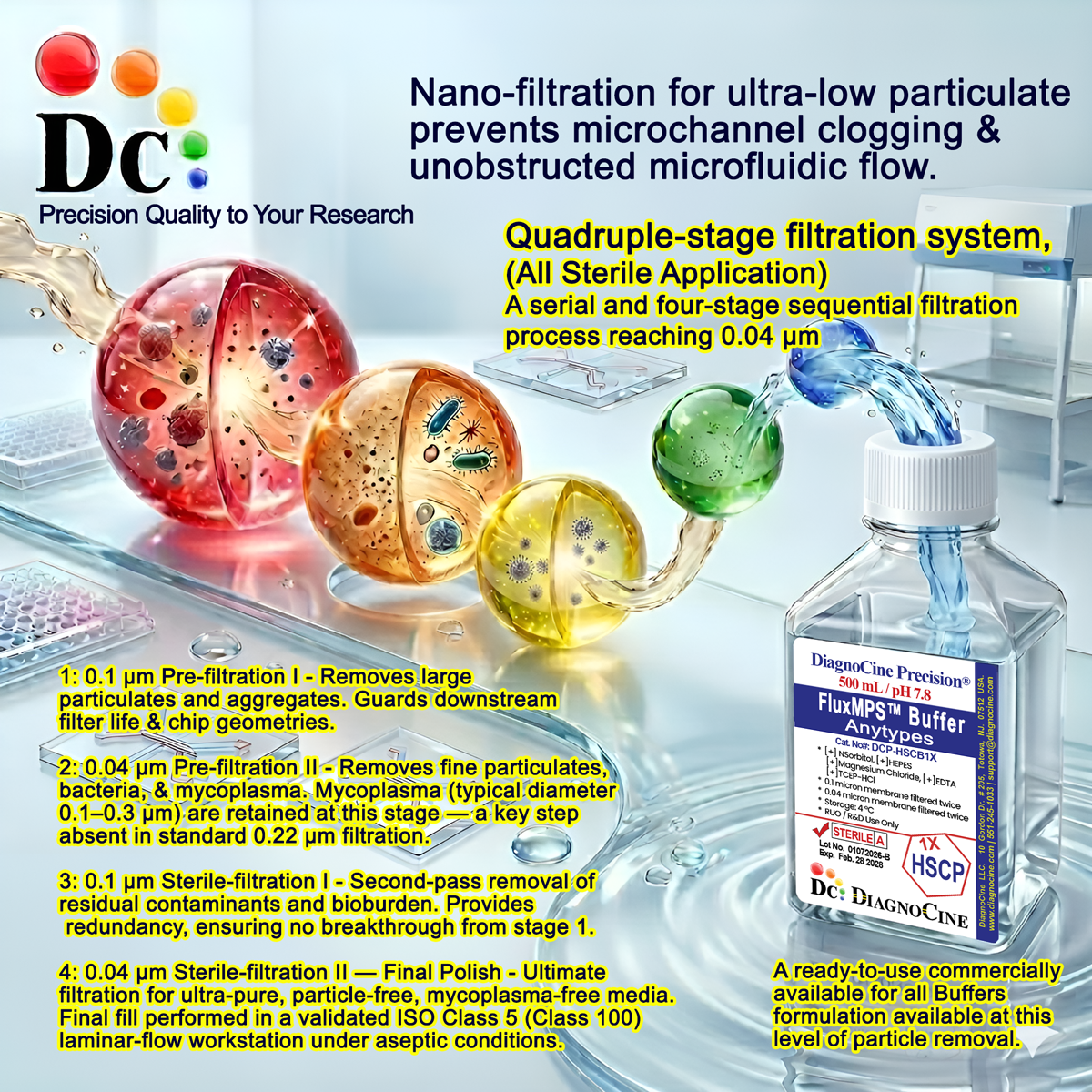
Quadruple-stage filtration system
Borate Buffered Saline [1X] is filtered through 0.1 µm membrane twice and 0.04 µm membrane twice — four sequential filtration passes designed to keep this buffer clean enough for sensitive microfluidic and cell-based systems.
-
1
0.1 µm Pre-filtration I
Removes larger particulates and aggregates, extending the life of downstream filters.
-
2
0.04 µm Pre-filtration II
Retains finer particulates and reduces bioburden ahead of the second filtration pass.
-
3
0.1 µm Sterile-filtration I
A second-pass 0.1 µm filtration performed in a sterile environment adds redundancy to the sterility assurance process.
-
4
0.04 µm Sterile-filtration II — Final Polish
A final 0.04 µm pass helps guard against mycoplasma contamination, since the smallest known mycoplasma species measure approximately 0.2 µm.
Performance vs. conventional buffer
Sequential 0.1 µm and 0.04 µm filtration, repeated in two passes each, removes finer particulates than a single 0.22 µm pass used in many conventional buffers.
© Diagnocine® — DCP-BBS1X
Where Borate Buffered Saline [1X] is used
BBS is a versatile, alkaline, isotonic buffer with bactericidal properties that emulates physiological conditions across biochemical and molecular biology protocols. Beyond routine laboratory use, borate-buffered chemistry has been explored in specialized research contexts, including evaluation of heat-killed, borate-buffered bacterial suspensions (Gordonia bronchialis, Rhodococcus coprophilus, Tsukamurella inchonensis) for canine flea allergy studies, and in lentivirus-mediated siRNA studies targeting the human metastasis suppressor 1 (MTSS1) gene to investigate hepatocellular carcinoma invasion and metastatic potential.
Automated Bioreactors & Robotics
For automated bioreactor and robotic liquid-handling systems, an optional 0.01 µm (10 nm) ultra-filtered variant of this buffer is available to further protect sensitive valves and sensors.
- Total Particulate Exclusion for automated flow paths
- Valve & Sensor Protection in robotic dispensing systems
- Extended Perfusion Stability in continuous-flow setups
Inquiry Required: the 0.01 µm ultra-filtered variant is available by request — contact support@diagnocine.com.
Micro Physiological System (MPS) & Chip
Ultra-low particulate, defined-pH buffer compatible with narrow microfluidic channels and perfusion systems.
Wash, Dilution & Reconstitution
Used as a wash and blocking buffer with Tween 20 and milk powder, and as a diluent that maintains a stable, alkaline pH environment.
iPSC-Derived Model Handling
Isotonic, bactericidal chemistry suited to gentle handling of sensitive stem-cell-derived models.
Endothelial & Primary Cell Perfusion
Physiological-like osmotic pressure supports applications involving biological samples or systems requiring stable conditions.
ELISA, Blotting & Blocking
Used for coating microtiter plates or other surfaces with proteins or antibodies in ELISA, and as a blocking buffer base.
Microscopy & Optical Sensing
Low-particulate, low-nuclease-activity chemistry supports clean backgrounds in optical and biosensor-based readouts.
Measured & declared parameters
Specifications below reflect the values stated for Borate Buffered Saline [1X] (DCP-BBS1X).
| Parameter | Specification |
|---|---|
| Formulation | Boric Acid (1 M), Sodium Hydroxide (0.25 M) |
| Appearance | Clear, Colorless Liquid |
| pH | 8.5 |
| Parameter | Specification |
|---|---|
| Sterility USP | Filtered 0.1 µm membrane twice in a sterile environment |
| DNase Activity | None detected after 18 hr incubation with plasmid DNA at room temperature |
| RNase Activity | None detected after 18 hr incubation with ribosomal RNA at room temperature |
| Water Quality | Ultrapure Type 1 water (18.2 MΩ·cm) |
| Manufacturing Standard ISO | ISO 13485-certified, CE-approved facilities |
| Parameter | Specification |
|---|---|
| Storage Temperature | 4°C |
| Shelf Life | 1 year |
| Parameter | Specification |
|---|---|
| Manufacturing QMS | ISO 13485-certified facilities (Suppliers of DiagnoCine Precision) |
| Regulatory Alignment | CE-approved |
| Final Assembly / Customization Site | DiagnoCine Precision, Totowa, New Jersey, USA |
| Intended Use | Research Use Only (RUO) |
Full composition
Borate Buffered Saline [1X] is formulated from two components at defined molarity.
| Component | CAS Number | Concentration |
|---|---|---|
| Boric Acid | 10043-35-3 | 1 M |
| Sodium Hydroxide | 1310-73-2 | 0.25 M |
Manufacturing & compliance
Borate Buffered Saline [1X] is produced and quality-tested under a documented, standards-aligned process.
ISO 13485:2016 QMS
Manufactured under ISO 13485-certified and CE-approved facilities (Suppliers of DiagnoCine Precision).
Ultrapure Type 1 Water
Formulated with Ultrapure Type 1 water (18.2 MΩ·cm) as the base solvent.
ISO Class 5 Fill & Finish
Final packaging, quality assurance, and testing are completed at the DiagnoCine R&D and Quality Testing Center.
Micro-Batch Precision
Specific customization requests and assembly are accomplished at DiagnoCine Precision in Totowa, New Jersey, USA.
DNase-Verified Clean
No DNase activity detected after 18 hr incubation of plasmid DNA with this product at room temperature.
RNase-Verified Clean
No RNase activity detected after 18 hr incubation of ribosomal RNA with this product at room temperature.
Sterility Assurance
Filtered through 0.1 µm membrane twice in a sterile environment.
Documentation & CoA
A Certificate of Analysis documenting appearance, pH, sterility filtration, and DNase/RNase results is available on request.
How DCP-BBS1X compares
A qualitative comparison of DCP-BBS1X against conventional single-pass filtered buffers.
| Parameter | DCP-BBS1X (FluxMPS™) | Conventional Buffer (0.22 µm filtered) | Standard Alternative (0.22 µm filtered) |
|---|---|---|---|
| Defined molarity formulation | 1 M Boric Acid / 0.25 M NaOH | Varies | Varies |
| Final filtration pore size | 0.04 µm | 0.22 µm | 0.22 µm |
| Number of filtration stages | 4 | 1 | 1 |
| Sterility environment filtration | check_circle | cancel | cancel |
| DNase/RNase verified clean | check_circle | cancel | cancel |
| Ultrapure Type 1 water base | check_circle | cancel | cancel |
| Manufacturing QMS | ISO 13485:2016 certified | Unspecified | Unspecified |
| Microfluidic channel compatibility | check_circle | cancel | cancel |
| Custom formulation available | check_circle | cancel | cancel |
Frequently asked questions
Common questions about DCP-BBS1X Borate Buffered Saline [1X].
Supporting literature
Curated literature relevant to borate-buffered saline chemistry, microfluidic perfusion, and buffer quality control.
- Bhatia SN, Ingber DE. Microfluidic organs-on-chips. Nat Biotechnol. 2014;32(8):760-772. doi:10.1038/nbt.2989
- Huh D, Hamilton GA, Ingber DE. From 3D cell culture to organs-on-chips. Trends Cell Biol. 2011;21(12):745-754. doi:10.1016/j.tcb.2011.09.005
- Good NE, Winget GD, Winter W, et al. Hydrogen ion buffers for biological research. Biochemistry. 1966;5(2):467-477. doi:10.1021/bi00866a011
- Ferreira GN, Monteiro GA, Prazeres DM, Cabral JM. Downstream processing of plasmid DNA for gene therapy and DNA vaccine applications. Trends Biotechnol. 2000;18(9):380-388. doi:10.1016/S0167-7799(00)01475-X
- Rottem S. Interaction of mycoplasmas with host cells. Physiol Rev. 2003;83(2):417-432. doi:10.1152/physrev.00030.2002
- Lonza. Mycoplasma detection and control in cell culture. Bioprocess review, applied practice reference. doi:10.1002/9780470054581.eib634
- Crowther JR. The ELISA Guidebook. 2nd ed. Methods Mol Biol. 2009;516:1-410. doi:10.1007/978-1-60327-254-4
- Sackmann EK, Fulton AL, Beebe DJ. The present and future role of microfluidics in biomedical research. Nature. 2014;507(7491):181-189. doi:10.1038/nature13118
- Halim AS, Khoo TL, Yussof SJM. Biologic and synthetic skin substitutes: an overview. Indian J Plast Surg. 2010;43(Suppl):S23-S28. doi:10.4103/0970-0358.70712