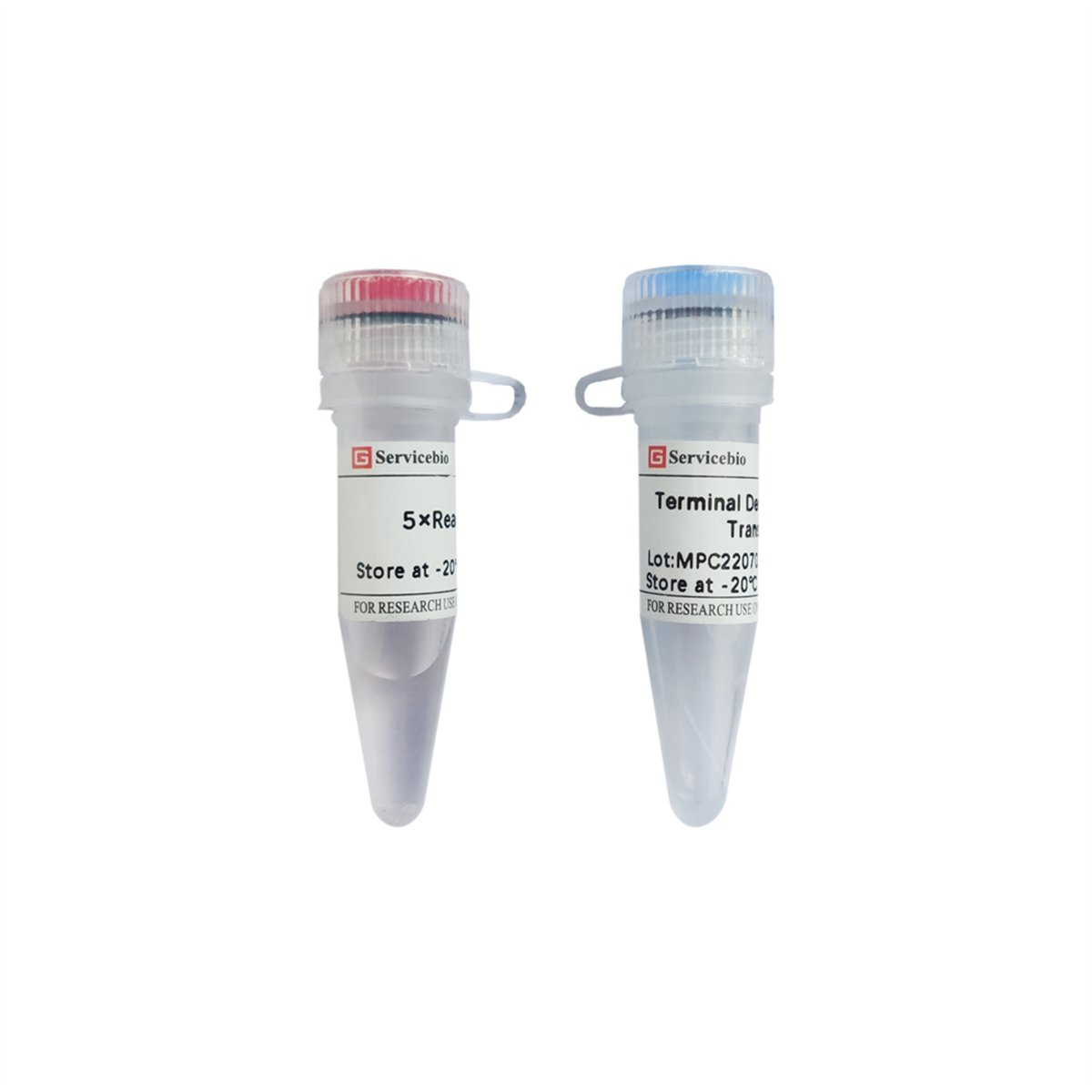
Terminal Deoxynucleotidyl Transferase
Cat. No.: SB-G3412-50UL
Size: 50UL
Description
This product, Terminal Deoxynucleotidyl Transferase, TdT for short, the Chinese name is terminal deoxyribonucleic acid transferase, is a non-template-dependent DNA polymerase, which can catalyze the addition of On dNTPs, oligonucleotides with a minimum length of 3 nucleotides can be catalyzed. TdT can also add NTP to the 3' hydroxyl end of RNA, but its catalytic activity for RNA templates is weaker than that for DNA templates. This product is mainly used in our company's Tunel Cell Apoptosis Detection Kit ( article number: G1501, G1502, G1504, G1505, G1507 ). The TdT produced by our company is obtained by evolutionary screening, which has higher enzyme activity and wider substrate spectrum than the wild type.
- Applications: Synthesis of homopolymers and heteropolymers; Homopolymer tailing at the 3′ hydroxyl end of linear double-stranded DNA; 3′ hydroxyl end labeling of oligonucleotides or DNA; 5′-RACE (rapid amplification of cDNA ends); In situ localization of apoptosis, etc.
- Source : Recombinant expression in Escherichia coli strain carrying calf thymus gene.
- Definition of enzyme activity : in the matching reaction buffer, the amount of enzyme required to incorporate 1 nmol of deoxyribonucleotide into the 3′ end of polynucleotide within 1 hour at 37°C is defined as one enzyme activity unit.
- Purity and concentration : SDS-PAGE detection purity ≥ 95%, no DNase, RNase; endogenous nucleic acid residues < 1 pg/μL (qPCR detection); 20 U/μL.
- Inactivation or inhibition : Heating at 70°C for 10 min or adding an appropriate amount of EDTA can inactivate it. Metal ion chelating agents, higher concentrations of ammonium ions, chloride ions, iodide ions, phosphate ions, heparin, etc. can all inhibit its activity.
- Enzyme storage buffer : 60 mM Potassium phosphate, 150 mM KCl, 1 mM DTT, 0.5% Triton X-100, 50% Glycerol, pH 7.2.
Storage and Handling Conditions
Transport in wet ice packs; store at -20°C, valid for 12 months.
Composition
| Component Number |
Component |
G3412-50UL |
| G3412-1 |
Terminal Deoxynucleotidyl Transferase |
50 μL |
| G3412-2 |
5×Reaction Buffer |
500 μL |
| Product Manual |
1 copy |
Steps
1. 1. The TdT can be directly used in our company's Tunel Cell Apoptosis Detection Kit ( Cat. No.: G1501, G1502, G1504, G1505, G1507 ); it can also be used in DNA end labeling and tailing reactions.
2. DNA 3′ end labeling:
| Component |
Volume |
| DNA to be labeled |
10 pmol |
| 5×Reaction Buffer |
10 μL |
| Radiolabeled ddATP (~10 TBq/mmol) |
1-2 MBq |
| Terminal Deoxynucleotidyl Transferase |
1-2 μL |
| Nuclease Free Water |
To 50 μL |
After setting up the reaction system according to the above table, gently mix and centrifuge the precipitated liquid, and incubate the reaction system at 37°C for 20 min. After the reaction, the system was incubated at 70°C for 20 min to terminate the reaction. ( The labeling efficiency of DNA 3' end is related to the type of 3' end, and the labeling efficiency of 3' protruding end is significantly higher than that of 3' indented end or blunt end )
3. Tailing of DNA ends:
| Component |
Volume |
| dna |
1 pmol of 3′-ends |
| 5×Reaction Buffer |
4 μL |
dATP or dTTP
dGTP or dCTP |
130 pmol
60 pmol |
| Terminal Deoxynucleotidyl Transferase |
1-2 μL |
| Nuclease Free Water |
To 20 μL |
After setting up the reaction system according to the above table, gently mix and centrifuge the precipitated liquid, and incubate the reaction system at 37°C for 25 min. After the reaction, the system was incubated at 70°C for 20 min to terminate the reaction. ( According to the above reaction conditions, about 110 dA or dT, or about 25 dC or dG can be added to each DNA 3′ hydroxyl end )
Precautions
- Enzyme products should be placed in an ice box or on an ice bath when used, and stored at -20°C immediately after use.
- Since 5×Reaction Buffer contains CoCl 2 , it is not compatible with downstream applications. The reaction mixture needs to be purified by column centrifugation or phenol/LF extraction and ethanol precipitation to remove CoCl 2 .
- For your safety and health, please wear a lab coat and disposable gloves for operation.