

cDNA Library, Mouse Thymocyte
cDNA Library, Mouse Thymocyte
Cat. No. FNK-02-713
Store at -20°C
Size 500 ng
Quantity
500 ng (40 ng/ul, 13ul) in 10 mM Tris-HCl-1mM EDTA (pH 7.5)
Quality
- Number of independent clones: 1.1 x 10⁶
- Average insert size : longer than 1 kb
Description
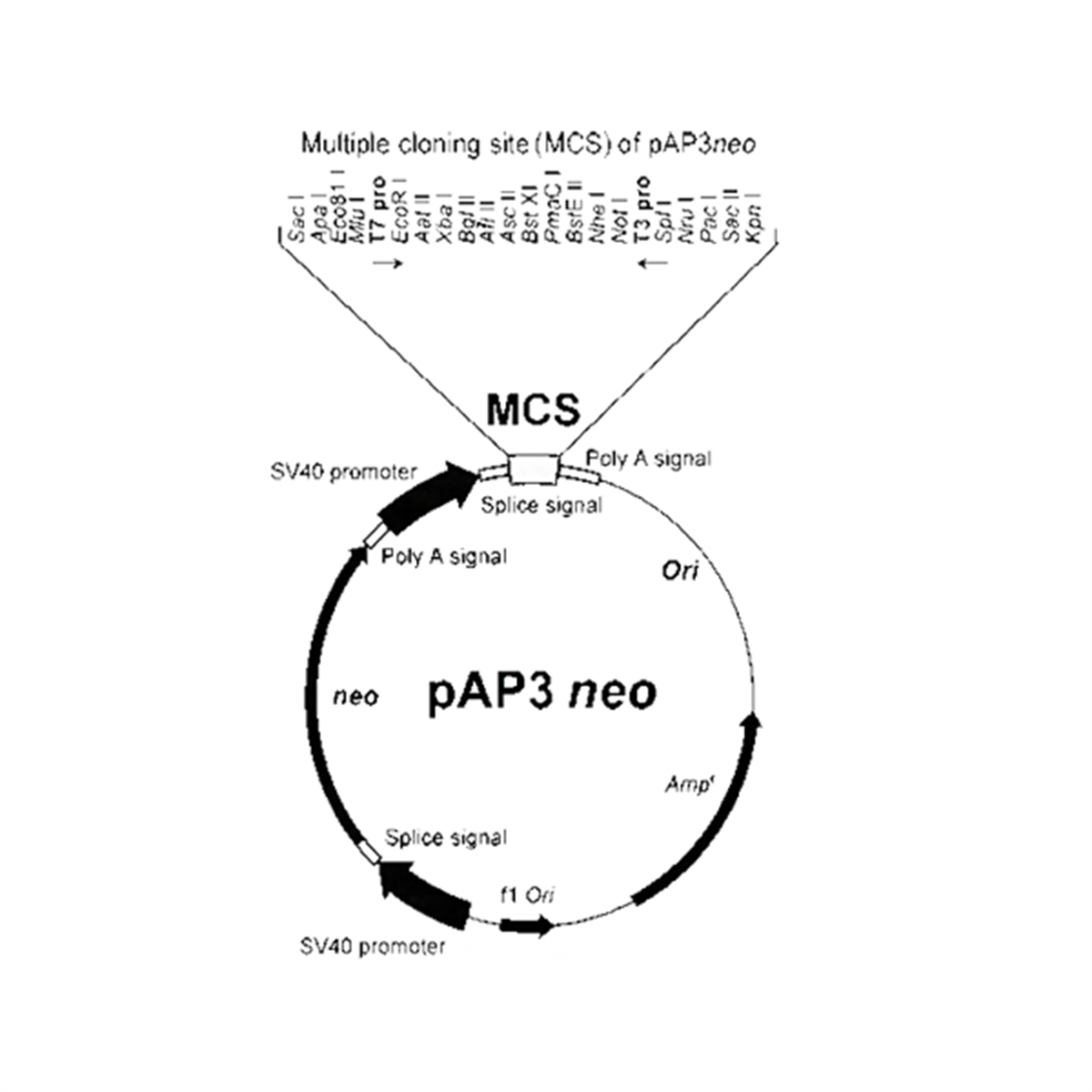
This cDNA library (plasmid DNA) is constructed from mouse thymocyte-derived poly(A)+ RNA by the Linker-Primer method (Ref.1) by Professor Hiroshi Nojima of the Research Institute for Microbial Diseases, Osaka University. This library is unidirectionally cloned using the oligo (dT)18 linker primer which contains the restriction enzyme site of Not I, and BamHI (Bgl II)-Sma I adaptor. The pAP3neo vector used in this library can express genes in mammalian cells as it contains the SV40 promoter. It also contains f1 ori which is necessary for ssDNA synthesis, and bacteriophage T7 and T3 promoter for RNA synthesis (see Figure). GenBank Accession No. AB003468
Application
PCR screening of known or unknown gene: Prepare the primers for the known or unknown gene (cDNA) and amplify the gene by PCR from this library followed by cloning to an appropriate vector. It is useful for large-scale protein productions, and preparation of probes, etc.
Standard amplifying conditions: 35 cycles of PCR reactions using 10-100 ng of cDNA as a template.(Change the quantity of template and the number of cycles depending on the expression level of mRNA of the particular gene.)
Note
* This library is to be used only by the purchaser. It is not allowed to amplify and transfer the library to a third person.
* Related products: human tissue specific cDNA libraries and cDNA libraries of model organisms
References
- Kobori M et al ” Large scale isolation of osteoclast-specific genes by an improved method involving the preparation of a subtracted cDNA library.” Genes Cells 3: 459-475 (1998) PMID: 9753427
- Sambrook J and Russell DW Molecular Cloning Chapter 11 ”Preparation of cDNA libraries and gene identification.” CSHL Press (2001)
