

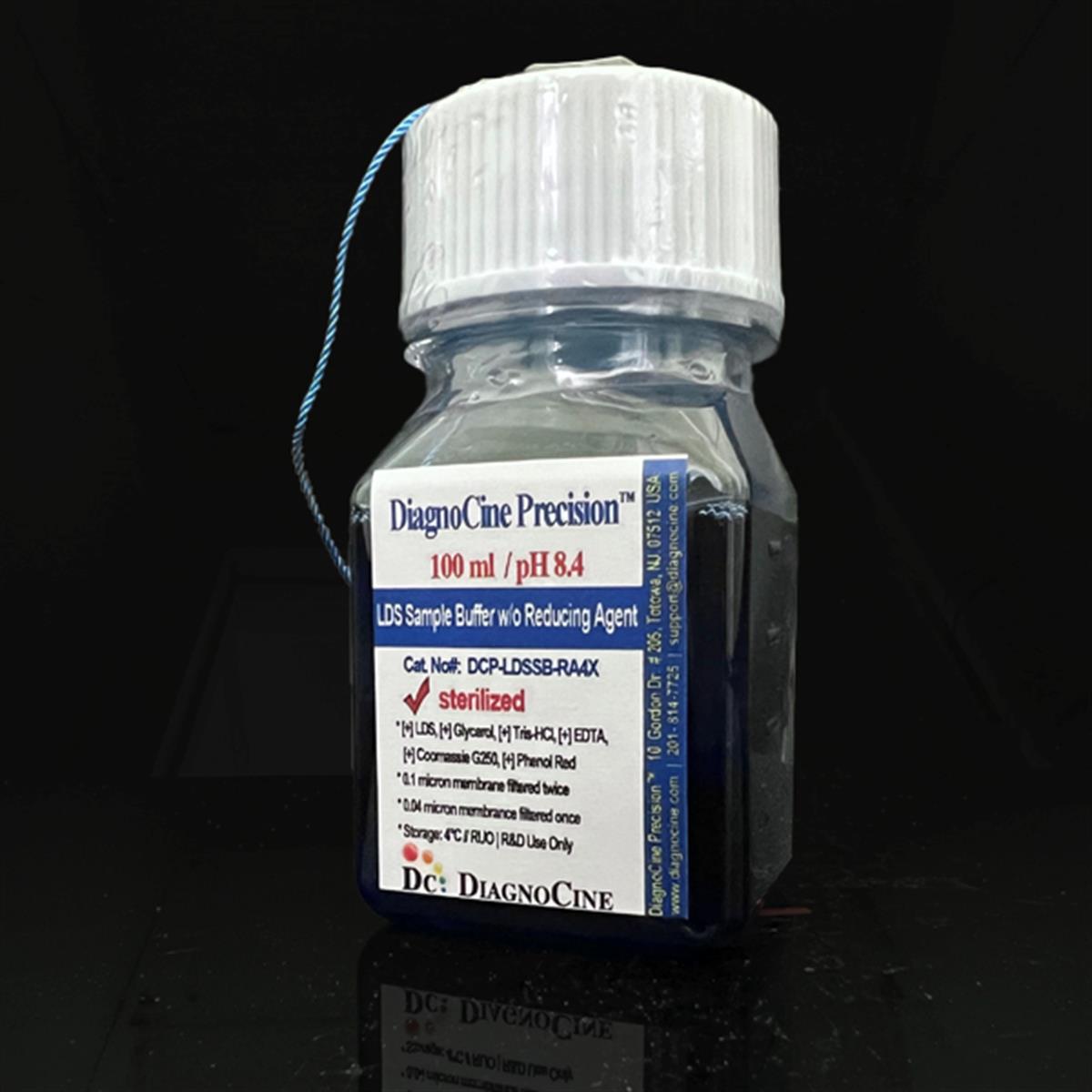
LDS Sample Buffer without Reducing Agent [4X]
FluxMPS™ LDS Sample Buffer without Reducing Agent [4X]
FluxMPS™ LDS Sample Buffer without Reducing Agent [4X] (DCP-LDSSB-RA4X) delivers optimal protein denaturation and sharp electrophoretic resolution for Bis-Tris and Tris-Acetate gel systems, manufactured under ISO 13485-certified, CE-approved facilities. Formulated without a reducing agent, it preserves native disulfide bonds for non-reducing and structural protein analysis, including downstream characterization of lysates from organ-on-chip (OoC) and microphysiological system (MPS) cell models. Each lot is Ultrapure and filtered once through a 0.45 micron membrane for particulate clarity.
- Non-Sterile, Ultrapure buffer filtered once through a 0.45 micron membrane for particulate clarity
- Slightly alkaline pH of 8.4 supports optimal protein denaturation and negative-charge migration during electrophoresis
- Formulated without a reducing agent, preserving disulfide-bonded protein structures for non-reducing and native-like analysis
- Compatible with Bis-Tris and Tris-Acetate gel systems; sharp dye front with both MES and MOPS running buffers
- Contains glycerol for sample density plus Coomassie G250 and phenol red tracking dyes for clear visualization
- Supplied as a 4X concentrate for flexible dilution into sample preparation workflows
- Available in 25 mL and 100 mL sizes
- Custom concentrations, additives, and pH modifications available on request
- pH8.4
- Concentration4X
- AppearancePurple liquid
- Filtration0.45 µm membrane, single pass
- SterilityNon-Sterile
- Storage4°C
- Shelf Life1 year
- Sizes Available25 mL, 100 mL
- Manufacturing StandardISO 13485-certified, CE-approved
- Intended UseRUO
Engineered for reproducible protein sample preparation
Standard gel-loading buffers vary lot to lot in clarity, pH, and dye performance. FluxMPS™ LDS Sample Buffer without Reducing Agent [4X] is manufactured to a defined, traceable specification for consistent sample prep results.
Particulate-clear filtration
Single-pass 0.45 micron membrane filtration removes coarse particulates for a consistent, Ultrapure sample buffer prior to packaging.
Precise, stable pH
A slightly alkaline pH of 8.4, buffered by 988 mM Tris-HCl, supports optimal disulfide-bond and protein denaturation conditions.
Ultrapure-grade water
Formulated with ultrapure Type 1 water (18.2 MΩ·cm) as part of DiagnoCine Precision's manufacturing standard.
Low-background dye chemistry
Coomassie G250 and phenol red tracking dyes give a sharp, low-background dye front for reliable gel imaging and documentation.
Defined, traceable composition
Tris-HCl, EDTA, LDS, glycerol, Coomassie blue, and phenol red are formulated to fixed concentrations under an ISO 13485 quality system.
Customization on demand
Different concentrations, additional chemicals, compounds, proteins, supplements, or pH values can be formulated on request.
Single-stage 0.45 micron filtration system
DCP-LDSSB-RA4X is manufactured as a non-sterile, Ultrapure LDS Sample Buffer, clarified through a single pass across a 0.45 micron membrane to remove coarse particulates before final packaging.
-
1
0.45 µm Membrane Filtration
A single pass through a 0.45 micron membrane removes coarse particulates from the Tris-HCl, EDTA, LDS, glycerol, and dye formulation, supporting consistent lot-to-lot clarity for gel loading and dye-front performance. Note that mycoplasma organisms can be as small as approximately 0.2 microns; buffers intended for mycoplasma-sensitive cell culture applications instead use DiagnoCine Precision's dedicated multi-stage 0.1 micron and 0.04 micron sterile filtration process.
As a non-sterile, research-grade reagent for gel electrophoresis sample preparation, this buffer is filtered once for particulate clarity rather than aseptic cell-culture use.
![FluxMPS LDS Sample Buffer without Reducing Agent [4X] (DCP-LDSSB-RA4X) single-stage 0.45 micron membrane filtration diagram for non-sterile protein sample buffer used in SDS-PAGE, Western blot, and organ-on-chip lysate analysis - Diagnocine](https://diagnocine.com/Content/Upload/Buffer/Only-Once-stage.png "FluxMPS™ Single-Stage Filtration System - Buffer for Microfluidic & Organ-on-a-Chip Applications | Diagnocine")
© Diagnocine® — DCP-LDSSB-RA4X
Where DCP-LDSSB-RA4X fits your workflow
Formulated without a reducing agent, this LDS Sample Buffer supports non-reducing and native-like protein analysis across a range of gel electrophoresis and downstream sample-preparation workflows.
Automated Bioreactors & Robotics
For customers integrating sample-prep buffers into automated liquid-handling or robotic workflows, DiagnoCine Precision also offers an optional 0.01 micron (10 nm) ultra-filtered variant across its buffer portfolio. Inquiry required to request this grade for this specific SKU.
- Total Particulate Exclusion
- Valve & Sensor Protection
- Extended Perfusion Stability
Inquiry Required: Contact support@diagnocine.com to request the 0.01 micron ultra-filtered grade.
Micro Physiological System (MPS) & Chip
Prepares protein lysates from organ-on-chip (OoC), tissue-on-chip (ToC), body-on-chip (BoC), lab-on-chip (LoC), and other microphysiological system (MPS) cultures for downstream SDS-PAGE analysis under non-reducing conditions.
Wash, Dilution & Reconstitution
Dilutes to 1X for standard gel loading, and supports lysate reconstitution and rinse steps ahead of Bis-Tris or Tris-Acetate electrophoresis.
iPSC-Derived Model Handling
Preserves intact disulfide bonds when preparing lysates from iPSC-derived neurons, cardiomyocytes, and hepatocytes for structural protein characterization.
Endothelial & Primary Cell Perfusion
Supports non-reducing sample preparation for protein expression studies in primary vascular and hepatic cell lysates.
ELISA, Blotting & Blocking
Serves as a loading buffer for Western blot sample preparation, compatible with Bis-Tris and Tris-Acetate systems and a sharp Coomassie G250 dye front.
Microscopy & Optical Sensing
Supports downstream biochemical characterization of proteins isolated from live-cell imaging, biosensor, and TEER-monitored culture systems, preserving disulfide-bonded structures for analysis.
Full specification sheet
Every measured value below is reported exactly as released for DCP-LDSSB-RA4X.
| Parameter | Specification |
|---|---|
| Formulation / Composition | See the full composition table below |
| Appearance | Purple liquid |
| pH | 8.4 |
| Concentration | 4X |
| Parameter | Specification |
|---|---|
| Sterility | Non-Sterile |
| Filtration | Filtered once through a 0.45 µm membrane |
| Reagent Grade | Ultrapure |
| Parameter | Specification |
|---|---|
| Storage Temperature | 4°C |
| Shelf Life | 1 year |
| Parameter | Specification |
|---|---|
| Manufacturing QMS ISO | ISO 13485-certified facility |
| Regulatory Alignment | CE-approved facility |
| Assembly & Customization Site | DiagnoCine Precision, Totowa, New Jersey, USA |
| Intended Use | Research Use Only (RUO) |
Full composition
A defined Tris-HCl, EDTA, LDS, glycerol, and tracking-dye formulation, released on a per-lot basis.
| Component | CAS Number | Concentration |
|---|---|---|
| Tris-HCl | 1185-53-1 | 988 mM |
| EDTA | 60-00-4 | 2.04 mM |
| LDS (Lithium Dodecyl Sulfate) | 2044-56-6 | 8% |
| Glycerol | 56-81-5 | 40% |
| Coomassie Blue (Coomassie G250) | 6104-58-1 | 0.88% |
| Phenol Red | 143-74-8 | 0.7 mM |
Manufacturing & compliance
DCP-LDSSB-RA4X is manufactured, packaged, and released under DiagnoCine Precision's quality system.
ISO 13485:2016 QMS
Manufactured under ISO 13485-certified, CE-approved facilities (suppliers of DiagnoCine Precision).
Ultrapure Type 1 Water
Formulated with ultrapure Type 1 water (18.2 MΩ·cm) consistent with DiagnoCine's manufacturing standard.
ISO Class 5 Fill & Finish
Final packaging, quality assurance, and testing are performed at the DiagnoCine R&D and Quality Testing Center.
Micro-Batch Precision
Custom assembly and specific customization requests are accomplished at DiagnoCine Precision in Totowa, New Jersey, USA.
Endotoxin Control (USP <85> Framework)
DiagnoCine Precision's QMS incorporates USP <85>-aligned bacterial endotoxin testing protocols for applicable sterile-grade buffer lines.
Particulate Control (USP <788> Framework)
Particulate testing protocols aligned with USP <788> are applied within DiagnoCine Precision's buffer manufacturing quality system.
Osmolality (USP <785> Framework)
Osmolality testing protocols aligned with USP <785> are part of DiagnoCine Precision's broader buffer quality system.
Documentation / CoA
A Certificate of Analysis is available for this lot upon request.
How DCP-LDSSB-RA4X compares
A side-by-side look at formulation and manufacturing differences versus conventional LDS and SDS sample buffers.
| Parameter | DCP-LDSSB-RA4X (FluxMPS™) | Conventional LDS Sample Buffer (Unfiltered) | Standard SDS Sample Buffer |
|---|---|---|---|
| Reducing agent-free formulation | check_circle | cancel | cancel |
| Bis-Tris / Tris-Acetate gel compatibility | check_circle | cancel | cancel |
| Membrane-filtered formulation | check_circle | cancel | cancel |
| Coomassie G250 tracking dye | check_circle | cancel | cancel |
| ISO 13485-certified manufacturing | check_circle | cancel | cancel |
| LDS-based (vs. SDS) protein handling | check_circle | check_circle | cancel |
| Custom formulation on request | check_circle | cancel | cancel |
| Totowa, NJ, USA manufacturing traceability | check_circle | cancel | cancel |
Frequently asked questions
Answers to common questions about DCP-LDSSB-RA4X.
Supporting literature
Curated references relevant to LDS/SDS sample buffer chemistry, non-reducing gel electrophoresis, and downstream analysis of microfluidic and organ-on-chip cell models.
- Laemmli UK. Cleavage of structural proteins during the assembly of the head of bacteriophage T4. Nature. 1970. doi:10.1038/227680a0
- Schagger H, von Jagow G. Tricine-sodium dodecyl sulfate-polyacrylamide gel electrophoresis for the separation of proteins in the range from 1 to 100 kDa. Anal Biochem. 1987. doi:10.1016/0003-2697(87)90587-2
- Wiltfang J, Arold N, Neuhoff V. A new multiphasic buffer system for sodium dodecyl sulfate-polyacrylamide gel electrophoresis of proteins and peptides. Electrophoresis. 1991. doi:10.1002/elps.1150120103
- Candiano G, Bruschi M, Musante L, et al. Blue silver: a very sensitive colloidal Coomassie G-250 staining for proteome analysis. Electrophoresis. 2004. doi:10.1002/elps.200305844
- Chevallet M, Luche S, Rabilloud T. Silver staining of proteins in polyacrylamide gels. Nat Protoc. 2006. doi:10.1038/nprot.2006.288
- Gallagher SR. One-dimensional SDS gel electrophoresis of proteins. Curr Protoc Mol Biol. 2012. doi:10.1002/0471142727.mb1002as98
- Bhatia SN, Ingber DE. Microfluidic organs-on-chips. Nat Biotechnol. 2014. doi:10.1038/nbt.2989
- Ronaldson-Bouchard K, Vunjak-Novakovic G. Organs-on-a-Chip: A fast track for engineered human tissues in drug development. Cell Stem Cell. 2018. doi:10.1016/j.stem.2018.02.011
- Zhang B, Korolj A, Lai BFL, Radisic M. Advances in organ-on-a-chip engineering. Nat Rev Mater. 2018. doi:10.1038/s41578-018-0034-7
- Gorr TA, Vogel J. Western blotting revisited: pitfalls of thoughtless and shortcut precautions. Physiol Genomics. 2015. doi:10.1152/physiolgenomics.00030.2015