


Tyrode's Balanced Salt Solution
Select See the table below
- See the table below
Tyrode's Balanced Salt Solution (TBSS)
Three 1X configurations of Tyrode's salts on a single page. This is a category page, not a product page — open the configuration you need with View.
| Name | Cat. No. | Size | Product Page |
|---|---|---|---|
| Tyrode's Balanced Salt Solution With Sodium bicarbonate Without Phenol red: 1X | DCP-TBSSB-R1X | 500 mL | Viewarrow_forward |
| Tyrode's Balanced Salt Solution w/ HEPES: 1X | DCP-TBSSH1X | 500 mL | Viewarrow_forward |
| Tyrode's Balanced Salts Solution w/ Sodium bicarbonate and Phenol red: 1X | DCP-TBSSBR1X | 500 mL | Viewarrow_forward |
Not sure which one? Compare what each configuration states · See applications by configuration · Read the FAQ
What Tyrode's salts do, and what changes between the three
Tyrode's Balanced Salt Solution (TBSS) is a physiologically isotonic buffer solution that plays a vital role in cell culture and tissue preservation. This solution maintains structural and physiological integrity by providing cells with essential nutrients while creating a stable environment with appropriate pH and osmotic balance. It serves multiple critical functions in laboratory settings, including maintaining intra- and extracellular osmotic balance, providing essential inorganic ions, supplying energy through glucose, and offering buffering capacity to maintain physiological pH. TBSS is especially valuable for mammalian body perfusion, tissue cleaning, and maintaining normal physiological functions in isolated intestinal muscle experiments.
- Three 1X configurations, each supplied in a 500 mL fill.
- pH 7.4 across the family.
- Two buffering routes are offered: sodium bicarbonate in two configurations, HEPES in the third.
- Phenol red is named as present in one configuration and as absent in another.
- Four stated functions: intra- and extracellular osmotic balance, essential inorganic ions, energy from glucose, and buffering capacity at physiological pH.
- Named uses: mammalian body perfusion, tissue cleaning, and isolated intestinal muscle experiments.
- Sterility: filtered 0.1 µm twice and 0.04 µm twice in a sterile environment.
- Storage: 4 °C. Customization of concentration, pH, and additives available on inquiry.
- Configurations in this family3
- Format1X liquid
- Fill size500 mL (all three)
- pH7.4
- Storage4 °C
- Sterility0.1 µm ×2, 0.04 µm ×2
- Configurations naming sodium bicarbonate2 of 3
- Configurations naming HEPES1 of 3
- Configurations naming phenol red1 of 3
- Intended useResearch Use Only (RUO)
The buffering route is the decision; the indicator is the detail
All three configurations share the Tyrode's base and pH 7.4. What separates them is how that pH is held, and whether a colour indicator is present.
Isotonic with the tissue, not just with saline
Tyrode's is a physiologically isotonic buffer solution that maintains structural and physiological integrity by holding intra- and extracellular osmotic balance and supplying essential inorganic ions.
Glucose is the energy term
Beyond ionic balance, the solution supplies energy through glucose — which is what lets tissue stay functional through a perfusion or an isolated-organ run rather than merely staying wet.
Bicarbonate buffering is gas-coupled
A bicarbonate-buffered balanced salt solution holds pH as one half of a bicarbonate–CO2 pair, so the gas phase over the solution is part of the buffer system rather than incidental to it.[4]
HEPES buffering is gas-independent
HEPES is a zwitterionic Good's buffer with a pKa near 7.3 at 37 °C and an effective range of about pH 6.8–8.2. Its buffering capacity does not depend on CO2, which suits work done outside an incubator.[2,3]
Phenol red is a read-out you may not want
Phenol red reports acidification by colour, which is useful at the bench. It is also a visible-range dye that can quench fluorescent signal, which is why phenol-red-free versions are stocked.[5]
Particulate control is built in
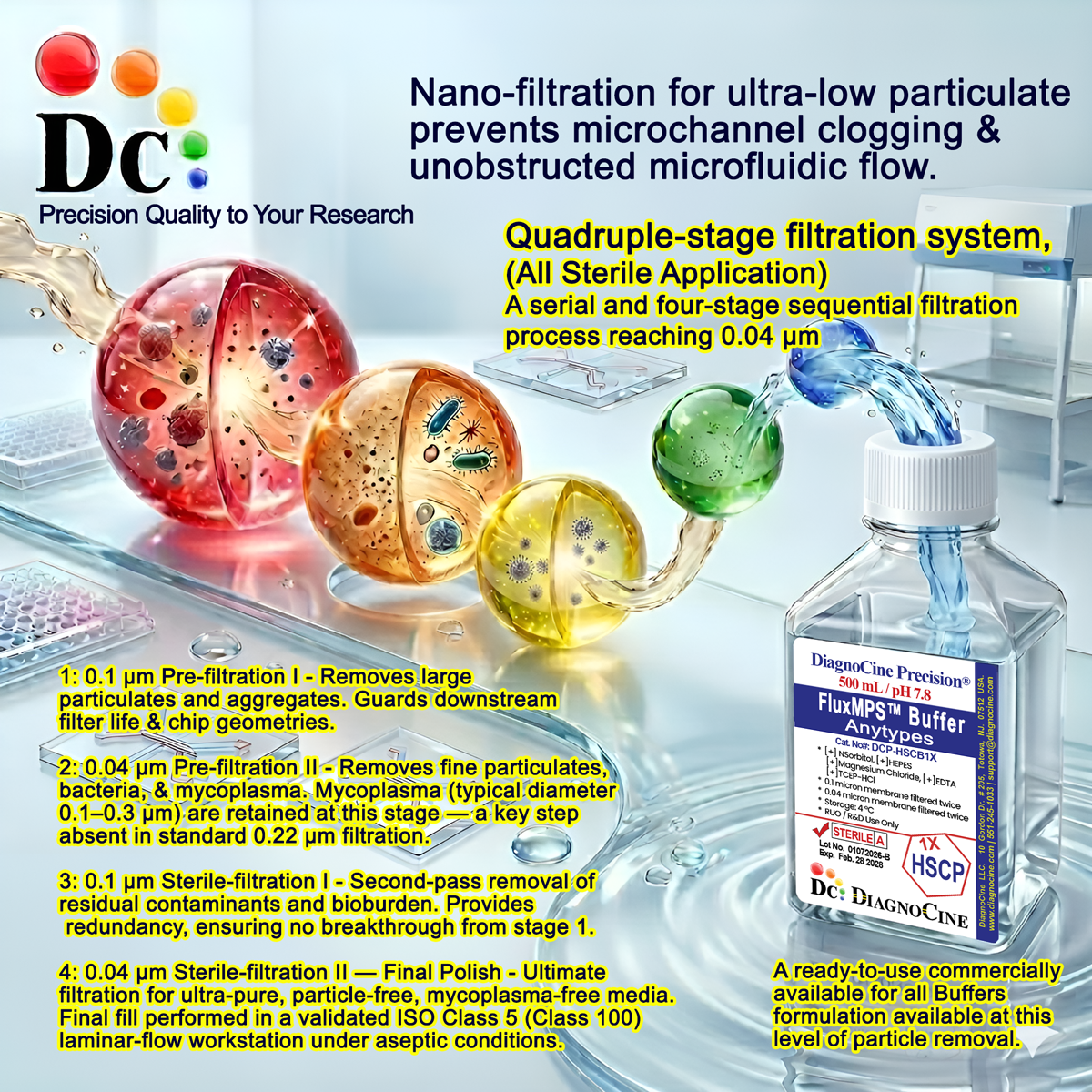
Every configuration is filtered 0.1 µm twice and 0.04 µm twice in a sterile environment — a sub-0.1 µm polish that matters for perfusion lines, microfluidic devices, and imaging backgrounds.
The question that picks the configuration
Will the solution sit under a controlled CO2 atmosphere, or in open air on a rig? Bicarbonate-buffered Tyrode's is written for the first case; the HEPES configuration is the one whose buffering does not depend on the gas phase. Phenol red is then a separate, downstream choice about the read-out.
Four membrane passes, two of them sub-0.1 µm
The source specifies one sterility process for the whole family: filtered 0.1 µm twice and 0.04 µm twice, in a sterile environment — two coarse passes followed by two sub-0.1 µm polishing passes.
-
1
0.1 µm Pre-filtration I
First 0.1 µm membrane pass. Removes bulk particulates and the microbial load carried in from raw materials and make-up water before any polishing step sees the solution.
-
2
0.04 µm Pre-filtration II
First sub-0.1 µm pass. Takes out the fine fraction a 0.1 µm or 0.2 µm membrane lets through — the size range that accumulates in perfusion tubing and microchannels.
-
3
0.1 µm Sterile-filtration I
Second 0.1 µm pass, performed in a sterile environment. This is the sterilizing step of the sequence rather than a clarifying one.
-
4
0.04 µm Sterile-filtration II — Final Polish
Second sub-0.1 µm pass, immediately before fill. The final polish is what distinguishes this architecture from a conventional single-membrane sterile filtration.
Why the polish matters for perfusion work
Tyrode's is used for mammalian body perfusion and tissue cleaning, where the solution passes through narrow lines and vasculature and contacts tissue directly. Particulate carried in at that point cannot be washed back out, so the two sub-0.1 µm passes sit at the end of the sequence rather than the beginning.
What each catalog name states — and what it does not
The source identifies each configuration by name only; it does not publish a component matrix. The table below reports exactly what each name asserts. Where a component is not mentioned, the cell says so instead of assuming an answer.
| Configuration | Sodium bicarbonate | HEPES | Phenol red |
|---|---|---|---|
| DCP-TBSSB-R1X With Sodium bicarbonate Without Phenol red |
check_circle Stated present | Not stated in the source | cancel Stated absent |
| DCP-TBSSH1X w/ HEPES |
Not stated in the source | check_circle Stated present | Not stated in the source |
| DCP-TBSSBR1X w/ Sodium bicarbonate and Phenol red |
check_circle Stated present | Not stated in the source | check_circle Stated present |
Which of the three belongs in which workflow
The source states the family-level uses: cell culture and tissue preservation, mammalian body perfusion, tissue cleaning, and maintaining normal physiological functions in isolated intestinal muscle experiments. Configuration-specific notes below are footnoted to their external source.
- Mammalian body perfusion.
- Tissue cleaning.
- Maintaining normal physiological functions in isolated intestinal muscle experiments.
- Cell culture and tissue preservation at pH 7.4.
- Fluorescence and luminescence read-outs, where a visible-range indicator dye would raise background or quench signal.[5]
- The same family-level uses — perfusion, tissue cleaning, isolated intestinal muscle work — with HEPES named as the buffering component.
- Procedures carried out in open ambient air rather than under a controlled CO2 atmosphere, since HEPES buffering capacity is independent of CO2 concentration.[2]
- Extended manipulation outside an incubator: counting, sorting, microscopy, and multi-step handling.[2]
- Work targeting pH 7.4, which sits inside the effective HEPES range of roughly pH 6.8–8.2.[3]
- HEPES-buffered Tyrode's is an established preparation for physiological experiments, including heart perfusion and dye-loading protocols.[1,6]
- Mammalian body perfusion.
- Tissue cleaning.
- Maintaining normal physiological functions in isolated intestinal muscle experiments.
- Cell culture and tissue preservation at pH 7.4.
- Protocols where a visual pH read is wanted: phenol red reports acidification by colour change.[5]
Identical across all three configurations
Only the buffering component and the indicator change between catalog numbers. Everything below is common to the family.
| Attribute | Specification, as stated by the source |
|---|---|
| Format | 1X liquid |
| Fill size | 500 mL |
| pH | 7.4 |
| Function | Intra- and extracellular osmotic balance; essential inorganic ions; energy through glucose; buffering capacity to maintain physiological pH |
| Storage | 4 °C |
| Sterility | Filtered 0.1 µm twice and 0.04 µm twice, in a sterile environment |
| Customization | Other concentrations; additions of chemicals, compounds, proteins, or supplements; different pH; further modifications — on inquiry |
| Intended use | Research Use Only (RUO) |
Sodium bicarbonate or HEPES — how the two buffering routes differ
| Property | Sodium bicarbonate route | HEPES route |
|---|---|---|
| Configurations in this family | DCP-TBSSB-R1X, DCP-TBSSBR1X | DCP-TBSSH1X |
| Buffer chemistry | Inorganic bicarbonate, working as one half of a bicarbonate–CO2 pair[4] | Zwitterionic Good's buffer, pKa near 7.3 at 37 °C[2] |
| Dependence on the gas phase | Gas-coupled — the CO2 over the solution is part of the buffer system[4] | Independent of CO2 concentration[2] |
| Effective buffering range | Set by the bicarbonate–CO2 equilibrium | Approximately pH 6.8–8.2[3] |
| Suits work outside an incubator | cancel Not the intended condition | check_circle Yes — extended manipulation in ambient air[2] |
| Stated pH of the finished solution | 7.4 | 7.4 |
Questions this catalog gets asked
Primary literature and cited sources
The source description carries no citation or reference list. The entries below are supporting literature for the Tyrode's formulation and for the HEPES buffer class, followed by the external technical sources footnoted on this page. Neither primary paper carries a publisher DOI, so none is shown — no DOI has been invented.
Supporting Literature
- Tyrode MV. The mode of action of some purgative salts. Archives Internationales de Pharmacodynamie et de Thérapie. 1910;20:205–223. — the paper in which the Tyrode's formulation was published.
- Good NE, Winget GD, Winter W, Connolly TN, Izawa S, Singh RMM. Hydrogen ion buffers for biological research. Biochemistry. 1966;5(2):467–477. — the paper that introduced HEPES and the other zwitterionic “Good's” buffers.
Footnoted Technical Sources
- ScienceDirect Topics. Tyrode's Solution — overview of composition and use in physiological experiments, including heart perfusion and dye-loading protocols. sciencedirect.com
- R&D Systems / Bio-Techne. HEPES Buffer Solution (1 M) — zwitterionic buffer, pKa 7.3 at 37 °C, buffering capacity independent of CO2 concentration. rndsystems.com
- Boston BioProducts. HEPES — pKa 7.5 at 25 °C and an effective buffering range of pH 6.8 to 8.2. bostonbioproducts.com
- Thermo Fisher Scientific. Balanced Salt Solutions — how the sodium bicarbonate level of a balanced salt solution sets the CO2 environment it is written for. thermofisher.com
- Thermo Fisher Scientific. Product FAQ on phenol red and fluorescent read-outs, and phenol-red-free formulations. thermofisher.com
- Cold Spring Harbor Protocols. HEPES-buffered Tyrode's solution — published recipe adjusted to pH 7.4. cshprotocols.cshlp.org