

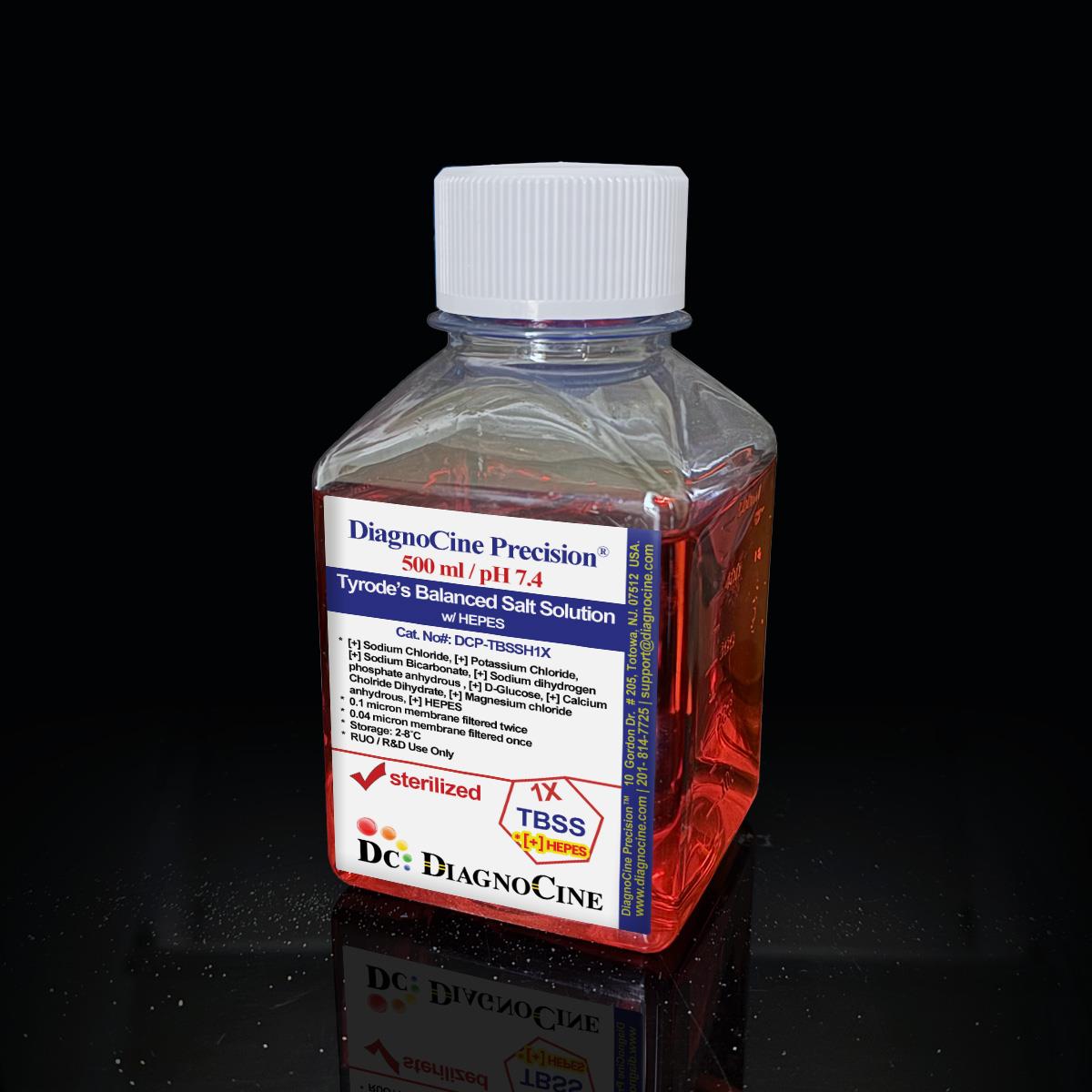
Tyrode's Balanced Salt Solution w/ HEPES: 1X
FluxMPS™ Tyrode's Balanced Salt Solution w/ HEPES: 1X
An MPS-grade, HEPES-buffered Tyrode's balanced salt solution engineered for a precise, stable pH and quadruple-stage ultra-filtration. Formulated for cell and tissue culture, isolated muscle and cardiac perfusion, and tissue preservation work where microchannel-safe purity and physiological reproducibility both matter.
- Quadruple-stage filtration: 0.1 µm membrane twice and 0.04 µm membrane twice for the world's cleanest physiological buffer
- Stable, HEPES-buffered pH of 7.4 for sensitive cell, tissue, and perfusion work
- Manufactured with Ultrapure Type 1 water (18.2 MΩ·cm)
- ISO Class 5 (Class 100) aseptic fill and finish
- Microchannel-safe for organ-on-a-chip, tissue-on-a-chip, and microfluidic perfusion systems
- Custom pH, concentrations, and additive formulations available on request
- Catalog No.DCP-TBSSH1X
- Size500 mL
- pH7.4
- AppearanceColorless, clear solution
- Filtration0.1 µm x2 + 0.04 µm x2
- SterilityNo growth, 14-day USP incubation
- Toxicity TestPasses
- Storage4°C, protected from light
- Shelf Life24 months
- Water QualityUltrapure Type 1, 18.2 MΩ·cm
Engineered where standard buffers fail
Conventional 0.22 µm-filtered balanced salt solutions leave behind subvisible particulates, drift in pH once exposed to ambient CO2, and carry variable bioburden into sensitive microchannels. FluxMPS™ Tyrode's Solution with HEPES is built to eliminate each of these failure modes with a defined, HEPES-stabilized formulation and a quadruple-stage filtration architecture.
Microchannel-safe purity
Final 0.04 µm pore size polish, produced under particulate-control protocols aligned with USP <788> testing methodology.
Precise, stable pH
HEPES (4-(2-hydroxyethyl)-1-piperazineethanesulfonic acid) buffering maintains stable pH 7.2-7.4 even when exposed to ambient CO2 levels, with a QC-released pH of 7.4.
Ultrapure-grade water
Manufactured with Ultrapure Type 1 water (18.2 MΩ·cm), supporting low-background downstream QC per USP <85> methodology.
Low background for imaging & assays
Colorless, clear formulation suited to confocal microscopy, biosensor readouts, and other optical assay formats used in isolated tissue and muscle experiments.
Defined, traceable composition
Every inorganic salt, D-Glucose, and HEPES concentration is formulated and lot-released to the exact mg/L values shown in the composition table below.
Customization on demand
Other concentrations, additions of chemicals, compounds, proteins, or supplements, different pH targets, and further modifications can be arranged on request.
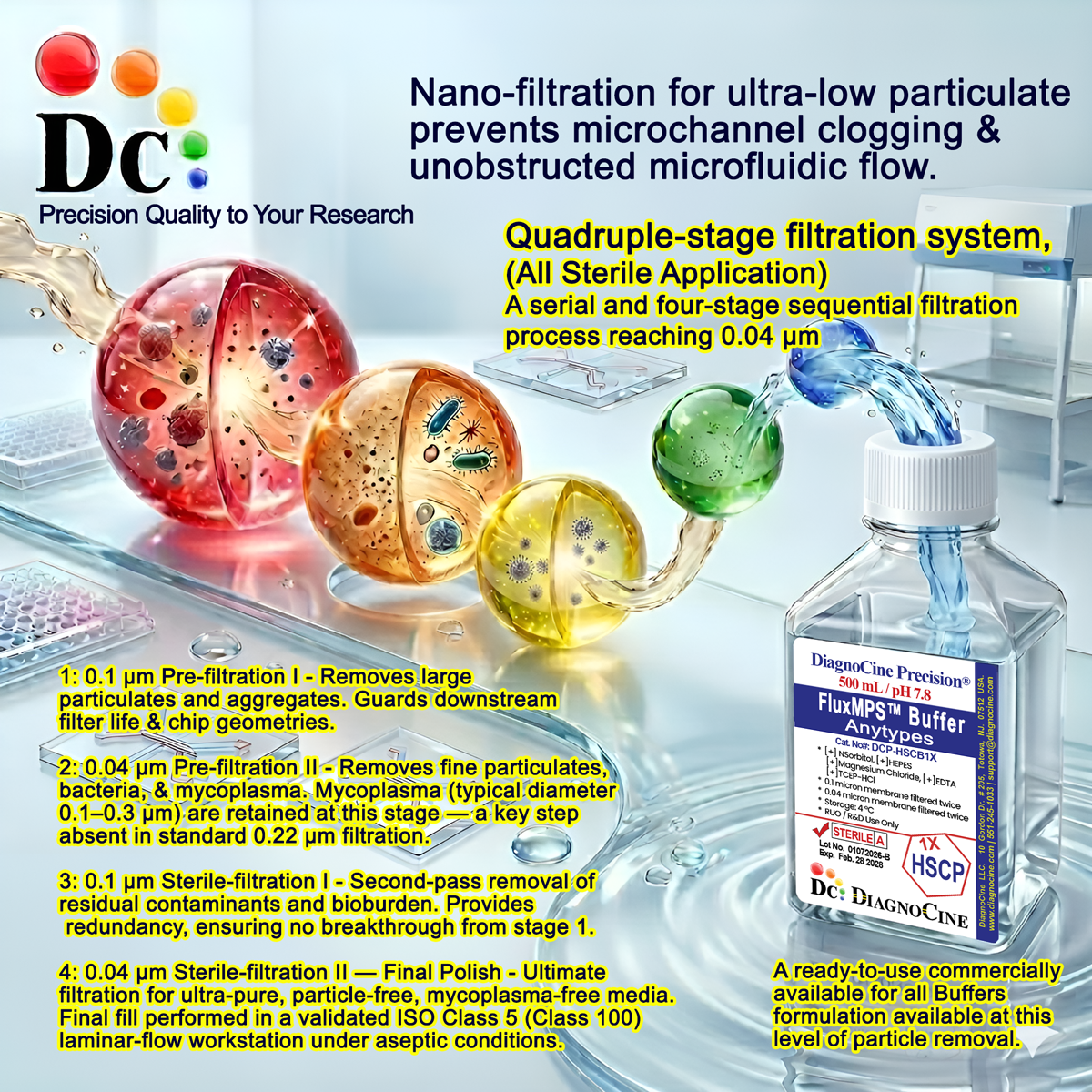
Quadruple-stage filtration system
FluxMPS™ Precision Sterile buffers, including this Tyrode's Solution with HEPES, are filtered through a 0.1-micron membrane twice and a 0.04-micron membrane twice — a quadruple-stage architecture designed to deliver the world's cleanest buffer for cell and molecular biology experiments.
-
1
0.1 µm Pre-filtration I
First pass removes large particulates and aggregates, extending the working life of the downstream filters.
-
2
0.04 µm Pre-filtration II
Retains fine particulates and bioburden that pass a single 0.1 µm stage, including organisms in the size range of the smallest mycoplasma types, which can be about 0.2 microns.
-
3
0.1 µm Sterile-filtration I
A second 0.1 µm pass provides redundancy ahead of the final polish, preventing mycoplasma contamination.
-
4
0.04 µm Sterile-filtration II — Final Polish
A second 0.04 µm pass delivers the ultimate polish under an ISO Class 5 (Class 100) aseptic fill.
Performance vs. conventional buffer
Sequential 0.1 µm and 0.04 µm filtration, applied twice each, removes finer particulates than a single 0.22 µm pass used in conventional balanced salt solutions, helping prevent mycoplasma contamination.
© Diagnocine® — DCP-TBSSH1X
Where this buffer performs
Tyrode's Balanced Salt Solution with HEPES is a multifunctional physiological medium that regulates pH, maintains proper osmotic pressure, and supplies essential nutrients for cellular metabolism and survival in vitro.
Automated Bioreactors & Robotics
For automated perfusion and robotic liquid-handling platforms, an optional 0.01 µm (10 nm) ultra-filtered variant of this buffer can be produced on request to further protect valves, sensors, and microchannels.
- Total Particulate Exclusion — supports long-run automated systems
- Valve & Sensor Protection — reduces risk of microfluidic clogging
- Extended Perfusion Stability — consistent buffer quality across long protocols
Inquiry Required: contact support@diagnocine.com to request the 0.01 µm ultra-filtered grade.
Micro Physiological System (MPS) & Chip
Supports perfusion and buffer-exchange steps in chip-based culture formats.
Wash, Dilution & Reconstitution
Used for washing, diluting, and reconstituting tissue and cell samples between experimental steps.
Balanced Nutrient & Osmotic Support
Provides essential nutrients and maintains optimal pH and osmotic conditions for various cell types during culture and experimental manipulations.
Temporary Preservation of Isolated Tissue
Creates an ideal environment for temporary preservation and transport of isolated tissues, maintaining viability and physiological function during experimental transitions.
Mammalian Tissue Perfusion
Frequently employed for perfusion experiments in mammalian tissues, providing physiological support during extended perfusion protocols.
Cardiac & Intestinal Muscle Studies
Especially suitable for isolated intestinal and cardiac muscle experiments, maintaining normal physiological function while allowing controlled experimental interventions.
Measured and declared parameters
Values below reflect this product's own formulation and QC release data.
| Parameter | Specification |
|---|---|
| Formulation / Composition | Balanced salt solution with HEPES buffer (see full composition table below) |
| Appearance | Colorless, clear solution |
| pH | 7.4 |
| Parameter | Specification |
|---|---|
| Sterility USP | No bacterial or fungal growth after 14 days of incubation |
| Toxicity Test | Passes |
| Water Quality | Ultrapure Type 1 water (18.2 MΩ·cm) |
| Fill Environment | ISO Class 5 (Class 100) |
| Filtration System | 0.1 µm membrane x2 + 0.04 µm membrane x2 |
| Parameter | Specification |
|---|---|
| Storage Temperature | 4°C, away from bright light |
| Shelf Life | 24 months |
| Use Before Expiry | Use before expiry date on product label |
| Parameter | Specification |
|---|---|
| Manufacturing QMS ISO | ISO 13485-certified facility |
| Regulatory Alignment | CE-approved facility |
| Production Method | Filtered-sterilized via 0.1 µm membrane (x2) and 0.04 µm membrane (x2); final packaging, quality assurance, and testing performed at the DiagnoCine R&D and Quality Testing Center, Totowa, New Jersey, USA |
| Intended Use | For Research Use Only (RUO) |
Full composition
Concentrations shown in mg/L, grouped exactly as declared on the certificate of composition.
| Component | CAS Number | Concentration (mg/L) |
|---|---|---|
| INORGANIC SALTS | ||
| Calcium chloride dihydrate | 10035-04-8 | 265.000 |
| Magnesium chloride anhydrous | 7786-30-3 | 46.900 |
| Potassium chloride | 7447-40-7 | 200.000 |
| Sodium bicarbonate | 144-55-8 | 1000.000 |
| Sodium chloride | 7647-14-5 | 8000.000 |
| Sodium dihydrogen phosphate anhydrous | 7558-80-7 | 50.000 |
| Component | CAS Number | Concentration (mg/L) |
|---|---|---|
| OTHERS | ||
| D-Glucose | 50-99-7 | 1000.000 |
| HEPES | 7365-45-9 | 2383.000 |
Manufactured under controlled conditions
This product is manufactured under ISO 13485-certified and CE-approved facilities (Suppliers of DiagnoCine Precision), with final packaging, quality assurance, and testing completed at the DiagnoCine R&D and Quality Testing Center. Specific customization requests and assembly are accomplished at DiagnoCine Precision in Totowa, New Jersey, USA.
ISO 13485:2016 QMS
Manufactured under an ISO 13485-certified, CE-approved quality management system.
Ultrapure Type 1 Water
Formulated with 18.2 MΩ·cm Type 1 water as the base for all buffer preparation.
ISO Class 5 Fill & Finish
Final aseptic fill performed under ISO Class 5 (Class 100) conditions.
Micro-Batch Precision
Composition prepared and lot-released to the declared mg/L values for every component.
Endotoxin — USP <85> BET
Endotoxin testing follows USP <85> Bacterial Endotoxins Test (BET) methodology as part of DiagnoCine's standard QC workflow.
Particulate — USP <788> Method 2
Particulate-control practices are aligned with USP <788> Method 2 testing methodology.
Osmolality — USP <785>
Osmolality-relevant QC practices are aligned with USP <785> methodology.
Documentation / CoA
A Certificate of Analysis is available — contact support@diagnocine.com.
How DCP-TBSSH1X compares
A side-by-side look at the FluxMPS™ filtration and formulation architecture versus conventional balanced salt solutions.
| Parameter | DCP-TBSSH1X (FluxMPS™) | Conventional Buffer (0.22 µm filtered) | Standard Alternative (0.22 µm filtered) |
|---|---|---|---|
| HEPES-buffered pH stability | check_circle pH 7.2-7.4 | cancel pH drifts with CO2 | cancel No secondary buffering |
| Final filtration pore size | check_circle 0.04 µm | cancel 0.22 µm | cancel 0.22 µm |
| Number of filtration stages | check_circle 4 | cancel 1 | cancel 1 |
| Water quality | check_circle Ultrapure Type 1 (18.2 MΩ·cm) | cancel Standard lab-grade water | cancel Standard lab-grade water |
| Manufacturing QMS | check_circle ISO 13485-certified | cancel Not certified | cancel Not certified |
| Microfluidic channel compatibility | check_circle | cancel | cancel |
| Custom formulation available | check_circle | cancel | cancel |
Frequently asked questions
Answers to common questions about DCP-TBSSH1X.
Supporting literature
Curated literature relevant to Tyrode's solutions, HEPES buffering, and microfluidic/organ-on-a-chip applications.
- Bhatia SN, Ingber DE. Microfluidic organs-on-chips. Nat Biotechnol. 2014. doi:10.1038/nbt.2989
- Good NE, et al. Hydrogen ion buffers for biological research. Biochemistry. 1966. doi:10.1021/bi00866a011
- Sackmann EK, Fulton AL, Beebe DJ. The present and future role of microfluidics in biomedical research. Nature. 2014. doi:10.1038/nature13118
- Halldorsson S, et al. Advantages and challenges of microfluidic cell culture in polydimethylsiloxane devices. Biosens Bioelectron. 2015. doi:10.1016/j.bios.2014.07.029
- Tyrode MV. The mode of action of some purgative salts. Arch Int Pharmacodyn Ther. 1910.
- Zhang B, Radisic M. Organ-on-a-chip devices advance to market. Lab Chip. 2017. doi:10.1039/C7LC00462A
- Low LA, et al. Organs-on-chips: into the next decade. Nat Rev Drug Discov. 2021. doi:10.1038/s41573-020-0079-3
- Ferrari E, et al. Digital microfluidic devices for cardiac cell perfusion. Micromachines. 2020. doi:10.3390/mi11040357
- Ingber DE. Human organs-on-chips for disease modeling, drug development and personalized medicine. Nat Rev Genet. 2022. doi:10.1038/s41576-022-00466-9