
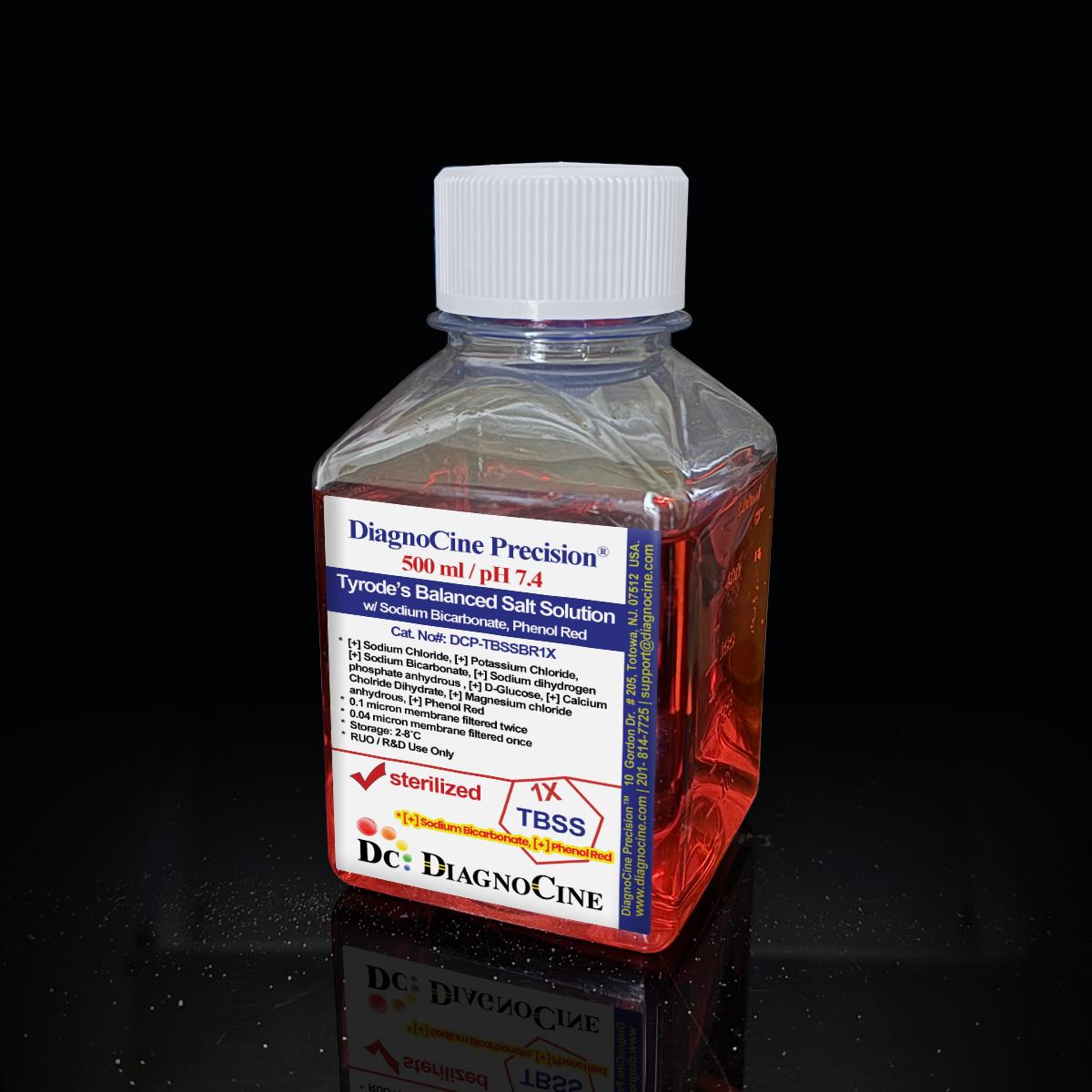
Tyrode's Balanced Salts Solution w/ Sodium bicarbonate and Phenol red: 1X
FluxMPS™ Tyrode's Balanced Salts Solution w/ Sodium Bicarbonate and Phenol Red: 1X
An MPS-grade, physiologically balanced isotonic salt solution formulated with a sodium bicarbonate buffering system and a phenol red visual pH indicator. Quadruple-stage filtered through 0.1 µm membrane twice and 0.04 µm membrane twice, this ready-to-use buffer delivers ultra-low particulate purity suited to microfluidic channels, organ-on-a-chip perfusion, and precise physiological pH monitoring.
- Quadruple-stage filtration: 0.1 µm membrane twice and 0.04 µm membrane twice for ultra-low particulate purity
- Endotoxin content NMT 1 EU/mL
- Target pH 7.4, maintained by a sodium bicarbonate buffering system
- Osmolality 270.00 - 310.00 mOsm/Kg H2O, isotonic with interstitial fluid
- Phenol Red included for immediate visual pH monitoring
- Sterile; no bacterial or fungal growth after 14 days incubation per USP specification
- pH, molarity, and additive customization available on request — contact support@diagnocine.com
- pH7.4
- Osmolality270.00 - 310.00 mOsm/Kg H2O
- Buffer SystemSodium Bicarbonate
- pH IndicatorPhenol Red
- EndotoxinNMT 1 EU/mL
- SterilityUSP 14-Day, No Growth
- Filtration0.1 µm x2 + 0.04 µm x2
- AppearanceColorless, Clear Solution
- Storage4°C, Protect from Light
- Shelf Life24 Months
Engineered where standard buffers fail
Conventional 0.22 µm-filtered balanced salt solutions can carry subvisible particulates that accumulate in narrow microchannels, drift in pH and ionic balance, and introduce assay background. Tyrode's Balanced Salts Solution is manufactured to a tighter purity standard purpose-built for sensitive cell, tissue, and microfluidic work.
Microchannel-safe purity
Quadruple-stage filtration through 0.1 µm and 0.04 µm membranes reduces particulate load beyond a single 0.22 µm pass, protecting narrow microfluidic and organ-on-a-chip channels.
Precise, stable pH
A sodium bicarbonate buffering system holds the solution at pH 7.4, with phenol red providing an immediate visual cue for pH status during use.
Ultrapure-grade water
Formulated with Ultrapure Type 1 water (18.2 MΩ·cm), minimizing trace contaminants that can interfere with sensitive cell and tissue assays.
Low background for imaging & assays
A colorless, clear base solution with a built-in phenol red indicator supports clean visual and optical readouts during physiological experiments.
Defined, traceable composition
Every inorganic salt and additive is manufactured and released to a defined mg/L specification, supporting reproducible ionic composition across lots.
Customization on demand
Alternate concentrations, additional chemicals, compounds, proteins, supplements, or pH modifications are available — contact support@diagnocine.com.
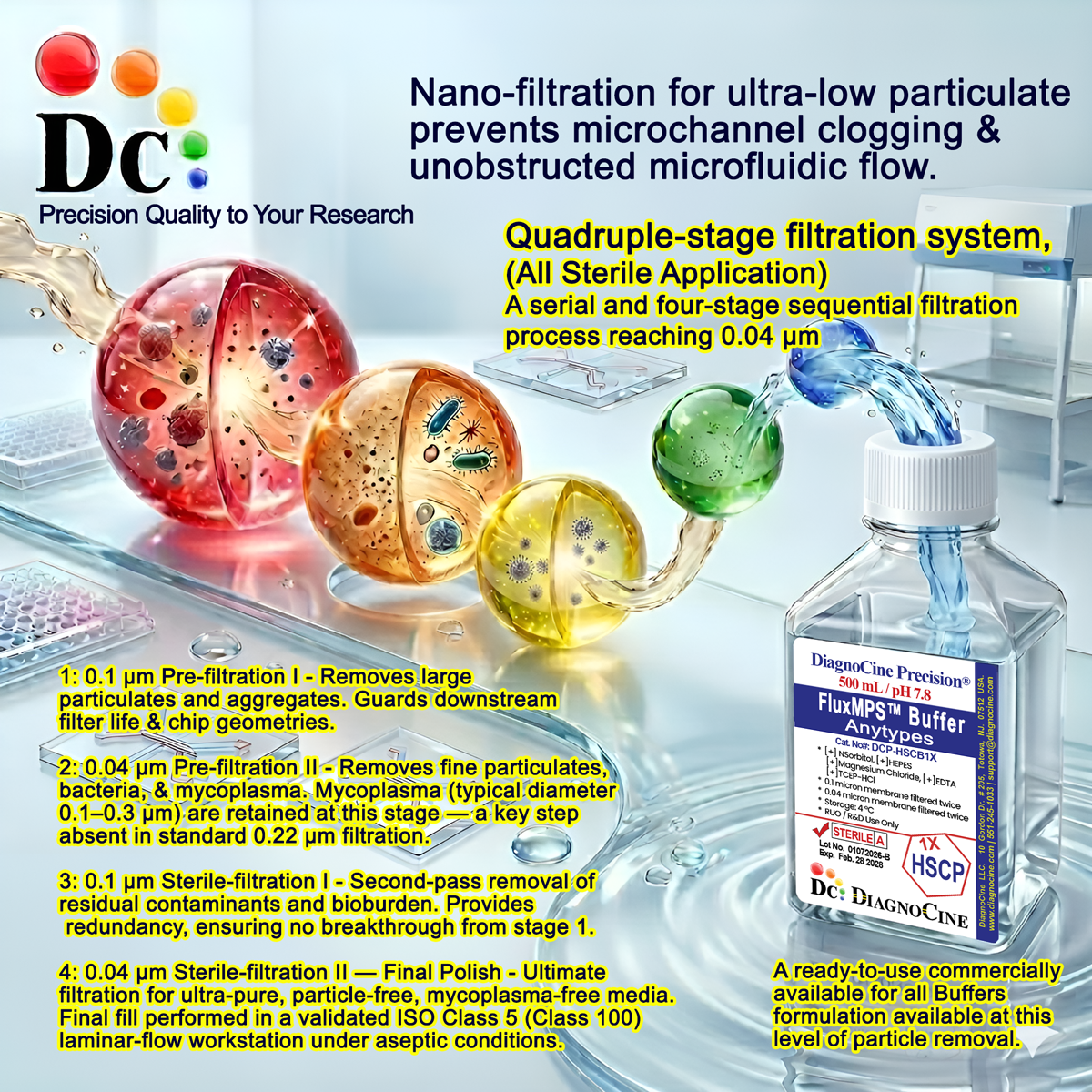
Quadruple-stage filtration system
This buffer is filter-sterilized through a 0.1 µm membrane twice and a 0.04 µm membrane twice, providing sequential pre-filtration and sterile-filtration passes that go beyond a single 0.22 µm sterilizing-grade pass.
-
1
0.1 µm Pre-filtration I
Removes large particulates and aggregates from the formulated solution, extending the working life of the downstream filters.
-
2
0.04 µm Pre-filtration II
Retains fine particulates and bioburden ahead of the final sterile-filtration passes, an important step given that the smallest mycoplasma types can be about 0.2 microns.
-
3
0.1 µm Sterile-filtration I
A second 0.1 µm pass provides redundant particulate and bioburden reduction ahead of final polishing.
-
4
0.04 µm Sterile-filtration II — Final Polish
A second 0.04 µm pass under ISO Class 5 (Class 100) aseptic fill conditions delivers the final purity polish before packaging.
Performance vs. conventional buffer
Sequential 0.1 µm and 0.04 µm filtration removes finer particulates than a single 0.22 µm pass typical of conventional balanced salt solutions, supporting the world's cleanest buffer standard for cell and molecular biology work.
© Diagnocine® — DCP-TBSSBR1X
Where Tyrode's Balanced Salts Solution is used
Physiologically balanced and isotonic with interstitial fluid, this solution supports cell and tissue culture maintenance, isolated organ perfusion, and physiological experiments requiring precise pH monitoring.
Automated Bioreactors & Robotics
An optional 0.01 µm (10 nm) ultra-filtered variant is available for automated bioreactor and robotic liquid-handling platforms where valve and sensor protection is critical.
- Total Particulate Exclusion for automated fluidics
- Valve & Sensor Protection in robotic dispensing systems
- Extended Perfusion Stability in closed-loop bioreactors
Inquiry Required: Contact support@diagnocine.com to request the 0.01 µm ultra-filtered grade.
Micro Physiological System (MPS) & Chip
Supports isolated organ perfusion studies and electrophysiological recordings in cardiac and smooth muscle tissue within microfluidic formats.
Wash, Dilution & Reconstitution
Used for washing of cells and tissues during experimental procedures and short-term preservation of isolated tissues and organs.
iPSC-Derived Model Handling
Provides an isotonic, buffered environment for cell and tissue culture maintenance of sensitive stem cell-derived models.
Endothelial & Primary Cell Perfusion
Supports isolated organ perfusion studies and physiological experiments in cardiac and smooth muscle tissue models.
ELISA, Blotting & Blocking
Its low-particulate, defined ionic background suits use as a wash or dilution buffer in immunoassay workflows.
Microscopy & Optical Sensing
The colorless, clear formulation with a phenol red pH indicator supports physiological experiments requiring precise pH monitoring during imaging.
Product specifications
Values below are drawn directly from this product's release specification.
| Parameter | Specification |
|---|---|
| Formulation / Composition | Balanced salt solution with sodium bicarbonate and phenol red |
| Appearance | Colorless, clear solution |
| pH USP <791> | 7.4 |
| Osmolality USP <785> | 270.00 - 310.00 mOsm/Kg H2O |
| Parameter | Specification |
|---|---|
| Endotoxin USP <85> | NMT 1 EU/mL |
| Sterility USP <71> | No bacterial or fungal growth after 14 days of incubation |
| Toxicity Test | Passes |
| Water Quality | Ultrapure Type 1 water (18.2 MΩ·cm) |
| Manufacturing Standard | ISO 13485-certified, CE-approved facilities |
| Fill Environment | ISO Class 5 (Class 100) |
| Parameter | Specification |
|---|---|
| Storage Temperature | 4°C, away from bright light |
| Shelf Life | 24 months |
| Expiry | Use before expiry date given on the product label |
| Parameter | Specification |
|---|---|
| Manufacturing Facility | ISO 13485-certified and CE-approved facilities (DiagnoCine Precision suppliers) |
| Traceability | Final packaging, quality assurance, and testing at the DiagnoCine R&D and Quality Testing Center |
| Manufacturing QMS | ISO 13485:2016 |
| Regulatory Alignment | CE-approved |
| Production Method | Customization and assembly at DiagnoCine Precision, Totowa, New Jersey, USA |
| Intended Use | Research Use Only (RUO) |
Full composition
Component concentrations are expressed in mg/L, as manufactured and released for this lot-controlled formulation.
| Component | CAS Number | Concentration (mg/L) |
|---|---|---|
| Calcium chloride dihydrate (CaCl2·2H2O) | 10035-04-8 | 265.000 |
| Magnesium chloride anhydrous (MgCl2) | 7786-30-3 | 46.900 |
| Potassium chloride (KCl) | 7447-40-7 | 200.000 |
| Sodium bicarbonate (NaHCO3) | 144-55-8 | 1000.000 |
| Sodium chloride (NaCl) | 7647-14-5 | 8000.000 |
| Sodium dihydrogen phosphate anhydrous (NaH2PO4) | 7558-80-7 | 50.000 |
| Component | CAS Number | Concentration (mg/L) |
|---|---|---|
| D-Glucose (C6H12O6) | 50-99-7 | 1000.000 |
| Phenol Red (C19H14O5S) | 143-74-8 | 15.000 |
Manufacturing & compliance
Every lot is manufactured, filled, and released under a controlled quality system.
ISO 13485:2016 QMS
Manufactured under ISO 13485-certified and CE-approved facilities (suppliers of DiagnoCine Precision).
Ultrapure Type 1 Water
Formulated with Ultrapure Type 1 water (18.2 MΩ·cm) as the base for consistent ionic quality.
ISO Class 5 Fill & Finish
Final sterile-filtration and fill occur under ISO Class 5 (Class 100) conditions.
Micro-Batch Precision
Final packaging, quality assurance, and testing are completed at the DiagnoCine R&D and Quality Testing Center.
Endotoxin USP <85> BET
Specification: NMT 1 EU/mL.
Particulate USP <788> Method 2
Filtration is performed in line with USP <788> Method 2 particulate-control practices.
Osmolality USP <785>
Specification: 270.00 - 310.00 mOsm/Kg H2O.
Documentation / CoA
A Certificate of Analysis is available for this lot — contact support@diagnocine.com.
How DCP-TBSSBR1X compares
A side-by-side look at filtration architecture and quality attributes against conventional buffered saline solutions.
| Parameter | DCP-TBSSBR1X (FluxMPS™) | Conventional Buffer (0.22 µm filtered) | Standard Alternative (0.22 µm filtered) |
|---|---|---|---|
| Bicarbonate-buffered, phenol red indicated | check_circle | cancel | cancel |
| Final filtration pore size | 0.04 µm | 0.22 µm | 0.22 µm |
| Number of filtration stages | 4 | 1 | 1 |
| Endotoxin specification | NMT 1 EU/mL | cancel | cancel |
| USP <788> particulate compliance | check_circle | cancel | cancel |
| Ultrapure Type 1 water base | check_circle | cancel | cancel |
| Manufacturing QMS | ISO 13485:2016 | cancel | cancel |
| Microfluidic channel compatibility | check_circle | cancel | cancel |
| Visual pH indicator included | check_circle | cancel | cancel |
| Custom formulation available | check_circle | cancel | cancel |
Frequently asked questions
Answers to the most common questions about DCP-TBSSBR1X.
Supporting literature
Curated literature relevant to balanced salt solutions, bicarbonate buffering, and microphysiological system applications.
- Bhatia SN, Ingber DE. Microfluidic organs-on-chips. Nat Biotechnol. 2014;32(8):760-772. doi:10.1038/nbt.2989
- Huh D, Matthews BD, Mammoto A, et al. Reconstituting organ-level lung functions on a chip. Science. 2010;328(5986):1662-1668. doi:10.1126/science.1188302
- Low LA, Mummery C, Berridge BR, et al. Organs-on-chips: into the next decade. Nat Rev Drug Discov. 2021;20(5):345-361. doi:10.1038/s41573-020-0079-3
- Ronaldson-Bouchard K, Vunjak-Novakovic G. Organs-on-a-chip: a fast track for engineered human tissues in drug development. Cell Stem Cell. 2018;22(3):310-324. doi:10.1016/j.stem.2018.02.011
- Good NE, Winget GD, Winter W, et al. Hydrogen ion buffers for biological research. Biochemistry. 1966;5(2):467-477. doi:10.1021/bi00866a011
- Halldorsson S, Lucumi E, Gomez-Sjoberg R, Fleming RMT. Advantages and challenges of microfluidic cell culture in polydimethylsiloxane devices. Biosens Bioelectron. 2015;63:218-231. doi:10.1016/j.bios.2014.07.029
- Sung JH, Wang YI, Narasimhan Sriram N, et al. Microfabricated mammalian organ systems and their integration into models of whole animals and humans. Lab Chip. 2013;13(7):1201-1212. doi:10.1039/c3lc41017j
- Hasiwa N, Daneshian M, Bruegger P, et al. Evidence for the detection of non-endotoxin pyrogens by the whole blood monocyte activation test. ALTEX. 2013;30(2):169-208. doi:10.14573/altex.2013.2.169
- Esch EW, Bahinski A, Huh D. Organs-on-chips at the frontiers of drug discovery. Nat Rev Drug Discov. 2015;14(4):248-260. doi:10.1038/nrd4539