

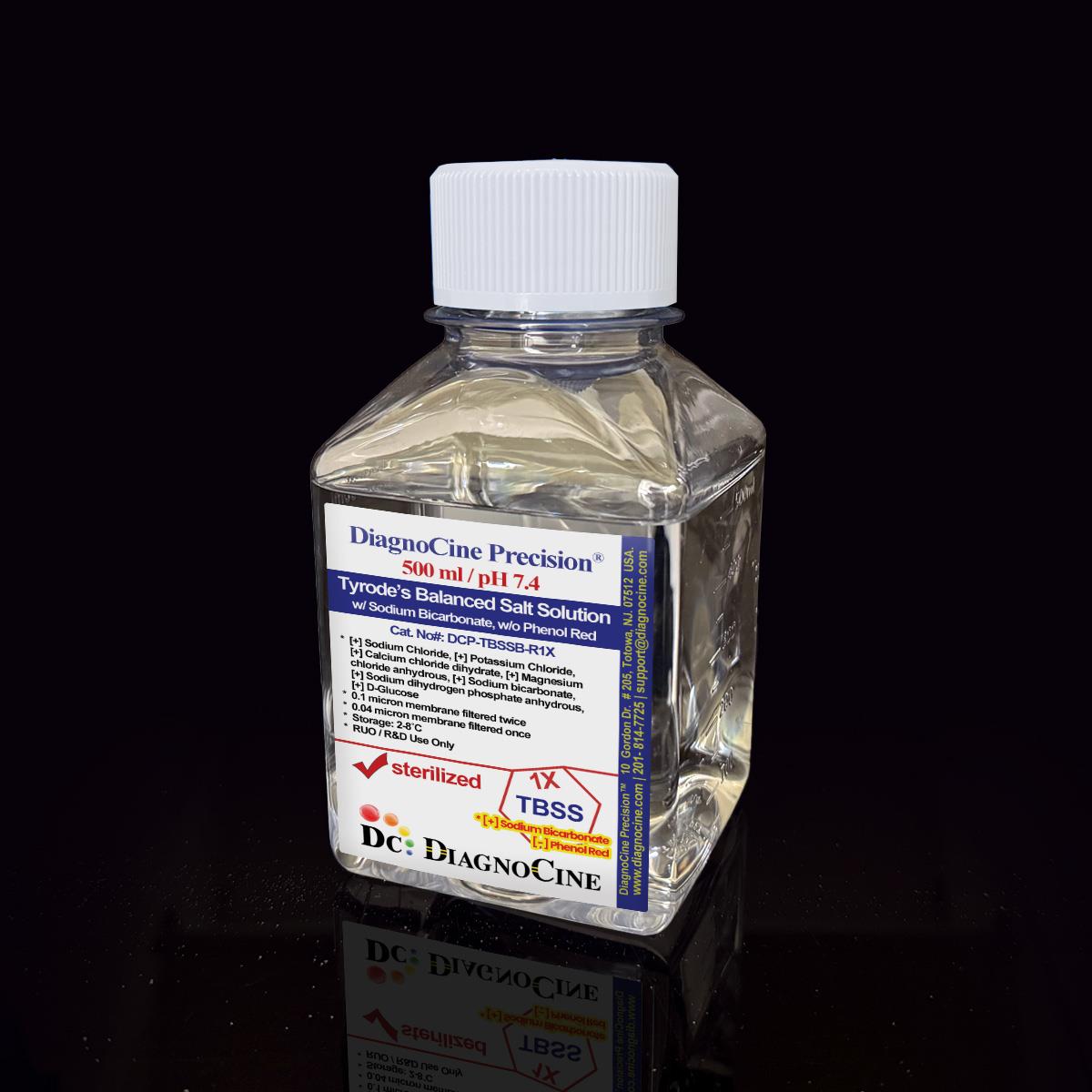
Tyrode's Balanced Salt Solution With Sodium bicarbonate Without Phenol red: 1X
FluxMPS™ Tyrode's Balanced Salt Solution With Sodium Bicarbonate Without Phenol Red: 1X
FluxMPS™ Tyrode's Balanced Salt Solution With Sodium Bicarbonate Without Phenol Red (DCP-TBSSB-R1X) is an MPS-grade, ready-to-use physiological buffer engineered for mammalian tissue perfusion, intestinal muscle physiology, and cellular metabolism research. Quadruple-stage filtered through a 0.1 µm membrane twice and a 0.04 µm membrane twice, it delivers microchannel-safe purity with sodium bicarbonate-based CO2 buffering and a phenol red-free formulation for clean fluorescence and calcium-imaging readouts.
- Sterile, ultrapure, quadruple-stage filtered: 0.1 µm membrane twice and 0.04 µm membrane twice for microchannel-safe purity
- Sodium bicarbonate (1000.000 mg/L) provides CO2 buffering suited to 5% CO2 incubation
- Formulated without phenol red for interference-free fluorescence microscopy, spectrophotometry, and calcium imaging
- Optimized ion profile (Ca2+, Mg2+, K+, Na+) mimicking extracellular fluid composition
- Endotoxin NMT 1EU/ml with sterility confirmed per USP specification
- Osmolality maintained at 270.00-310.00 mOsm/Kg H2O
- Manufactured under ISO 13485-certified, CE-approved facilities
- Custom concentrations, additives, and pH available on request
- pH7.4
- Osmolality270.00-310.00 mOsm/Kg H2O
- Sodium Bicarbonate1000.000 mg/L
- D-Glucose1000.000 mg/L
- EndotoxinNMT 1EU/ml
- SterilityNo growth after 14 days (USP)
- Filtration0.1 µm x2 + 0.04 µm x2
- Storage4°C, protected from light
- Shelf Life24 months
- AppearanceColorless, clear solution
Engineered where standard buffers fail
Conventional 0.22 µm-filtered balanced salt solutions can carry subvisible particulates, ionic drift, and elevated endotoxin that compromise fragile cell and tissue models. FluxMPS™ Tyrode's Balanced Salt Solution is engineered as the world's cleanest buffer for all cell and molecular biology experiments, addressing each of these failure modes directly.
Microchannel-safe purity
Quadruple-stage filtration through a 0.1 µm membrane twice and a 0.04 µm membrane twice removes fine particulates before they can obstruct narrow microfluidic channels.
Precise, stable pH
Sodium bicarbonate (1000.000 mg/L) buffers to pH 7.6-8.2 under 5% CO2 incubation, while calcium and magnesium content supports smooth muscle contraction studies in intestinal and cardiovascular tissues.
Ultrapure-grade water
Formulated on Ultrapure Type 1 water (18.2 MΩ·cm) per USP <85>, minimizing background contaminants that interfere with sensitive assays.
Low background for imaging & assays
Formulated without phenol red, eliminating optical interference in fluorescence microscopy, spectrophotometry, and calcium imaging.
Defined, traceable composition
Contains essential ions (Ca2+, Mg2+, K+, Na+) mimicking extracellular fluid composition, plus D-Glucose (1000.000 mg/L) for immediate energy during short-term experiments.
Customization on demand
Other concentrations, additions of chemicals, compounds, proteins, or supplements, different pH, and further modifications are available on request.
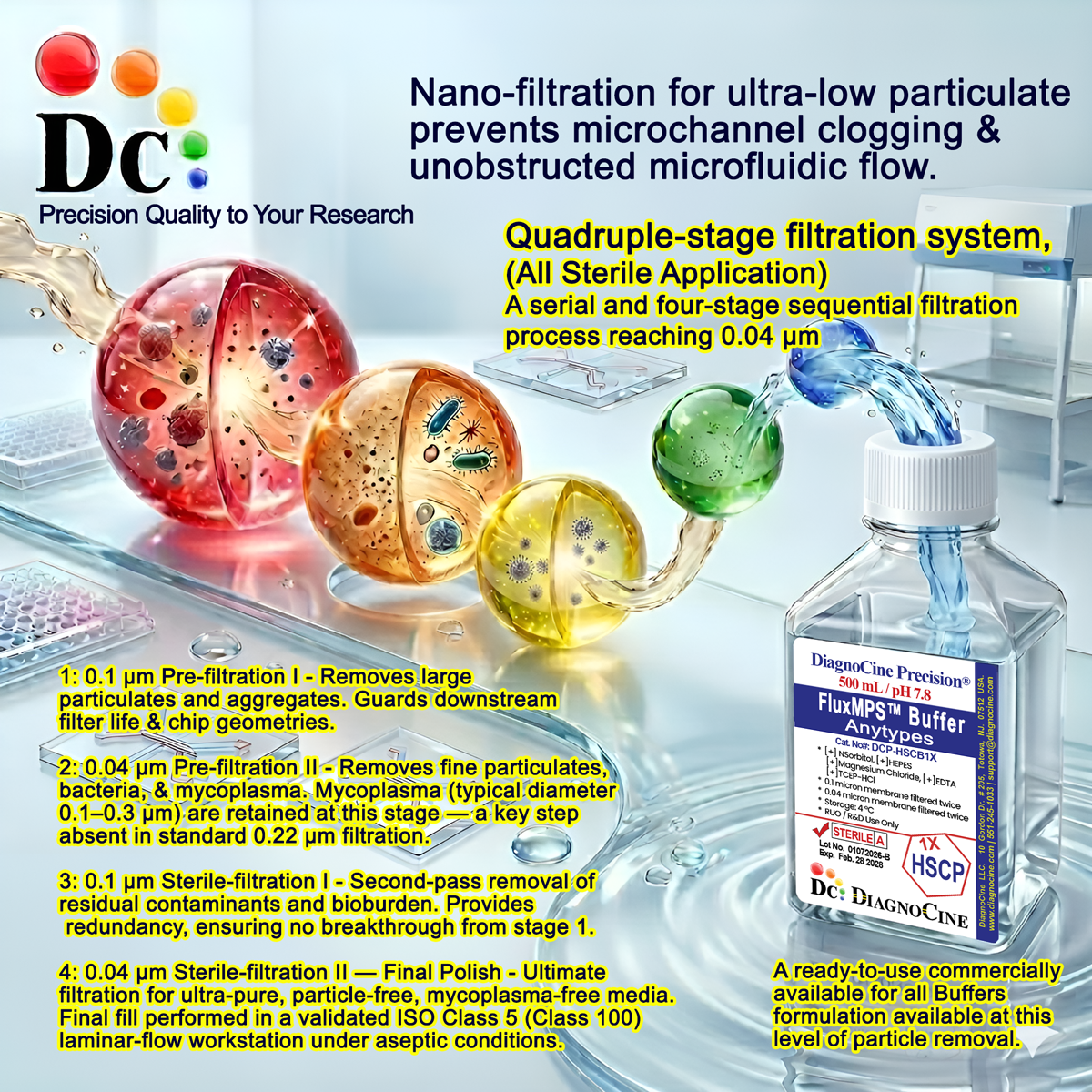
Quadruple-stage filtration system
DCP-TBSSB-R1X is sterile-filtered through a 0.1 µm membrane twice and a 0.04 µm membrane twice, a quadruple-stage architecture designed to remove fine particulates and reduce bioburden before ISO Class 5 aseptic fill.
-
1
0.1 µm Pre-filtration I
First 0.1 µm membrane pass removes large particulates and aggregates, extending the life of downstream filters.
-
2
0.04 µm Pre-filtration II
First 0.04 µm membrane pass retains fine particulates and bioburden, helping guard against mycoplasma contamination.
-
3
0.1 µm Sterile-filtration I
Second 0.1 µm membrane pass provides redundant sterile filtration ahead of final polishing.
-
4
0.04 µm Sterile-filtration II — Final Polish
Second 0.04 µm membrane pass delivers the final polish under ISO Class 5 aseptic fill conditions.
Performance vs. conventional buffer
Sequential 0.1 µm and 0.04 µm filtration, each applied twice, removes finer particulates than a single-pass 0.22 µm filtration used in conventional balanced salt solutions.
© Diagnocine® — DCP-TBSSB-R1X
Where DCP-TBSSB-R1X is used
DCP-TBSSB-R1X supports mammalian tissue perfusion and maintenance, physiological studies using isolated intestinal muscles, cellular metabolism research, and serves as a base solution for customized culture media.
Automated Bioreactors & Robotics
An optional 0.01 µm (10 nm) ultra-filtered variant of this buffer is available for automated bioreactor and robotic perfusion systems that demand the lowest possible particulate load.
- Total Particulate Exclusion — sub-10 nm filtration for maximal particulate removal
- Valve & Sensor Protection — reduces particulate-related fouling of automated fluidic hardware
- Extended Perfusion Stability — supports longer unattended run times in closed perfusion loops
Inquiry Required: the 0.01 µm (10 nm) ultra-filtered grade is available on request — contact support@diagnocine.com.
Micro Physiological System (MPS) & Chip
Perfusion buffer for mammalian tissue maintenance within microfluidic organ-on-a-chip devices.
Wash, Dilution & Reconstitution
Serves as a base solution for customized culture media and general laboratory dilution steps.
iPSC-Derived Model Handling
Supports cellular metabolism research in iPSC-derived in vitro models.
Endothelial & Primary Cell Perfusion
Suited to mammalian tissue perfusion and maintenance in vascular and primary cell workflows.
ELISA, Blotting & Blocking
Phenol red-free formulation avoids optical interference in colorimetric and chemiluminescent assay readouts.
Microscopy & Optical Sensing
Calcium-sensitive, phenol red-free formulation supports calcium imaging and smooth muscle contraction studies in isolated intestinal muscle preparations.
Detailed specifications
Measured and declared parameters for DCP-TBSSB-R1X.
| Parameter | Specification |
|---|---|
| Formulation | Tyrode's Balanced Salt Solution with Sodium Bicarbonate, without Phenol Red |
| Appearance | Colorless, clear solution |
| pH USP <791> | 7.4 |
| Osmolality USP <785> | 270.00-310.00 mOsm/Kg H2O |
| Sodium Bicarbonate Content | 1000.000 mg/L |
| CO2 Buffering pH Range (5% CO2 incubation) | 7.6-8.2 |
| D-Glucose Content | 1000.000 mg/L |
| Parameter | Specification |
|---|---|
| Endotoxin USP <85> BET | NMT 1EU/ml |
| Sterility USP <71> | No bacterial or fungal growth observed after 14 days of incubation |
| Toxicity Test | Passes |
| Filtration System | Filtered 0.1-micron membrane twice and 0.04-micron membrane twice (quadruple-stage) |
| Water Quality | Ultrapure Type 1 water (18.2 MΩ·cm) |
| Manufacturing Standard ISO 13485:2016 | ISO 13485-certified, CE-approved facility |
| Parameter | Specification |
|---|---|
| Storage Temperature | 4°C, away from bright light |
| Shelf Life | 24 months |
| Usage Note | Use before expiry date given on product label |
| Parameter | Specification |
|---|---|
| Manufacturing QMS | ISO 13485-certified facility (Suppliers of DiagnoCine Precision) |
| Regulatory Alignment | CE-approved manufacturing facility |
| Production Method | Final packaging, quality assurance, and testing performed at the DiagnoCine R&D and Quality Testing Center |
| Customization & Assembly Location | DiagnoCine Precision, Totowa, New Jersey, USA |
| Intended Use | For Research Use Only (RUO); tissue culture and biochemical applications, not for clinical, diagnostic, or therapeutic use in humans |
Full composition
Component concentrations for DCP-TBSSB-R1X, expressed in mg/L, grouped as originally categorized.
| Component | CAS Number | Concentration |
|---|---|---|
| Calcium chloride dihydrate | 10035-04-8 | 265.000 mg/L |
| Magnesium chloride anhydrous | 7786-30-3 | 46.900 mg/L |
| Potassium chloride | 7447-40-7 | 200.000 mg/L |
| Sodium bicarbonate | 144-55-8 | 1000.000 mg/L |
| Sodium chloride | 7647-14-5 | 8000.000 mg/L |
| Sodium dihydrogen phosphate anhydrous | 7558-80-7 | 50.000 mg/L |
| Component | CAS Number | Concentration |
|---|---|---|
| D-Glucose | 50-99-7 | 1000.000 mg/L |
Manufacturing & compliance
DCP-TBSSB-R1X is manufactured, filtered, and packaged under controlled quality systems.
ISO 13485:2016 QMS
Manufactured under ISO 13485-certified and CE-approved facilities (Suppliers of DiagnoCine Precision).
Ultrapure Type 1 Water
Formulated on Ultrapure Type 1 water (18.2 MΩ·cm) as the base for all buffer components.
ISO Class 5 Fill & Finish
Final sterile fill is performed within an ISO Class 5 (Class 100) aseptic environment.
Micro-Batch Precision
Final packaging, quality assurance, and testing are completed at the DiagnoCine R&D and Quality Testing Center; customization and assembly occur at DiagnoCine Precision in Totowa, New Jersey, USA.
Endotoxin — USP <85> BET
Endotoxin content is NMT 1EU/ml, verified per the USP Bacterial Endotoxins Test.
Particulate — USP <788> Method 2
Particulate testing is performed as part of the quality release process for this filtered buffer.
Osmolality — USP <785>
Osmolality is maintained at 270.00-310.00 mOsm/Kg H2O.
Documentation / CoA
A Certificate of Analysis is available for this lot on request.
How DCP-TBSSB-R1X compares
A comparison against conventionally filtered balanced salt solutions.
| Parameter | DCP-TBSSB-R1X (FluxMPS™) | Conventional Buffer (0.22 µm filtered) | Standard Alternative (0.22 µm filtered) |
|---|---|---|---|
| Sodium Bicarbonate Buffering System | check_circle | cancel | cancel |
| Final Filtration Pore Size | 0.04 µm | 0.22 µm | 0.22 µm |
| Number of Filtration Stages | 4 | 1 | 1 |
| Endotoxin Specification | NMT 1EU/ml | Not specified | Not specified |
| USP Particulate Compliance | check_circle | cancel | cancel |
| Water Quality | Ultrapure Type 1 (18.2 MΩ·cm) | Standard Type 2 water | Standard Type 2 water |
| Manufacturing QMS | ISO 13485-certified | Not specified | Not specified |
| Phenol Red-Free Formulation | check_circle | cancel | cancel |
| Custom Formulation Available | check_circle | cancel | cancel |
Frequently asked questions
Common questions about DCP-TBSSB-R1X.
Supporting literature
Curated peer-reviewed literature relevant to Tyrode's balanced salt solutions, organ-on-a-chip perfusion, and buffer chemistry.
- Bhatia SN, Ingber DE. Microfluidic organs-on-chips. Nat Biotechnol. 2014. doi:10.1038/nbt.2989
- Huh D, Hamilton GA, Ingber DE. From 3D cell culture to organs-on-chips. Trends Cell Biol. 2011. doi:10.1016/j.tcb.2011.09.005
- Tyrode MV. The mode of action of some purgative salts. Arch Int Pharmacodyn Ther. 1910.
- Halldorsson S, Lucumi E, Gomez-Sjoberg R, Fleming RM. Advantages and challenges of microfluidic cell culture in polydimethylsiloxane devices. Biosens Bioelectron. 2015. doi:10.1016/j.bios.2014.07.029
- Yin F, et al. Engineering stem cell organoids. Cell Stem Cell. 2016. doi:10.1016/j.stem.2016.01.009
- Bergdahl A, Gomez MF, Dreja K, et al. Cholesterol depletion impairs vascular reactivity to endothelin-1 by reducing store-operated Ca2+ entry dependent on TRPC1. Circ Res. 2003. doi:10.1161/01.RES.0000102614.90336.4B
- Ashammakhi N, et al. Gut-on-a-chip: current progress and future opportunities. Biomaterials. 2020. doi:10.1016/j.biomaterials.2020.119920
- Malda J, et al. Osmolality and ionic composition considerations for physiological buffers in cell culture. J Tissue Eng Regen Med. 2013.
- United States Pharmacopeia. USP General Chapter 85, Bacterial Endotoxins Test.
- United States Pharmacopeia. USP General Chapter 788, Particulate Matter in Injections.