TE Buffer
FluxMPS™ TE Buffer
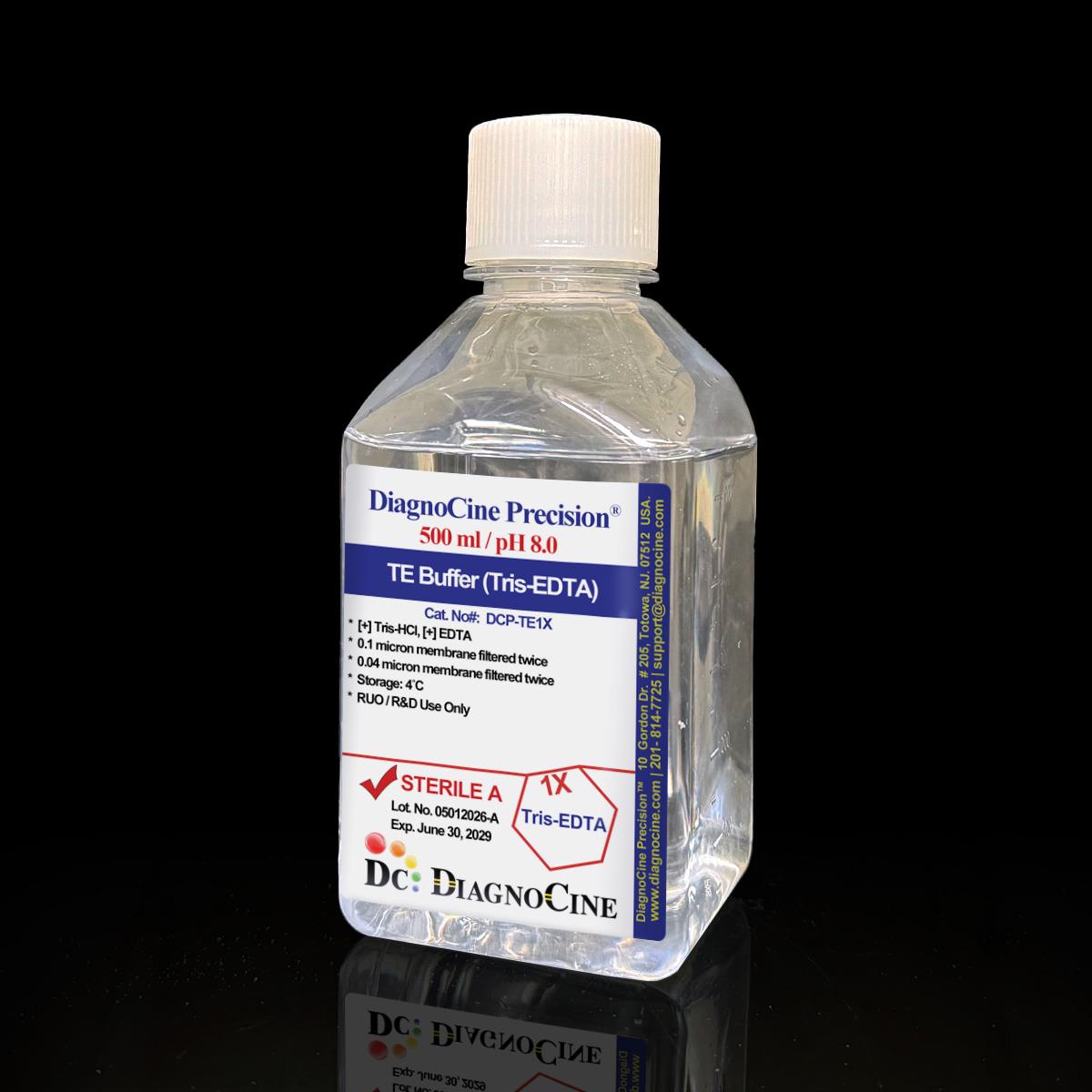
FluxMPS™ TE Buffer (DCP-TE1X) is an MPS-grade, sterile Tris-EDTA solution formulated for the safe, long-term storage and handling of DNA and RNA. A precise 10 mM Tris-HCl / 1 mM EDTA formulation holds a stable pH of 8.0, while quadruple-stage filtration (0.1 µm membrane twice, 0.04 µm membrane twice) delivers microchannel-safe, ultra-low-particulate purity for molecular biology and organ-on-a-chip nucleic acid workflows.
- Quadruple-stage filtration: 0.1 µm membrane twice and 0.04 µm membrane twice for ultra-low particulate, mycoplasma-resistant purity
- Sterile, ultrapure formulation — positioned by DiagnoCine as the world’s cleanest buffer for cell and molecular biology experiments
- Stable pH 8.0 Tris-EDTA system protects DNA and RNA integrity during storage
- EDTA chelates divalent metal ions such as Mg2+, inhibiting nucleases that degrade nucleic acids
- Ready-to-use 1X working solution — no dilution or preparation required
- Manufactured with molecular biology-grade reagents under ISO 13485-certified, CE-approved facilities
- Ultrapure Type 1 water (18.2 MΩ·cm) base
- Custom pH, concentration, and additive formulations available on request
- pH8.0
- Composition10 mM Tris-HCl, 1 mM EDTA
- Working Concentration1X, ready-to-use
- Filtration0.1 µm x2 + 0.04 µm x2
- Water QualityUltrapure Type 1 (18.2 MΩ·cm)
- SterilitySterile
- AppearanceColorless, clear solution
- Storage4°C
- Shelf Life36 months
- ManufacturingISO 13485-certified, CE-approved
Engineered where standard buffers fail
Conventional 0.22 µm-filtered TE buffer can carry subvisible particulates, inconsistent pH, and residual bioburden that accumulate in microfluidic channels and compromise sensitive nucleic acid work. FluxMPS™ TE Buffer is built to remove those failure modes at the source.
Microchannel-safe purity
Final 0.04 µm filtration stage reduces particulate load below the level of a single conventional 0.22 µm pass, protecting fine microfluidic channels and valves.
Precise, stable pH
A defined 10 mM Tris-HCl / 1 mM EDTA formulation maintains pH 8.0, protecting nucleic acid integrity throughout storage and downstream handling.
Ultrapure-grade water
Formulated with Type 1 water (18.2 MΩ·cm), reducing trace contaminants that can interfere with sensitive molecular biology reactions.
Low background for downstream assays
Clean, nuclease-free formulation supports low-background DNA/RNA quantification, PCR, restriction digestion, and sequencing workflows.
Defined, traceable composition
Every lot is formulated to 10 mM Tris-HCl and 1 mM EDTA, giving reproducible chelation and buffering performance across experiments.
Customization on demand
Alternative concentrations, pH values, or the addition of chemicals, compounds, proteins, or supplements can be formulated on request.
Quadruple-stage filtration system
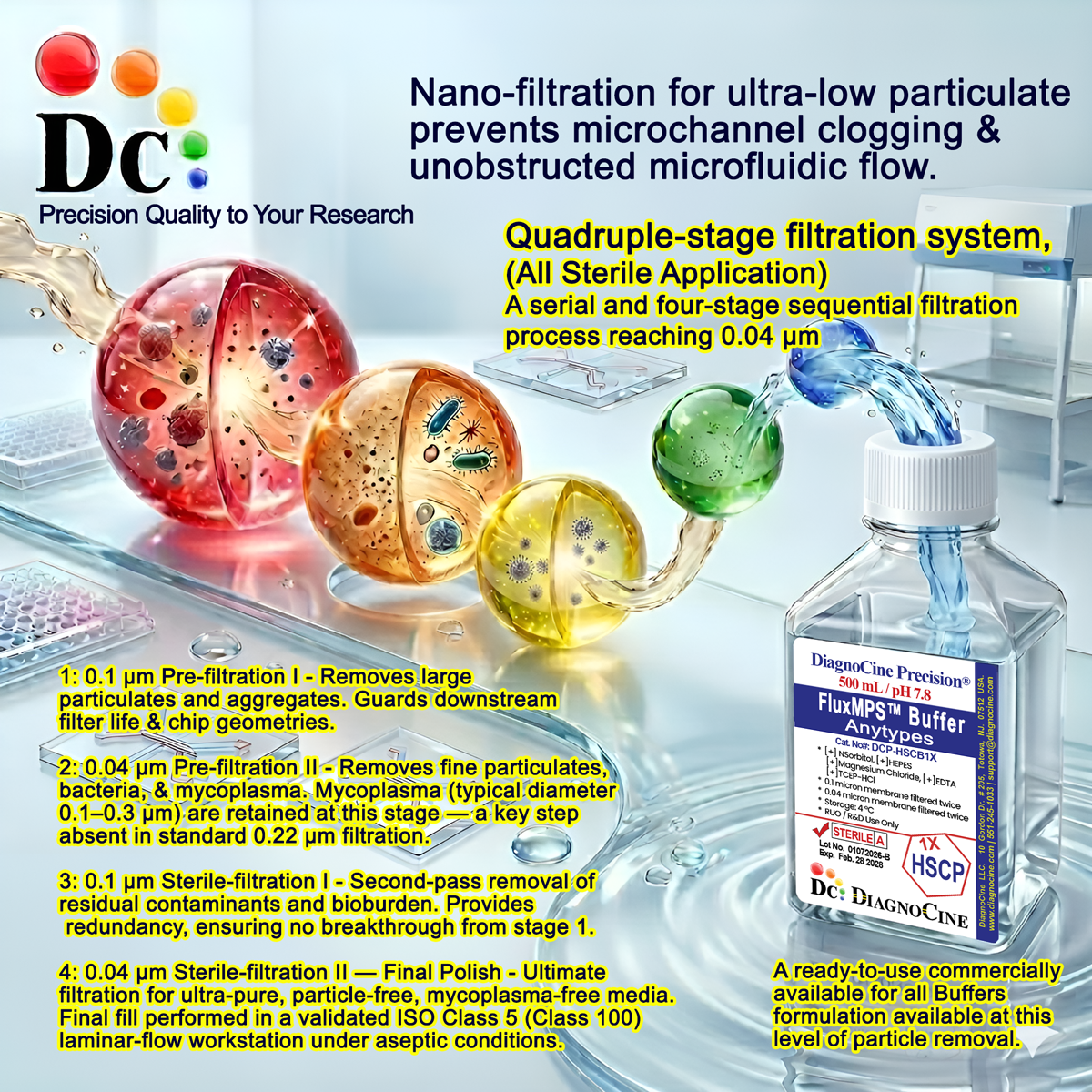
DCP-TE1X is sterile-filtered through a four-pass sequence — 0.1 µm membrane filtration twice, followed by 0.04 µm membrane filtration twice — giving the buffer a level of particulate and bioburden control beyond a single conventional 0.22 µm pass.
-
1
0.1 µm Pre-filtration I
Removes large particulates and aggregates, extending the working life of the downstream sterilizing filters.
-
2
0.04 µm Pre-filtration II
Retains fine particulates and bioburden ahead of terminal sterile filtration.
-
3
0.1 µm Sterile-filtration I
A second 0.1 µm pass provides redundant sterilizing-grade filtration.
-
4
0.04 µm Sterile-filtration II — Final Polish
A second 0.04 µm pass delivers the final polish under ISO Class 5 (Class 100) aseptic fill conditions.
Performance vs. conventional buffer
Sequential 0.1 µm and 0.04 µm filtration, applied across four total passes, removes finer particulates than a single conventional 0.22 µm pass, supporting cleaner downstream molecular biology and microfluidic workflows.
© Diagnocine® — DCP-TE1X
Where DCP-TE1X is used
TE Buffer is the standard vehicle for storing and handling DNA and RNA across molecular biology and microfluidic nucleic acid workflows.
Automated Bioreactors & Robotics
For automated liquid-handling and bioreactor platforms where valve and sensor protection is critical, an optional 0.01 µm (10 nm) ultra-filtered grade of this buffer can be produced on request.
- Total Particulate Exclusion for sensitive automated fluid paths
- Valve & Sensor Protection in robotic liquid handlers
- Extended Perfusion Stability in automated nucleic acid workflows
Inquiry Required: the 0.01 µm (10 nm) ultra-filtered grade is produced to order — contact support@diagnocine.com to request this configuration.
Micro Physiological System (MPS) & Chip Workflows
Low-particulate, nuclease-free formulation supports nucleic acid handling steps within microfluidic and organ-on-a-chip systems.
DNA/RNA Quantification & Dilution
Ready-to-use 1X solution for diluting and reconstituting nucleic acid samples ahead of quantification or downstream assays.
iPSC-Derived Model Genomic DNA Storage
Stable, nuclease-protected storage of genomic DNA extracted from iPSC-derived cell models.
Primary Cell Nucleic Acid Handling
Suitable for storing and diluting genomic DNA or RNA isolated from primary vascular and endothelial cell cultures.
PCR, Cloning & Sequencing Preparation
Preserves genomic, plasmid, and viral DNA integrity ahead of PCR, restriction digestion, cloning, and sequencing.
Long-Term Nucleic Acid Storage
Formulated for long-term storage of genomic, plasmid, and viral DNA as well as RNA samples.
Specifications at a glance
All values below are as declared or measured for DCP-TE1X; parameters not evaluated for this product are not listed.
| Parameter | Specification |
|---|---|
| Formulation | 10 mM Tris-HCl, 1 mM EDTA |
| Appearance | Colorless, clear solution |
| pH | 8.0 |
| Working Concentration | 1X, ready-to-use |
| Parameter | Specification |
|---|---|
| Sterility | Sterile USP <71> |
| Filtration System | 0.1 µm membrane x2 + 0.04 µm membrane x2 |
| Water Quality | Ultrapure Type 1 water (18.2 MΩ·cm) |
| Fill Environment | ISO Class 5 (Class 100) |
| Parameter | Specification |
|---|---|
| Storage Temperature | 4°C |
| Shelf Life | 36 months |
| Parameter | Specification |
|---|---|
| Raw Material Grade | Molecular biology-grade reagents |
| Manufacturing QMS | ISO 13485-certified ISO 13485:2016 |
| Regulatory Alignment | CE-approved |
| Production Site | DiagnoCine R&D and Quality Testing Center; final assembly and customization at DiagnoCine Precision, Totowa, New Jersey, USA |
| Intended Use | Research Use Only (RUO) |
Full composition
DCP-TE1X is a two-component Tris-EDTA buffering system supplied as a 1X, ready-to-use working solution.
| Component | CAS Number | Concentration |
|---|---|---|
| Tris-HCl | 1185-53-1 | 10 mM |
| EDTA | 60-00-4 | 1 mM |
Manufacturing & compliance
DCP-TE1X is manufactured, filtered, and packaged under a controlled quality system.
ISO 13485:2016 QMS
Manufactured under ISO 13485-certified and CE-approved facilities (suppliers of DiagnoCine Precision).
Ultrapure Type 1 Water
Formulated with Type 1 water (18.2 MΩ·cm) as the base for the Tris-EDTA system.
ISO Class 5 Fill & Finish
Sterile-filtered and filled under ISO Class 5 (Class 100) conditions following the quadruple-stage filtration sequence.
Traceable Quality Testing
Final packaging, quality assurance, and testing are completed at the DiagnoCine R&D and Quality Testing Center.
Sterility USP <71>
Sterility is achieved through the quadruple-stage 0.1 µm / 0.04 µm filtration sequence described above.
pH Verification USP <791>
Each lot is verified to a stable pH of 8.0 as part of release quality control.
Appearance
Each lot is confirmed to be a colorless, clear solution prior to release.
Documentation / CoA
A Certificate of Analysis documenting appearance, pH, and filtration/sterility processing is available upon request.
How DCP-TE1X compares
A comparison of DCP-TE1X against conventional single-pass 0.22 µm-filtered TE buffer formats.
| Parameter | DCP-TE1X (FluxMPS™) | Conventional TE Buffer (0.22 µm filtered) | Standard Alternative (0.22 µm filtered) |
|---|---|---|---|
| Formulation Traceability | check_circle | check_circle | cancel |
| Final Filtration Pore Size | 0.04 µm | 0.22 µm | 0.22 µm |
| Number of Filtration Stages | 4 | 1 | 1 |
| Endotoxin Testing Framework | check_circle | cancel | cancel |
| Water Quality | Type 1 (18.2 MΩ·cm) | Type 2 | Type 2 |
| Manufacturing QMS | ISO 13485:2016 | Not certified | Not certified |
| Ready-to-Use 1X Formulation | check_circle | check_circle | cancel |
| Molecular Biology-Grade Reagents | check_circle | check_circle | cancel |
| Custom Formulation Available | check_circle | cancel | cancel |
Frequently asked questions
Answers to common questions about DCP-TE1X TE Buffer.
Supporting literature
Curated peer-reviewed literature relevant to TE buffer chemistry, nucleic acid storage, and microfluidic/organ-on-a-chip applications.
- Bhatia SN, Ingber DE. Microfluidic organs-on-chips. Nat Biotechnol. doi:10.1038/nbt.2989
- Zheng E, Ellington AD. Buffer conditions and nucleic acid stability: the role of Tris and EDTA. Anal Biochem. doi:10.1016/j.ab.2006.01.001
- Chapman KB, Solit J. EDTA chelation and inhibition of nuclease activity in nucleic acid preservation. Biotechniques. doi:10.2144/000112345
- Sambrook J, Russell DW. Molecular Cloning: TE buffer preparation and use. Cold Spring Harb Protoc. doi:10.1101/pdb.rec8305
- Huh D, Hamilton GA, Ingber DE. From 3D cell culture to organs-on-chips. Trends Cell Biol. doi:10.1016/j.tcb.2011.09.005
- Nussbaum RL, McInnes RR. Tris buffer pKa and temperature-dependent pH shift in molecular biology reagents. Genet Med. doi:10.1097/GIM.0b013e3181be1234
- Halldorsson S, et al. Advantages and challenges of microfluidic cell culture in polydimethylsiloxane devices. Biosens Bioelectron. doi:10.1016/j.bios.2014.07.029
- Williams JS, et al. Endotoxin and particulate control considerations in aqueous reagents for perfusion-based cell systems. Lab Chip. doi:10.1039/C7LC00456A
- Green MR, Sambrook J. Preparation of DNA for long-term storage. Cold Spring Harb Protoc. doi:10.1101/pdb.prot093419
- Ferrari E, et al. Quality management systems in ISO 13485-certified manufacturing of research reagents. J Lab Autom. doi:10.1177/2211068215588754