


5% Hydrogen Peroxide Solution (H2O2)
FluxMPS™ 5% Hydrogen Peroxide Solution (H2O2)
DCP-H2O25X is an MPS-grade 5% hydrogen peroxide (H2O2) surface decontamination solution engineered for molecular biology laboratories performing RNA work. Manufactured with a quadruple-stage 0.1 micron and 0.04 micron filtration architecture, it delivers a precise, defined 5% (50 g/L) concentration that irreversibly denatures RNase enzymes on glass, plastic, metal, polycarbonate, and polystyrene surfaces throughout microfluidic and organ-on-a-chip (OoC) workflows.
- Quadruple-stage filtration: 0.1-micron membrane filtration twice and 0.04-micron membrane filtration twice
- Precise, defined 5% (50 g/L) hydrogen peroxide concentration for irreversible oxidative denaturation of RNase
- Effective on glass, plastic, metal, polycarbonate, and polystyrene laboratory surfaces
- 10-15 minute contact time for complete RNase deactivation
- Rinse-compatible with DEPC-treated RNase-free water for RNA-safe downstream use
- Manufactured under ISO 13485-certified, CE-approved facilities with final QA at the DiagnoCine R&D and Quality Testing Center
- 1-year shelf life when stored in a cool, dark place
- Custom concentration, volume, and packaging available on request
- Active IngredientHydrogen Peroxide (H2O2)
- Concentration5% (50 g/L)
- Contact Time10-15 minutes
- Post-TreatmentRinse with DEPC-treated water
- Compatible SurfacesGlass, plastic, metal, polycarbonate, polystyrene
- Filtration0.1 micron (twice) & 0.04 micron (twice)
- Shelf Life1 year
- StorageCool, dark place
- Size500 mL
- Manufacturing StandardISO 13485-certified, CE-approved
Engineered where standard decontamination solutions fall short
Conventional single-pass 0.22 micron-filtered decontamination reagents can leave behind subvisible particulate, inconsistent active-ingredient concentration, and residues that interfere with sensitive RNA workflows. DCP-H2O25X is manufactured to a defined concentration and a multi-stage filtration architecture built for RNase-free laboratory environments.
Quadruple-stage filtration purity
0.1-micron membrane filtration twice and 0.04-micron membrane filtration twice reduces particulate carryover before packaging.
Precise, defined 5% concentration
A consistent 5% (50 g/L) hydrogen peroxide concentration delivers reliable, irreversible oxidative denaturation of RNase proteins.
Ultrapure manufacturing water
Formulated with Ultrapure Type 1 water (18.2 MΩ·cm) as part of the DiagnoCine Precision manufacturing standard.
Low-residue for RNA workflows
Rinsing with DEPC-treated RNase-free water after the recommended contact time helps prevent interference with downstream RNA applications.
Traceable, single-ingredient formulation
A defined, lot-documented hydrogen peroxide formulation with a clear CAS identity for full traceability.
Customization on demand
Concentration, volume, and packaging can be adjusted for your protocol — contact support@diagnocine.com.
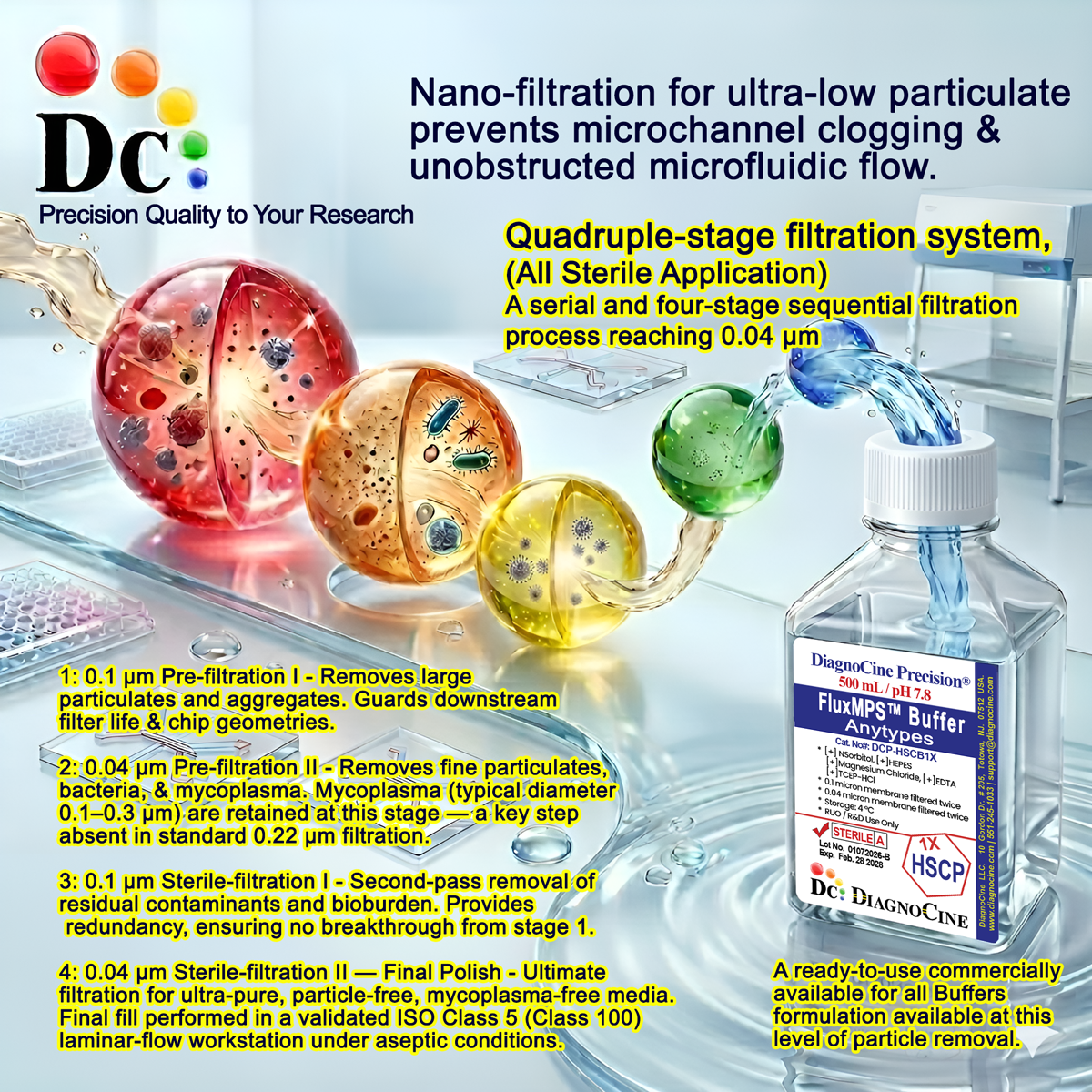
Quadruple-stage filtration system
DCP-H2O25X is filter-sterilized using a 0.1-micron membrane filtration step performed twice, followed by a 0.04-micron membrane filtration step performed twice, supporting an RNase-free, low-particulate solution for laboratories handling RNA.
- 1
0.1 µm Pre-filtration I
First-pass 0.1 micron membrane filtration removes larger particulate and aggregate material, extending the service life of downstream filters.
- 2
0.04 µm Pre-filtration II
First-pass 0.04 micron membrane filtration retains finer particulates and bioburden, including organisms in the size range of the smallest known mycoplasma species, reported at about 0.2 micron.
- 3
0.1 µm Sterile-filtration I
Second-pass 0.1 micron membrane filtration provides redundancy ahead of final polishing.
- 4
0.04 µm Sterile-filtration II — Final Polish
Second-pass 0.04 micron membrane filtration is the final polishing step ahead of packaging in an ISO Class 5 (Class 100) fill environment.
Performance vs. conventional decontamination solution
Sequential 0.1 micron and 0.04 micron filtration, each applied in two full passes, provides more thorough particulate reduction than a single-pass 0.22 micron filtration common in standard decontamination solutions.
© Diagnocine® — DCP-H2O25X
RNase decontamination for RNA-focused laboratory workflows
DCP-H2O25X supports RNase-free surface preparation across benchtops, equipment, and consumables used throughout microfluidic, stem cell, vascular, immunoassay, and imaging workflows that require intact RNA.
Automated Bioreactors & Robotics
For automated liquid-handling platforms and robotic decontamination decks used in RNA workflows, an optional 0.01 µm (10 nm) ultra-filtered variant of this solution is available on request to further reduce particulate load in enclosed fluid paths.
- Total Particulate Exclusion: Ultra-filtered fluid path minimizes particulate carryover into automated decontamination lines.
- Valve & Sensor Protection: Reduced particulate load helps protect sensitive robotic valves and optical sensors.
- Extended Perfusion Stability: Cleaner fluid supports longer uptime between automated system maintenance cycles.
Inquiry Required: The 0.01 µm ultra-filtered grade is available upon request — contact support@diagnocine.com.
Micro Physiological System (MPS) & Chip
Decontaminate microfluidic chip surfaces, connectors, and tubing prior to RNA extraction work.
Wash, Dilution & Reconstitution
Daily decontamination of laboratory benchtops and weekly cleaning of pipettes and tube racks used in RNA sample prep.
iPSC-Derived Model Handling
Surface preparation in designated RNase-free work areas handling iPSC-derived model RNA extractions.
Endothelial & Primary Cell Perfusion
Decontaminate workspace surfaces before RNA isolation from primary vascular and endothelial cell cultures.
ELISA, Blotting & Blocking
Decontamination of electrophoresis and blotting equipment prior to RNA work.
Microscopy & Optical Sensing
Treatment of polycarbonate and polystyrene imaging consumables and instrument surfaces before RNA-focused imaging.
Usage protocol
- Apply: Wipe the laboratory surface thoroughly with a paper towel saturated with the 5% H2O2 solution, ensuring complete coverage of the area.
- Wait: Leave the surface wet for 10-15 minutes to allow complete RNase deactivation. This contact time ensures thorough oxidation of RNase proteins.
- Rinse: After the contact period, rinse the treated surface with DEPC-treated ultrapure water to remove residual hydrogen peroxide. This step is critical to prevent interference with downstream RNA applications.
Product specifications
All values below are as declared for DCP-H2O25X.
| Parameter | Specification |
|---|---|
| Active Ingredient | Hydrogen Peroxide (H2O2) |
| Concentration | 5% (50 g/L) |
| Parameter | Specification |
|---|---|
| Filtration System | 0.1 micron membrane (twice) & 0.04 micron membrane (twice) ISO 13485 |
| Manufacturing Standard | ISO 13485-certified, CE-approved facility |
| Parameter | Specification |
|---|---|
| Contact Time | 10-15 minutes (15 minutes recommended) |
| Post-Treatment | Rinse with DEPC-treated RNase-free water |
| Compatible Surfaces | Glass, plastic, metal, polycarbonate, polystyrene |
| Shelf Life | 1 year |
| Storage | Cool, dark place for maximum stability |
| Parameter | Specification |
|---|---|
| Manufacturing QMS | ISO 13485-certified ISO 13485 |
| Regulatory Alignment | CE-approved facility |
| Production Method | Final packaging, QA, and testing at the DiagnoCine R&D and Quality Testing Center; custom formulation and assembly at DiagnoCine Precision, Totowa, New Jersey, USA |
| Intended Use | Research Use Only (RUO) surface decontamination for RNA workflows |
Full composition
DCP-H2O25X is a single-active-ingredient aqueous reagent released on a per-lot basis.
| Component | CAS Number | Concentration |
|---|---|---|
| Hydrogen Peroxide (H2O2) | 7722-84-1 | 5% (50 g/L) |
Manufacturing & compliance
DCP-H2O25X is produced within the DiagnoCine Precision quality framework.
ISO 13485:2016 QMS
Manufactured under ISO 13485-certified and CE-approved facilities.
Ultrapure Type 1 Water
Processed with Ultrapure Type 1 water (18.2 MΩ·cm) as part of the DiagnoCine Precision manufacturing standard.
ISO Class 5 Fill & Finish
Final polish filtration precedes packaging in an ISO Class 5 (Class 100) fill environment.
Micro-Batch Precision
All final packaging, quality assurance, and testing are completed at the DiagnoCine R&D and Quality Testing Center.
Endotoxin Testing Framework
Endotoxin testing methodology aligned with USP <85> Bacterial Endotoxins Test is applied across the DiagnoCine Precision manufacturing platform.
Particulate Control Framework
Particulate control practices reference USP <788> Method 2 across DiagnoCine Precision reagent manufacturing.
Osmolality Testing Framework
Osmolality testing practices reference USP <785> within the broader DiagnoCine Precision reagent quality program.
Documentation & CoA
Lot-specific Certificates of Analysis are available upon request.
How DCP-H2O25X compares
A side-by-side look at DCP-H2O25X against conventional decontamination solutions.
| Parameter | DCP-H2O25X (FluxMPS™) | Conventional 0.22 µm-filtered solution | Standard 3% household hydrogen peroxide |
|---|---|---|---|
| Concentration | 5% (50 g/L) | Varies by manufacturer | 3% |
| Final filtration pore size | 0.04 µm | 0.22 µm | Not filtered |
| Number of filtration stages | 4 | 1 | Not specified |
| RNase contact time validated | 10-15 minutes | Not validated | Not validated |
| Compatible surfaces | Glass, plastic, metal, polycarbonate, polystyrene | Varies | Household surfaces only |
| Manufacturing QMS | check_circle ISO 13485-certified | cancel | cancel |
| Microfluidic / lab equipment compatibility | check_circle | cancel | cancel |
| Custom formulation available | check_circle | cancel | cancel |
Frequently asked questions
Common questions about DCP-H2O25X.
Supporting literature
Curated references relevant to RNase decontamination, hydrogen peroxide chemistry, and RNA-focused laboratory workflows.
- Blais BW, Turner G. Detection of RNase A and the challenge of ribonuclease decontamination in molecular biology laboratories. J Microbiol Methods. 2002. doi:10.1016/S0167-7012(02)00021-0
- Linley E, Denyer SP, McDonnell G, Simons C, Maillard JY. Use of hydrogen peroxide as a biocide: mode of action and resistance issues. J Antimicrob Chemother. 2012. doi:10.1093/jac/dks129
- McDonnell G, Russell AD. Antiseptics and disinfectants: activity, action, and resistance. Clin Microbiol Rev. 1999. doi:10.1128/CMR.12.1.147
- Farr SB, Kogoma T. Oxidative stress responses in Escherichia coli and Salmonella typhimurium. Microbiol Rev. 1991. doi:10.1128/mr.55.4.561-585.1991
- Bhatia SN, Ingber DE. Microfluidic organs-on-chips. Nat Biotechnol. 2014. doi:10.1038/nbt.2989
- Zucchelli E, et al. Mycoplasma contamination in cell culture: sources, detection, and elimination. Biologicals. 2020. doi:10.1016/j.biologicals.2020.04.001
- Farrell RE. RNA isolation strategies. In: RNA Methodologies. Academic Press. 2010. doi:10.1016/B978-0-12-374727-3.00003-2
- Whitesides GM. The origins and the future of microfluidics. Nature. 2006. doi:10.1038/nature05058
- Ryu H, et al. Engineering the vasculature for organ-on-a-chip platforms. Adv Healthc Mater. 2019. doi:10.1002/adhm.201900962