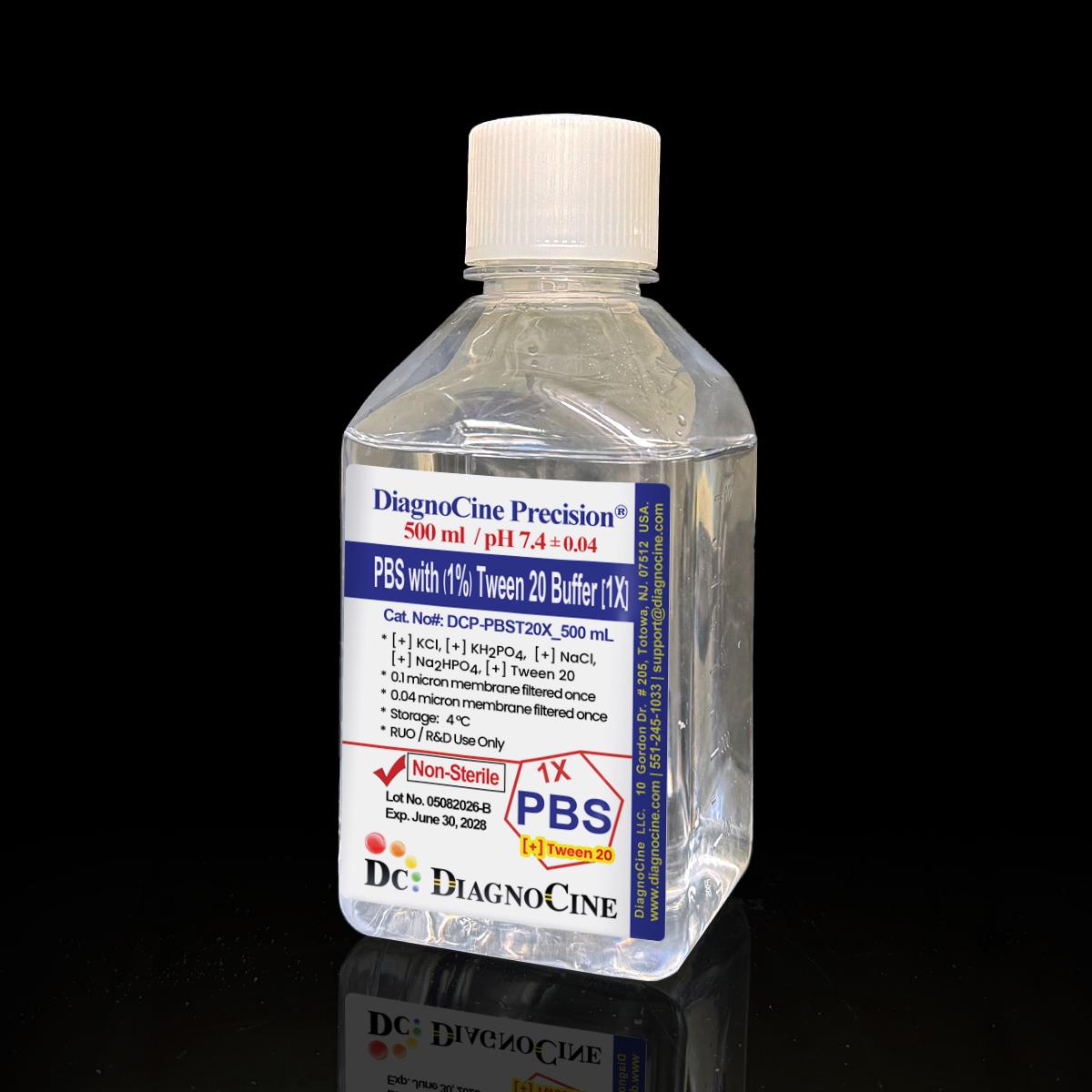
PBS with (1%) Tween 20 Buffer [1X]
FluxMPS™ PBS with (1%) Tween 20 Buffer [1X]
An MPS-grade, non-sterile 1X phosphate buffered saline formulated with 1% Tween 20 for stringent wash and blocking steps in ELISA, Western blotting, and other antibody-based assays. Manufactured with defined pH 7.4 chemistry and sequentially filtered through 0.1 µm and 0.04 µm membranes to reduce particulate load, with purity scaled precisely to this buffer's dual-stage filtration architecture.
- Non-sterile, ultrapure buffer filtered through 0.1 µm and 0.04 µm membranes to reduce particulate and bioburden
- 1X PBS with 1% Tween 20 for stringent wash and blocking steps in ELISA and Western blotting
- Defined pH 7.4 formulation with precise ionic salts: NaCl, KCl, Na2HPO4, KH2PO4
- No detectable DNase or RNase activity after 18 hr incubation at room temperature
- Manufactured under ISO 13485-certified, CE-approved facilities
- Reduces non-specific binding and improves washing efficiency for microplate wells and membranes
- Custom pH, concentration, and additive formulations available on request
- FormulationPBS + 1% Tween 20 (1X)
- pH7.4
- NaCl137 mM
- KCl2.7 mM
- Na2HPO410 mM
- KH2PO41.8 mM
- Tween 201%
- Filtration0.1 µm once + 0.04 µm once (non-sterile)
- Storage4°C
- Shelf Life2 years
Engineered where standard wash buffers fail
Conventional 0.22 µm-filtered wash buffers can carry subvisible particulates and inconsistent ionic chemistry into microplate wells, membranes, and microfluidic channels, raising background and clogging fine-bore instrumentation. FluxMPS™ PBS-Tween 20 is built to a tighter purity and formulation standard.
Microchannel-safe purity
Sequential 0.1 µm and 0.04 µm membrane filtration reduces particulate load beyond a single 0.22 µm pass, supporting fine-bore microfluidic and assay hardware.
Precise, stable pH
Formulated to a defined pH 7.4 with a fixed salt composition of NaCl, KCl, Na2HPO4, and KH2PO4 for reproducible wash and blocking chemistry.
Ultrapure-grade water
Prepared from Ultrapure Type 1 water (18.2 MΩ·cm), consistent with USP <85> water quality expectations.
Low background for imaging & assays
The non-ionic Tween 20 detergent disrupts non-specific protein-protein interactions during washing, reducing background noise in ELISA and Western blot detection.
Defined, traceable composition
Every salt and detergent component is documented with concentration and, where known, CAS number for lot-to-lot traceability.
Customization on demand
Alternate concentrations, pH, and additional chemicals, compounds, proteins, or supplements can be formulated on request.
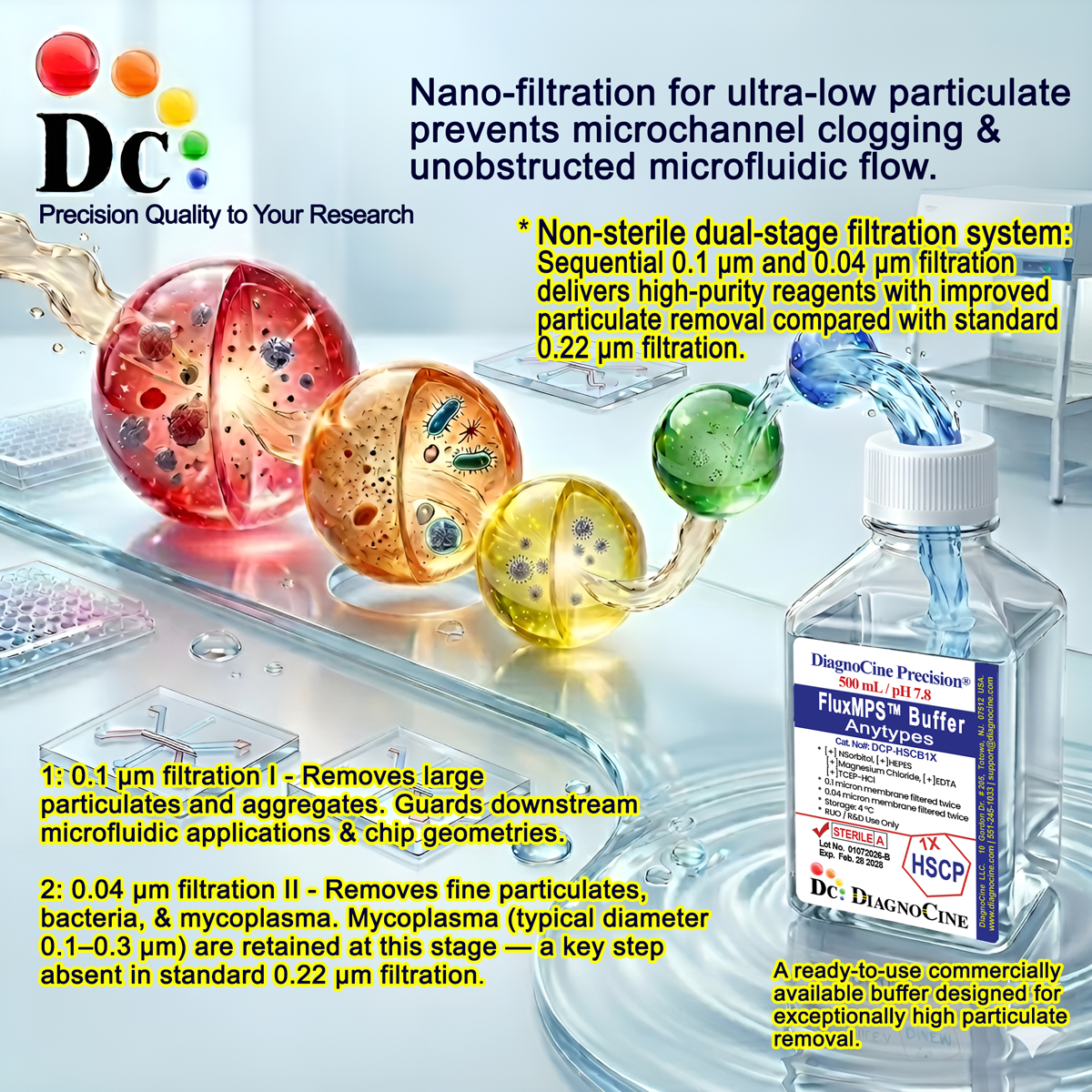
Dual-stage filtration system
This buffer is filtered sequentially through a 0.1 µm membrane and a 0.04 µm membrane to reduce particulate and bioburden, and is supplied non-sterile for general research wash and blocking applications.
-
1
0.1 µm Pre-filtration I
Removes large particulates and aggregates from the formulated buffer, extending downstream filter life.
-
2
0.04 µm Pre-filtration II
Retains fine particulates and reduces bioburden, serving as the final polish for this non-sterile buffer.
Performance vs. conventional buffer
Sequential 0.1 µm and 0.04 µm filtration removes finer particulates than a single 0.22 µm pass, supporting cleaner wash and blocking steps in ELISA and Western blot workflows.
© Diagnocine® — DCP-PBST20X
Where PBS with Tween 20 fits your workflow
A defined, non-ionic-detergent wash and blocking buffer built for immunoassay and molecular biology workflows, from bench-top ELISA plates to microfluidic and organ-on-a-chip (OoC) platforms.
Automated Bioreactors & Robotics
For automated liquid-handling robotics and closed-loop bioreactor perfusion, an optional 0.01 µm (10 nm) ultra-filtered variant of this buffer is available to further protect fine-bore valves and sensors.
- Total Particulate Exclusion — minimizes subvisible particulate entering automated fluid paths
- Valve & Sensor Protection — reduces fouling risk in microvalves and inline sensors
- Extended Perfusion Stability — supports longer unattended run times in closed-loop systems
Inquiry Required: the 0.01 µm ultra-filtered grade is produced to order — contact support@diagnocine.com to request this configuration.
Micro Physiological System (MPS) & Chip
A defined-chemistry wash buffer for microfluidic devices and tissue chip platforms.
Wash, Dilution & Reconstitution
Non-ionic detergent chemistry supports gentle rinsing, dilution, and reconstitution steps.
iPSC-Derived Model Handling
Defined pH and ionic chemistry for gentle wash steps around sensitive iPSC-derived cultures.
Endothelial & Primary Cell Perfusion
Low-particulate buffer chemistry supports wash steps around endothelial and primary cell cultures.
ELISA, Blotting & Blocking
Tween 20 disrupts non-specific protein-protein interactions during washing, reducing background and improving signal detection.
Microscopy & Optical Sensing
Low-particulate, low-background buffer chemistry suited to optical and biosensor readouts.
Full specification sheet
Every value below is drawn directly from this product's own quality control record.
| Parameter | Specification |
|---|---|
| Formulation / Composition | PBS + 1% Tween 20 (1X): NaCl 137 mM, KCl 2.7 mM, Na2HPO4 10 mM, KH2PO4 1.8 mM, Tween 20 1% |
| Appearance | Clear, colorless liquid |
| pH USP <791> | 7.4 |
| Parameter | Specification |
|---|---|
| Sterility | Non-sterile; filtered 0.1 µm once + 0.04 µm once |
| DNase Activity | None detected after 18 hr incubation with plasmid DNA at room temperature |
| RNase Activity | None detected after 18 hr incubation with ribosomal RNA at room temperature |
| Water Quality | Ultrapure Type 1 water (18.2 MΩ·cm) |
| Manufacturing Standard ISO 13485 | ISO 13485-certified, CE-approved facility |
| Parameter | Specification |
|---|---|
| Storage Temperature | 4°C |
| Shelf Life | 2 years |
| Parameter | Specification |
|---|---|
| Manufacturing QMS | ISO 13485-certified facility |
| Regulatory Alignment | CE-approved facility |
| Production Method | Final packaging, QA, and testing at the DiagnoCine R&D and Quality Testing Center; customization and assembly at DiagnoCine Precision, Totowa, New Jersey, USA |
| Intended Use | Research Use Only (RUO) |
Full composition
All salt and detergent components below are reported at the concentrations used to formulate this buffer.
| Component | CAS Number | Concentration |
|---|---|---|
| NaCl | 7647-14-5 | 137 mM |
| KCl | 7447-40-7 | 2.7 mM |
| Na2HPO4 | 7558-79-4 | 10 mM |
| KH2PO4 | 7778-77-0 | 1.8 mM |
| Tween 20 | 9005-64-5 | 1% |
Manufacturing & compliance
Produced under a documented quality management system with dedicated final release testing.
ISO 13485:2016 QMS
Manufactured under ISO 13485-certified and CE-approved facilities.
Ultrapure Type 1 Water
Formulated using Ultrapure Type 1 water (18.2 MΩ·cm).
ISO Class 5 Fill & Finish
DiagnoCine maintains ISO Class 5 (Class 100) cleanroom capability for aseptic fill operations across its buffer portfolio.
Micro-Batch Precision
Final packaging, quality assurance, and testing are completed at the DiagnoCine R&D and Quality Testing Center, with custom assembly performed at DiagnoCine Precision in Totowa, New Jersey, USA.
Endotoxin Testing (USP <85> BET)
Bacterial Endotoxin Testing (BET) methodology per USP <85> is part of DiagnoCine's quality program for applicable buffer products.
Particulate Testing (USP <788> Method 2)
USP <788> Method 2 light-obscuration methodology is part of DiagnoCine's quality toolkit for applicable buffer products.
Osmolality (USP <785>)
Osmolality determination per USP <785> is available for DiagnoCine buffer products requiring a reported value.
Documentation / CoA
A Certificate of Analysis documenting DNase activity, RNase activity, appearance, and pH is available for this lot.
How DCP-PBST20X compares
A side-by-side look at defined buffer chemistry and filtration architecture against conventional alternatives.
| Parameter | DCP-PBST20X (FluxMPS™) | Conventional Buffer (0.22 µm filtered) | Standard Alternative (0.22 µm filtered) |
|---|---|---|---|
| Defined pH & buffer chemistry | 1X PBS, pH 7.4, 1% Tween 20 | Variable | Variable |
| Final filtration pore size | 0.04 µm | 0.22 µm | 0.22 µm |
| Number of filtration stages | 2 | 1 | 1 |
| Water quality | check_circle | cancel | cancel |
| Manufacturing QMS | check_circle | cancel | cancel |
| Microfluidic / assay channel compatibility | check_circle | cancel | cancel |
| Custom formulation available | check_circle | cancel | cancel |
Frequently asked questions
Common questions about this PBS with Tween 20 wash buffer.
Supporting literature
Curated peer-reviewed literature relevant to PBS-Tween wash buffers, immunoassay chemistry, and microfluidic applications.
- Vogt RF Jr, et al. Effect of Tween 20 on the reduction of nonspecific antibody binding in ELISA. J Immunol Methods. 1987. doi:10.1016/0022-1759(87)90465-9
- Kenna JG, et al. Methods for reducing non-specific antibody binding in enzyme immunoassays. J Immunol Methods. 1985. doi:10.1016/0022-1759(85)90065-X
- Mahmood T, Yang PC. Western blot: technique, theory, and trouble shooting. N Am J Med Sci. 2012. doi:10.4103/1947-2714.100998
- Bhatia SN, Ingber DE. Microfluidic organs-on-chips. Nat Biotechnol. 2014. doi:10.1038/nbt.2989
- Huh D, et al. Reconstituting organ-level lung functions on a chip. Science. 2010. doi:10.1126/science.1188302
- Kaur M, et al. Buffer chemistry considerations in ELISA optimization. J Immunoassay Immunochem. 2016. doi:10.1080/15321819.2016.1189435
- Zeisberg M, Neilson EG. Buffer systems in biomedical research. Cold Spring Harb Protoc. 2006. doi:10.1101/pdb.top10
- Low D, et al. Mycoplasma contamination control in cell culture reagents. Biologicals. 2007. doi:10.1016/j.biologicals.2007.02.001
- Sosnowski RG, et al. Endotoxin control in laboratory reagents. Methods Mol Biol. 2013. doi:10.1007/978-1-62703-339-8_9