

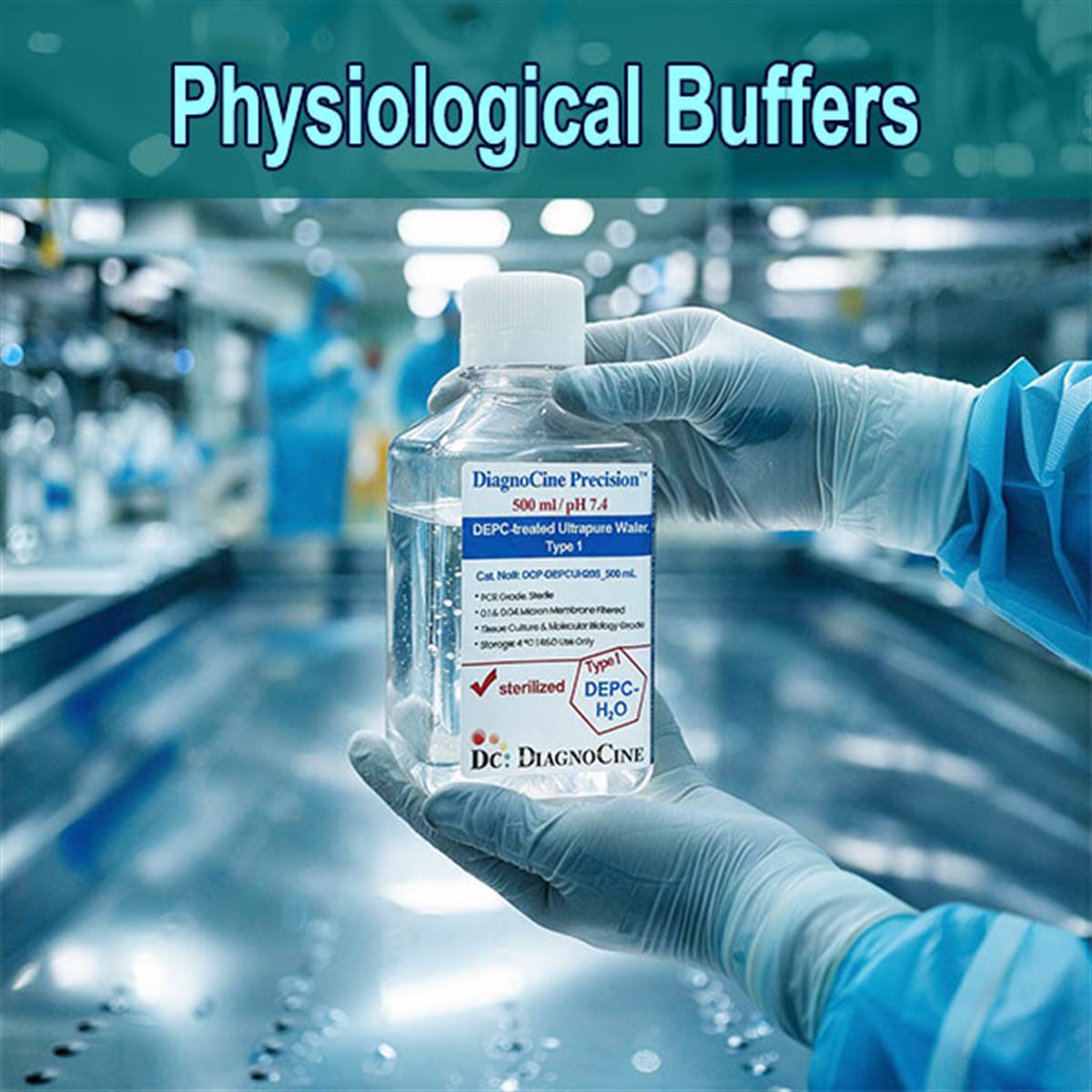
Physiological Buffers - Category Selection Guide
Two groups, one page. Find your formulation in the catalog below and go straight to the product page — the design rationale, history, applications, and selection guidance follow.
| Product | Buffer Base | Primary Application | Product Page |
|---|---|---|---|
| 1 Krebs-Ringer Buffer — metabolic, microfluidic & open-air workflows 2 products | |||
| UltraClean Krebs-Ringer Bicarbonate Buffer with Calcium chloride, 10mM HEPES, 0.2% Bovine Serum Albumin and Sodium bicarbonate, without Glucose, 1X (Liquid), 0.04um sterile filtered | HEPES + NaHCO3 | Metabolic & microfluidic studies | Viewarrow_forward |
| UltraClean Krebs-Ringer Bicarbonate Buffer with Calcium Chloride, 10mM HEPES Buffer, and 0.2% Bovine Serum Albumin, without Glucose and Sodium Bicarbonate, 1X (Liquid) | HEPES | Open-air / custom-gas workflows | Viewarrow_forward |
| 2 Physiological Buffer — ex vivo neural tissue viability 1 product | |||
| Artificial Cerebrospinal Fluid (ACSF) | CSF-matched | Neurobiology standard | Viewarrow_forward |
Not sure which group? Compare the two subcategories · See applications by group · Read the FAQ
What a physiological buffer has to do that PBS does not
Standard buffers like PBS or Tris are fine for basic biochemistry, but modeling living systems in vitro demands more. Physiological buffers are multi-component formulations engineered to mimic the electrolyte, nutrient, and buffering profiles of real tissue — keeping primary cells, tissue slices, and microfluidic organ models alive and functioning outside the body.
- Group 1 — Krebs-Ringer Buffer (2): two UltraClean Krebs-Ringer Bicarbonate Buffers — one with sodium bicarbonate, one without.
- Group 2 — Physiological Buffer (1): Artificial Cerebrospinal Fluid (ACSF).
- Complex electrolyte balance — precise mixtures of monovalent (Na+, K+) and divalent (Ca2+, Mg2+) cations needed for membrane potentials, signaling, and contraction.
- Dual buffering — many formulations combine an organic buffer (HEPES) with a gas-regulated physiological buffer (sodium bicarbonate) to hold pH ~7.4 across different setups.
- Metabolic & structural support — glucose as an energy source; proteins like BSA to prevent surface adhesion and stabilize fragile membrane proteins.
- Microfluidic readiness — 0.04 µm filtration prevents microchannel clogging in organ-on-a-chip platforms.
- Products in this category3
- Subcategories2
- Krebs-Ringer Buffer configurations2
- Physiological Buffer (ACSF) configurations1
- HEPES concentration (Krebs-Ringer)10 mM
- Bovine serum albumin (Krebs-Ringer)0.2%
- Glucose (Krebs-Ringer)Glucose-free, both
- Sodium bicarbonate (Krebs-Ringer)1 of 2
- Sterile filtration (bicarbonate Krebs-Ringer)0.04 µm
- Target physiological pH~7.4
Recreating a dynamic, nutrient-rich fluid on the bench
In vivo, cells are bathed in dynamic, nutrient-rich fluid that manages osmotic pressure, supplies energy, and clears waste. Physiological buffers recreate that in the lab — and each component below answers a specific way that a simple saline fails.
Complex electrolyte balance
Precise mixtures of monovalent (Na+, K+) and divalent (Ca2+, Mg2+) cations, needed for membrane potentials, signaling, and contraction.
Dual buffering
Many formulations combine an organic buffer (HEPES) with a gas-regulated physiological buffer (sodium bicarbonate) to hold pH ~7.4 across different experimental setups.
Metabolic support
Glucose serves as the energy source. Removing it deliberately — a glucose-free formulation — is what makes a controlled baseline for measuring cellular respiration and metabolism possible.
Structural support (BSA)
Proteins like BSA prevent surface adhesion and stabilize fragile membrane proteins — the reason 0.2% BSA appears in both Krebs-Ringer configurations.
Microchannel-safe filtration
Organ-on-a-chip microfluidics demands ultra-filtered, high-purity versions of these classic solutions to avoid nanoscale clogging; 0.04 µm filtration prevents microchannel clogging.
Atmosphere compatibility
A bicarbonate-free, glucose-free version retains HEPES buffering and protein stabilization while giving stable pH in normal atmosphere — for open-air and custom-gas workflows.
The specification that decides the workflow
Two variables separate these products more than anything else: whether sodium bicarbonate is present, and whether glucose is present. Bicarbonate sets what atmosphere the experiment has to run under; glucose sets whether the medium is a support solution or a controlled metabolic baseline. Read both before matching a formulation to a protocol.
From a frog heart in tap water to organ-on-a-chip
Every number on a modern physiological buffer datasheet traces back to one of four developments. Each one explains a component you still see in the formulation today.
-
1
1882–1883 Ringer and the calcium requirement
British physiologist Sydney Ringer found that an isolated frog heart keeps beating only when the bathing solution contains the right ratios of sodium, potassium, and calcium — famously discovering the calcium requirement after an assistant used mineral-rich tap water. Significance: founded the field of physiological saline design; “Ringer's solution” is the ancestor of modern cell-culture and tissue media.
-
2
1932 Krebs & Henseleit formalize bicarbonate buffering
Hans Krebs & Kurt Henseleit, in their urea-cycle work, formalized a bicarbonate-buffered, electrolyte-balanced solution (Krebs–Henseleit / Krebs-Ringer bicarbonate buffer) for maintaining tissue slices. Significance: established the bicarbonate-buffered, substrate-supplemented media used for ex vivo metabolic studies.
-
3
1957 The first brain-slice recordings
Choh-Luh Li & Henry McIlwain made the first electrical recordings from mammalian brain slices, showing (among other things) the need for glucose in the bathing medium. Significance: launched brain-slice electrophysiology and the artificial cerebrospinal fluid (ACSF) formulations that support it.
-
4
Late 20th century–present Refinement and miniaturization
Neuroscience drove refinement of ACSF (including sucrose / NMDG variants to reduce excitotoxicity during slicing), and organ-on-a-chip microfluidics now demands ultra-filtered, high-purity versions of these classic solutions to avoid nanoscale clogging. Significance: extended physiological media from tissue baths to microfluidic and translational platforms.
How this category is organized
Two groups. Use this table to find the right group before drilling into a product.
| Group | What it is | Buffer bases | Products |
|---|---|---|---|
| 1 · Krebs-Ringer Buffer | UltraClean Krebs-Ringer Bicarbonate Buffers with calcium chloride, 10 mM HEPES and 0.2% BSA, glucose-free — one with sodium bicarbonate, one without | HEPES ± NaHCO3 | 2 |
| 2 · Physiological Buffer | Artificial Cerebrospinal Fluid (ACSF), matched to the CNS electrolyte profile | CSF-matched | 1 |
Which workflow, which group
Select a group to see the workflows it is intended to support.
- Metabolic flux studies — controlled-substrate media (e.g., glucose-free) for measuring cellular respiration and metabolism
- Microfluidics / organ-on-a-chip — circulating physiological media through microscopic cellular channels; 0.04 µm filtration prevents microchannel clogging and BSA limits surface adhesion
- Isolated organ & tissue-bath experiments — sustaining muscle contraction or vascular tone in isolated cardiovascular tissue
- Open-air / custom-gas workflows — the bicarbonate-free version gives stable pH in normal atmosphere without a 5% CO2 incubator
- Neurophysiology / brain-slice electrophysiology — incubating and recording from living brain or spinal-cord slices; ACSF matches the CNS electrolyte profile and maintains acute brain-slice viability for electrophysiology and patch-clamp recording
- Sucrose / NMDG ACSF variants were developed to reduce excitotoxicity during slicing
How the three formulations compare
Core attributes and the workflow each product is intended for.
| Product | Core Attributes | Best Use |
|---|---|---|
| UltraClean Krebs-Ringer Bicarbonate Buffer + CaCl2, 10 mM HEPES, 0.2% BSA, + sodium bicarbonate, glucose-free, 0.04 µm filtered | Glucose-free, HEPES/bicarbonate double-buffered | Metabolic & microfluidic studies — glucose-free baseline for controlled metabolism; BSA limits surface adhesion; 0.04 µm filtration prevents microchannel clogging |
| UltraClean Krebs-Ringer Bicarbonate Buffer + CaCl2, 10 mM HEPES, 0.2% BSA, glucose-free & bicarbonate-free | Bicarbonate-free, glucose-free | Open-air / custom-gas workflows — stable pH in normal atmosphere without a 5% CO2 incubator, while retaining HEPES buffering and protein stabilization |
| Artificial Cerebrospinal Fluid (ACSF) | Matches CNS electrolyte profile | Neurobiology standard — maintains acute brain-slice viability for electrophysiology and patch-clamp recording |
Frequently asked questions
The questions that come up most often when a purchasing spec meets a bench protocol.
The primary literature behind physiological buffers
The three papers that define the lineage of every product on this page.
- Ringer, S. (1883). A further contribution regarding the influence of the different constituents of the blood on the contraction of the heart. The Journal of Physiology, 4(1), 29–42. — The landmark paper establishing that calcium (and potassium) are essential to sustain contraction; the origin of physiological saline design. doi:10.1113/jphysiol.1883.sp000120
- Krebs, H. A., & Henseleit, K. (1932). Untersuchungen über die Harnstoffbildung im Tierkörper. Hoppe-Seyler's Zeitschrift für physiologische Chemie, 210(1–2), 33–66. — The work that established the Krebs–Henseleit (Krebs-Ringer bicarbonate) buffer for sustaining tissue ex vivo.
- Li, C.-L., & McIlwain, H. (1957). Maintenance of resting membrane potentials in slices of mammalian cerebral cortex and other tissues in vitro. The Journal of Physiology, 139(2), 178–190. — The founding study of brain-slice electrophysiology and the ACSF-type media that support it. doi:10.1113/jphysiol.1957.sp005885