

- Home
- UltraClean Krebs-Ringer Bicarbonate Buffer with Calcium chloride, 10mM HEPES, 0.2% Bovine Serum Albumin and Sodium bicarbonate, without Glucose, 1X (Liquid), 0.04um sterile filtered

UltraClean Krebs-Ringer Bicarbonate Buffer with Calcium chloride, 10mM HEPES, 0.2% Bovine Serum Albumin and Sodium bicarbonate, without Glucose, 1X (Liquid), 0.04um sterile filtered
FluxMPS™ UltraClean Krebs-Ringer Bicarbonate Buffer with Calcium Chloride, 10mM HEPES, 0.2% Bovine Serum Albumin and Sodium Bicarbonate, without Glucose, 1X (Liquid), 0.04 µm Sterile Filtered
An MPS-grade, glucose-free Krebs-Ringer Bicarbonate Buffer formulated at pH 7.4 with 10 mM HEPES, calcium chloride, sodium bicarbonate, and 0.2% bovine serum albumin. Quadruple-stage filtration (0.1 µm membrane twice and 0.04 µm membrane twice) delivers microchannel-safe purity for Glucose-Stimulated Insulin Secretion (GSIS) assays, islet perifusion, primary adipocyte lipolysis studies, and microfluidic perfusion platforms.
- Quadruple-stage filtration: 0.1 µm membrane twice and 0.04 µm membrane twice for microchannel-safe purity
- Endotoxin NMT 1 EU/mL, verified per USP specification
- Defined pH 7.4 with 10 mM HEPES buffering (pKa 7.3 at 37°C)
- Osmolality 250.00 - 290.00 mOsm/Kg H2O
- Formulated without glucose — purpose-built for GSIS and non-glucose functional assays
- Manufactured with ultrapure Type 1 water (18.2 MΩ·cm)
- Compatible with organ-on-a-chip, tissue-on-a-chip, and microfluidic perfusion systems
- Custom pH, molarity, and additive formulations available on request
- pH7.4
- Concentration1X
- HEPES Buffer10 mM
- Osmolality250.00 - 290.00 mOsm/Kg H2O
- EndotoxinNMT 1 EU/mL
- Sterility0.1 µm x2, 0.04 µm x2
- FiltrationQuadruple-stage
- Storage4°C, protect from light
- Shelf Life24 months
- FormatLiquid, Glucose-free
Engineered where standard KRB buffers fail
Conventional 0.22 µm-filtered Krebs-Ringer Bicarbonate Buffer carries subvisible particulates and variable ionic content that accumulate in microfluidic channels, drift in pH and osmolality, and elevate assay background in insulin secretion and imaging workflows. FluxMPS™ buffer is engineered to remove these failure modes at the source.
Microchannel-safe purity
Sequential 0.1 µm and 0.04 µm membrane filtration reduces particulate load below levels that clog or foul microfluidic and OoC channels.
Precise, stable pH
Formulated at pH 7.4 with 10 mM HEPES, a zwitterionic buffer with a pKa of 7.3 at 37°C that resists the initial pH rise seen at culture initiation.
Ultrapure-grade water
Manufactured with Type 1 water (18.2 MΩ·cm) meeting USP <85> expectations for reagent-grade purity.
Low background for imaging & assays
Glucose-free formulation and clean particulate profile support GSIS ELISA, confocal imaging, and biosensor-based readouts without confounding signal.
Defined, traceable composition
Every inorganic salt and additive is lot-released and documented, from calcium chloride dihydrate through sodium bicarbonate and HEPES.
Customization on demand
Alternate concentrations, pH, or added chemicals/proteins/supplements can be produced — inquire at support@diagnocine.com.
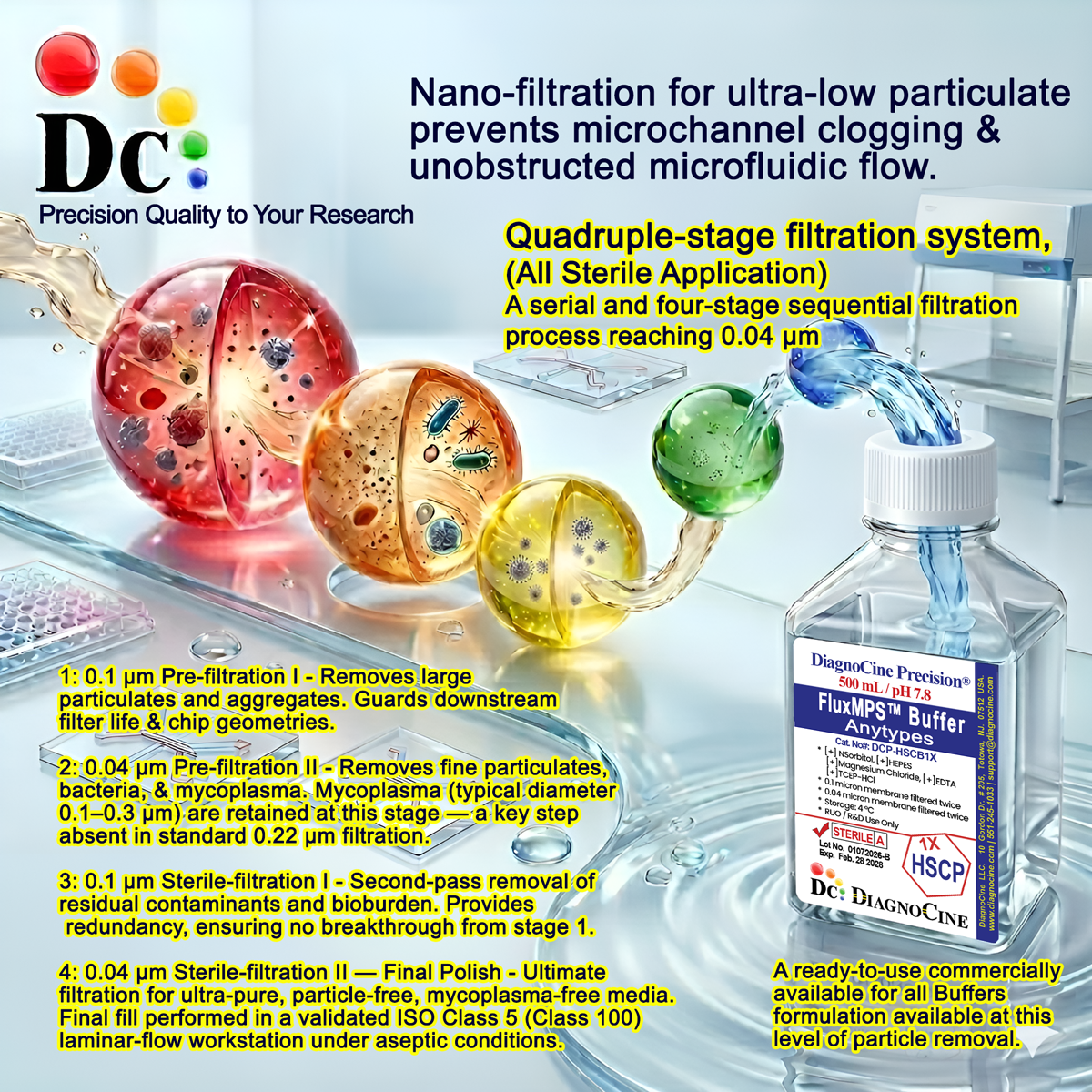
Quadruple-stage filtration system
This buffer is filtered through a 0.1 µm membrane twice and a 0.04 µm membrane twice, a four-pass architecture designed to remove particulates and bioburden well beyond what a single-pass conventional filter achieves.
- 1
0.1 µmPre-filtration I
Removes large particulates and aggregates, extending the working life of the downstream filters.
- 2
0.04 µmPre-filtration II
Retains fine particulates and bioburden ahead of final sterile filtration.
- 3
0.1 µmSterile-filtration I
A second 0.1 µm pass provides redundant sterile filtration.
- 4
0.04 µmSterile-filtration II — Final Polish
A second 0.04 µm pass performed in an ISO Class 5 (Class 100) aseptic fill environment gives the final polish. This pore size is well below the approximately 0.2 micron diameter of the smallest known mycoplasma organisms, supporting mycoplasma contamination control.
Performance vs. conventional buffer
Sequential 0.1 µm and 0.04 µm filtration removes finer subvisible particulates than a single-pass 0.22 µm filtration typical of standard laboratory KRB buffer, supporting cleaner microfluidic channels and reduced assay background.
© Diagnocine® — DCP-KRBBWOG1X
Where this buffer performs
Krebs-Ringer Bicarbonate Buffer without glucose supports tissue cell culture washing, primary adipocyte preparation, lipolysis assays, islet pre-perifusion for viability and functionality studies, pituitary bioassays, and Glucose-Stimulated Insulin Secretion (GSIS) assays that require a non-glucose baseline.
Automated Bioreactors & Robotics
For automated perfusion bioreactors and robotic liquid-handling platforms, an optional 0.01 µm (10 nm) ultra-filtered variant of this buffer is available on inquiry, engineered for total particulate exclusion in sensitive fluidic hardware.
- Total Particulate Exclusion for closed-loop perfusion systems
- Valve & Sensor Protection against sub-micron fouling
- Extended Perfusion Stability across long-duration runs
Inquiry Required: contact support@diagnocine.com to request the 0.01 µm ultra-filtered grade of this buffer.
Micro Physiological System (MPS) & Chip
Supports perfusion of pancreas-on-chip and islet-on-chip GSIS models where a defined, glucose-free buffer baseline is required.
Wash, Dilution & Reconstitution
Used to wash and equilibrate primary adipocytes, pancreatic islets, and tissue samples ahead of functional assays.
iPSC-Derived Model Handling
Provides a defined, glucose-free perifusion buffer for iPSC-derived beta-cell and islet organoid functional studies.
Endothelial & Primary Cell Perfusion
Supports primary adipocyte lipolysis assays and primary cell perfusion protocols requiring a stable ionic and pH background.
ELISA, Blotting & Blocking
Serves as the basal, glucose-free medium for GSIS ELISA workflows measuring stimulated insulin secretion.
Microscopy & Optical Sensing
Clean particulate profile and defined composition support low-background confocal imaging and biosensor-based functional readouts.
Detailed specifications
All values below are declared for this product as supplied by DiagnoCine Precision.
| Parameter | Specification |
|---|---|
| Formulation | Krebs-Ringer Bicarbonate Buffer with calcium chloride, 10mM HEPES, 0.2% bovine serum albumin, sodium bicarbonate, without glucose |
| Appearance | Clear, colorless solution |
| pH (USP <791>) | 7.4 |
| Osmolality (USP <785>) | 250.00 - 290.00 mOsm/Kg H2O |
| Concentration | 1X |
| HEPES Buffering Range (pKa) | 7.3 at 37°C |
| Parameter | Specification |
|---|---|
| Endotoxin (USP <85> BET) USP | NMT 1 EU/mL |
| Sterility (USP <71>) USP | Filtered 0.1 micron membrane twice in a sterile environment; no bacterial or fungal growth after 14 days incubation |
| Filtration System | 0.1 µm membrane twice and 0.04 µm membrane twice (Quadruple-stage) |
| Water Quality | Ultrapure Type 1 water (18.2 MΩ·cm) |
| Manufacturing Standard ISO | ISO 13485-certified, CE-approved facilities |
| Fill Environment | ISO Class 5 (Class 100) |
| Parameter | Specification |
|---|---|
| Storage Temperature | 4°C, away from bright light |
| Shelf Life | 24 months |
| Handling Note | Use before the expiry date given on the product label |
| Parameter | Specification |
|---|---|
| Manufacturing QMS ISO | ISO 13485-certified |
| Regulatory Alignment | CE-approved facilities |
| Production Method | Final packaging, QA, and testing at the DiagnoCine R&D and Quality Testing Center; customization performed at DiagnoCine Precision, Totowa, New Jersey, USA |
| Intended Use | Research Use Only (RUO) |
Full composition (mg/L)
Component concentrations are expressed in mg/L as released per manufacturing lot.
| Component | CAS Number | Concentration (mg/L) |
|---|---|---|
| INORGANIC SALTS | ||
| Calcium chloride dihydrate | 10035-04-8 | 367.000 |
| Magnesium chloride hexahydrate | 7791-18-6 | 223.000 |
| Potassium chloride | 7447-40-7 | 372.000 |
| Sodium bicarbonate | 144-55-8 | 1260.000 |
| Sodium chloride | 7647-14-5 | 7012.000 |
| Component | CAS Number | Concentration (mg/L) |
|---|---|---|
| OTHERS | ||
| Bovine serum albumin | 9048-46-8 | 2000.000 |
| HEPES buffer | 7365-45-9 | 2380.000 |
Manufacturing & compliance
This buffer is manufactured under ISO 13485-certified and CE-approved facilities, with final packaging, quality assurance, and testing performed at the DiagnoCine R&D and Quality Testing Center.
ISO 13485:2016 QMS
Manufactured under an ISO 13485-certified, CE-approved quality management system.
Ultrapure Type 1 Water
Formulated with Type 1 water at 18.2 MΩ·cm resistivity.
ISO Class 5 Fill & Finish
Final sterile filtration and fill occur in an ISO Class 5 (Class 100) environment.
Micro-Batch Precision
Customization and assembly are completed at DiagnoCine Precision in Totowa, New Jersey, USA.
Endotoxin (USP <85> BET)
NMT 1 EU/mL.
Sterility (USP <71>)
No bacterial or fungal growth observed after 14 days of incubation.
Osmolality (USP <785>)
250.00 - 290.00 mOsm/Kg H2O.
Documentation / CoA
Certificate of Analysis available for this lot.
How DCP-KRBBWOG1X compares
A comparison against conventional Krebs-Ringer Bicarbonate Buffer preparations.
| Parameter | DCP-KRBBWOG1X (FluxMPS™) | Conventional KRB Buffer | Standard Alternative (0.22 µm filtered) |
|---|---|---|---|
| Glucose-free formulation | check_circle | cancel | cancel |
| Final filtration pore size | 0.04 µm | 0.22 µm | 0.22 µm |
| Number of filtration stages | 4 | 1 | 1 |
| Endotoxin specification | NMT 1 EU/mL | Not typically specified | Not typically specified |
| Water quality | Ultrapure Type 1 (18.2 MΩ·cm) | Standard purified water | Standard purified water |
| Manufacturing QMS | check_circle ISO 13485 | cancel | cancel |
| Microfluidic channel compatibility | check_circle | cancel | cancel |
| Custom formulation available | check_circle | cancel | cancel |
Frequently asked questions
Answers to common questions about DCP-KRBBWOG1X.
Supporting literature
Curated references relevant to Krebs-Ringer Bicarbonate Buffer use in cell physiology and microfluidic applications.
- Ringer S. A further contribution regarding the influence of the different constituents of the blood on the contraction of the heart. J Physiol. 1885. doi:10.1113/jphysiol.1885.sp000184
- Good NE, et al. Hydrogen ion buffers for biological research. Biochemistry. 1966. doi:10.1021/bi00866a011
- Rorsman P, Ashcroft FM. Pancreatic beta-cell electrical activity and insulin secretion: of mice and men. Physiol Rev. 2018. doi:10.1152/physrev.00008.2017
- Rodbell M. Metabolism of isolated fat cells. J Biol Chem. 1964. doi:10.1016/S0021-9258(18)91674-1
- Bowe DB, et al. Static incubation for the measurement of glucose-stimulated insulin secretion from mouse islets. J Vis Exp. 2014. doi:10.3791/50775
- Bhatia SN, Ingber DE. Microfluidic organs-on-chips. Nat Biotechnol. 2014. doi:10.1038/nbt.2989
- Zhang B, Radisic M. Organ-on-a-chip devices advance to market. Lab Chip. 2017. doi:10.1039/C6LC01554A
- Wagner J, et al. Determination of bacterial endotoxin in pharmaceutical products. Pharmeuropa Bio. 2005. doi:10.1016/j.pharmbio.2005.01.001
- Freshney RI. Culture of Animal Cells: A Manual of Basic Technique and Specialized Applications. Wiley. 2015. doi:10.1002/9781118873686