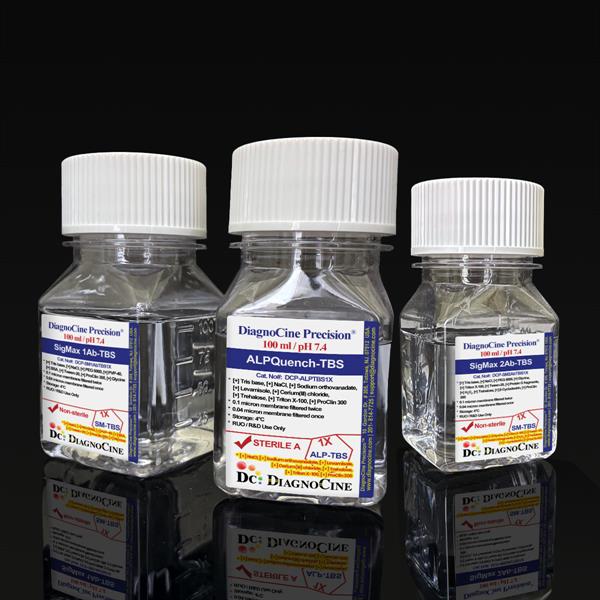
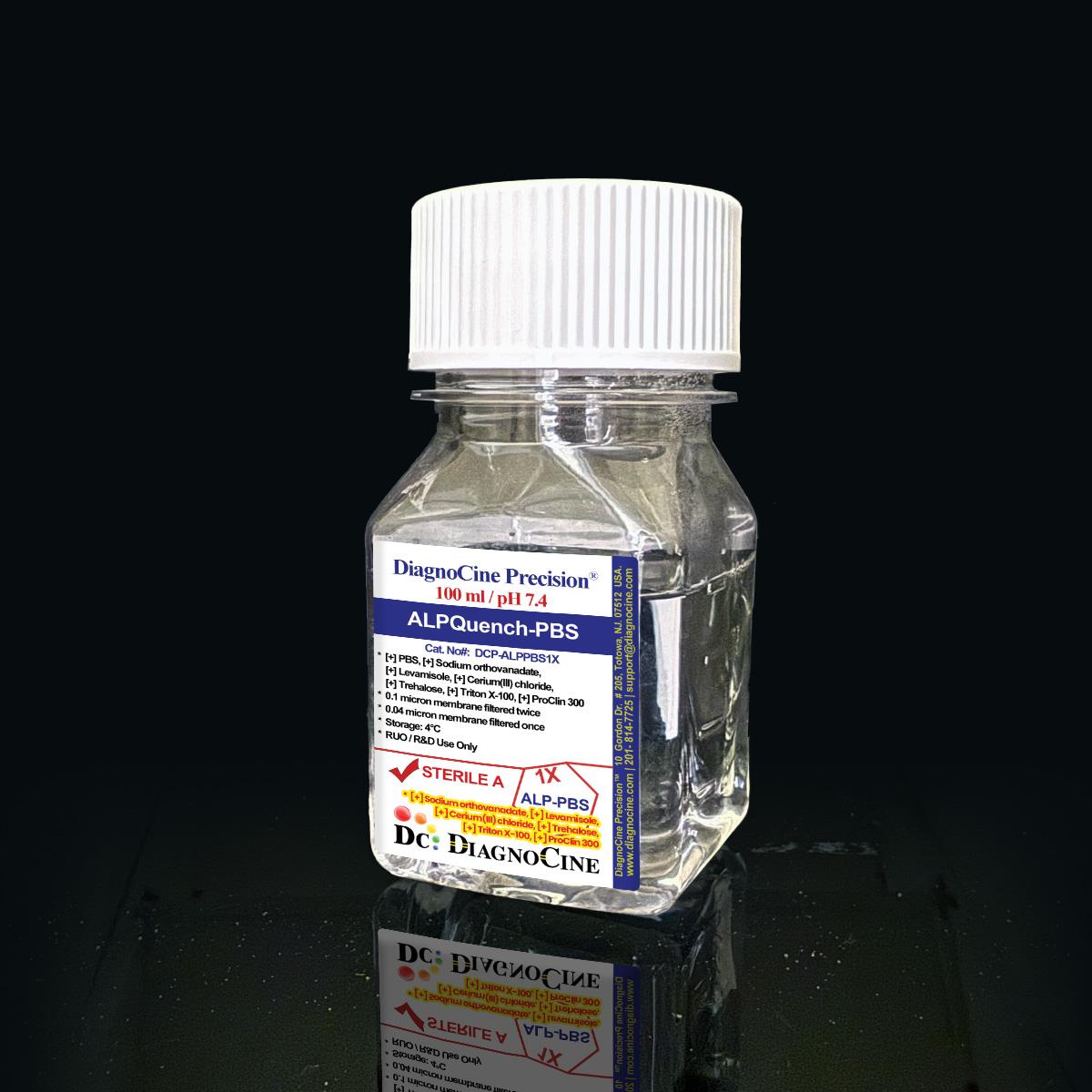
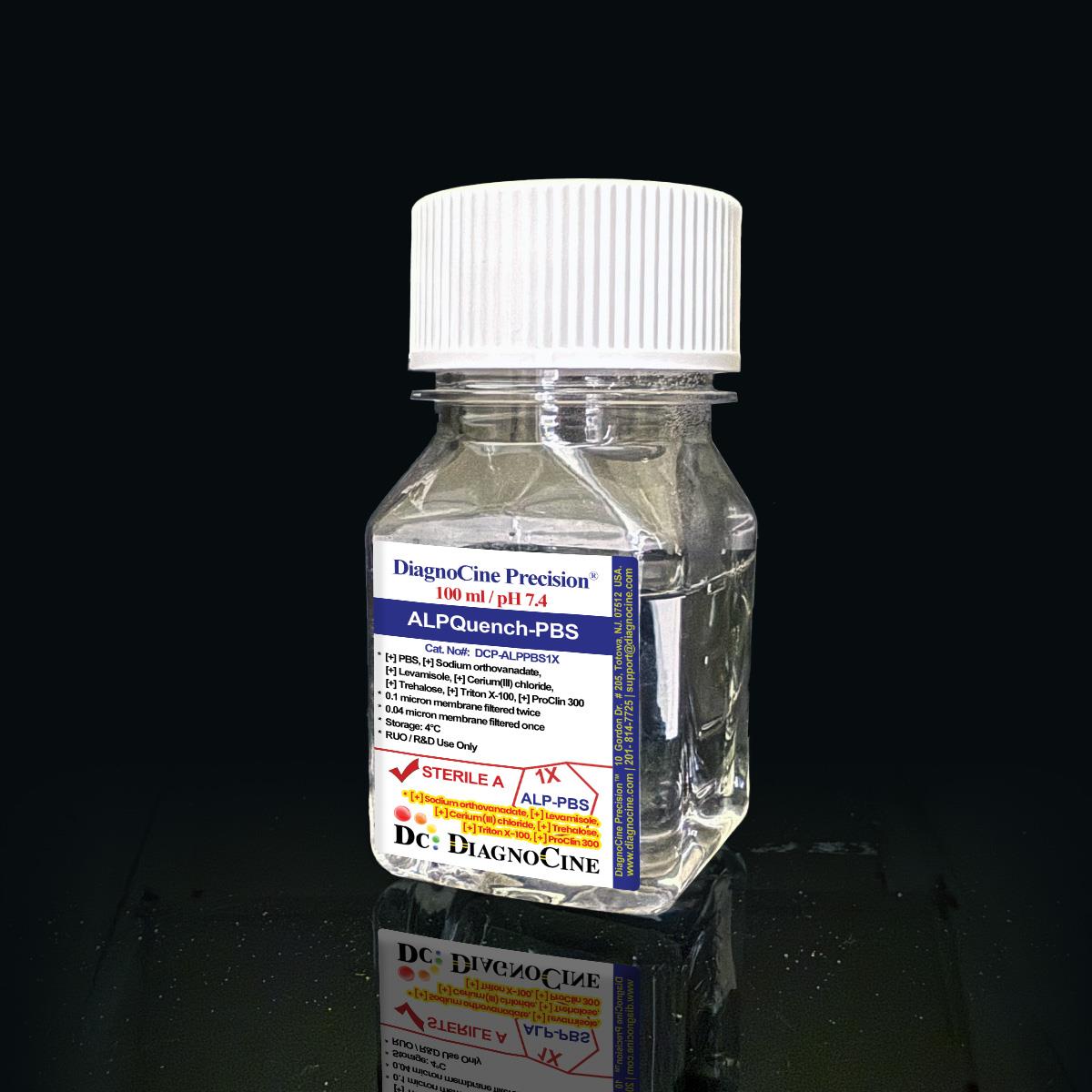
ALPQuench-PBS
FluxMPS™ ALPQuench-PBS
ALPQuench-PBS is an MPS-grade, PBS-based alkaline phosphatase (ALP) quenching buffer purpose-built for sequential and multiplex immunostaining protocols. Ultrapure and dual-stage filtered for microchannel-safe use, it delivers precise, stable pH 7.4 buffering while suppressing residual ALP activity between labeling rounds — without compromising sample integrity or downstream antibody binding.
- Dual-stage filtered: 0.1 µm membrane once and 0.04 µm membrane once
- Ultrapure PBS-based formulation, pH 7.4
- Complete ALP inactivation between multiplex staining rounds without disrupting tissue morphology
- Formulated with levamisole, sodium orthovanadate, and cerium(III) chloride ALP-suppression chemistry
- Compatible with FFPE and frozen tissue sections, ELISA, and automated IHC/IF platforms
- Supplied non-sterile, 100 mL, for Research Use Only
- pH, molarity, and additive customization available on request
- pH7.4
- SterilityNon-Sterile
- Filtration0.1 µm x1 + 0.04 µm x1
- AppearanceClear, Colorless Liquid
- Storage4°C
- Shelf Life1 year
- Size100 mL
- FormatLiquid
- Buffer SystemPBS-based
- Intended UseRUO
Engineered where standard quenching buffers fail
Conventional 0.22 µm-filtered wash buffers leave subvisible particulates behind, allow ALP carryover between staining rounds, and drive background in both chromogenic and fluorescent readouts. ALPQuench-PBS is engineered against every one of these failure modes.
Microchannel-safe purity
Dual-stage 0.1 µm and 0.04 µm membrane filtration reduces particulate carryover relative to a single 0.22 µm pass, supporting clean multiplex signal.
Precise, stable pH
Buffered to pH 7.4 in a PBS backbone, supporting broad compatibility with standard immunoreagents and downstream assay components.
Ultrapure-grade water
Formulated with Ultrapure Type 1 water (18.2 MΩ·cm) consistent with USP <85> expectations for sensitive immunoassay reagents.
Low background for imaging & assays
Suppresses residual alkaline phosphatase activity between staining rounds, eliminating cross-reactivity and non-specific signal in chromogenic and fluorescent detection.
Defined, traceable composition
Formulated with a proprietary blend of enzyme inhibitors (levamisole, sodium orthovanadate, cerium(III) chloride) and stabilizers at lot-controlled concentrations.
Customization on demand
Alternate concentrations, pH, and additive chemistries (proteins, supplements, compounds) available on request.
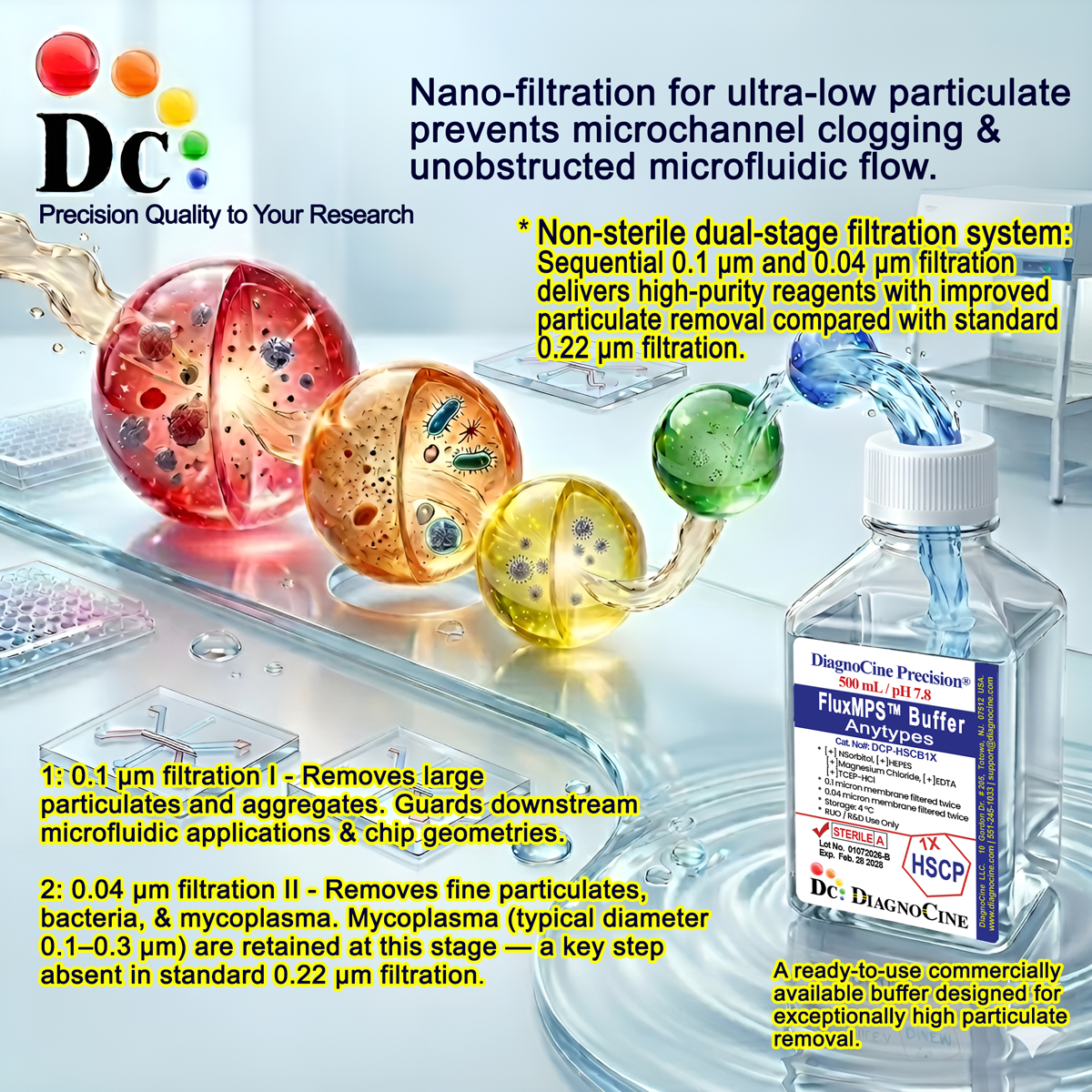
Dual-stage filtration system
ALPQuench-PBS is manufactured through a sequential 0.1 µm and 0.04 µm membrane filtration process, positioning purity ahead of standard single-pass 0.22 µm-filtered buffers used in routine immunoassay workflows.
-
1
0.1 µm Pre-filtration I
Removes large particulates and aggregates, extending the working life of the downstream filter.
-
2
0.04 µm Pre-filtration II
Retains fine particulates for a cleaner, lower-background formulation entering final fill.
Performance vs. conventional buffer
Sequential 0.1 µm and 0.04 µm filtration removes finer particulates than a single 0.22 µm pass, supporting cleaner backgrounds in multiplex immunohistochemistry, immunofluorescence, and ELISA readouts.
© Diagnocine® — DCP-ALPPBS1X
Where ALPQuench-PBS is used
ALPQuench-PBS suppresses alkaline phosphatase activity between sequential labeling steps across a range of immunoassay and multiplex staining workflows.
Automated Bioreactors & Robotics
For automated IHC/IF staining platforms and robotics-driven workflows, an optional 0.01 µm (10 nm) ultra-filtered variant of ALPQuench-PBS can be requested to further reduce particulate load on valves, sensors, and fluidic pathways.
- Total Particulate Exclusion for automated fluidic pathways
- Valve & Sensor Protection on automated staining platforms
- Extended Perfusion Stability in continuous or multi-round protocols
Inquiry Required: Contact support@diagnocine.com to request the 0.01 µm ultra-filtered grade of ALPQuench-PBS.
Micro Physiological System (MPS) & Chip Immunostaining
PBS-based, dual-stage filtered formulation supports multiplex ALP-based staining cycles on chip-based and microfluidic culture platforms.
Wash, Dilution & Reconstitution
Used between sequential labeling steps to wash, dilute, and rinse specimens while quenching residual ALP activity.
iPSC-Derived Model Immunolabeling
Suppresses endogenous alkaline phosphatase background during multi-round immunolabeling of iPSC-derived tissue models with high native ALP activity, such as liver-derived cells.
Endothelial & Primary Cell Multiplex Staining
Supports clear, distinct labeling of multiple antigens on endothelial and primary cell specimens across sequential ALP-conjugated antibody rounds.
ELISA, IHC & Multiplex Blocking
Core use case: quenching residual ALP activity between multiple ALP-conjugated antibodies or detection reagents in ELISA and multiplex IHC/IF protocols.
Microscopy & Optical Multiplex Detection
Reduces non-specific ALP-driven substrate reactions, lowering background in fluorescent and chromogenic microscopy-based detection workflows.
Specifications at a glance
Measured and declared parameters for ALPQuench-PBS (DCP-ALPPBS1X).
| Parameter | Specification |
|---|---|
| Formulation Type | Phosphate-buffered saline (PBS)-based alkaline phosphatase quenching buffer |
| Appearance | Clear, Colorless Liquid |
| pH (USP <791>) | 7.4 |
| Parameter | Specification |
|---|---|
| Sterility | Non-Sterile USP <71> N/A |
| Filtration System | 0.1 µm membrane once + 0.04 µm membrane once |
| Water Quality | Ultrapure Type 1 water (18.2 MΩ·cm) USP <85> |
| Manufacturing Standard | ISO 13485-certified, CE-approved facility ISO 13485:2016 |
| Parameter | Specification |
|---|---|
| Storage Temperature | 4°C |
| Shelf Life | 1 year |
| Parameter | Specification |
|---|---|
| Manufacturing Facility | ISO 13485-certified, CE-approved (Diagnocine Precision suppliers) |
| Traceability | Final packaging, QA, and testing performed at DiagnoCine R&D and Quality Testing Center |
| Manufacturing QMS | ISO 13485:2016 |
| Regulatory Alignment | CE-approved |
| Production Site | DiagnoCine Precision, Totowa, New Jersey, USA |
| Intended Use | For Research Use Only (RUO) |
Full composition
ALPQuench-PBS combines PBS buffer salts with a proprietary blend of alkaline phosphatase inhibitors and stabilizers, released per lot.
| Component | CAS Number | Concentration |
|---|---|---|
| Sodium Chloride (NaCl) | 7647-14-5 | 137 mM |
| Potassium Chloride (KCl) | 7447-40-7 | 2.7 mM |
| Sodium Phosphate Dibasic | 7558-79-4 | 10 mM |
| Potassium Phosphate Monobasic | 7778-77-0 | 1.8 mM |
| Sodium Orthovanadate | 13721-39-6 | 10 mM |
| Levamisole | 14769-73-4 | 1 mM |
| Cerium(III) chloride | 7790-86-5 | 5 mM |
| Trehalose | 99-20-7 | 1% |
| Triton X-100 | 9002-93-1 | 0.05% |
| ProClin 300 | 55965-84-9 | 0.05% |
Manufacturing & compliance
ALPQuench-PBS is manufactured, packaged, and quality tested under a controlled, ISO 13485-aligned process.
ISO 13485:2016 QMS
Manufactured under ISO 13485-certified and CE-approved facilities (suppliers of Diagnocine Precision).
Ultrapure Type 1 Water
Formulated with Ultrapure Type 1 water (18.2 MΩ·cm) consistent with USP <85> expectations.
Dual-Stage Filtration
Filtered 0.1 µm membrane once and 0.04 µm membrane once for a cleaner, low-background formulation.
Traceable Final Assembly
Final packaging, quality assurance, and testing performed at the DiagnoCine R&D and Quality Testing Center; customization and assembly performed at DiagnoCine Precision, Totowa, New Jersey, USA.
Sterility Status
Supplied Non-Sterile for research use.
Appearance QC
Verified Clear, Colorless Liquid at pH 7.4 prior to release.
Regulatory Alignment
CE-approved supplier facilities under ISO 13485:2016 quality management.
Documentation / CoA
Certificate of Analysis available upon request.
How DCP-ALPPBS1X compares
ALPQuench-PBS versus generic 0.22 µm-filtered wash buffers.
| Parameter | DCP-ALPPBS1X (FluxMPS™) | Conventional PBS (0.22 µm Filtered) | Standard Alternative (0.22 µm Filtered) |
|---|---|---|---|
| Dedicated ALP Quenching Chemistry | check_circle | cancel | cancel |
| Final Filtration Pore Size | 0.04 µm | 0.22 µm | 0.22 µm |
| Number of Filtration Stages | 2 | 1 | 1 |
| PBS-Based Formulation | check_circle | check_circle | check_circle |
| ISO 13485 Manufacturing | check_circle | cancel | cancel |
| Custom Formulation Available | check_circle | cancel | cancel |
Frequently asked questions
Common questions about ALPQuench-PBS (DCP-ALPPBS1X).
Supporting literature
Curated literature relevant to alkaline phosphatase quenching, multiplex immunostaining, and buffer purity considerations.
- Tan WCC, et al. Overview of multiplex immunohistochemistry/immunofluorescence techniques in the era of single-cell spatial biology. Immunology. 2020. doi:10.1111/imm.13143
- Bolognesi MM, et al. Multiplex staining by sequential immunostaining and antibody removal on routine tissue sections. J Histochem Cytochem. 2017. doi:10.1369/0022155417719419
- Van der Loos CM. Multiple immunoenzyme staining: methods and visualizations for the observation with spectral imaging. J Histochem Cytochem. 2008. doi:10.1369/jhc.2008.951106
- Ramos-Vara JA. Principles and methods of immunohistochemistry. Methods Mol Biol. 2017. doi:10.1007/978-1-4939-6817-6_10
- Millan JL. Alkaline Phosphatases: Structure, substrate specificity and functional relatedness to other members of a large superfamily of enzymes. Purinergic Signal. 2006. doi:10.1007/s11302-005-5435-6
- Low SH, et al. Organ-on-a-chip: Engineering for translational research. Nat Rev Drug Discov. 2021. doi:10.1038/s41573-020-0079-3
- Ingber DE. Human organs-on-chips for disease modelling, drug development and personalized medicine. Nat Rev Genet. 2022. doi:10.1038/s41576-022-00466-9
- Buchwalow I, Samoilova V, Boecker W, Tiemann M. Non-specific binding of antibodies in immunohistochemistry: fallacies and facts. Sci Rep. 2011. doi:10.1038/srep00028