

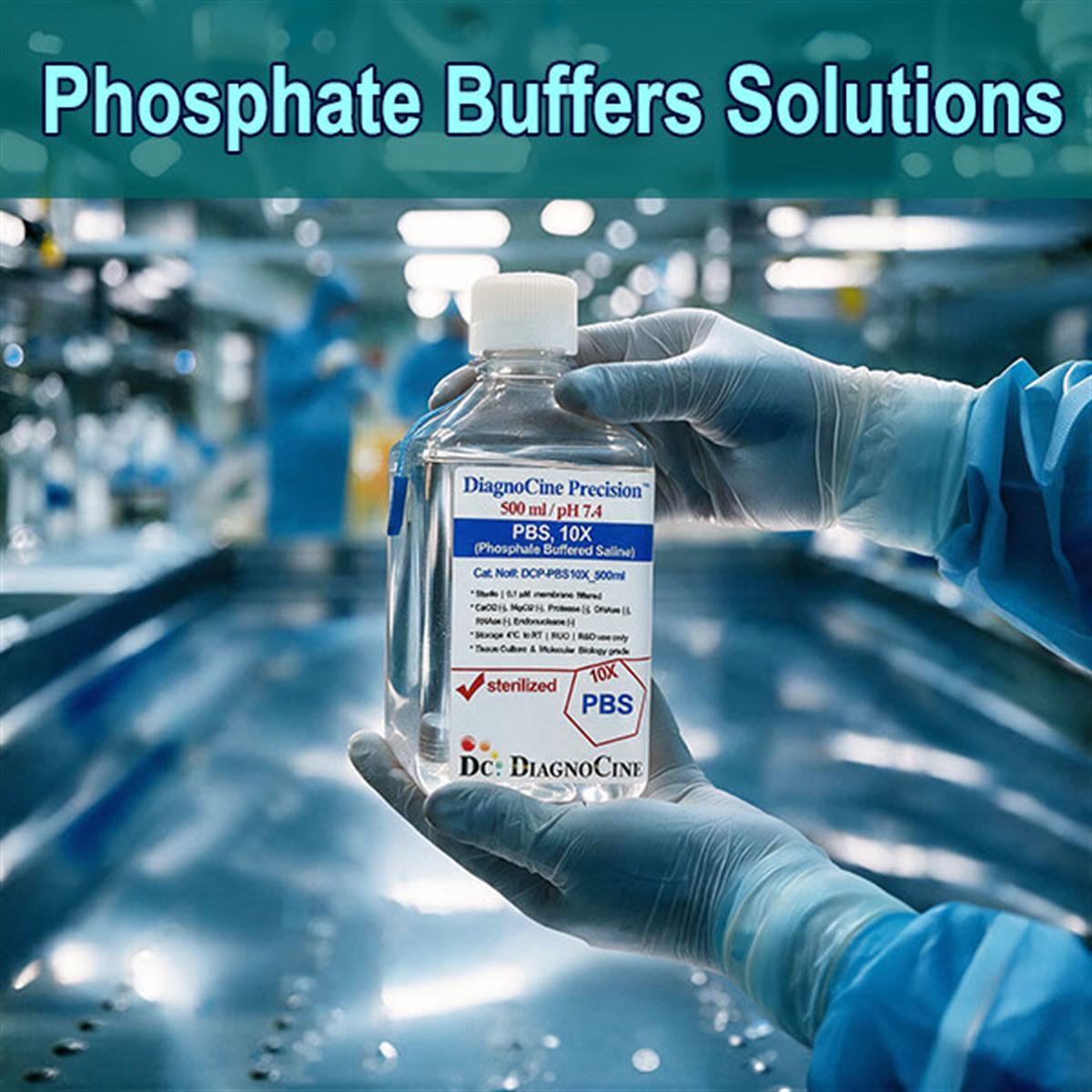
Phosphate Buffers — Category Selection Guide
Five phosphate-based formats, one page. This is a category reference, not an order page — pick the format your protocol needs and click View to reach its product page. The chemistry, applications, and compatibility limits follow below.
| Phosphate Buffer | Core Formulation | Best Use | Product Page |
|---|---|---|---|
| Dulbecco’s PBSProduct#: Dulbecco'sPBS | Phosphate buffer with NaCl and KCl | Classic cell culture standard — washing mammalian cells before passaging | Viewarrow_forward |
| Phosphate Buffered SalineProduct#: PhosphateBufferedSaline | Na2HPO4 / KH2PO4 / NaCl isotonic mix | Universal workhorse — antibody dilutions, plate and membrane rinses | Viewarrow_forward |
| Phosphate Based Washing BufferProduct#: PhosphateBasedWashingBuffer | PBS + non-ionic surfactant (e.g., Tween-20; “PBST”) | Optimized for blots & ELISAs — removes weakly and non-specifically bound reagents | Viewarrow_forward |
| Phosphate Based Lysis/Extraction BuffersProduct#: PhosphateBasedLysis/ExtractionBuffers | Phosphate core with cell-solubilizing surfactants | Gentle protein / enzyme extraction — keeps proteins in native, active conformations | Viewarrow_forward |
| Phosphate Based Blocking BuffersProduct#: PhosphateBasedBlockingBuffers | PBS with passivating proteins or polymers | Surface passivation — blocks unreacted sites on ELISA plates or membranes | Viewarrow_forward |
Not sure which format? Check the buffering and compatibility reference · See applications by format · Read the FAQ
Why phosphate is the default physiological buffer
Phosphorus sits at the center of biology — it forms the backbone of DNA and RNA, drives energy transfer through ATP, and helps stabilize intracellular pH. Phosphate buffers are among the most widely used buffering systems in the life sciences precisely because they mirror the physiological conditions inside living cells and tissues.
The numbers that decide whether phosphate is the right base for a protocol — and the three situations in which it is the wrong one.
- Five formats stocked: Dulbecco’s PBS, Phosphate Buffered Saline, Phosphate Based Washing Buffer, Phosphate Based Lysis/Extraction Buffers, and Phosphate Based Blocking Buffers.
- Buffering pair: the H2PO4− / HPO42− equilibrium, with a pKa (pKa2) of ~7.2.
- Peak capacity across roughly pH 5.8–8.0, with excellent stability right at the physiological set point of pH 7.4.
- Isotonic environment: combined with NaCl/KCl (as in PBS), phosphate buffers deliver the osmotic pressure that keeps cells from swelling and bursting or shrinking.
- Biocompatible: phosphate is a natural intracellular ion, so it is well tolerated and essentially non-toxic to cells, tissues, and native proteins.
- Avoid with phosphate-interacting enzymes (e.g., alkaline phosphatase) and in studies of phosphorylated proteins, where free phosphate can cause competitive inhibition or interference.
- Phosphate chelates divalent cations (Ca2+, Mg2+) and precipitates in ethanol — important for some enzymatic and nucleic acid workflows.
- In those cases, a Tris- or HEPES-based buffer is preferable.
- Buffering pairH2PO4− / HPO42−
- pKa (pKa2)~7.2
- Peak buffering rangeroughly pH 5.8–8.0
- Physiological set pointpH 7.4
- Tonicity salts (Dulbecco’s PBS)NaCl and KCl
- PBS phosphate saltsNa2HPO4 / KH2PO4
- Washing-buffer surfactantnon-ionic, e.g. Tween-20 (PBST)
- Formats in this catalog5
- Formats in the source comparison6
- Alternative base when phosphate interferesTris or HEPES
Cells are highly sensitive to their environment
A small pH shift can unfold proteins, inactivate enzymes, and kill cultures. Three properties make phosphate valuable — and three more decide when to reach for a different base instead.
Physiological pH buffering
The H2PO4− / HPO42− equilibrium has a pKa (pKa2) of ~7.2, giving peak buffering capacity across roughly pH 5.8–8.0 and excellent stability right at the physiological set point of pH 7.4.
Isotonic environment
Combined with NaCl/KCl (as in PBS), phosphate buffers deliver the osmotic pressure needed to keep cells from swelling and bursting or shrinking.
Biocompatibility
Because phosphate is a natural intracellular ion, it is well tolerated and essentially non-toxic to cells, tissues, and native proteins.
Phosphate-interacting enzymes
Avoid phosphate buffers when the assay involves phosphate-interacting enzymes such as alkaline phosphatase, where free phosphate can cause competitive inhibition or interference.
Phosphorylated-protein studies
The same interference applies to studies of phosphorylated proteins. In these cases a Tris- or HEPES-based buffer is preferable.
Divalent cations and ethanol
Phosphate can also chelate divalent cations (Ca2+, Mg2+) and precipitate in ethanol, which is important for some enzymatic and nucleic acid workflows.
The limitation that decides the purchase
Phosphate is the default physiological base, not a universal one. Avoid phosphate buffers when your assay involves phosphate-interacting enzymes (e.g., alkaline phosphatase) or studies of phosphorylated proteins, where free phosphate can cause competitive inhibition or interference. Phosphate can also chelate divalent cations (Ca2+, Mg2+) and precipitate in ethanol, which is important for some enzymatic and nucleic acid workflows. In these cases, a Tris- or HEPES-based buffer is preferable.
From a physiological observation to a bench standard
Three developments turned phosphate from something measured in blood into the reagent bottle on every cell-culture bench.
-
1
Early 20th century Physiological buffering is quantified
Physiologists including L. J. Henderson and Donald Van Slyke established that blood and intracellular fluids hold a narrow, stable pH, and characterized the roles of the body’s buffer systems — including the inorganic phosphate pair (H2PO4− / HPO42−). Significance: this laid the quantitative foundation for physiological buffering (the Henderson–Hasselbalch relationship) and identified phosphate as a key intracellular buffer.
-
2
1933 Reproducible recipes
A. A. Green published precise recipes and ionic-strength / dissociation data for mixing accurate acetate and phosphate buffers. Significance: this turned phosphate buffering from a physiological observation into a reproducible bench standard.
-
3
1954 PBS is standardized
Renato Dulbecco & Marguerite Vogt, working on poliovirus plaque assays, standardized a balanced phosphate-buffered saline (PBS) — phosphate buffer plus NaCl and KCl matched to physiological osmolality — as the medium for handling mammalian cells. Significance: this established Dulbecco’s PBS (DPBS), which became the global standard wash / carrier solution for cell culture and virology.
The parameters that decide a phosphate buffer purchase
Every value below is stated in the source description for this category. Use the right-hand column to translate a chemistry figure into a bench decision.
| Parameter | Value | What it decides at the bench |
|---|---|---|
| Buffering pair | H2PO4− / HPO42− | The inorganic phosphate pair identified as a key intracellular buffer |
| pKa (pKa2) | ~7.2 | Sets where buffering capacity peaks — the reason phosphate suits physiological work |
| Peak buffering capacity | roughly pH 5.8–8.0 | The usable pH window; outside it, capacity falls away |
| Physiological set point | pH 7.4 | Excellent stability right at the pH of blood and culture media |
| Tonicity | NaCl / KCl added (as in PBS) | Delivers the osmotic pressure that keeps cells from swelling and bursting or shrinking |
| Biocompatibility | natural intracellular ion | Well tolerated and essentially non-toxic to cells, tissues, and native proteins |
| Enzyme interference | phosphate-interacting enzymes (e.g., alkaline phosphatase) | Free phosphate can cause competitive inhibition or interference — use Tris or HEPES |
| Phospho-protein interference | studies of phosphorylated proteins | Same interference risk — use Tris or HEPES |
| Divalent cation chelation | Ca2+, Mg2+ | Matters for some enzymatic workflows that require free divalent cations |
| Ethanol behavior | precipitates in ethanol | Matters for nucleic acid workflows built on ethanol precipitation |
Which phosphate format for which bench workflow
The first tab lists the workflows shared across the whole phosphate family. The remaining tabs give the intended use of each catalog format.
- Cell culture handling — washing cells, diluting suspensions, and serving as a carrier during centrifugation or counting
- Immunoassays — the base for wash and antibody-dilution steps in ELISA, Western blot, and multiplex assays
- Protein purification & chromatography — a stable, non-denaturing environment for column separations
- Tissue & organ handling — maintaining primary dissections or biopsies before fixation or processing
- Reagent and sample dilution — a general-purpose physiological diluent across molecular workflows
- Classic cell culture standard, formulated to Dulbecco’s specifications
- Premier choice for washing mammalian cells before passaging
- Maintaining osmotic balance without harming delicate lines
- Antibody dilutions
- Plate and membrane rinses
- A reliable, cost-effective, stable physiological background for routine assays
- Optimized for blots and ELISAs
- The mild detergent lowers surface tension to wash away weakly or non-specifically bound antibodies and reagents
- Does so without stripping target proteins
- Gentle protein and enzyme extraction
- Mimics the cell’s interior to keep extracted proteins and enzymes in native, active conformations
- Surface passivation — blocks unreacted sites on ELISA plates or membranes
- Effective for non-phosphorylated targets, giving clean binding and low background
How the phosphate formats compare
The source comparison table, reproduced row-for-row. Core formulation and the workflow each format is intended for.
| Product | Core Formulation | Best Use |
|---|---|---|
| Dulbecco’s PBS (DPBS) | Phosphate buffer with NaCl and KCl | Classic cell culture standard — formulated to Dulbecco’s specifications; premier choice for washing mammalian cells before passaging, maintaining osmotic balance without harming delicate lines |
| Phosphate Buffered Saline (PBS) | Na2HPO4 / KH2PO4 / NaCl isotonic mix | Universal workhorse — antibody dilutions, plate/membrane rinses; reliable, cost-effective, stable physiological background for routine assays |
| Phosphate-Based Washing Buffer | PBS + non-ionic surfactant (e.g., Tween-20; “PBST”) | Optimized for blots & ELISAs — mild detergent lowers surface tension to wash away weakly/non-specifically bound antibodies and reagents without stripping target proteins |
| Phosphate-Based Lysis/Extraction Buffers | Phosphate core with cell-solubilizing surfactants | Gentle protein/enzyme extraction — mimics the cell’s interior to keep extracted proteins and enzymes in native, active conformations |
| Phosphate-Based Blocking Buffers | PBS with passivating proteins or polymers | Surface passivation — blocks unreacted sites on ELISA plates or membranes; effective for non-phosphorylated targets, giving clean binding and low background |
| Microfluidic-Ready PBS, 1X | Ultra-pure, sterile, 0.04 µm filtered | Microfluidics & lab-on-a-chip — fine filtration removes debris and nanoscale aggregates that clog microchannels or scatter light in single-cell imaging and droplet assays |
Frequently asked questions
The questions that come up most often when a phosphate buffer meets a bench protocol.
The literature behind the phosphate buffer standard
The source’s own reference list, reproduced and independently verified against the primary record.
- Green, A. A. (1933). The preparation of acetate and phosphate buffer solutions of known pH and ionic strength. Journal of the American Chemical Society, 55(6), 2331–2336. doi:10.1021/ja01333a018 — Foundational physical-chemistry reference mapping the ionic strengths and dissociation profiles for mixing accurate phosphate buffers.
- Dulbecco, R., & Vogt, M. (1954). Plaque formation and isolation of pure lines with poliomyelitis viruses. Journal of Experimental Medicine, 99(2), 167–182. doi:10.1084/jem.99.2.167 — The paper conventionally credited with standardizing phosphate-buffered saline (PBS/DPBS) for cell culture and virology.
- Freshney, R. I. (2016). Culture of Animal Cells: A Manual of Basic Technique and Specialized Applications (7th ed.). Wiley-Blackwell. — The standard reference manual for cell culture practice, including buffer and PBS use in routine handling.