ICG ADIBO
Size of product (mg)
-
1 mg

-
5 mg

-
25 mg

ICG ADIBO
Cat. No. List below
Description
ICG ADIBO couples with azide-modified biomolecules to form a 1,4-disubstituted 1,2,3-triazole linkage. This reaction occurs spontaneously without the need for catalysts, making it ideal for in vivo applications and studies in complex biological environments.
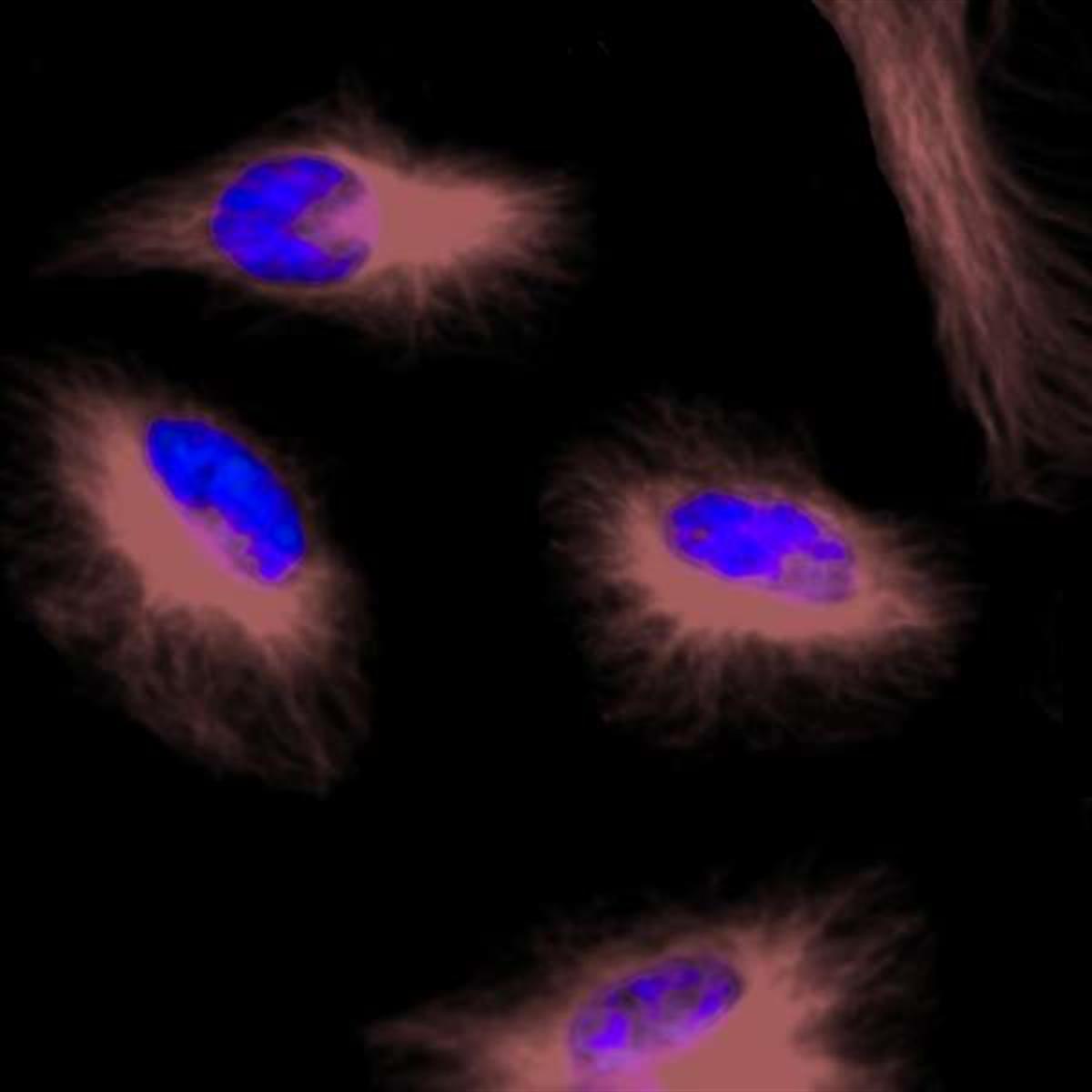
ICG ADIBO's NIR fluorescence enables deep tissue imaging, allowing researchers to visualize structures beneath the skin surface. This capability is particularly valuable in In vivo imagin, tumor detection and monitoring, vascular mapping, and cellular tracking and dynamics studies.
The strained alkyne (ADIBO) reactive group participates in SPAAC reactions, offering several advantages like highly specific labeling of azide-modified biomolecules, don't need cytotoxic copper catalysts or additional coupling reagents, bioorthogonal reactions compatible with living systems, minimal interference with native biochemical processes, and faster reaction kinetics compared to traditional alkyne groups.
ICG ADIBO finds applications in numerous fields, including live-cell imaging and tracking, In vivo molecular imaging, nucleotide and protein functionalization, drug discovery and development, nanomedicine & targeted therapy, and metabolic labeling studies.
ICG ADIBO represents a significant advancement in bioorthogonal labeling technology, offering researchers a versatile and biocompatible tool for exploring biological systems with high specificity and minimal disruption. Its combination of NIR fluorescence and copper-free click chemistry compatibility makes it an invaluable asset in modern biomedical research, particularly for in vivo imaging and studies in sensitive biological environments.
Why ICG ADIBO is superior to other similar products:
1. Copper-free click chemistry (SPAAC) functionality, eliminating the need for potentially toxic copper catalysts
2. NIR fluorescence (785/812 nm), enabling deep tissue imaging with minimal autofluorescence
3. High reaction speed due to the strained alkyne (ADIBO) group, allowing for faster labeling compared to traditional alkynes
4. Biocompatibility for in vivo applications, with no additional reagents or catalysts required
5. Minimal interference with native biochemical processes, preserving cellular function during imaging
6. High extinction coefficient (≥ 172,000 cm?¹M?¹) for bright fluorescence signals
7. Versatile excitation options, compatible with 750-800 nm laser lines or LEDs
8. Forms stable 1,4-disubstituted 1,2,3-triazole linkages with azide-modified biomolecules
9. Suitable for both in vivo and in vitro applications due to its bioorthogonality
10. Enables live-cell imaging, nucleotide functionalization, and protein labeling without cellular toxicity
11. Long fluorescence lifetime, beneficial for advanced imaging techniques like fluorescence lifetime imaging (FLIM)
12. Good water solubility when conjugated, reducing aggregation issues in biological systems
13. Based on FDA-approved parent compound (ICG), suggesting potential for clinical translation
14. Excellent photostability compared to some other NIR dyes, allowing for extended imaging sessions
15. Versatility in labeling various biomolecules (proteins, lipids, nucleic acids, sugars) through azide modifications
- Fluorophore: ICG
- Reactive group: Strained alkyne
- Excitation/Emission Max.(nm): 785/812
- Extinction coefficient: ≥ 172,000 cm-1M-1
- CF280: 0.10
- Appearance: Green Solid
- Molecular Weight: 989.27 g/mol
- Solubility: DMF, DMSO
- Storage conditions: -20 ℃, protect from light
| Quick link (Cat.#) | Series | Quick link (Cat.#) | Series |
| RFP0815 | ICG | RFP0915 | ICG (water-soluble) |
| POS1604 | ICG NHS ester | POA1616 | ICG Vinylsulfone |
| POSN1604 | ICG Sulfo-NHS ester | POI1616 | ICG Isothiocyanate |
| POC1616 | ICG Carboxylic acid | PWM1301 | ICG Maleimid |
| POE1616 | ICG Amine | PWT1301 | ICG Thiol |
| POR2616 | ICG Dichlorotriazine | POH1616 | ICG Hydrazide |
| POK1616 | ICG Alkyne | POG1616 | ICG PEG4-Alkyne |
| DOC1061 | ICG ADIBO | POZ1616 | ICG Azide |
Background
ICG Dyes
ICG is clinically approved NIR dye and used in medical diagnostics, in vitro, vivo and animal model study. NIR fluorescence allows to observe the deep image from the surface of skin and its usage spreads to a wide range of research fields. ICG fluorescence method is safe and cost effective technique and used in a wide range of medical fields such as breast cancer sentinel lymph node navigation, detecting cerebral vessels, coronary arteries and biliary trees, tracking tumor location, detecting small HCC, etc. The method has several advantages such as radiation free, compact instrumentation, real-time monitoring, easy operation, etc. The maximum excitation/emission values of ICG are 785/821 nm. When ICG is injected into a human body, it rapidly bound to plasma protein, mainly high-density lipoprotein, and generates red-shifted fluorescence (845 nm). ICG in aqueous solution is unstable over time, thus the fresh solution should be used for effective trials. BioActs provides ICG dye for biological research and medical diagnostics and also offers various reactive and functionalized ICG dyes for labeling of antibodies, peptides, proteins and ligands.
Table 1. ICG dye applications


Figure 1. Structure of Indocyanine Green (ICG) dye
Citation & Reference
1. Masashi Gotoh. Development of a canine model of pulmonary emphysema and imaging of the emphysematous lung with infrared thoracoscopy. J Thorac Cardiovasc Surg 126.6 (2003): 1916-21.
2. Aaron M. Mohs. An integrated widefield imaging and spectroscopy system for contrast-enhanced, image-guided resection of tumors. IEEE Trans Biomed Eng 62.5 (2015): 1416-24.
3. Mohammed Hassan. Near Infrared Fluorescence Imaging with ICG in TECAB Surgery Using the da Vinci Si Surgical System in a Canine Model. J Card Surg 27.2 (2012): 158-162.
4. R. C. Benson. Fluorescence properties of indocyanine green as related to angiography. Phys Med Biol 23.1 (1978): 159-63.
5. Mitsuharu Miwa. The Principle of ICG Fluorescence Method. The Open Surgical Oncology Journal 2 (2010): 26-28.