

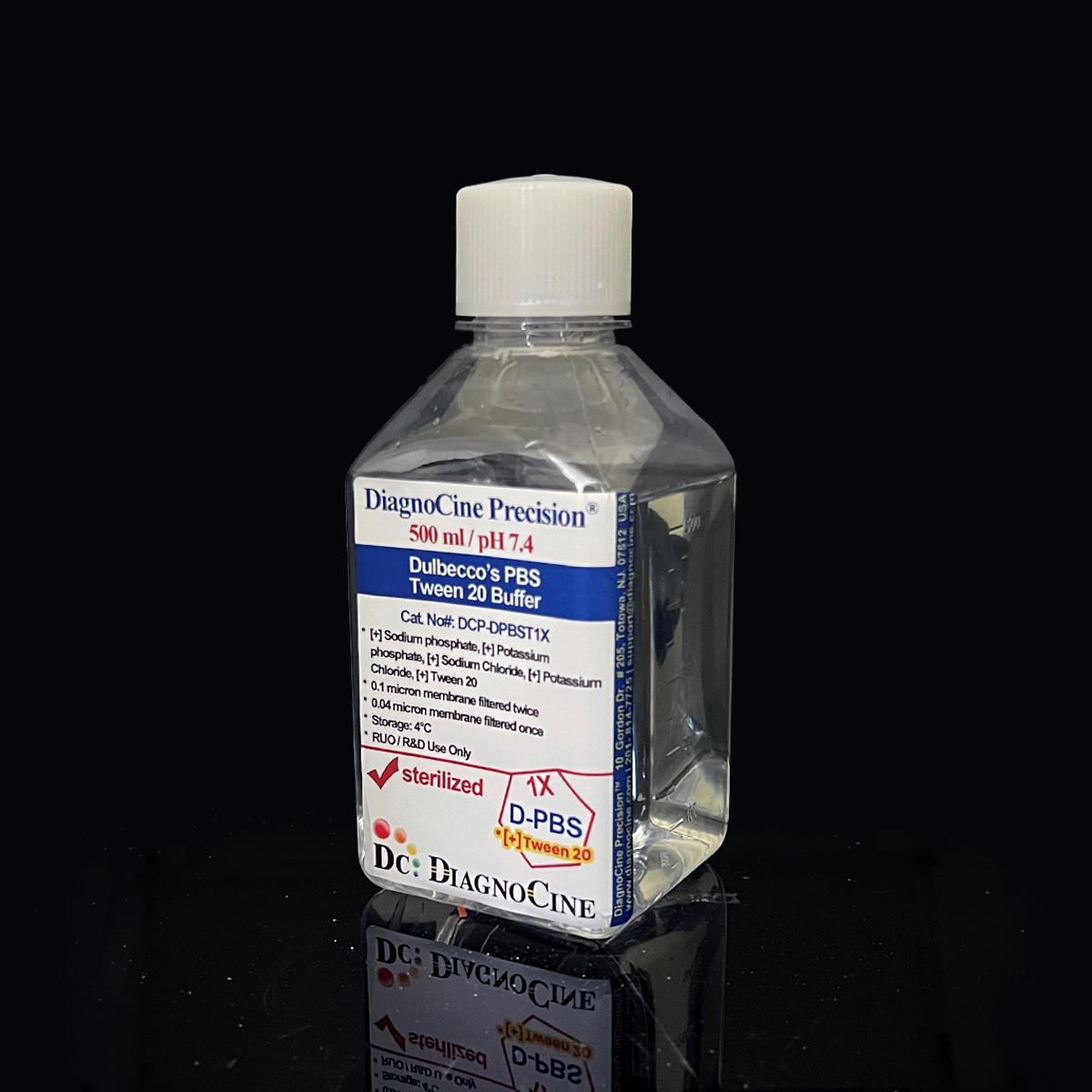
Dulbecco's PBS Tween 20 Buffer [1X]
FluxMPS™ Dulbecco's PBS Tween 20 Buffer [1X]
FluxMPS™ Dulbecco's PBS Tween 20 Buffer [1X] is a detergent-optimized wash and dilution buffer built for immunoassays, cell and molecular biology, and microfluidic workflows that cannot tolerate particulate or bioburden carry-over. Every lot is quadruple-stage filtered (0.1 µm membrane twice, 0.04 µm membrane twice) and formulated at pH 7.4 with a physiological salt background plus 0.05% Tween 20 to reduce non-specific binding and background signal.
- Quadruple-stage filtration: 0.1 µm membrane twice and 0.04 µm membrane twice, in a sterile environment
- Formulated at pH 7.4 with 137 mM NaCl, 2.67 mM KCl, 8.09 mM sodium phosphate, 1.47 mM potassium phosphate
- Contains 0.05% Tween 20 to lower background noise and improve signal-to-noise ratio in immunoassays
- No detectable DNase or RNase activity after 18 hr incubation at room temperature
- Suitable for ELISA, Western blotting, protein/antibody dilution, and PFA-fixed sample washing
- Manufactured under ISO 13485-certified, CE-approved processes
- Custom concentrations, pH, and additive formulations available on request
- pH7.4
- FormulationDPBS + 0.05% Tween 20
- NaCl137 mM
- KCl2.67 mM
- Sodium phosphate8.09 mM
- Potassium phosphate1.47 mM
- Tween 200.05%
- Filtration0.1 µm x2 + 0.04 µm x2
- Storage4°C
- Shelf Life2 years
Engineered where standard wash buffers fail
Conventional 0.22 µm-filtered PBS-Tween formulations can carry subvisible particulate and finer bioburden into washing steps, contributing background signal in sensitive immunoassays and accumulating in narrow microfluidic channels. FluxMPS™ Dulbecco's PBS Tween 20 Buffer [1X] is built to remove that variable.
Microchannel-safe purity
Quadruple-stage filtration through 0.1 µm and 0.04 µm membranes is designed to reduce fine particulate load that can otherwise accumulate in microfluidic channels and valves.
Precise, stable pH
Formulated to pH 7.4 with a defined phosphate-buffered salt background of 137 mM NaCl, 2.67 mM KCl, 8.09 mM sodium phosphate, and 1.47 mM potassium phosphate.
Ultrapure-grade water
Manufactured with Ultrapure Type 1 water (18.2 MΩ·cm) and processed in a sterile environment for research applications that demand low-background reagents.
Low background for imaging & assays
Tween 20 at 0.05% reduces non-specific binding and protein-protein interactions during washing, improving signal-to-noise ratio in ELISA, Western blotting, and other immunoassays.
Defined, traceable composition
Every component and concentration is lot-documented, from the phosphate buffering salts through to the detergent content, with no DNase or RNase activity detected after 18 hr incubation at room temperature.
Customization on demand
Other concentrations, pH values, and additions of chemicals, compounds, proteins, or supplements can be formulated on request.
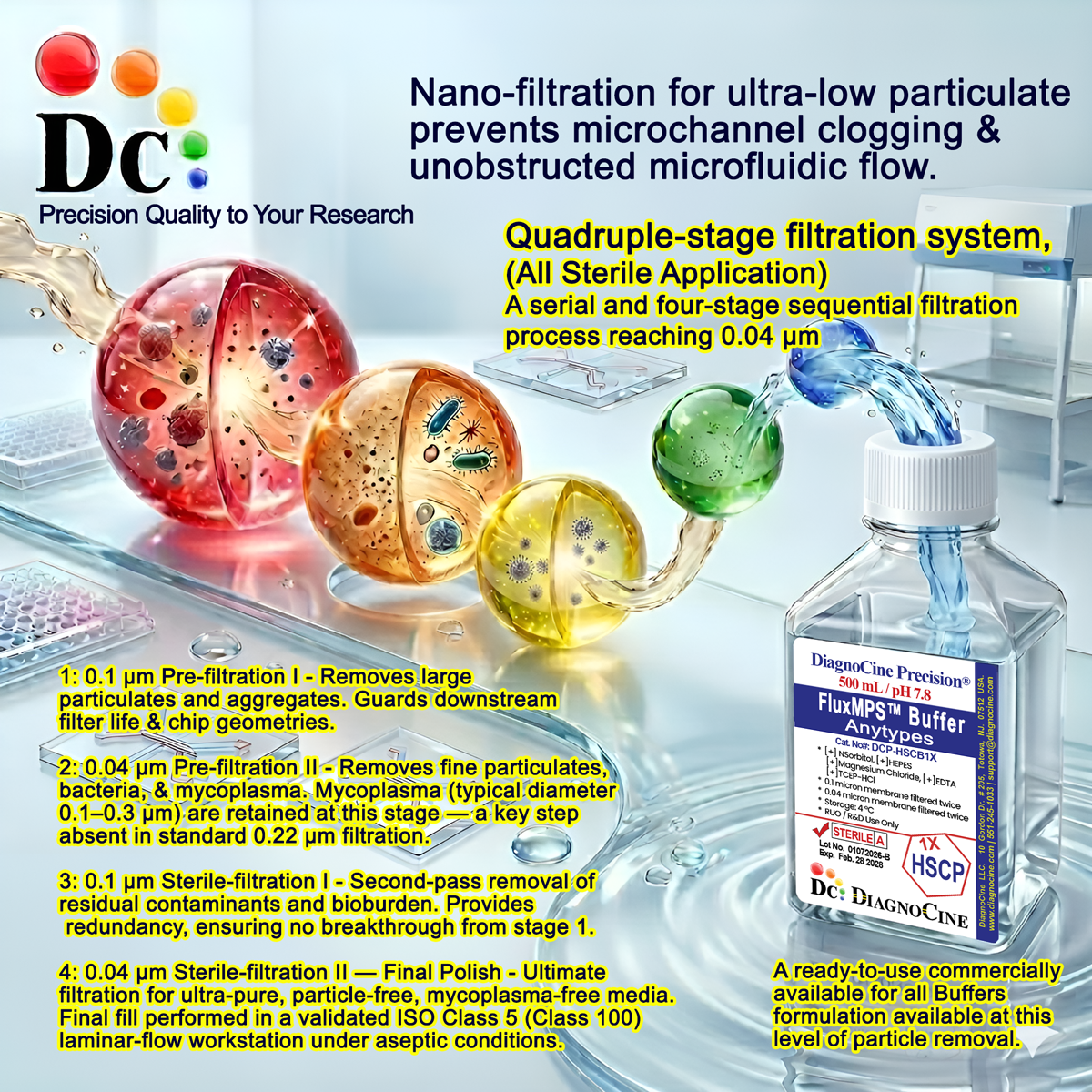
Quadruple-stage filtration system
Every lot of FluxMPS™ Dulbecco's PBS Tween 20 Buffer [1X] is filtered through a 0.1 µm membrane twice and a 0.04 µm membrane twice, in a sterile environment, before final fill.
- 1
0.1 µmPre-filtration I
First pass through a 0.1 µm membrane removes larger particulate and aggregates ahead of downstream filtration.
- 2
0.04 µmPre-filtration II
First pass through a 0.04 µm membrane targets finer particulates and bioburden ahead of the sterile filtration passes.
- 3
0.1 µmSterile-filtration I
Second 0.1 µm pass provides redundant particulate and bioburden control before final polishing.
- 4
0.04 µmSterile-filtration II — Final Polish
Second 0.04 µm pass, completed in a sterile environment, is the final polish intended to help prevent mycoplasma contamination; the smallest mycoplasma types can be about 0.2 microns.
Performance vs. conventional buffer
Sequential 0.1 µm and 0.04 µm membrane filtration, applied across four total passes, is designed to remove finer particulate and bioburden than a single conventional 0.22 µm pass, supporting cleaner washing steps in immunoassays and microfluidic workflows.
© Diagnocine® — DCP-DPBST1X
Where this buffer is used
A detergent-containing PBS-based buffer formulated for washing, dilution, and reconstitution steps across immunoassay, molecular biology, and microfluidic workflows.
Automated Bioreactors & Robotics
For automated bioreactor and robotic liquid-handling platforms, an optional 0.01 µm (10 nm) ultra-filtered variant of this buffer can be produced to further protect fine-tolerance valves and sensors.
- Total Particulate Exclusion for sensitive automated fluidics
- Valve & Sensor Protection in robotic dispensing systems
- Extended Perfusion Stability in continuous-flow platforms
Inquiry Required: contact support@diagnocine.com to request the 0.01 µm ultra-filtered grade.
Micro Physiological System (MPS) & Chip
A physiologically balanced, low-background wash and dilution buffer suited to microfluidic channel handling.
Wash, Dilution & Reconstitution
Used as a washing buffer for immunoassays and to dilute antibody and protein solutions and other samples and reagents in biochemical and molecular biology experiments.
iPSC-Derived Model Handling
A physiological, low-background buffer suitable for wash and dilution steps in iPSC-derived cell model workflows.
Endothelial & Primary Cell Perfusion
Provides a physiological environment for cells in various cell culture applications, including primary and endothelial cell handling.
ELISA, Blotting & Blocking
Reduces non-specific binding and protein-protein interactions during washing steps, improving signal-to-noise ratio in ELISA, Western blotting, and other protein immunoassays, and is suitable for coating plates with proteins.
Microscopy & Optical Sensing
Effective for washing paraformaldehyde (PFA) fixed samples in microscopy and histology applications.
Specification summary
Measured and manufactured parameters for DCP-DPBST1X.
| Parameter | Specification |
|---|---|
| Formulation / Composition | Dulbecco's PBS with 0.05% Tween 20 |
| Appearance | Clear, colorless liquid |
| pH (USP <791>) | 7.4 |
| Molarity / Concentration | NaCl 137 mM; KCl 2.67 mM; Sodium phosphate 8.09 mM; Potassium phosphate 1.47 mM |
| Parameter | Specification |
|---|---|
| Sterility USP <71> | Filtered 0.1-micron membrane twice and 0.04-micron membrane twice in a sterile environment |
| DNase Activity | None detected (18 hr, room temperature, plasmid DNA) |
| RNase Activity | None detected (18 hr, room temperature, ribosomal RNA) |
| Water Quality | Ultrapure Type 1 water (18.2 MΩ·cm) |
| Parameter | Specification |
|---|---|
| Storage temperature | 4°C |
| Shelf life | 2 years |
| Parameter | Specification |
|---|---|
| Manufacturing QMS ISO 13485 | Manufactured under ISO 13485-certified, CE-approved facilities |
| Regulatory alignment | CE-approved; final packaging, QA, and testing at the DiagnoCine R&D and Quality Testing Center |
| Production method | Customization requests and assembly completed at DiagnoCine Precision, Totowa, New Jersey, USA |
| Intended use | Research Use Only (RUO) |
Full composition
Component list and concentrations for DCP-DPBST1X, reproduced from the certified formulation.
| Component | CAS Number | Concentration |
|---|---|---|
| Sodium phosphate | 7558-79-4 | 8.09 mM |
| Potassium phosphate | 7778-77-0 | 1.47 mM |
| NaCl | 7647-14-5 | 137 mM |
| KCl | 7447-40-7 | 2.67 mM |
| Tween 20 | 9005-64-5 | 0.05% |
Manufacturing & compliance
DCP-DPBST1X is manufactured, tested, and packaged under a controlled quality system.
ISO 13485:2016 QMS
Manufactured under ISO 13485-certified and CE-approved facilities.
Ultrapure Type 1 Water
Formulated with Ultrapure Type 1 water (18.2 MΩ·cm) grade inputs.
Sterile Fill & Finish
Filtered and filled in a sterile environment as part of the quadruple-stage filtration process.
Micro-Batch Precision
Final packaging, quality assurance, and testing performed at the DiagnoCine R&D and Quality Testing Center.
Nuclease Testing
No DNase activity detected after incubation of plasmid DNA and this product for 18 hr at room temperature; no RNase activity detected after incubation of ribosomal RNA for 18 hr at room temperature.
Filtration Sterility
Filtered through a 0.1-micron membrane twice and a 0.04-micron membrane twice in a sterile environment, per USP <71> sterility principles.
pH Control
Formulated and verified to pH 7.4 per USP <791> testing principles.
Documentation / CoA
Lot-specific documentation is available on request.
How DCP-DPBST1X compares
A structural comparison against conventional single-pass filtered wash buffers.
| Parameter | DCP-DPBST1X (FluxMPS™) | Conventional (0.22 µm filtered buffer) | Standard alternative (0.22 µm filtered buffer) |
|---|---|---|---|
| Detergent-optimized wash formulation (0.05% Tween 20) | check_circle | cancel | cancel |
| Final filtration pore size | 0.04 µm | 0.22 µm | 0.22 µm |
| Number of filtration stages | 4 | 1 | 1 |
| Nuclease-tested (DNase/RNase) | check_circle | cancel | cancel |
| Water quality | Ultrapure Type 1 (18.2 MΩ·cm) | Standard purified | Standard purified |
| Manufacturing QMS | ISO 13485-certified | cancel | cancel |
| Microfluidic channel compatibility | check_circle | cancel | cancel |
| pH reproducibility | 7.4, lot-controlled | Variable | Variable |
| Custom formulation | check_circle | cancel | cancel |
Frequently asked questions
Common questions about DCP-DPBST1X.
Supporting literature
Curated references relevant to PBS-Tween wash buffers, immunoassay optimization, and microphysiological systems.
- Crowther, J.R. The ELISA Guidebook. Methods in Molecular Biology.doi:10.1385/1592590497
- Vogt, R.F. et al. Quantitative differences among various proteins as blocking agents for ELISA microtiter plates. J Immunol Methods.doi:10.1016/0022-1759(87)90066-9
- Kenna, T.J. et al. Effects of ELISA methodology on measurement of pathogen-specific antibody. J Immunol Methods.doi:10.1016/j.jim.2010.11.005
- Bhatia, S.N.; Ingber, D.E. Microfluidic organs-on-chips. Nat Biotechnol.doi:10.1038/nbt.2989
- Sackmann, E.K. et al. The present and future role of microfluidics in biomedical research. Nature.doi:10.1038/nature13118
- Huh, D. et al. Reconstituting organ-level lung functions on a chip. Science.doi:10.1126/science.1188302
- Ezzell, J.W. et al. Detergent effects on antibody-antigen interactions in immunoassay washing. J Immunol Methods.doi:10.1016/0022-1759(89)90398-5
- Rottem, S. Interaction of mycoplasmas with host cells. Physiol Rev.doi:10.1152/physrev.00019.2002
- Sung, J.H. et al. Recent advances in body-on-a-chip systems. Anal Chem.doi:10.1021/acs.analchem.8b05293